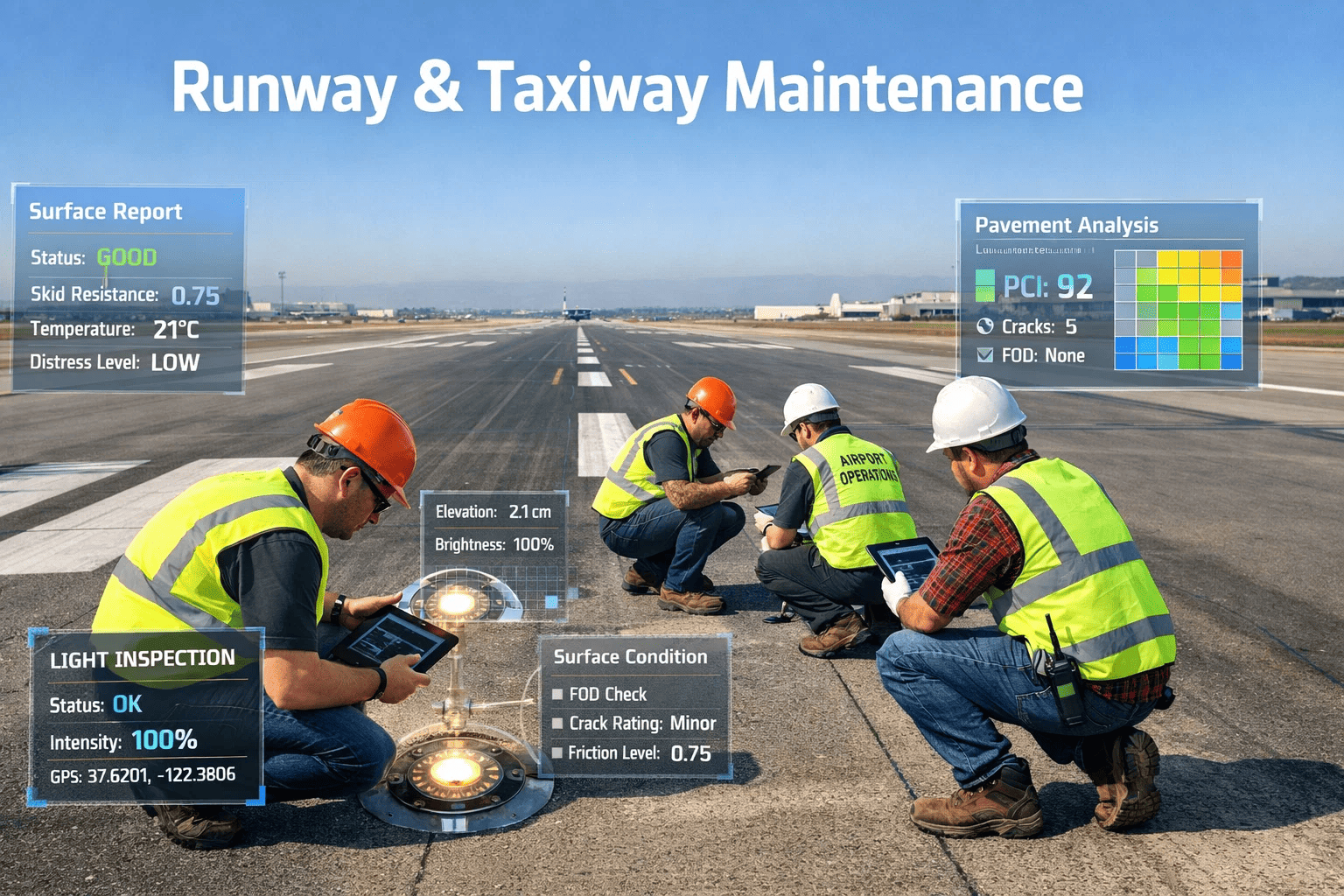
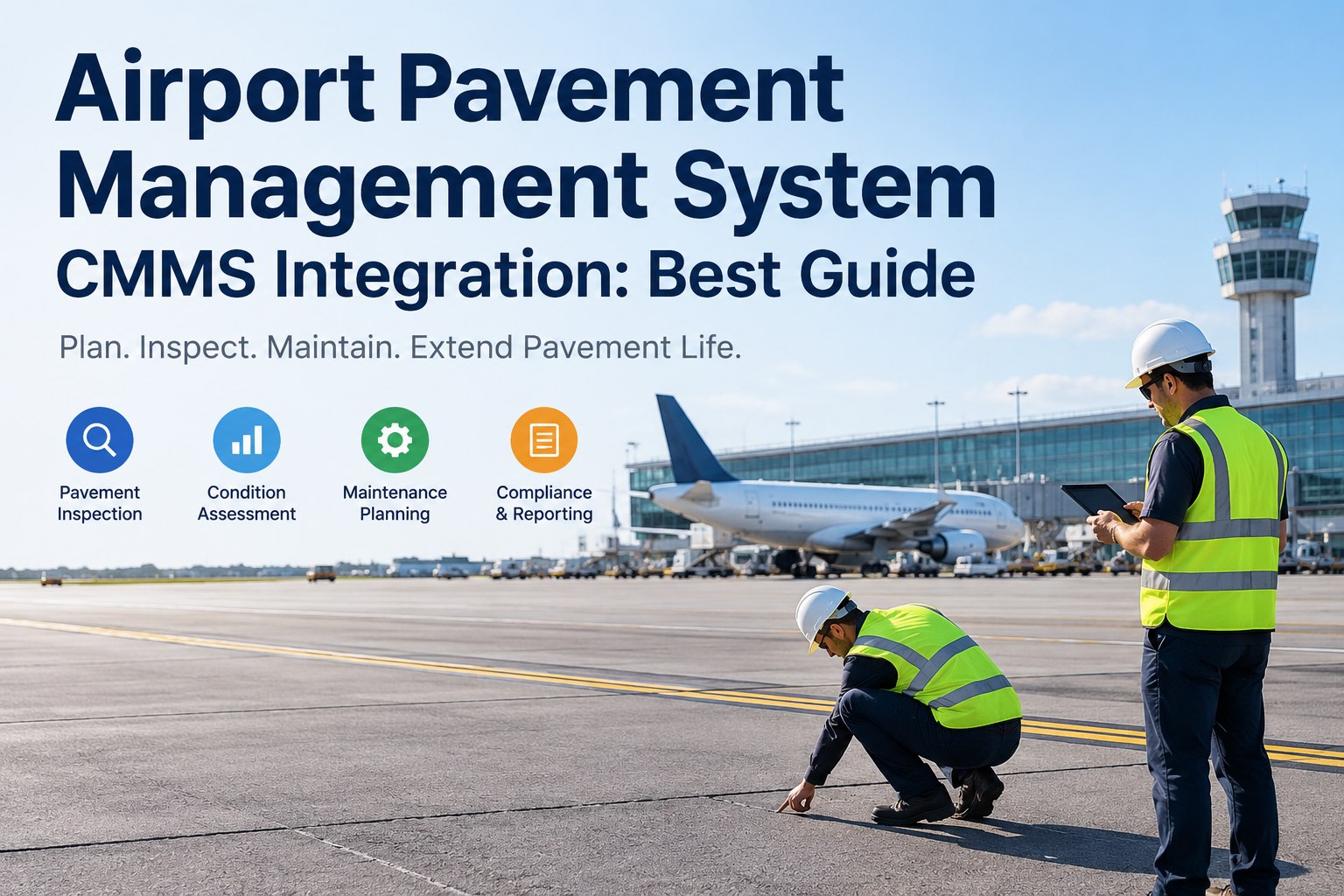
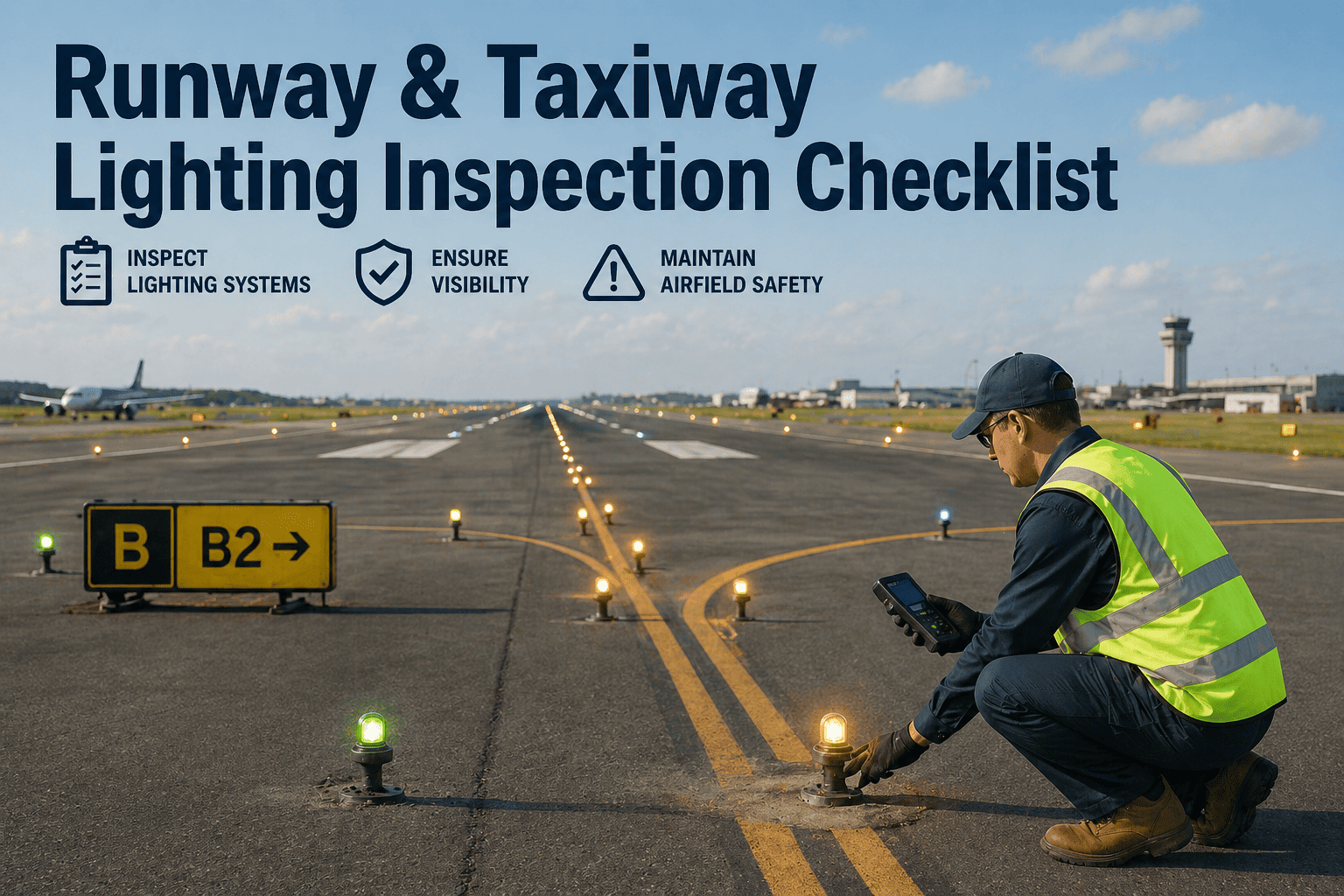
Runway and taxiway maintenance is not just about keeping pavement smooth and markings visible — it is the operational backbone of airport safety, regulatory compliance, and flight schedule reliability. Under FAA Part 139, certificated airports must conduct systematic pavement inspections, maintain friction standards, track Foreign Object Debris (FOD), and document every defect with corrective action timelines that satisfy both federal inspectors and insurance underwriters. A single missed friction test or an undocumented crack exceeding severity thresholds can trigger enforcement actions, operational restrictions, or worse — a runway excursion incident during adverse weather. The difference between airports that maintain continuous FAA compliance and those that scramble before audits is not luck or manpower — it is structured maintenance workflows, automated inspection scheduling, and a CMMS platform that knows the difference between a transverse crack requiring monitoring and a longitudinal joint failure requiring immediate NOTAMs and closure. Start a free trial to digitize your runway maintenance checklist and track every inspection automatically, or book a demo to see how OxMaint structures airfield maintenance workflows by FAA compliance requirements.
Automate Your Airfield Maintenance Compliance — Stop Scrambling Before FAA Audits
OxMaint digitizes every runway and taxiway maintenance task by FAA Part 139 requirements, schedules inspections automatically, tracks pavement condition trends, and generates audit-ready compliance documentation in under 60 seconds. No more missed friction tests. No more incomplete inspection records. No more scrambling when inspectors arrive. Want to maintain continuous Part 139 compliance without the documentation burden? Start a free trial for 30 days or book a demo with our airport operations specialists.
FAA Part 139 Requirements
What FAA Part 139 Actually Requires for Runway and Taxiway Maintenance — and What Most Airports Get Wrong
FAA Part 139 establishes mandatory inspection intervals, pavement condition reporting standards, friction measurement protocols, and corrective action timelines that apply to all certificated airports serving scheduled passenger operations. The regulation is not a suggestion — it is a certification requirement with enforcement mechanisms including fines, operational restrictions, and certificate suspension. Yet compliance failures are common, not because airport operators are negligent, but because Part 139 requirements are layered, interdependent, and difficult to track without purpose-built systems.
Daily Safety Inspections
Every 24 Hours
Visual inspection of all movement areas for surface defects, FOD, wildlife, marking deterioration, and lighting functionality. Must be conducted by trained personnel with documented findings and corrective actions initiated same-day for safety-critical items.
Documentation: Inspection checklist with date, time, inspector name, findings, and corrective action status
Pavement Condition Index (PCI) Assessment
Annual or Per AC 150/5380-6
Systematic pavement condition evaluation following ASTM D5340 methodology. All runways, taxiways, and aprons must be rated on 0-100 scale with distress types, severity levels, and extent quantified. Ratings below 55 trigger capital planning requirements.
Documentation: PCI report with distress maps, severity classification, photos, and maintenance recommendation priority matrix
Friction Testing
Annual + Post-Event
Runway surface friction measurement using FAA-approved equipment (continuous friction measurement equipment per AC 150/5320-12). Testing required annually and after any event affecting friction characteristics — overlay, grooving, rubber removal, or contamination.
Documentation: Friction test data with equipment calibration certificate, ambient conditions, and comparison to maintenance planning friction level thresholds
Marking and Signage Maintenance
Continuous + Annual Review
All runway and taxiway markings must meet retroreflectivity standards per AC 150/5340-1. Faded, damaged, or incorrect markings require immediate correction. Annual review of all airfield signage for accuracy, illumination, and visibility from required distances.
Documentation: Marking condition reports with retroreflectivity measurements, deficiency photos, and completion certificates for repainting work orders
Pavement Distress Classification
The Seven Critical Pavement Distresses That Determine Your Maintenance Priority — and When Each One Requires Action
Not all cracks are created equal in airfield pavement management. A hairline transverse crack in a taxiway shoulder might be monitored quarterly, while a 10-foot alligator crack pattern at a runway threshold could require immediate closure and emergency repair. Understanding distress severity classification is essential for rational maintenance resource allocation and defensible compliance documentation.
| Distress Type |
Low Severity |
Medium Severity |
High Severity |
Action Trigger |
| Alligator Cracking |
Interconnected cracks forming pattern under 1 sq ft, no spalling |
Pattern 1-10 sq ft, minor spalling at edges |
Pattern over 10 sq ft, significant spalling, loose material |
High severity in runway touchdown zone = immediate repair |
| Longitudinal Cracking |
Single crack under 1/4 inch width, no secondary cracks |
Crack 1/4 to 3/4 inch, moderate spalling |
Crack over 3/4 inch, severe spalling, multiple parallel cracks |
High severity at pavement edge = seal within 30 days |
| Transverse Cracking |
Single crack under 1/4 inch, sealed or stable |
Crack 1/4 to 3/4 inch, moderate secondary cracking |
Crack over 3/4 inch, extensive secondary cracking |
High severity crossing full runway width = monitor monthly |
| Joint Seal Damage |
Minor adhesion loss, no intrusion |
Sealant extruded or hardened, minor intrusion visible |
Complete sealant failure, water intrusion, spalling at joint |
High severity = reseal before next freeze-thaw cycle |
| Raveling and Weathering |
Aggregate particles loose but bonded, minor surface texture loss |
Aggregate loss visible, texture degradation measurable |
Significant aggregate loss, exposed base visible |
High severity = surface treatment within 60 days |
| Rutting and Depression |
Depression under 1/4 inch deep, water drains |
Depression 1/4 to 1 inch, ponding during rain |
Depression over 1 inch, standing water after rain stops |
High severity in runway safety area = correct within 48 hours |
| Jet Blast Erosion |
Minor aggregate displacement at holding position |
Visible pavement loss, exposed base in localized area |
Significant erosion creating FOD source or tire hazard |
High severity = immediate FOD sweep + repair planning |
CMMS Benefits
How CMMS Automation Converts FAA Compliance From a Manual Documentation Burden Into a Systematic Workflow
The challenge in airport pavement maintenance is not knowing what needs to be done — it is doing it on schedule, documenting it correctly, linking findings to corrective actions, and producing audit-ready records on demand. Generic work order systems were not designed for FAA Part 139 compliance requirements. They do not understand PCI scoring, friction thresholds, NOTAM triggers, or the difference between a maintenance planning friction level and an action friction level. OxMaint's airport maintenance CMMS structures your inspection workflows around Part 139 requirements and generates compliance documentation automatically.
Automated Inspection Scheduling
Daily safety inspections, monthly pavement walks, quarterly friction monitoring, and annual PCI assessments are scheduled automatically with crew assignment, equipment requirements, and weather dependency flags. Missed inspections trigger alerts before they become compliance gaps.
Deficiency Tracking with Severity Logic
When an inspector logs a pavement distress, the system prompts for distress type, severity level, location, and extent. High-severity findings in critical areas auto-generate corrective action work orders with Part 139-compliant timelines. Medium-severity items queue for next maintenance cycle with priority ranking.
NOTAM Integration and Closure Triggers
Work orders affecting runway or taxiway availability automatically generate NOTAM draft text with closure start time, estimated duration, and affected surface identifiers. NOTAM issuance and cancellation are tracked within the work order lifecycle — no missed notifications to pilots or ATC.
Friction Data Trending
Friction test results are logged per runway third with comparison to baseline, previous test, and maintenance planning friction level threshold. Declining friction trends trigger preventive maintenance work orders for rubber removal, grooving evaluation, or surface treatment before reaching action levels.
Photo Documentation Library
Every deficiency finding, corrective action, and post-repair verification includes photo attachments with GPS coordinates and timestamp metadata. Photo libraries are organized by surface, defect type, and repair history — critical for demonstrating condition trends during FAA inspections or insurance reviews.
Audit-Ready Compliance Reports
One-click generation of Part 139 compliance reports covering inspection completion rates, deficiency resolution timelines, friction test histories, and corrective action close-out documentation. Reports export to PDF with all supporting photos, technician signatures, and equipment calibration certificates attached.
FAA Part 139 Compliant · Friction Tracking · PCI Management · NOTAM Integration
Your Airport Pavement Is Degrading Right Now — Is Your Maintenance Program Tracking It?
OxMaint structures your runway and taxiway maintenance around FAA compliance requirements, automates inspection scheduling, tracks pavement condition trends, and generates audit-ready documentation. Configure your first airfield asset hierarchy and inspection workflow today — no implementation fee, no minimum contract. Start a free trial for 30 days or book a demo with our airport operations specialists.
Preventive Maintenance Programs
The Five Airfield Preventive Maintenance Programs That Extend Pavement Life and Reduce Capital Costs
Reactive maintenance is expensive and operationally disruptive. Waiting until a runway requires full-depth reconstruction means multi-million-dollar capital projects, extended closures, and years of flight schedule impacts. Preventive maintenance programs — crack sealing, surface treatments, joint resealing, friction restoration — extend pavement service life by decades when applied at the right condition thresholds. The challenge is knowing when each treatment is cost-effective versus premature or too late.
01
Crack Sealing and Joint Maintenance
PCI 70-85, Low-Medium Severity Cracking
Seal all transverse and longitudinal cracks before they propagate and allow water intrusion into base layers. Joint sealant replacement at first signs of hardening or adhesion loss prevents spalling and secondary cracking. Treatment cost: $8-15 per linear foot. Deferred cost: Full panel replacement at $180-250 per square yard.
Cycle: Annual inspection, seal as needed before winter freeze-thaw
02
Surface Treatment and Seal Coating
PCI 55-70, Raveling and Weathering Visible
Rejuvenating seal coats or slurry seals restore surface texture, seal minor cracks, and protect against UV and moisture degradation. Applied when aggregate loss is visible but before base exposure occurs. Treatment cost: $1.50-3.50 per square yard. Deferred cost: Overlay required at $12-18 per square yard.
Cycle: Every 5-7 years for high-traffic surfaces, 8-12 years for low-traffic taxiways
03
Rubber Removal and Friction Restoration
Friction Below Planning Level, Visible Rubber Buildup
High-pressure water blasting or chemical treatment removes tire rubber deposits from runway touchdown zones. Restores friction to design levels and prevents hydroplaning risk during wet operations. Treatment cost: $0.80-2.00 per square yard. Operational cost of deferred treatment: Runway friction below minima = wet operations restrictions.
Cycle: Annual for high-traffic runways, bi-annual for medium traffic, after any friction test showing decline
04
Pavement Grooving and Texturing
New Construction or After Overlay, Friction Optimization Needed
Transverse or longitudinal grooving improves wet-weather friction by channeling water away from tire contact patches. Applied to new pavements or after overlays to restore friction characteristics. Treatment cost: $2.50-4.50 per square yard. Benefit: Extends friction service life by 50-100% versus ungrooved surfaces.
Cycle: During construction or major rehabilitation, re-grooving every 15-20 years as grooves wear
05
FOD Prevention and Pavement Edge Repair
Continuous, Triggered by Inspections
Daily FOD sweeps, vegetation control at pavement edges, and immediate repair of spalled joints or edge breaks prevent foreign objects from entering movement areas. Edge deterioration accelerates moisture intrusion — early repair preserves structural integrity. Treatment cost: Minimal labor + materials. Deferred cost: Engine damage claims averaging $500K-2M per incident.
Cycle: Daily FOD sweeps, quarterly edge inspections, repair within 48 hours of finding
Common Compliance Failures
The Most Frequent FAA Part 139 Compliance Failures During Airport Certification Inspections — and How to Avoid Them
FAA certification inspections are not checklist exercises — they are comprehensive audits where inspectors review documentation completeness, verify corrective action timelines, test inspector training records, and physically inspect movement areas for condition and marking compliance. Even well-run airports fail inspections when documentation gaps appear or when deficiency resolution timelines cannot be proven. These are the most common findings and their corrective actions.
Incomplete Daily Inspection Records
Finding: Daily safety inspection checklists missing dates, inspector signatures, or documented findings. Inspector unable to produce records for randomly-selected dates during past 90 days.
Correction: CMMS-enforced inspection workflows that require date, time, inspector ID, and finding entry before checklist can be closed. Digital records stored with automatic backup and audit trail.
Deficiency Resolution Timelines Not Tracked
Finding: Pavement deficiencies identified during inspections but no documented corrective action initiation date, completion date, or priority classification. High-severity items open for months without explanation.
Correction: Automated work order generation from inspection findings with severity-based due dates. Overdue work orders escalate to management with mandatory resolution justification or extension approval.
Friction Testing Not Current or Incomplete
Finding: Annual friction testing not conducted within 12-month window, or testing conducted but results not documented with equipment calibration certificates and ambient condition records.
Correction: Calendar-triggered friction test work orders with equipment calibration attachment requirements and data entry fields for all required parameters. Test results stored with comparison to historical baseline.
Marking Condition Below Standard
Finding: Runway or taxiway markings faded below retroreflectivity standards, incorrect per current FAA AC 150/5340-1 guidance, or damaged with no documented repainting schedule.
Correction: Annual marking condition assessment work orders with retroreflectivity measurement requirements and photo documentation. Deficient markings auto-generate repainting work orders with 30-day completion requirement.
Training Records Insufficient
Finding: Airfield inspectors cannot demonstrate completion of Part 139.303 training requirements, or training records incomplete with missing course completion certificates or recurrent training dates.
Correction: Inspector qualification tracking module with training course completion dates, certificate uploads, and automatic recurrent training reminders. Inspectors not current are blocked from closing inspection checklists.
Pavement Management
Building a 20-Year Pavement Capital Plan That Optimizes Condition, Cost, and Operational Availability
Pavement management is not just about fixing what is broken — it is about strategic capital allocation that keeps all surfaces above minimum condition thresholds while deferring expensive reconstruction as long as possible. A defensible pavement management program requires PCI trending, treatment selection logic, budget constraint modeling, and multi-year project sequencing that balances condition optimization with available funding and operational restrictions.
Step 1
Establish PCI Baseline Across All Surfaces
Conduct ASTM D5340 pavement condition assessments on every runway, taxiway, and apron section. Rate each surface on 0-100 scale, classify distress types and severity, and photograph representative sections. Baseline establishes current condition and calibrates deterioration models.
→
Step 2
Model Deterioration Curves and Treatment Triggers
Project PCI decline over time using FAA deterioration curves adjusted for local climate, traffic levels, and construction quality. Define treatment triggers: crack sealing at PCI 70-85, surface treatment at 55-70, overlay at 40-55, reconstruction below 40. Model prevents premature treatment and catastrophic failures.
→
Step 3
Sequence Projects by Condition Priority and Budget
Rank all surfaces by years-to-threshold-breach. Allocate annual budget to highest-priority surfaces first, deferring lower-priority work only when budget-constrained. Balance preventive treatments (high ROI, low cost) against major rehabs (essential but expensive). Maintain fleet average PCI above 70.
→
Step 4
Update Plan Annually with Inspection Data
Re-assess PCI annually for critical surfaces, every 2-3 years for secondary surfaces. Update deterioration models with actual condition changes. Adjust project sequencing based on budget changes, unexpected failures, or new construction. Plan is dynamic, not static.
Technology Integration
How Modern Airfield Maintenance Programs Integrate CMMS with Pavement Management Software and GIS Mapping
The most sophisticated airport maintenance operations do not rely on standalone systems — they integrate CMMS work order management with pavement management modeling tools and geographic information systems that visualize condition, work history, and project sequencing on interactive airfield maps. Integration eliminates duplicate data entry, enables spatial analysis of defect patterns, and provides operations teams with real-time surface condition awareness.
CMMS ↔ Pavement Management System
PCI assessment data from annual condition surveys flows automatically into CMMS asset records. Deterioration models generate preventive maintenance work orders at optimal treatment timings. Completed work orders update pavement management system with treatment type, cost, and post-repair condition — closing the feedback loop.
CMMS ↔ GIS Mapping Platform
Every inspection finding, defect location, and work order is geocoded with latitude-longitude coordinates. GIS layers display defect density heatmaps, treatment history by section, and friction test results overlaid on airfield base maps. Operations staff query maps to see all open work orders affecting specific runways or taxiways.
CMMS ↔ NOTAM Management System
Work orders requiring runway or taxiway closures trigger automated NOTAM draft generation with surface identifier, closure start/end times, and reason codes. NOTAM issuance confirmation links back to work order. Cancellation upon work completion prevents stale NOTAMs confusing pilots or ATC.
Case Study
How a 12,000-Foot Runway Went From PCI 68 to PCI 82 in Three Years Without Major Capital — A Preventive Maintenance Success Story
Initial Condition — Year 0
Regional airport with 12,000-foot primary runway showing PCI 68, widespread low-to-medium severity transverse cracking, moderate raveling at edges, and declining friction in touchdown zones. Capital budget insufficient for overlay. Traditional approach: defer all work until reconstruction funding available in 8-10 years.
Preventive Maintenance Strategy
Implemented systematic crack sealing program (all cracks over 1/4 inch sealed annually before winter), edge joint resealing on 3-year cycle, rubber removal in touchdown zones every 18 months, and slurry seal surface treatment on non-critical taxiways to extend their service life and free capital for runway focus.
Three-Year Results
Runway PCI increased to 82 — crack sealing arrested propagation, joint resealing prevented spalling, rubber removal restored friction to design levels. Total preventive maintenance cost over three years: $180,000. Deferred overlay cost avoided: $2.4 million. Extended runway service life by estimated 6-8 years through systematic preventive care.
We were facing a $3.2 million runway overlay with no clear funding path when we started tracking pavement condition systematically through OxMaint. The PCI data showed we were not in catastrophic failure territory — we were in the preventive maintenance window. We implemented crack sealing, friction restoration, and joint maintenance programs that cost us under $70K annually. Three years later, our runway PCI is up 14 points and we have deferred that overlay by at least five years. The key was having the data to make the case for preventive work instead of waiting for failure.
Airport Operations Manager · Part 139 Certificated Airport · 85,000 Annual Operations
Frequently Asked Questions
Runway and Taxiway Maintenance — What Airport Operators Ask Most
What is the difference between maintenance planning friction level and minimum friction level for runways?
Maintenance planning friction level is the threshold at which preventive friction restoration work should be scheduled — typically rubber removal, grooving evaluation, or surface treatment. Minimum friction level is the regulatory limit below which runway operations may be restricted during wet conditions per FAA guidance. Planning levels are set higher than minimums to provide margin and trigger maintenance before operational restrictions are necessary.
Book a session to configure friction thresholds in your CMMS.
How often must airports conduct Pavement Condition Index assessments under FAA Part 139?
FAA Advisory Circular 150/5380-6 recommends annual PCI assessments for critical surfaces (primary runways, high-traffic taxiways) and assessments every 2-3 years for secondary surfaces. Part 139 does not specify exact intervals but requires airports to maintain pavement in safe condition with documented condition tracking. Annual assessments provide sufficient data for deterioration modeling and preventive maintenance planning.
Start tracking PCI history in a free trial.
Can a CMMS system automatically generate NOTAMs when runway or taxiway closures are scheduled?
Yes. OxMaint work orders affecting movement area availability can auto-generate NOTAM draft text including surface identifier, closure start and end times, reason for closure, and contact information. Draft NOTAMs are reviewed and issued through your standard NOTAM process with issuance confirmation linked back to the work order. NOTAM cancellation is triggered automatically when work order is closed and surface is returned to service.
See NOTAM integration in a live demo.
What documentation does FAA require for pavement distress findings during daily inspections?
Daily inspection records must include date, time, inspector name, all findings with location and description, and corrective actions initiated for safety-critical items. High-severity defects require immediate corrective action or operational restriction with documentation of decision rationale. Medium and low severity items must be logged with planned corrective action timeline. Photo documentation is not explicitly required but is considered best practice for demonstrating condition and repair completion.
Configure inspection checklists in a free trial.
How do airports track inspector training and certification compliance for Part 139 requirements?
Part 139.303 requires airport operators to ensure personnel conducting safety inspections are trained and qualified. OxMaint maintains inspector qualification records including training course completion dates, certificate uploads, and recurrent training due dates. Inspectors with expired qualifications are flagged in the system and cannot be assigned to or close inspection work orders until training is current. Qualification records are audit-ready for FAA certification inspections.
See inspector qualification tracking in a demo.