Total Cost of Ownership Analysis for Aviation Maintenance Software
By Lewis Abbott on April 1, 2026
Most aviation maintenance teams evaluate software by comparing license fees. That is the wrong number. The true Total Cost of Ownership (TCO) of aviation maintenance software—spanning implementation, training, integration, compliance, and downtime exposure—typically runs 3x to 5x the sticker price over a five-year period. Organizations that miss this reality end up locked into platforms that drain budgets, slow teams down, and leave compliance risk unaddressed. This analysis breaks down every cost layer, shows where vendors hide fees, and helps you evaluate what a modern CMMS platform actually costs versus what it saves. Want to see how Oxmaint stacks up? start a free trial or book a demo and get a clear TCO comparison for your operation.
$7.7B
Global Aviation MRO Software Market (2024)
Growing to $11.7B by 2032 at 5.3% CAGR
3–5x
True TCO vs. Quoted License Price
Hidden costs dwarf sticker price over 5 years
57%
Software Buyers Report Regret
34% blame hidden costs that exceeded budget
25–30%
TCO Reduction with Right Platform
Cloud-native MRO vs. on-premise over 5 years
WHAT IS TCO IN AVIATION MAINTENANCE SOFTWARE?
The Iceberg Nobody Talks About Before You Sign
Total Cost of Ownership is the complete financial picture of a software investment—from the day you start evaluating to the day you switch or sunset it. In aviation maintenance, that window is typically five to seven years. The license fee you see in a vendor proposal is the tip of the iceberg. Implementation fees, data migration, staff training, integration with existing MRO systems, compliance audit prep, and productivity loss during onboarding sit invisibly below the waterline. Capterra's 2025 research found that 57% of software buyers regret purchases, and 34% specifically blame expenses that exploded beyond the initial quote. For aviation teams managing EASA, FAA, or Transport Canada compliance obligations, the stakes of a poor TCO analysis are higher than in most sectors. Every dollar of surprise cost competes directly with your maintenance budget. Start a free trial and see Oxmaint's transparent pricing structure before you commit to anything.
What You See
Annual License / Subscription Fee
Per-User Seat Cost
Basic Onboarding Quote
15–25% of actual TCO
What's Hidden Below
Implementation & Configuration Fees
Data Migration & Cleansing
System Integration (ERP, SCADA, CAMO)
Staff Training & Retraining
Compliance Audit Preparation
Productivity Dip at Go-Live
Customization & Module Add-Ons
Vendor Lock-in & Exit Costs
75–85% of actual TCO
THE 6 TCO COST PILLARS
Every Cost Category You Must Evaluate Before Choosing Aviation CMMS
Aviation maintenance software procurement decisions involve six distinct cost categories. Missing any one of them leads to a budget overrun that hits your team six to eighteen months after go-live—when vendors are harder to exit. Here is the complete breakdown your finance and operations teams need to evaluate before signing.
01
Acquisition Costs
License fee, subscription, initial hardware, legal review, and vendor evaluation time. This is typically 15–25% of five-year TCO yet receives 90% of procurement attention.
Most visible, least impactful
02
Implementation & Integration
Configuration, data migration, ERP/SCADA/CAMO integration, and API development. For large aviation operators, this alone can reach $50,000–$200,000 with legacy systems.
Often underquoted by 40–60%
03
Training & Change Management
Initial training, refresher courses, new hire onboarding, and productivity loss during the adoption curve. Budget 10–15% of total implementation cost for training alone.
Most underbudgeted category
04
Compliance & Audit Readiness
Documentation overhead, audit trail generation, regulatory reporting for FAA/EASA/Transport Canada, and compliance consultant fees for gap assessments during implementation.
Aviation-specific cost multiplier
05
Ongoing Operations & Support
Annual maintenance fees (15–20% of license for on-premise), IT staffing, hosting infrastructure, security updates, and premium support tiers. Cloud/SaaS shifts this to the vendor.
Compounds every year
06
Exit & Switching Costs
Data export fees, contractual penalties, parallel-run costs, and re-implementation if you switch platforms. Vendor lock-in is a hidden TCO multiplier most buyers ignore at purchase.
Highest risk, least discussed
HIDDEN COSTS COMPARISON
On-Premise vs. Cloud MRO: Where the 5-Year Numbers Actually Land
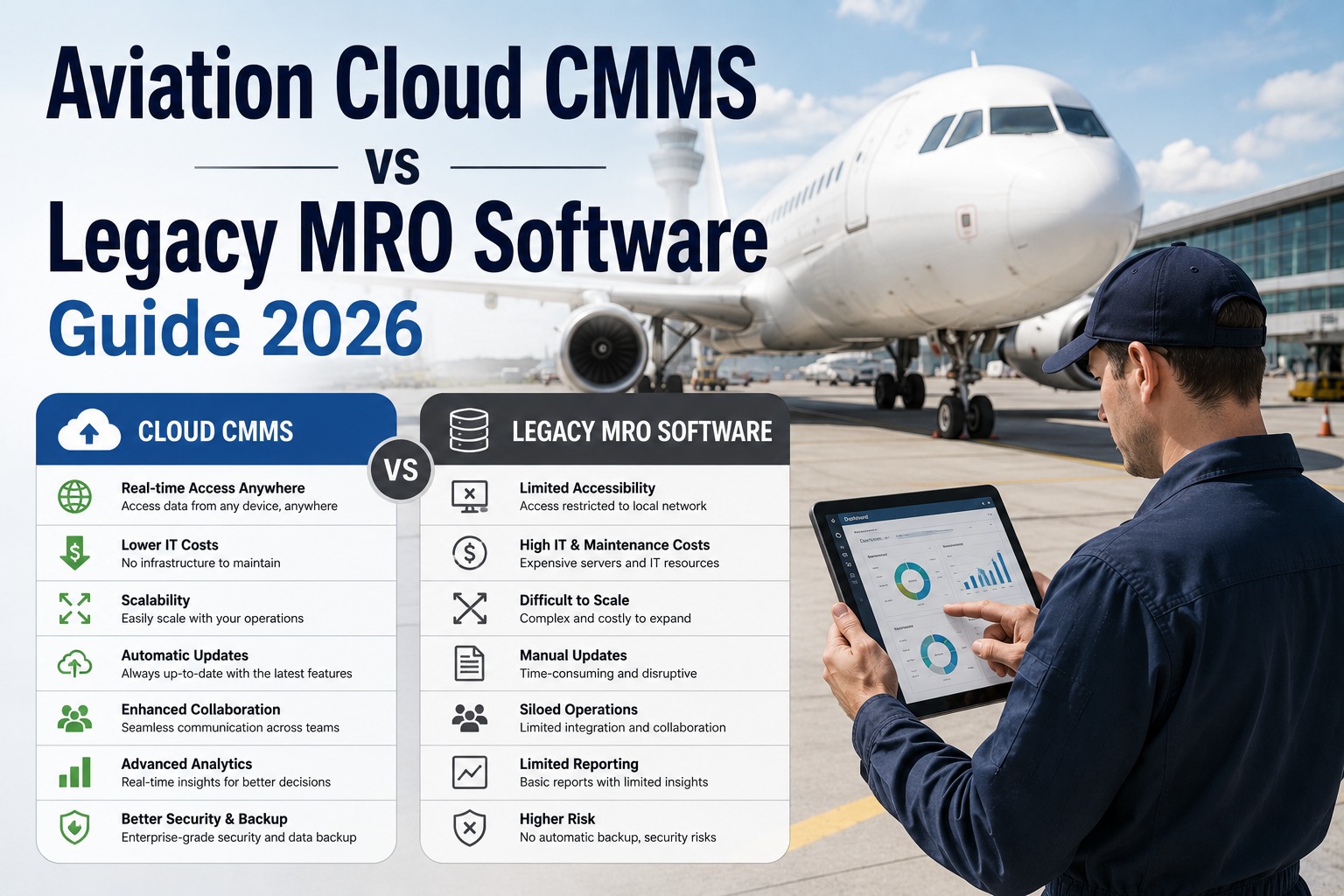
The on-premise vs. cloud debate in aviation MRO software is ultimately a TCO question, not a features question. On-premise systems carry high upfront capital expenditure, internal IT overhead, and maintenance obligations that scale with your fleet. Cloud-native platforms shift those costs to the vendor and deliver predictable operating expenditure. Large operators document 25–30% reductions in five-year TCO after moving to managed cloud MRO hosting. The table below maps the cost differences across the six pillars for a 50-aircraft operator. Book a demo and get a custom TCO comparison built for your fleet size and current tech stack.
Cost Pillar
On-Premise MRO (5-Year)
Cloud / SaaS MRO (5-Year)
Advantage
License / Subscription
$80K–$250K upfront + annual
$18K–$90K/yr predictable OPEX
Cloud
Implementation
$50K–$200K (complex config)
$8K–$40K (faster deploy)
Cloud
Infrastructure & IT
$20K–$60K/yr (servers, staff)
Included in subscription
Cloud
Software Updates
Periodic, manual, costly
Continuous, automatic
Cloud
Data Control
Full on-site ownership
Vendor-managed (check SLAs)
On-Premise
Compliance Audit Trail
Manual or add-on module
Built-in, always current
Cloud
Mobile & Multi-Site
Expensive add-ons
Included standard
Cloud
Exit / Migration
Complex, data-intensive
Easier export (check contracts)
Cloud
Estimated 5-Year TCO
$420K–$900K
$140K–$320K
25–30% lower
PAIN POINTS
Four Ways Aviation Teams Overpay for Maintenance Software Without Realizing It
Modular Pricing Traps
Vendors quote a base price for core work order management, then charge separately for inventory, compliance reporting, mobile access, and analytics. A $500/user/month quote becomes $1,200/user once your team actually needs all modules.
Integration Cost Blowouts
Connecting aviation CMMS to existing ERP, CAMO, or flight operations systems requires custom API work. Vendors underquote this at proposal stage. 40–60% of aviation software projects exceed their integration budget within the first year.
Productivity Dip at Go-Live
Most aviation maintenance teams experience a 20–40% productivity loss during the 2–4 month post-launch adoption period. This is a real operational cost that rarely appears in ROI projections vendors share at the sales stage.
Vendor Lock-In Penalties
Data portability clauses buried in contracts mean that switching platforms after three years can cost as much as the original implementation. Aviation operators with compliance records spanning 7+ years face the highest exit risk.
HOW OXMAINT REDUCES TCO
Built to Minimize Every Layer of Total Cost of Ownership
Oxmaint was architected to deliver a low TCO profile from day one—no surprise implementation fees, no module paywalls for core functionality, and no heavy IT overhead. The platform is cloud-native, mobile-first, and designed for multi-site aviation and industrial operations without requiring a long implementation runway. Here is how Oxmaint addresses each TCO cost driver directly. Start a free trial with no upfront commitment and validate the platform against your actual maintenance workflows.
No Heavy Implementation Fees
Oxmaint deploys in days, not months. Pre-built asset hierarchy templates cover Portfolio, Property, System, Asset, and Component levels without custom configuration sprints that inflate project costs.
All Core Features Included
Work orders, preventive maintenance scheduling, asset lifecycle tracking, inventory management, compliance documentation, and mobile access are all included. No modular add-on pricing traps.
IoT & SCADA Integration Ready
Native integration with IoT sensors and SCADA systems means real-time asset health data flows directly into maintenance workflows without costly custom API development or middleware layers.
Audit-Ready Compliance Built In
Digital signatures, GMP compliance documentation, and audit trail generation eliminate the consultant fees and manual overhead that aviation teams typically spend on compliance prep.
Rolling 5–10 Year CapEx Forecasting
Investor-grade CapEx forecasting models are built into the platform. No separate analytics module purchase required. Finance and operations get the same data in real time.
Mobile-First, Multi-Site Capable
Technicians across multiple facilities access the same platform from mobile devices with no extra licensing cost per site. Multi-site portfolio reporting is standard, not a premium tier.
Condition-Based Lifecycle Tracking
Asset condition scoring and remaining useful life tracking prevent the reactive repair cycles that inflate maintenance labor costs to $19/HP versus the $9/HP achievable with planned programs.
Transparent Switching Terms
No data hostage clauses. Oxmaint customers own their maintenance records, inspection histories, and asset data. Export tools are available from day one—not hidden in premium support tiers.
TCO vs. ROI ANALYSIS
The 5-Year Financial Model: What Aviation Maintenance Software Actually Costs and Returns
TCO is only half the equation. The return on that investment is what determines whether a software decision was correct. Below is a representative 5-year model for a mid-size aviation operation with 40–80 assets across 2–3 facilities, moving from reactive to preventive maintenance using Oxmaint. Emergency repairs cost 4.8x more than planned maintenance events. Every unplanned downtime hour in commercial aviation costs operators an average of $260,000 in lost productivity. The ROI math is not complicated—but it requires the full TCO picture to calculate honestly. Book a demo and our team will run this model with your actual maintenance cost data.
5-Year Total Cost (Oxmaint)
Platform Subscription (5yr)$75K–$180K
Implementation & Onboarding$8K–$25K
Staff Training (initial + refreshers)$6K–$15K
IoT Sensor Integration$10K–$30K
Internal IT OverheadMinimal (cloud-managed)
Total 5-Year TCO$99K–$250K
vs
5-Year Documented Savings
Emergency Repair Avoidance (4.8x cost)$480K–$960K
Downtime Hours Eliminated$320K–$780K
MRO Inventory Optimization (15%)$90K–$210K
Compliance Penalty Avoidance$60K–$180K
Asset Life Extension (20–30%)$140K–$380K
Total 5-Year Value$1.09M–$2.51M
8–12x
ROI over 5 years
6–10 mo
Typical payback period
$0
Implementation surprise fees
30 days
Free trial to validate ROI
No Credit Card Required
See Exactly What Oxmaint Costs and Returns for Your Operation
Most aviation maintenance teams are overpaying for software that underdelivers. Oxmaint's transparent TCO model means no surprises after you sign. Start free, validate with your actual data, and get a custom ROI projection before committing to anything.
Eight Questions to Ask Every Aviation CMMS Vendor Before You Sign
The right questions during vendor evaluation prevent the hidden cost surprises that hit 57% of software buyers post-purchase. Use this checklist in every MRO software evaluation conversation—any vendor that deflects these questions is telling you something important about their TCO structure.
01
What is the total implementation cost for a fleet of my size, including data migration?
Any vendor quoting implementation below 15% of the annual license fee for a complex operation is underestimating. Get it in writing.
02
Which features require separate modules or upgraded pricing tiers?
Mobile access, multi-site reporting, CapEx forecasting, and compliance audit trails are often paywalled features. Confirm what is included in the base price.
03
How does integration with our ERP and CAMO systems work, and what does it cost?
Native integrations reduce cost significantly compared to custom API builds. Ask for a specific integration scope document, not a general capability statement.
04
What are the data export and contract exit terms?
Vendors that restrict data portability or charge for export are building switching costs into your contract. This is a hidden TCO element that compounds over time.
05
How are software updates and new feature releases delivered and priced?
On-premise systems often charge for major version upgrades. Cloud/SaaS platforms should deliver updates automatically. Confirm which model the vendor uses.
06
What compliance documentation and audit trail capabilities are built in?
FAA, EASA, and Transport Canada compliance reporting should be standard. If compliance tools require a separate purchase, add that cost to your TCO calculation immediately.
07
Can we run a free trial with our own data before committing?
Vendors confident in their platform offer real trials with real data. Controlled demo environments that only show polished workflows are not adequate for aviation operations evaluation.
08
What is the pricing model if we scale from 3 sites to 10 sites?
Per-site licensing models penalize growth. Confirm whether multi-site capability is included in the base subscription or charged as an additional fee per facility.
FREQUENTLY ASKED QUESTIONS
TCO Questions Aviation Maintenance Teams Ask Most
How long does a typical aviation CMMS implementation take, and what drives the timeline?
Implementation timelines range from 2 weeks to 18 months depending on system complexity, data migration scope, and integration requirements. Cloud-native platforms like Oxmaint with pre-built aviation asset templates deploy in 2–6 weeks for most operations. The primary timeline drivers are data migration from legacy systems, integration depth with existing ERP or CAMO platforms, and the number of sites requiring configuration. Heavy customization requirements are the biggest schedule risk—they also inflate TCO significantly. If a vendor quotes a 12-month implementation for a 50-aircraft operation, that timeline cost alone should factor into your TCO comparison. Start a free trial and see how quickly Oxmaint deploys for your operation size.
What is a realistic ROI timeline for aviation maintenance software investment?
Most aviation and industrial operations achieve payback within 6–12 months when transitioning from reactive to preventive maintenance management. The fastest ROI comes from two sources: emergency repair avoidance (which saves 4.8x the cost of a planned repair event) and unplanned downtime reduction. A single avoided AOG event or unplanned facility shutdown can recover the entire annual software cost. Operations that also leverage CapEx forecasting to defer premature equipment replacement typically see additional ROI that extends into year 2 and 3. Teams with existing data in spreadsheets or legacy CMMS platforms tend to see faster payback because the comparative baseline is clear. Book a demo and get a payback projection specific to your maintenance spend profile.
How does Oxmaint pricing compare to legacy aviation MRO platforms like AMOS or Veryon?
Legacy aviation MRO platforms like AMOS and OASES start at approximately $500 per user per month before implementation, customization, and module costs are added. Five-year TCO for a 20-user operation on legacy platforms typically runs $300,000–$600,000 when all cost pillars are included. Oxmaint's pricing model is structured to deliver the same core functionality at a significantly lower five-year TCO, with no heavy implementation fees, no per-site licensing, and no module paywalls for compliance, mobile access, or CapEx reporting. The key differentiator is that Oxmaint was built for multi-site commercial and industrial portfolios—including aviation—without the enterprise implementation complexity that inflates legacy platform TCO. Contact our team for a direct comparison against your current or shortlisted platforms.
What hidden costs should we specifically watch for in aviation MRO software contracts?
The six most common hidden cost triggers in aviation MRO contracts are: (1) Module unlock fees for compliance reporting, mobile access, or multi-site dashboards quoted separately from base pricing; (2) Data migration and cleansing charges that vendors quote as a range and then bill at the high end; (3) Custom integration development for ERP or CAMO connectivity; (4) Annual maintenance fees of 15–20% of the original on-premise license; (5) Premium support tier requirements for SLA-backed response times; and (6) Data export or contract exit fees that make switching platforms costly after year 3. Reading contract renewal terms and data portability clauses before signing prevents the most expensive surprises. Start a free trial and review Oxmaint's transparent contract structure with no hidden cost layers.