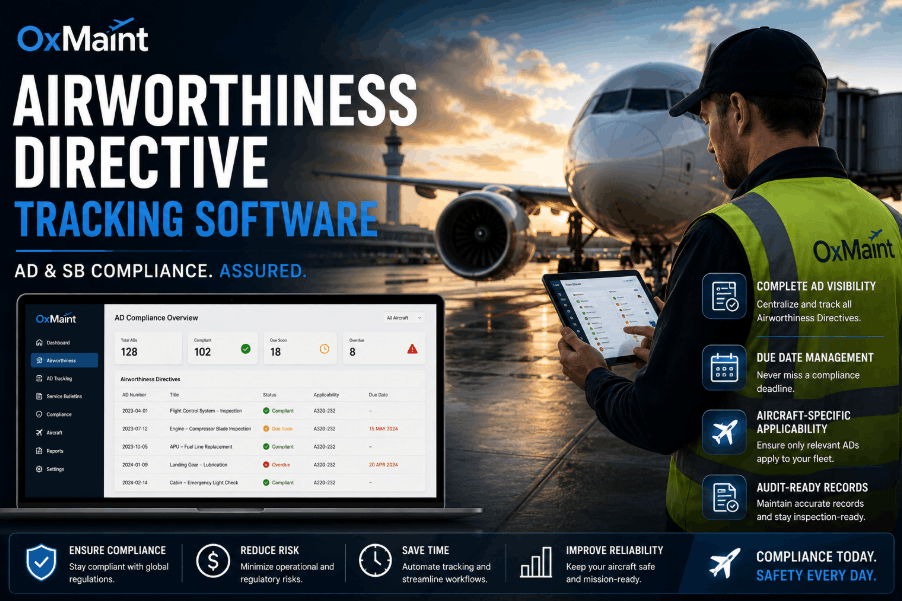
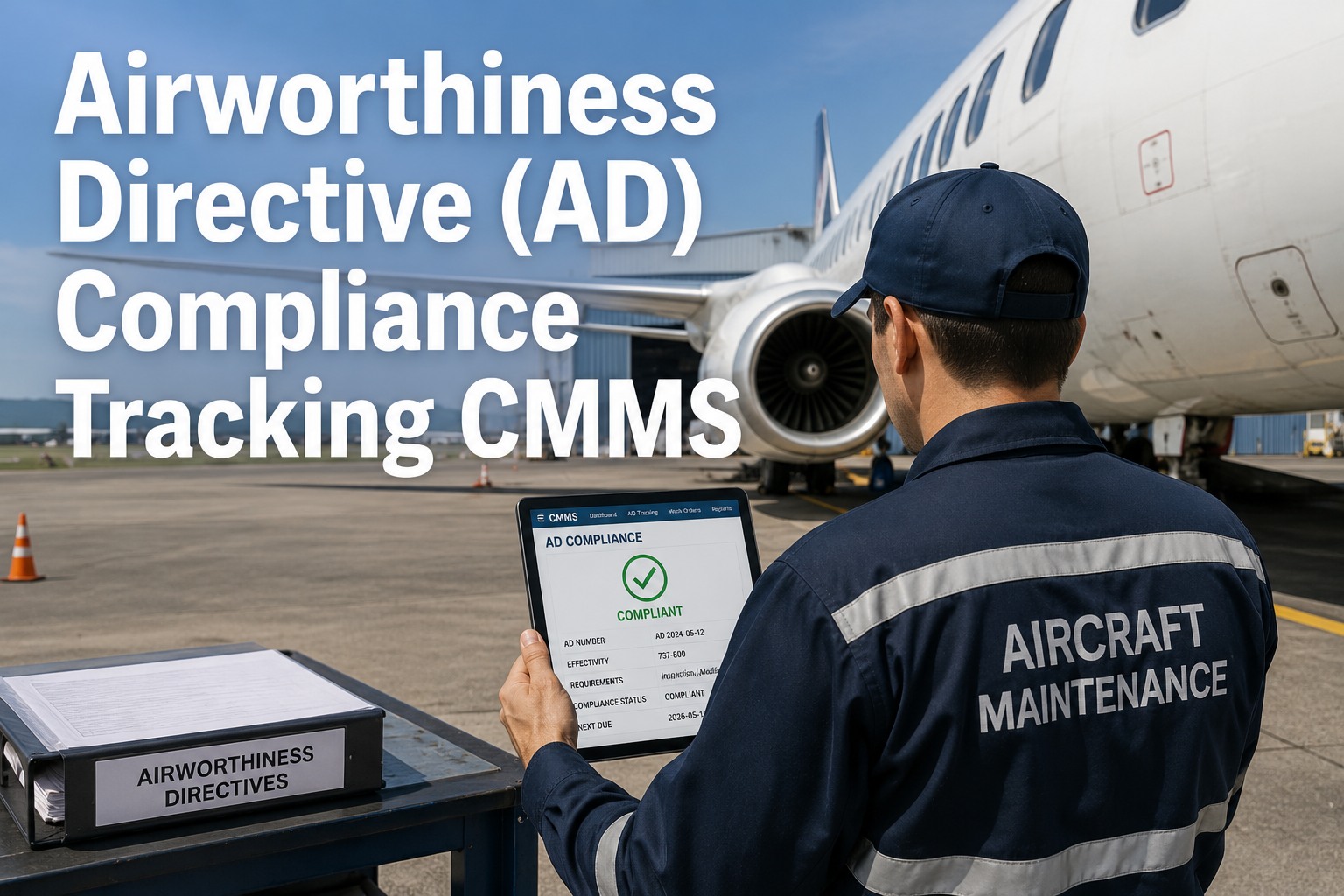
For a Technical Records Manager, an untracked Airworthiness Directive is not an administrative oversight—it is a federal violation.How OxMaint eliminates the risk of manual AD tracking across every tail number in your fleet. FAA 14 CFR Part 39, EASA Part-M, and TCCA CARs impose strict recurring-inspection and terminating-action deadlines on every applicable directive. Legacy tracking methods—spreadsheets, binders, and shared email folders—create dangerous blind spots: directives are missed during applicability reviews, compliance evidence is scattered across filing cabinets, and auditors walk away with findings that ground aircraft and attract significant civil penalties. OxMaint's dedicated airworthiness directive tracking software auto-ingests FAA, EASA, and TCCA AD and Service Bulletin libraries, maps each directive to individual tail numbers based on aircraft type, serial number, and modification status, and enforces recurring-inspection schedules with automated threshold alerts. Technical Records Managers can Book a Demo to see how a single compliance dashboard replaces hundreds of manual lookups, giving your team one-click audit-ready evidence packages that satisfy regulatory examiners on the first request. OxMaint links every AD to its associated work orders, technician sign-offs, and parts traceability records—creating an unbroken digital chain of evidence from directive issuance to terminating action, protecting your AOC holder from certificate action and your aircraft from unscheduled ground events.
Stop Chasing Directives. Start Proving Compliance.
OxMaint auto-imports FAA, EASA, and TCCA ADs, maps applicability per tail, and generates audit-ready evidence in one click. Purpose-built for Technical Records Managers.
2026 AD Compliance Risk Profile: Where Fleets Fail
Data from aviation maintenance oversight bodies continues to show that AD non-compliance findings originate not from deliberate negligence, but from applicability determination failures and recurring-interval miscalculations. When Sign Up Free and configure your fleet in OxMaint, every new directive ingested is automatically cross-referenced against your aircraft configurations—eliminating the manual lookup that consumes hours per audit cycle. Fleets operating more than 10 tail numbers without a dedicated AD library tool face compounding risk: each new FAA NPRM or EASA Emergency AD requires a manual sweep of every aircraft record, creating a workload that grows linearly with fleet size. OxMaint scales that process to near-zero effort by executing applicability logic automatically, flagging affected aircraft, and dispatching work orders before threshold dates are breached. Book a Demo today and see the applicability engine in action against your live fleet roster.
TOP SOURCES OF AD NON-COMPLIANCE FINDINGS (INDUSTRY AUDIT DATA)
Missed Applicability Determination
41%
Recurring Interval Miscalculation
28%
Incomplete Compliance Evidence
18%
Terminating Action Not Captured
9%
Critical Failure Modes in Manual AD Tracking
Risk #1
Applicability Blind Spots
Spreadsheets cannot auto-match new directives to tail numbers. A modified aircraft may inherit or lose applicability, and manual records rarely reflect that change.
Risk #2
Recurring Interval Drift
AD recurring inspections tied to flight hours, cycles, or calendar days drift when logbook entries are made late, pushing compliance dates past their FAA-mandated limit.
Risk #3
Terminating Action Gaps
Once a terminating modification is embodied, the recurring AD should close. Manual systems frequently leave the AD active, polluting the compliance record.
Risk #4
Fragmented Evidence
Compliance sign-offs live in paper logbooks, scanned PDFs in email, and spreadsheets—three separate systems that cannot be assembled quickly during a ramp audit.
Risk #5
SB Mandatory Confusion
Service Bulletins referenced by an AD become mandatory. Manual trackers rarely flag this linkage, leaving referenced SBs treated as optional discretionary work.
Risk #6
Multi-Registry Gaps
Fleets operating on multiple registries—FAA N-registered and EASA EU-registered aircraft—require parallel AD libraries. Manual cross-referencing is error-prone and time-intensive.
AD Non-Compliance: The Escalation Path
A single undetected AD finding during a routine Part 145 surveillance audit can trigger a chain of regulatory consequences that extends well beyond a corrective action plan. Book a Demo to understand how OxMaint structures your AD records before the next audit cycle begins. Without a verifiable digital compliance trail, the burden of proof falls entirely on your technical records team—and reconstructing that evidence from paper logbooks under audit time pressure is a compounding liability. OxMaint ensures every AD compliance action is timestamped, linked to the authorizing work order, and cross-referenced to the specific airworthiness limitation item at the time of embodiment. Regulatory findings become non-issues when your entire AD history is exportable to a single PDF on demand. Sign Up Free and configure your first aircraft tail in under five minutes.
Directive Issued
FAA, EASA, or TCCA publishes a new AD or Emergency AD targeting your aircraft type. OxMaint auto-ingests and maps applicability to affected tails within hours.
→
Threshold Approaching
Without automation, compliance threshold dates are calculated manually and logged on spreadsheets. OxMaint triggers escalating alerts at configurable lead times before the deadline.
→
Audit Event
Regulator requests full AD compliance status for the fleet. Manual teams scramble across logbooks and folders. OxMaint delivers a one-click exportable compliance package.
→
Finding Issued
A missed recurring inspection or absent evidence results in a Level 1 or Level 2 finding—potential AOC suspension. OxMaint eliminates this scenario with closed-loop compliance tracking.
Manual AD Tracking vs OxMaint Compliance Engine
Spreadsheets & Manual Tracking
New directives require manual download, review, and spreadsheet entry per tail.
Recurring intervals calculated manually; calendar drift causes undetected overruns.
Terminating actions must be manually closed; open ADs pollute the compliance record.
Compliance evidence scattered across logbooks, email, and filing cabinets.
Multi-registry fleets require duplicate manual processes for each authority.
OxMaint AD Tracking Software
Auto-ingested FAA, EASA, and TCCA library with per-tail applicability mapping on publication.
Threshold calculations updated live from logbook entries; alerts issued before deadline breach.
Terminating-action capture automatically closes recurring AD requirements with linked evidence.
All compliance sign-offs, work orders, and parts records linked to the directive record.
Unified dashboard spans all registries; single audit export covers your entire fleet.
"We operate a mixed FAA and EASA fleet of 23 aircraft. Before OxMaint, every surveillance audit required two weeks of records preparation. Now our Technical Records team pulls a full AD compliance package for any tail in under three minutes. Our last EASA continued airworthiness audit closed with zero findings for the first time in six years."
Technical Records Manager, Regional Charter Operator – 23 Aircraft Fleet
Zero AD Findings Starts Here.
Auto-import your AD library, prove per-tail compliance instantly, and close every audit with confidence. OxMaint is built for Technical Records Managers who cannot afford a miss.
Frequently Asked Questions
Q1 Which AD authorities does OxMaint support?
OxMaint auto-ingests directives from the FAA, EASA, and TCCA. Additional national authority libraries can be configured on request for operators on other registries.
Q2 How does per-tail applicability mapping work?
Each aircraft is configured with its type, model, serial number, and modification status. The system cross-references these attributes against every directive effectivity statement to determine applicability automatically.
Q3 Can OxMaint track both recurring and one-time ADs?
Yes. The system manages one-time compliance, recurring inspections tied to hours/cycles/calendar, and terminating actions. Once a terminating modification is embodied, the recurring requirement is automatically closed.
Q4 How is compliance evidence captured and stored?
Every AD compliance action is linked to the authorizing work order, technician sign-off, and parts traceability record. Evidence packages are exportable as a single PDF for audit submission.
Q5 Does OxMaint track mandatory Service Bulletins referenced by ADs?
Yes. SBs that are incorporated by reference into an AD are flagged as mandatory and tracked with the same compliance workflow as the parent directive.
Q6 Can OxMaint handle fleets operating on multiple registries simultaneously?
Yes. OxMaint supports multi-registry fleet configurations, applying the correct authority's AD library to each tail number and presenting a unified compliance view across the entire fleet.
Q7 How quickly can our fleet be configured and go live?
Most operators complete aircraft configuration and AD library import within three to five business days, including initial applicability review and threshold setup for all open directives.
Q8 Does OxMaint integrate with existing maintenance management or ERP systems?
Yes. OxMaint provides robust APIs for integration with major aviation MRO and ERP platforms, enabling bi-directional data exchange of logbook entries, work orders, and parts records.
Audit-Ready AD Compliance for Every Tail in Your Fleet.
Eliminate manual applicability lookups, prevent recurring interval overruns, and prove compliance to any authority in one click.