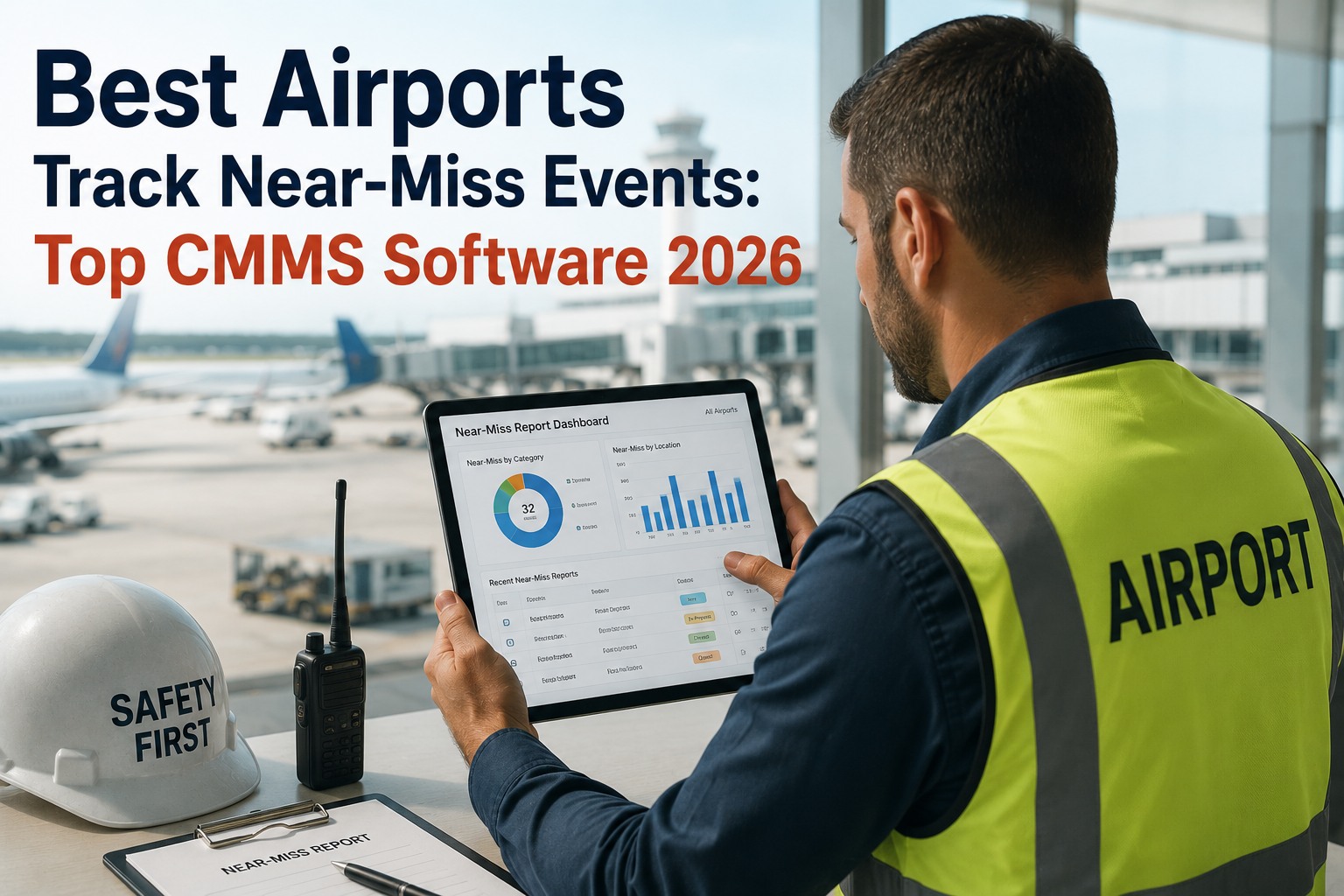
Best airports track near-miss events with the same rigor as failures, because in aviation the ratio holds for every serious incident there are roughly 29 minor events and 300 near-misses feeding it, and the FAA recorded over 1,600 runway incursions in fiscal 2025 alone. Best CMMS platforms treat the near-miss log as the leading indicator that predicts failure weeks in advance. When runway vehicle strikes, jetbridge misalignments, baggage system jams, or de-icing rig faults get captured as structured records — not verbal debriefs — the pattern surfaces before it becomes an unplanned closure. Book a Demo to see how OxMaint turns near-miss capture into MTBF and MTTR gains for airport engineering teams.
Best Airports Track Near-Miss Events: Top CMMS Software 2026
The best airports track every near-miss event, not just failures. See how top 2026 CMMS software converts leading indicators into measurable MTBF gains — before the incident report is ever written.
The Safety Pyramid: Why Near-Misses Are the Leading Indicator
The airports with the lowest unplanned downtime and the strongest audit records do one thing consistently — they treat the base of the safety pyramid as operational data, not paperwork. Every runway vehicle near-hit, every de-icer hose burst-warning, every jetbridge misalign event is a leading indicator that a failure is forming. Ignore the base and the top of the pyramid arrives on its own schedule. Start a free OxMaint account and begin logging near-miss events against your asset hierarchy on day one — no credit card, no setup fee, full mobile capture from the first shift.
Fatality, hull loss, closure
Injuries, equipment damage, delays
Runway incursions, close calls, warnings
The pattern signal — captured only in CMMS logs
6 Near-Miss Categories the Best Airports Log Daily
A near-miss program only works when the categories are structured, mobile-reportable, and linked to the physical asset that generated the signal. Below are the six event classes top-performing airport engineering teams capture in their CMMS — each with the failure mode it predicts. Book a 30-minute demo to see these categories pre-configured for your airport's asset list, with sample mobile forms and dashboards walked through live.
Every Near-Miss You Log Today Is a Failure You Won't Investigate Tomorrow.
OxMaint captures runway, jetbridge, BHS, de-icing, lighting, and GSE near-miss events on mobile — then auto-links them to the asset for trending, corrective work orders, and audit-ready records.
Paper Debrief vs. CMMS Near-Miss Capture — The Operational Gap
The difference between an airport that reduces downtime year over year and one that repeats the same failures is not effort — it is whether the near-miss signal survives the shift handover. Paper and verbal debriefs lose the pattern; CMMS records preserve it. Sign up for free access and load your first runway, gate, or BHS asset into OxMaint in under ten minutes — the free tier includes mobile capture, work orders, and asset-linked history.
OxMaint's Airport Near-Miss Workflow — 4 Stages, One Record
A near-miss event is only valuable if it moves through capture, trending, corrective action, and executive visibility without losing the thread. Here is how OxMaint structures the flow — every stage bound to the asset that generated the signal. Schedule a walkthrough with an OxMaint solutions engineer to see the full workflow demonstrated on airport-specific assets — BHS conveyors, gate jetbridges, and GSE fleets — plus a live MTBF dashboard configured for your reporting cadence.
Program Maturity — Where Does Your Airport Sit Today?
Airport near-miss maturity spans from verbal debriefs that die at shift change to full CMMS-based programs where every leading indicator feeds a live MTBF curve. Use this scale to locate your current state and the gap driving the next tier of avoidable disruption. Wherever you sit today, create a free OxMaint workspace and move one tier up this week — most teams reach L3 (digital log with asset linkage) within the first shift of using the mobile app.
We used to close out near-misses in a shift briefing and hope someone remembered. After moving to OxMaint, three baggage belt jams on the same conveyor section within ten days triggered a corrective work order automatically. The bearing was replaced during a scheduled window — not during peak. That one intervention would have been a full BHS stoppage on a Friday evening. The pattern was in the data all along; we just needed the CMMS to surface it.
Frequently Asked Questions
Stop Losing the Signal at Shift Change.
OxMaint captures every near-miss on mobile, bins it to the asset, trends it live, and routes corrective work — turning the base of your safety pyramid into the reliability program the COO can see.