A Runway Safety Team is only as strong as the action items it actually closes. The meeting is the easy part — what moves the incursion numbers is the disciplined loop behind it: hazards reported, actions assigned with owners and dates, closure verified, and the whole trail retained for the next FAA look. This 2026 guide covers Runway Safety Team software for FAA airports: how the RSAT / RSAP cadence works, where action items go to die, and what to demand of the platform that keeps a Part 139 runway-safety record defensible. Start free on OxMaint to run RST actions to close, or schedule a demo.
RSAT · RSAP · FAA Order 7050.1 · Part 139
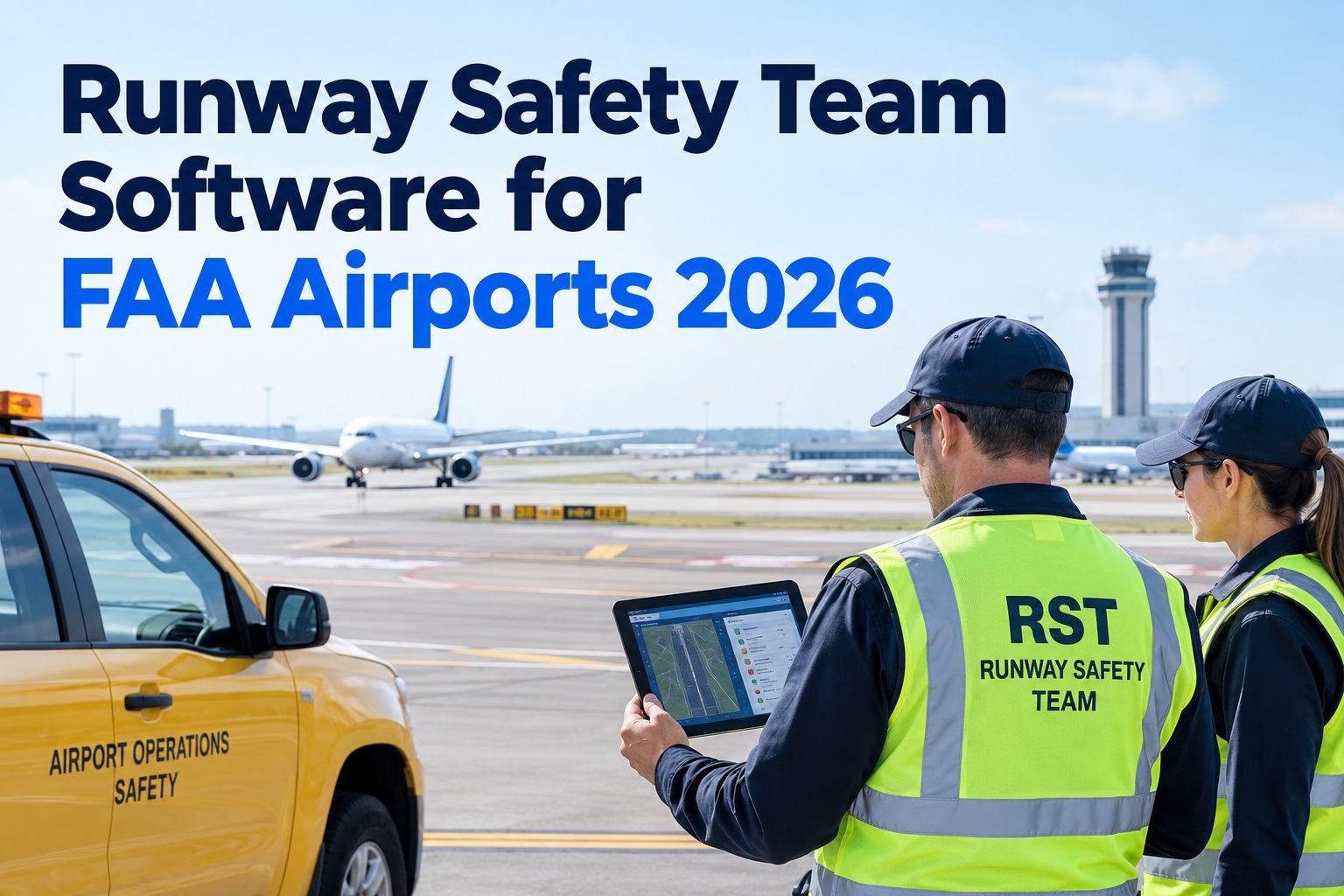
Runway Safety Team Software for FAA Airports
The meeting doesn't move the numbers — the closed action item does. Run the cadence, close the loop, keep the record.
~78%
Average incursion reduction reported at mitigated locations under the FAA Runway Safety Program
RSAP
The action plan an RSAT meeting produces — the tracked-action backbone
~30 days
The kind of timely-response window FAA guidance sets for safety recommendations
Part 139
Certificated airports oversee and facilitate completion of assigned action items
What a Runway Safety Team Actually Runs
At a Part 139 airport, runway safety runs through the Runway Safety Action Team (RSAT) — a standing collaboration of airport operations, air traffic, and airfield stakeholders. The RSAT meets, walks the local risk picture, and produces a Runway Safety Action Plan (RSAP): a documented list of hazards and mitigations, each with an owner and a due date. The FAA tracks meeting completion, the RSAP, and its action items. The airport's job under the program is to oversee and facilitate completion of the items assigned to it. That last clause — facilitate completion — is the whole game. An RSAP full of open, aging action items is a program on paper only.
01
RSAT Meeting
Stakeholders convene on the local runway-safety picture — hot spots, incursion history, geometry, markings, driver risk.
→
02
RSAP
The meeting produces an action plan — each hazard paired with a mitigation, an owner, and a due date.
→
03
Action Closure
Items executed, verified, and closed — with the evidence retained. The only step that changes the risk.
Where Runway Safety Programs Actually Break
Airports rarely fail to hold the meeting. They fail in the space between the RSAP and the closed action — and every failure mode below is a documentation and follow-through problem, not a safety-knowledge problem.
01
Orphaned Actions
An action item with no clear single owner. Everyone assumes someone else has it; it ages quietly until the next meeting reopens it unchanged.
02
No Closure Evidence
The item is "done" but nothing proves it — no photo, no work-order reference, no sign-off. Verbal closure doesn't survive an FAA look.
03
Hazard Reports Lost
A near-miss or hazard spotted on the airfield never reaches the RSAP because reporting means a form nobody fills in from the field.
04
Meeting-to-Meeting Amnesia
Each RSAT starts by reconstructing what happened since the last one. Without a live tracker, the cadence loses its memory.
Run Every RSAP Action to Verified Closure — Free Forever
Every safety event traces back to the reporting and follow-up workflow behind it — and airports that run that workflow seriously see the incident numbers move. Load your RSAP into OxMaint: each action a tracked task with an owner, due date, closure evidence, and audit trail against the asset and event. No card, no time limit.
The RST Workflow · Report to Closed Record
A runway-safety program that moves the numbers runs one continuous workflow, not a once-a-quarter event. These are the five stages the software has to carry — from a hazard spotted on the airfield to a closed, retained record.
Stage 1
Mobile Hazard & Near-Miss Capture
Anyone on the airfield reports a hazard or near-miss from a phone — location, photo, category — so risks reach the program instead of dying in someone's memory.
Stage 2
Triage & RSAP Linkage
Reports triaged by severity and linked to the RSAP — recurring hazards surface as patterns the RSAT can act on, not one-off notes.
Stage 3
Action Assignment
Each mitigation becomes a task with one named owner, a due date, and a priority — the orphaned-action failure mode designed out.
Stage 4
Execution & Closure Evidence
Work done on a mobile work order with photos, mandatory fields, and e-sign — closure that's proven, not asserted.
Stage 5
Audit Trail & Cadence Memory
Every action, closure, and hazard retained against the asset and event — so the next RSAT opens with a live status, not a blank page.
Best-Platform Criteria · What to Demand of RST Software
"Best RST software" isn't the tool with the most charts — it's the one that carries an action item from the RSAP to a verified, retained closure. These six capabilities separate a runway-safety platform that delivers from a meeting-minutes app.
Owner + Due Date on Every Action
No action item exists without one accountable owner and a date. The single most important guard against the orphaned-action failure mode.
Closure Evidence Built In
Photo, work-order link, and e-sign attached to closure — so "done" is provable to an FAA reviewer, not just stated.
Mobile Field Reporting
Hazard and near-miss capture from the airfield in seconds. If reporting is friction, hazards go unreported.
Event-to-Asset Linkage
Every hazard and action tied to the runway, taxiway, sign, or light it concerns — a searchable safety history by asset.
Live Action-Item Dashboard
Open vs closed, aging, and overdue at a glance — so the RSAT chairs a status review, not a memory test.
Retained Audit Trail
Complete, timestamped, retrievable history of meetings, RSAPs, and closures for the Part 139 record.
Why RST Belongs in the Same System as Maintenance
Most runway-safety mitigations are maintenance actions — repaint a faded hold-short marking, fix a burned-out taxiway edge light, regrade a confusing geometry, replace a damaged sign. Splitting the safety action item off into a separate safety-only tool means the actual fix lives in the CMMS while its safety context lives somewhere else. Keep them in one system and the safety action and the work order are the same object — assigned, executed, and closed once, with the safety trail intact.
One Action, One Record
The RSAP mitigation and the maintenance work order are a single tracked item — no double entry, no drift between two systems.
Safety Checks on High-Risk Work
Mandatory safety checks, digital LOTO, and permits ride on the work orders for high-risk airfield tasks — safety inside the operating system, not beside it.
Hazard Data Where Work Lives
Near-miss and hazard reports sit next to the asset history and PM record — patterns emerge because the data isn't siloed.
How OxMaint Runs the Runway Safety Team Program
Hazard capture, RSAP action tracking, closure evidence, and the retained record all live on one platform — every action item an owned, dated task against the runway, taxiway, sign, or light it concerns, and every closure proven and kept for the Part 139 file.
Report
Mobile Hazard Capture
Airfield hazards and near-misses reported from a phone with location, photo, and category — straight into the program.
Plan
RSAP Action Register
Every mitigation logged as a task with one owner, a due date, and a priority — the RSAP as a live register, not a document.
Execute
Action = Work Order
The safety mitigation and the maintenance work order are one object — assigned, executed, and closed a single time.
Prove
Closure Evidence
Photos, mandatory fields, and e-sign on completion — closure an FAA reviewer can verify, not just read about.
Track
Live Action Dashboard
Open, aging, and overdue action items across every RSAP at a glance — the RSAT's standing status view.
Retain
Part 139 Audit Trail
Complete, timestamped history of hazards, actions, and closures by asset and event — retrievable on demand.
Bring Runway Safety Inside Your Maintenance Operating System
Free forever plan — no card, no time limit. Put safety execution where the data on hazards, incidents, and closures actually lives — the same system that runs your maintenance and operations. Or book 30 minutes and we'll map your RSAP and airfield asset register onto the platform end to end.
Frequently Asked Questions
What is a Runway Safety Action Team (RSAT) and how does it relate to a Runway Safety Team?
The RSAT is the FAA's field mechanism for local runway safety — a standing collaboration of airport operations, air traffic, and airfield stakeholders that meets on the local risk picture and produces a Runway Safety Action Plan (RSAP). At a Part 139 airport, this is the runway safety team in practice: the meeting sets direction, but the tracked RSAP action items are what actually reduce risk.
What is an RSAP and why does it matter?
A Runway Safety Action Plan is the documented output of an RSAT meeting — a list of local hazards, each paired with a mitigation, an owner, and a due date. It matters because it's the accountability backbone: the FAA tracks the RSAP and its action items, and Part 139 airports are expected to oversee and facilitate completion of the items assigned to them. An RSAP full of open, aging actions is the classic sign of a stalled program.
Where do runway safety programs most often fail?
Not in holding the meeting — in the gap between the RSAP and the closed action. Orphaned action items with no clear owner, closures with no supporting evidence, hazards that never get reported because the form is friction, and meeting-to-meeting amnesia where each RSAT rebuilds context from scratch. Every one is a follow-through and documentation problem the right software designs out.
Why run RST in a CMMS instead of a standalone safety tool?
Because most runway-safety mitigations are maintenance actions — repainting a hold-short marking, fixing a taxiway edge light, replacing a damaged sign. In a CMMS the safety action and the work order are the same tracked object, executed and closed once with the safety trail intact. A separate safety-only tool splits the fix from its context and creates double entry and drift.
Book a demo to see it unified.
How does RST software keep a Part 139 record defensible?
By capturing each action item with an owner and due date, attaching closure evidence — photo, work-order link, e-sign — and retaining a complete, timestamped, retrievable history of meetings, RSAPs, and closures tied to the asset and event. When an FAA reviewer asks what was done about a hazard, the answer is a records pull, not a reconstruction.
Start free to build the trail from day one.