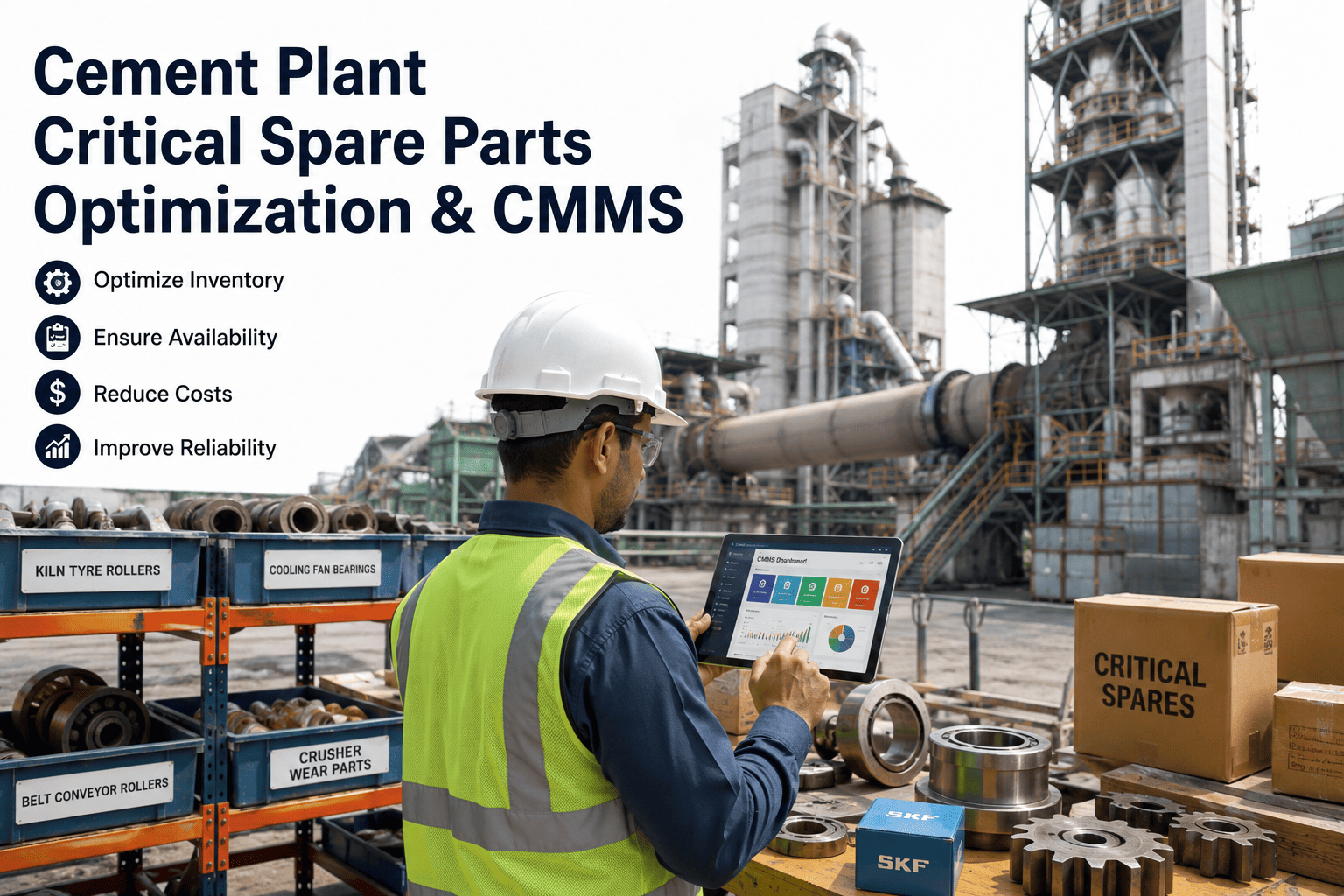
Cement plants carry between 18 and 34 months of critical spare parts lead time on slow-moving components — kiln tyre pads, clinker cooler grate segments, preheater cyclone wear liners, and specialised gearbox housings that single-source suppliers manufacture only to order. When one of those components fails without a warehouse spare, the plant absorbs $180,000 or more per idle kiln day while waiting for a part that could, in many cases, be printed in 48 to 96 hours. Additive manufacturing does not replace the full spare parts supply chain — but for a defined set of geometry-stable, non-safety-critical components, it eliminates the lead time that turns a manageable maintenance event into an extended production loss. Book a demo to see how Oxmaint manages digital spare part files alongside physical inventory across your cement plant asset register.
Technology & Trends
3D Printing & Additive Manufacturing for Cement Plant Spare Parts
6–8 min read
96 hrs
maximum print time for most cement plant wear parts under 50 kg versus 18 to 34 months supplier lead time for slow-moving OEM components
60%
reduction in spare parts holding cost achievable through digital inventory replacing physical stock for printable component categories
$180K
average daily production loss per idle kiln day while awaiting a single-source OEM spare part without an on-site or printable alternative
40%
of cement plant spare part categories are suitable for additive manufacturing based on geometry, material, and load classification criteria
What Can — and Cannot — Be 3D Printed in a Cement Plant
Additive manufacturing suitability depends on three factors: geometry complexity, operating load, and material requirements. The assessment grid below maps common cement plant spare part categories against these criteria to guide print-vs-stock decisions.
Part Category
Geometry
Load Class
Material
Printability
Clinker cooler grate segments
Complex
Thermal + impact
Heat-resistant alloy
✓ Printable
Preheater cyclone wear liners
Moderate
Abrasion
Ceramic / hard alloy
✓ Printable
Conveyor belt cleaner blades
Simple
Low impact
Polymer / PU
✓ Printable
Valve bodies and housings
Moderate
Pressure
316L stainless steel
▮ Conditional
Impeller and fan blades
Complex
Dynamic fatigue
High-strength alloy
▮ Conditional
Custom brackets and fixtures
Variable
Static / low
Steel / polymer
✓ Printable
Kiln tyre pads and shims
Simple
Compressive
Low-alloy steel
▮ Conditional
Kiln girth gear segments
Complex
High cyclic load
Case-hardened steel
✗ Not suitable
Main bearing inner races
Precision
High dynamic
Bearing steel
✗ Not suitable
✓ Printable — approved for on-demand production with standard qualification
▮ Conditional — requires engineering sign-off and post-print testing per application
✗ Not suitable — safety-critical or tolerance-dependent; maintain physical stock
Three Additive Manufacturing Technologies Used in Cement Plant Maintenance
Selective Laser Sintering (SLS)
Metal & Polymer
Produces high-density metal and polymer parts via powder bed fusion. Preferred for wear liners, grate segments, and valve bodies requiring structural integrity. Lead time 24–72 hours for most cement plant geometries.
Precision±0.1 mm
Max temp1,200°C parts
MaterialsSteel, Inconel, nylon
Fused Deposition Modelling (FDM)
Polymer
Layer-by-layer thermoplastic extrusion. Fastest and lowest cost for jigs, fixtures, belt cleaner blades, and non-load-bearing brackets. Most in-house cement plant printing programmes start here.
Precision±0.3 mm
CostLowest
MaterialsPLA, ABS, PETG, PEEK
Direct Energy Deposition (DED)
Metal — Repair & Rebuild
Deposits metal powder or wire via focused energy beam. Used for rebuilding worn cement plant components — trunnion journals, kiln shell sections, and girth gear teeth — restoring geometry without full replacement.
Precision±0.5 mm
StrengthNear-wrought
Best forRepair, cladding
Lead Time: Traditional Procurement vs On-Demand Printing
Third-party remanufacture
External print bureau (metal)
On-demand 3D printing
4–48 hrs
← 99% faster than OEM
Digital Spare Parts Inventory: How Oxmaint Manages Print Files Alongside Physical Stock
A 3D printing programme only delivers its full value when the digital part files — CAD models, print parameters, material specifications, and qualification records — are managed with the same rigour as physical spare parts inventory. Oxmaint's digital spare parts inventory connects print files to asset records, tracks qualification status, and creates work orders that include both the physical print job and the post-print inspection checklist. Book a demo to see how Oxmaint manages digital and physical spare parts inventory in a single asset-linked system.
1
Part Identified for Digital Inventory
Maintenance or engineering team identifies a component as suitable for additive manufacturing using the printability criteria. CAD file, material specification, and print parameters are uploaded to the Oxmaint part record.
2
Part Qualified and Approved in CMMS
First-article inspection results, mechanical test data, and engineering approval are stored against the part record. Oxmaint tracks qualification status — draft, under review, approved, or superseded — so technicians always print from a current approved file.
3
Work Order Triggers Print Job
When a condition-based or breakdown work order requires a digitally stocked part, Oxmaint generates a print job linked to the approved file. The technician receives the work order with print parameters, material specification, and post-print inspection checklist attached.
4
Post-Print Inspection Tracked in Oxmaint
Implementing a Cement Plant 3D Printing Programme: Four Phases
01
Audit & Prioritise
Review slow-moving spare parts register for components with lead times above 6 months. Score each against printability criteria — geometry, load class, material, and safety classification. Identify the 10 to 20 parts where 3D printing delivers the highest risk-reduction value per printing investment.
02
Digitise & Qualify
Commission 3D scanning or CAD model creation for prioritised parts. Print first articles using an approved bureau or in-house capability. Run dimensional and mechanical qualification against OEM specifications. Upload approved files to Oxmaint digital inventory with full qualification records.
03
Integrate with CMMS
Link digital part files to asset records in Oxmaint so that every work order referencing a printable component shows print status, material availability, and estimated print time alongside physical stock levels. Set minimum physical stock rules for safety-critical variants that must remain physically stocked.
04
Expand & Track ROI
Track avoided procurement cost, reduced stock holding value, and eliminated downtime per printed part through Oxmaint work order records. Use the ROI data to justify expanding the digital parts library and, where volume justifies it, investing in on-site printing capability for the highest-frequency categories.
Book a demo to see how Oxmaint tracks digital parts ROI per asset class.
Frequently Asked Questions
QWhich cement plant spare parts deliver the highest ROI from 3D printing?
Parts with the highest ROI combine three characteristics: long OEM lead time (above 12 months), moderate-to-complex geometry that makes machining expensive, and relatively low structural load requirements. Clinker cooler grate segments, preheater wear liners, custom brackets, and belt conveyor components consistently appear at the top of cement plant digital inventory programmes. Parts with lead times under 3 months rarely justify the digitisation investment.
QDo 3D-printed cement plant parts meet the same mechanical specifications as OEM components?
Metal parts produced by SLS or direct energy deposition can match or exceed OEM mechanical properties for many cement plant applications — provided the correct alloy and print parameters are used and post-print heat treatment is applied where required. Polymer parts are appropriate for low-load applications only. Every printed part should be qualified against the OEM specification through dimensional verification and mechanical testing before installation, with results recorded in Oxmaint.
Book a demo to see the qualification workflow in Oxmaint.
QShould cement plants invest in in-house 3D printing or use external bureaus?
Most cement plants start with external print bureaus for metal parts — where the equipment cost is high and demand is intermittent — and evaluate in-house polymer printing for high-frequency, low-load components like belt cleaner blades and jigs. The decision depends on print frequency per year: above 40 metal prints annually, in-house SLS economics typically become favourable. Below that threshold, a qualified bureau network managed through Oxmaint work orders delivers better cost per part.
QHow does Oxmaint track digitally stocked parts differently from physical inventory?
Digital parts in Oxmaint carry a file status (approved, under review, superseded), a print lead time estimate, a material and bureau reference, and a linked qualification record. Physical inventory tracks on-hand quantity, reorder point, and supplier lead time. Both types appear on the same asset-linked work order — the technician sees physical stock levels and digital print status side by side when planning a repair.
Book a demo to see the combined inventory view.
QWhat cybersecurity considerations apply to digital spare parts files?
Digital CAD files and print parameter sets are intellectual property assets that require access control, version management, and secure transfer to print bureaus. Oxmaint stores digital part files with role-based access control and full audit trails of who accessed, modified, or sent each file. This connects directly to the broader OT/IT security considerations covered in the cement plant CMMS and ICS cybersecurity article below.
Continue Reading