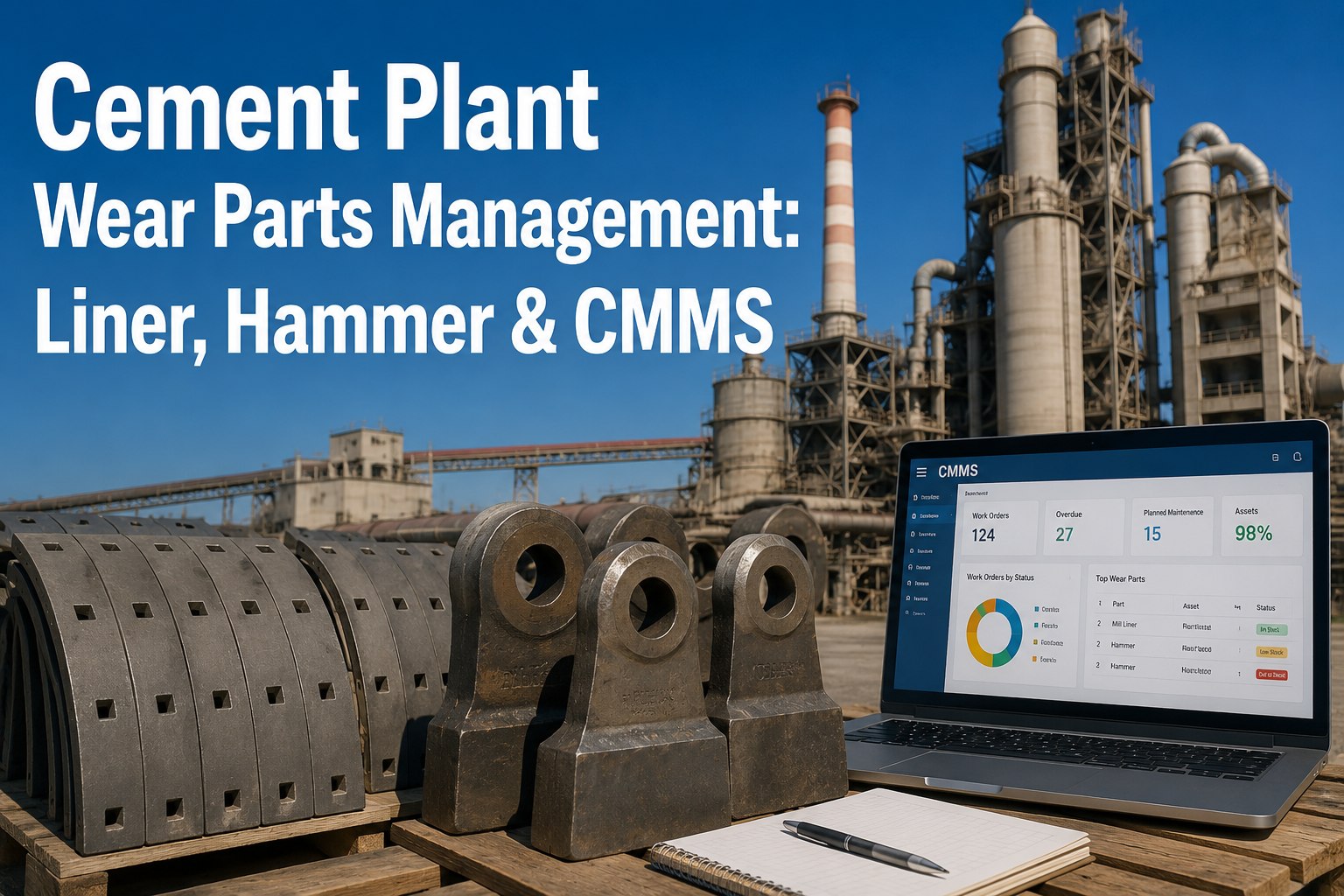
An unplanned rotary kiln stop caused by a stockout of refractory bricks that cost $180 per unit costs between $18,000 and $45,000 per hour in lost clinker production — a ratio that makes even the most aggressive spare parts stocking policy look cheap. Cement plants that run without structured inventory management tied to their CMMS spend an average of 3.2 times more on emergency spare procurement than plants with condition-triggered reorder systems, and extend unplanned shutdown durations by 2.4 days per event when critical parts are not available at the moment of need. Book a demo to see how Oxmaint connects spare parts inventory directly to asset condition records and auto-reorder triggers across your full cement plant equipment base.
See How Oxmaint Links Spare Parts Inventory to Every Asset Record
From kiln refractory bricks to mill liner sets and crusher jaw plates, Oxmaint connects every critical spare to the asset it protects — with condition-triggered reorder, consumption tracking, and stockout alerts that activate before the equipment fails. Book a 30-minute demo with your plant's equipment list and see the inventory system configured against your actual spare parts catalogue.
Inventory and Spare Parts Compliance Coverage for Cement Plants by Region
Spare parts management in cement manufacturing must satisfy regional maintenance record requirements, equipment inspection documentation standards, and MRO procurement governance frameworks. Oxmaint automates spare parts consumption tracking, minimum stock documentation, and procurement audit trail generation so your storeroom records are audit-ready without manual administration.
| Region | Key Frameworks | Oxmaint Inventory Coverage |
|---|---|---|
| USA | OSHA 29 CFR 1910 equipment maintenance, MSHA Part 56 spare parts requirements, EPA Title V | Critical spare register, consumption audit trail, procurement records, reorder documentation |
| UAE | OSHAD-SF maintenance records, SASO standards, Civil Defence equipment spare requirements | Digital spare parts registers, multi-site inventory dashboards, procurement audit exports |
| India | Factories Act 1948 maintenance provisions, BIS IS 14489, DGMS spare parts directives | Statutory spare register tracking, consumption records, compliance certificate integration |
| Germany | BetrSichV maintenance parts requirements, DIN EN 13306 MRO standards, TUV documentation | Spare parts condition archiving, minimum stock records, procurement documentation per asset |
| UK | PUWER 1998 maintenance provisions, PSSR 2000 pressure parts, HSE spare parts guidance | Digital MRO records, critical spare tracking, compliance export for HSE inspection |
| Canada | CSA Z1000 MRO management, Provincial OHS maintenance parts requirements | Multi-site spare parts dashboards, consumption audit trails, auto-reorder documentation |
Oxmaint delivers complete spare parts audit trails, consumption records, and procurement documentation for cement plants across every region above — your storeroom generates compliant MRO records automatically from daily consumption without any manual reporting.
What Makes Spare Parts Management Purpose-Built for Cement Plant Operations?
A generic stockroom system tracks what is on the shelf. A cement-grade spare parts CMMS links every item on the shelf to the specific asset it protects, triggers reorder when condition data predicts upcoming consumption, and surfaces the right parts list before a shutdown scope is finalised. Book a demo to see how Oxmaint configures the spare parts catalogue for your plant's specific equipment classes and critical spare categories.
Asset-Linked Spare Catalogue
Every spare part in the storeroom linked to the specific assets it serves. Kiln refractory bricks linked to each kiln zone. Ball mill liner sets linked to each mill shell. Crusher jaw plates linked to each crusher unit. When a technician opens a work order for a specific asset, the required parts list appears automatically — no searching, no misidentification, no ordering for the wrong equipment specification.
Auto-Reorder Triggers
Minimum stock levels set per part, linked to consumption rate data from work order history. When kiln brick stock falls below the threshold required for one full campaign replacement, a purchase requisition is raised automatically. Reorder points are calculated from actual consumption frequency — not from initial commissioning estimates that no longer reflect real operating patterns after years of production.
Consumption Tracking
Every spare part issued against a work order is deducted from stock automatically and recorded against the asset and job. Consumption history per part builds the data foundation for accurate reorder point calculation, abnormal usage pattern detection, and shutdown scope budgeting. A mill liner consumed after only 6,000 running hours when the standard cycle is 12,000 hours triggers an investigation flag rather than a routine reorder.
Criticality Classification
Spare parts classified by criticality tier: critical spares with lead times exceeding shutdown window duration, standard spares with defined minimum stock, and consumables managed on routine reorder cycles. Critical spares for kiln tyre segments, girth gear sections, and preheater cyclone dip tubes are tracked with dedicated minimum stock levels and procurement lead time records that prevent the 2.4-day shutdown extensions caused by emergency sourcing from unprepared suppliers.
Four Spare Parts Management Failures Costing Cement Plants Every Shutdown
Critical Spare Stockouts Extending Unplanned Shutdown Duration
A clinker cooler grate drive chain fails without warning. The chain is not stocked. Emergency procurement takes 72 hours from an international supplier. The kiln stands cold for three days at a production loss of $45,000 per hour while a $4,200 component is shipped at express freight cost. 68% of cement plant stockouts of this type are preventable with properly configured minimum stock levels and lead time tracking in a CMMS-linked inventory system.
Excess and Obsolete Inventory Consuming Capital Without Return
Cement plants without asset-linked inventory management accumulate spare parts purchased for equipment that has since been replaced, upgraded, or decommissioned. Average excess and obsolete inventory across cement plants without CMMS-linked storerooms represents 22% of the total MRO budget value — capital tied up in parts that will never be consumed, stored in space that could hold genuine critical spares, and written off at periodic audits without ever protecting a single running hour of production.
Shutdown Scope Budgets Inaccurate Because Spare Costs Are Unknown
Without consumption history linked to work orders, shutdown planners estimate spare parts requirements from experience and intuition rather than actual data. A planned kiln inspection that should consume 800 refractory bricks based on historical records actually requires 1,400 because the condition has deteriorated beyond the estimate — and the additional 600 bricks are not in stock. Scope and cost overruns of 35 to 60% trace directly to disconnected spare parts data. Read the cement plant asset lifecycle management guide to understand how spare parts data feeds capital replacement planning at the equipment level.
Abnormal Consumption Rates Masking Underlying Equipment Problems
A preheater cyclone inlet seal consumed three times in six months instead of the expected annual replacement cycle. Without consumption tracking linked to the specific asset, this pattern goes undetected. The root cause — a misaligned duct section creating abnormal thermal stress on the seal face — is never investigated. Parts continue to be ordered and replaced reactively while the underlying mechanical condition deteriorates toward a full cyclone inlet failure costing $280,000 in repair and $320,000 in lost production.
How Oxmaint Structures Spare Parts Management at Cement Plants
Oxmaint connects the spare parts catalogue to asset records, work order history, and condition data — turning the storeroom from a passive parts storage facility into an active component of the predictive maintenance programme. Book a demo to walk through the spare parts configuration for your plant's critical equipment classes.
Ready to Eliminate Spare Parts Stockouts at Your Cement Plant?
Oxmaint spare parts management deploys within the first 60 days of the standard cement plant implementation. Asset-linked catalogue, minimum stock levels, and auto-reorder triggers all active before your next planned shutdown. Book a demo to configure the spare parts system against your plant's critical equipment and storeroom structure.
Oxmaint Spare Parts Platform: Feature Modules for Cement Plant Storerooms
Each module targets a specific failure point in cement plant spare parts management — from stockout prevention to abnormal consumption detection. Book a demo to walk through the full inventory module with your plant's actual spare parts categories and critical equipment list.
Reactive Stockroom vs Oxmaint Spare Parts Management: The Performance Gap
The cost difference between reactive and structured spare parts management in cement manufacturing is measurable in procurement premiums, shutdown extensions, and excess inventory write-offs. Read the complete cement plant maintenance software buyer's guide to understand how spare parts management fits within a fully structured CMMS programme for integrated cement operations.
| Performance Factor | With Oxmaint Inventory | Reactive Stockroom |
|---|---|---|
| Critical Spare Availability | Stock levels maintained against asset condition data and supplier lead times. Auto-reorder ensures critical spares arrive before they are needed. Stockout rate reduced to under 4% across all critical spare categories within 18 months. | 68% of critical spare stockouts are preventable but occur because minimum stock levels are not set or not monitored. Emergency procurement adds 2.4 days to average unplanned shutdown duration at premium freight and supplier rates. |
| Emergency Procurement Cost | Planned procurement at standard supplier rates. Lead time data per part ensures reorder fires ahead of the need window. Emergency freight and out-of-hours supplier premiums reduced by 71% within 12 months of structured inventory deployment. | Emergency spare procurement costs 3.2 times standard planned procurement rates. Air freight, emergency supplier surcharges, and out-of-hours handling fees added to every stockout event regardless of how predictable the consumption was. |
| Shutdown Scope Accuracy | Shutdown work packs generated from asset consumption history pull accurate parts lists. Planners confirm stock availability weeks before the outage window. Parts on order arrive before the shutdown starts. Scope cost variance under 12%. | Parts discovered missing after the kiln goes cold extend shutdown duration while emergency orders are placed. 35 to 60% scope cost overruns driven partly by unbudgeted spare parts procurement at emergency rates during the outage event. |
| Excess Inventory Value | Asset-linked catalogue automatically flags parts with no linked active asset — obsolete spares identified and written off systematically. Excess inventory value reduced by 44% within 24 months of CMMS-linked storeroom deployment. | 22% of total MRO budget value tied up in excess and obsolete inventory. Parts purchased for decommissioned equipment, duplicate orders from disconnected systems, and over-stocked consumables accumulate undetected without asset linkage data. |
| Abnormal Usage Detection | Consumption rates tracked per part per asset. Deviation from baseline triggers investigation flag before the next replacement event. Root cause addressed before abnormal consumption escalates to equipment failure. Average 6 to 8 weeks of early warning per incident. | Abnormal consumption patterns invisible without asset-linked tracking. Same part replaced repeatedly without investigation. Underlying equipment deterioration continues undetected until a failure event exposes the root cause at 4 to 5 times the intervention cost. |
| Parts Identification Speed | Required parts list populates automatically when a work order is opened for any asset. Part number, specification, current stock level, and storeroom location visible in under 3 minutes. Technicians confirm availability before starting repair, eliminating mid-task storeroom trips. | Technicians spend 25 minutes average identifying and locating correct spare specifications for each unplanned repair. Wrong-spec parts ordered from supplier when storeroom records are incomplete, adding days to repair timelines on critical rotating equipment. |
Key Performance Indicators: Spare Parts Management Impact at Cement Plants
These KPI measurements represent outcomes from cement plants that transitioned from reactive stockroom management to Oxmaint-structured spare parts programmes. Book a demo to see how these metrics apply to your plant's specific spare parts categories and consumption patterns.
Cement Plant Spare Parts Performance Benchmarks: Results Within 18 Months
These benchmarks represent average results from cement plants that transitioned from reactive stockroom management to Oxmaint-structured spare parts programmes across their full equipment base.
Spare Parts Results Are Available at Your Cement Plant
Oxmaint spare parts management reaches full operational function within 60 days of deployment. Asset-linked catalogue built, minimum stock levels set, auto-reorder triggers active. Book a demo to configure the inventory system against your plant's critical spare categories and supplier lead times.
Spare Parts ROI in Cement Manufacturing: The Financial Case
Frequently Asked Questions: Spare Parts Management for Cement Plants
QHow does Oxmaint calculate minimum stock levels for cement plant critical spares?
QCan auto-reorder triggers connect to existing procurement or ERP systems?
QHow long does spare parts catalogue setup take for a typical integrated cement plant?
QWhich global compliance frameworks support CMMS-linked spare parts records?
QHow does condition-triggered reorder differ from simple minimum stock level reorder?
QWhat is the typical ROI payback period for spare parts management investment at a cement plant?
Continue Reading: Cement Plant CMMS Inventory and Asset Resources
Explore these resources to build a complete picture of spare parts management, asset lifecycle tracking, and CMMS ROI across your cement plant operations.
Eliminate Spare Parts Stockouts at Your Cement Plant Today
Oxmaint spare parts management is fully operational within 60 days of deployment. Asset-linked catalogue, minimum stock levels, auto-reorder triggers, and abnormal consumption alerts all active — no production shutdown required. Book a 30-minute demo to configure the inventory system against your plant's critical spare categories and see the auto-reorder workflow running against your actual equipment base.