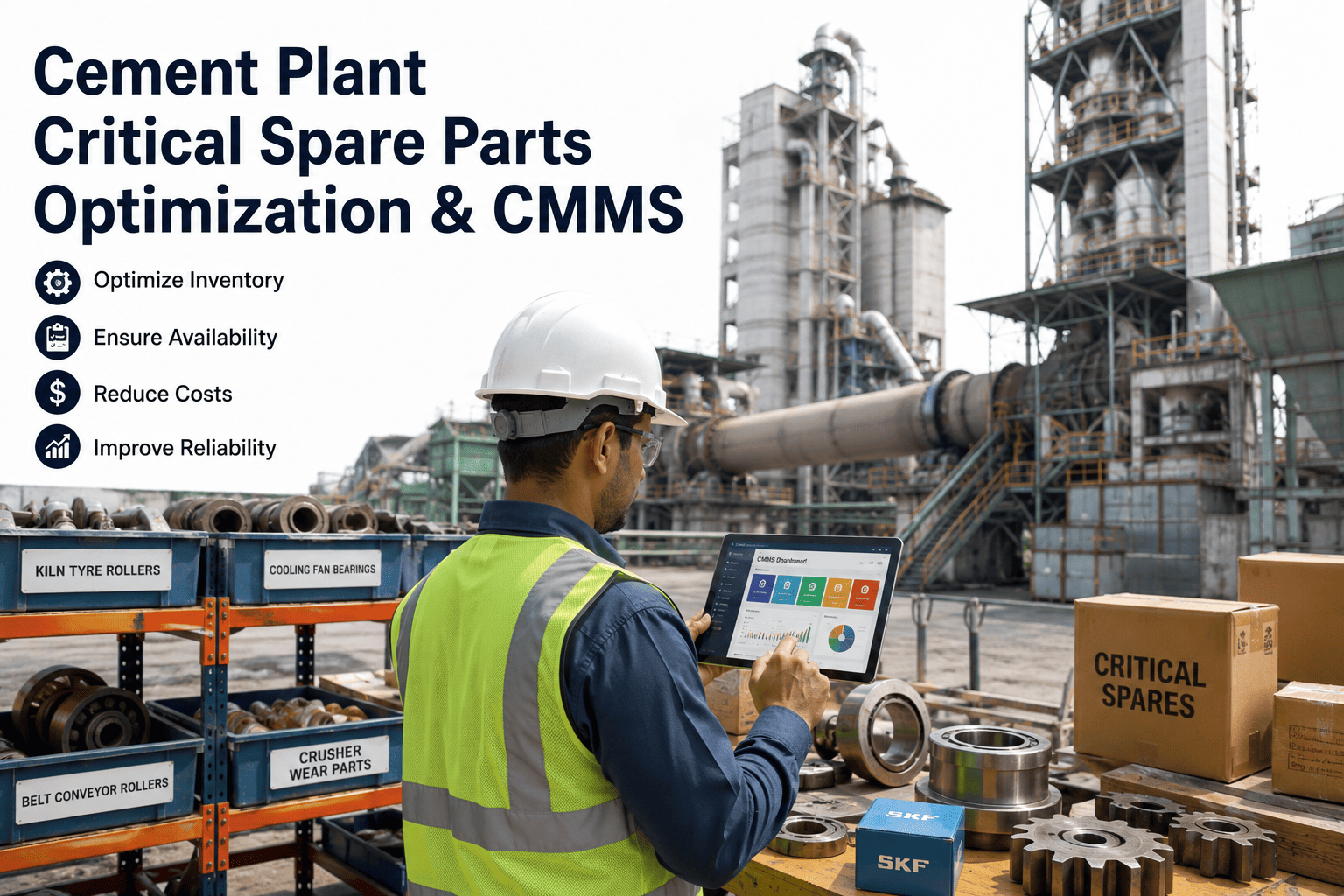
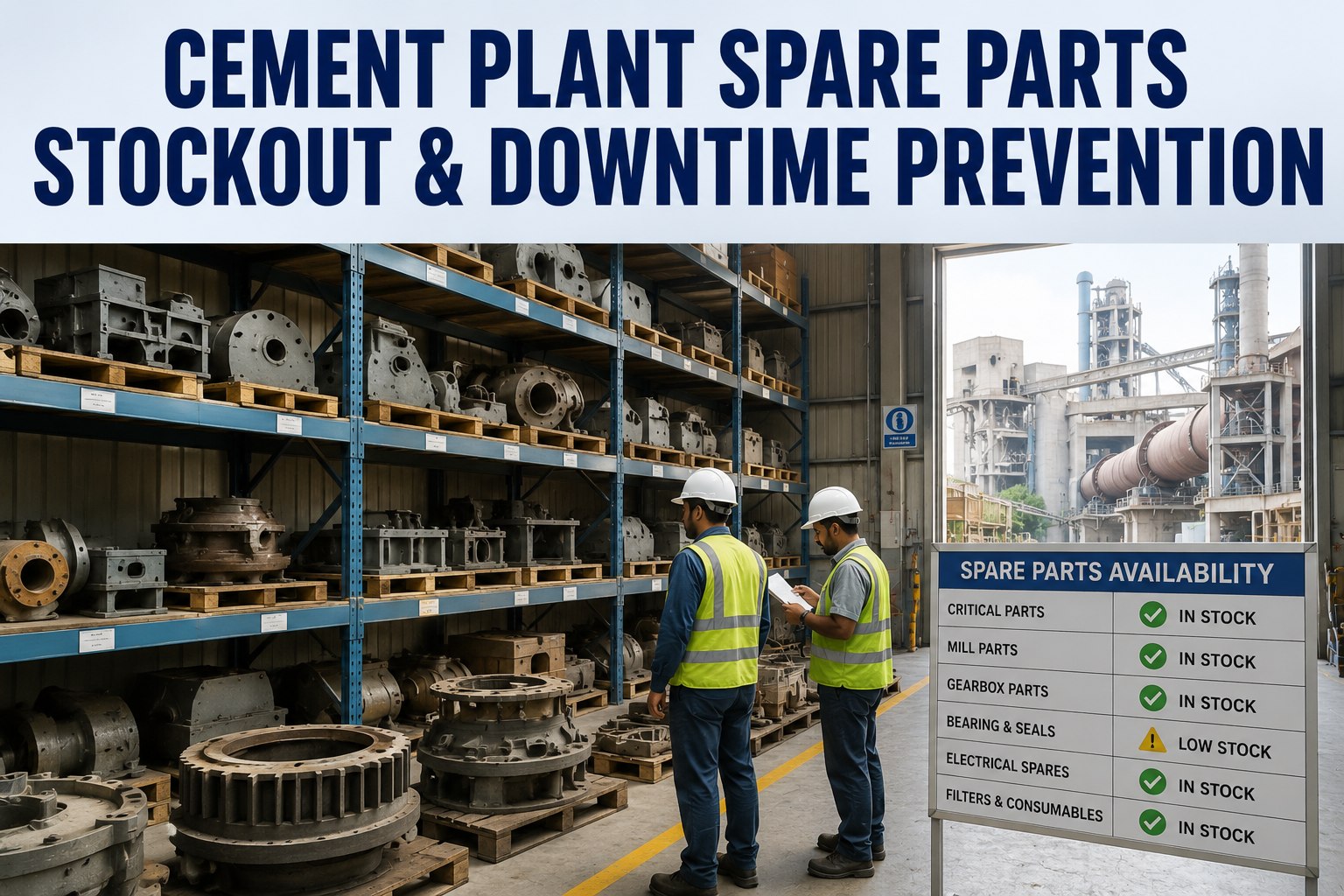
Cement plants carry between $2 million and $18 million worth of spare parts inventory at any given time — yet 20–30% of all maintenance delays in the cement industry are caused by the wrong part being unavailable at the right moment. That contradiction defines the spare parts paradox: plants over-invest in inventory while simultaneously suffering stockout-driven downtime. A bearing worth $340 sits on a shelf for three years while a $28 seal — ordered weekly — runs out on a Sunday night and stops a 4,000-tonne-per-day kiln. The CMMS-connected spare parts programme eliminates this paradox by replacing gut-feel stocking decisions with consumption data, asset-linked reorder logic, and shutdown-synchronised procurement. Start your free OxMaint trial and connect your spare parts to every work order, every asset, and every planned shutdown from day one.
Cement Plant Spare Parts Inventory Management with CMMS
How to eliminate stockout downtime, reduce over-investment by 25–40%, and build a precision spare parts system that synchronises with your kiln schedule, PM programme, and procurement cycle.
Step 1 — Classify Your Inventory Before You Manage It
The foundational error most cement plants make is treating all spare parts identically. A kiln thrust roller bearing and a light bulb cannot share the same reorder logic. Every part in your storeroom must be classified before a CMMS can apply intelligent stocking rules. OxMaint uses a three-axis classification framework that cement plant teams can implement immediately. Book a demo to see how OxMaint's classification engine auto-tags your parts catalogue against your asset register.
The Real Cost of Getting Spare Parts Management Wrong
OxMaint connects every spare part to every asset and every work order — automatically.
No more guessing. No more stockouts. No more $120K surprises at 2 AM.
How to Calculate the Right Reorder Point for Cement Plant Parts
The reorder point (ROP) is the inventory level at which a new purchase order is automatically triggered. Setting it too high wastes capital; too low causes stockouts. In cement plants, two variables dominate every ROP calculation: vendor lead time (which varies dramatically for imported or OEM-specific parts) and consumption rate (which spikes during shutdown periods). Sign up for OxMaint to have the platform calculate and maintain ROPs automatically for your entire parts catalogue.
Manual vs. CMMS Spare Parts Management: The Full Comparison
Shutdown Parts Planning: Where the Biggest Savings Hide
Annual kiln shutdowns in cement plants involve 200–500 individual maintenance tasks — each requiring specific parts, tools, and consumables. Getting the parts wrong adds hundreds of thousands of dollars to shutdown costs through contractor idle time, emergency procurement, and extended outage windows. OxMaint's shutdown planning module builds your parts bill of materials directly from your planned work order list. Start free on OxMaint to build your next shutdown BOM from your live asset register.
OxMaint Turns Your Spare Parts Storeroom Into a Strategic Asset
Asset-linked inventory, zone-aware reorder points, and shutdown-synchronised procurement — all in one platform that your stores team and maintenance technicians actually use.
5 OxMaint Features That Transform Cement Plant Parts Management
Every spare part in OxMaint is linked to the specific asset it serves — not just a generic category. When a technician opens a work order for Kiln #2 Drive Motor, they see the exact bearing model, seal kit, and lubricant specification for that asset. Wrong-part orders — which account for 12–18% of emergency procurement in paper-managed plants — drop to near zero.
OxMaint calculates reorder points from your closed work order history — not manufacturer estimates. As your consumption patterns shift (higher usage during summer peak production, lower during off-season), the platform adjusts ROPs automatically. Cement environment wear acceleration factors are applied per operating zone — dusty areas show tighter reorder points than sheltered zones for the same part number.
When a shutdown work order package is created, OxMaint aggregates all parts requirements across every task in that package into a consolidated BOM. Stock on hand is checked in real time. Shortfalls trigger purchase requisitions automatically — with long-lead parts flagged for priority ordering. The result: zero day-of-shutdown parts surprises.
For plants with multiple storerooms, satellite stores, or multi-site operations, OxMaint provides a single inventory view across all locations. A technician at Site A can check if Site B has a critical spare before placing an emergency order. Inter-site transfer requests are raised in the platform and tracked to completion — eliminating the duplicate safety stocking that inflates inventory value at multi-site cement operations by 25–40%.
OxMaint logs actual delivery performance against every purchase order — promised lead time vs. actual receipt date. Over time, your vendor scorecards reveal which suppliers consistently deliver on time and which inflate safety stock requirements due to unreliable lead times. For cement plants sourcing OEM parts internationally, this data is critical for setting accurate reorder points and reducing emergency air-freight costs.
Ready to Eliminate Stockout Downtime?
OxMaint's spare parts management module is ready for cement plant deployment in days — not months. Connect your parts to your assets, automate your reorder logic, and never lose a shift to a missing part again.
Start Free — No Credit Card RequiredFrequently Asked Questions
How many spare parts does a typical cement plant need to manage in a CMMS?
A mid-size cement plant (1–3 MTPA) typically manages 3,000–8,000 active stock-keeping units across all storerooms. Larger integrated operations can exceed 15,000 SKUs. OxMaint handles catalogues of this scale without performance degradation, and the asset-linking feature ensures that even 15,000 parts remain navigable through asset-hierarchy search rather than raw list scrolling.
Can OxMaint integrate with SAP or Oracle ERP for procurement automation?
Yes. OxMaint provides API-based integration with major ERP platforms including SAP MM and Oracle Procurement modules. Purchase requisitions generated by OxMaint's inventory module can be pushed directly into your ERP's procurement workflow, eliminating manual re-entry and ensuring that CMMS consumption data feeds your financial and inventory accounting systems in real time.
How do we handle spare parts for equipment that wears faster in cement environments?
OxMaint's zone-based wear tracking allows you to tag each asset location as ambient, dusty, or hot zone. The platform then applies environment-specific consumption multipliers — typically 1.3–1.5× for dusty zones and 2–3× for hot zones — when calculating reorder points. This replaces the dangerous practice of relying on manufacturer consumption estimates that were developed for clean industrial environments, not cement plant conditions.
What is the fastest way to build an initial spare parts catalogue in OxMaint?
OxMaint supports bulk CSV import for initial parts catalogue population. Most cement plants can import their existing parts list from Excel or ERP exports in under a day. The OxMaint onboarding team then assists with asset-linking — connecting each part number to the relevant asset records — typically completing this process within 2–3 weeks for a plant with 3,000–5,000 SKUs.
How should we prioritise which parts to bring into the CMMS first?
Start with Class A critical parts for your kiln lines — the 50–100 parts whose stockout would stop production immediately. These deliver the fastest ROI because a single avoided kiln stoppage typically recovers the full first-year CMMS cost. Expand to Class B within 60–90 days, and complete the full catalogue migration within 6 months. This phased approach is exactly how OxMaint's fastest-adopting cement plant customers structure their rollout.
Can mobile access work for storeroom staff who are not technical CMMS users?
OxMaint's mobile interface is designed for non-technical users. Storeroom staff use a simplified issue-and-receipt view: scan the QR code on the shelf location, enter quantity issued or received, and confirm. The system handles all the inventory accounting in the background. Most storeroom teams reach full proficiency within 2–3 days of introduction — no technical training required beyond the basic workflow.
How does OxMaint help reduce the risk of ordering obsolete parts after equipment replacement?
When an asset is retired or replaced in OxMaint, all linked spare parts are automatically flagged for obsolescence review. The stores manager receives a notification listing the affected parts and their current stock value. A guided disposal or transfer workflow prevents the common scenario of continuing to reorder parts for equipment that no longer exists — a situation that costs cement plants an estimated $50,000–$200,000 annually in avoidable obsolete inventory write-offs.