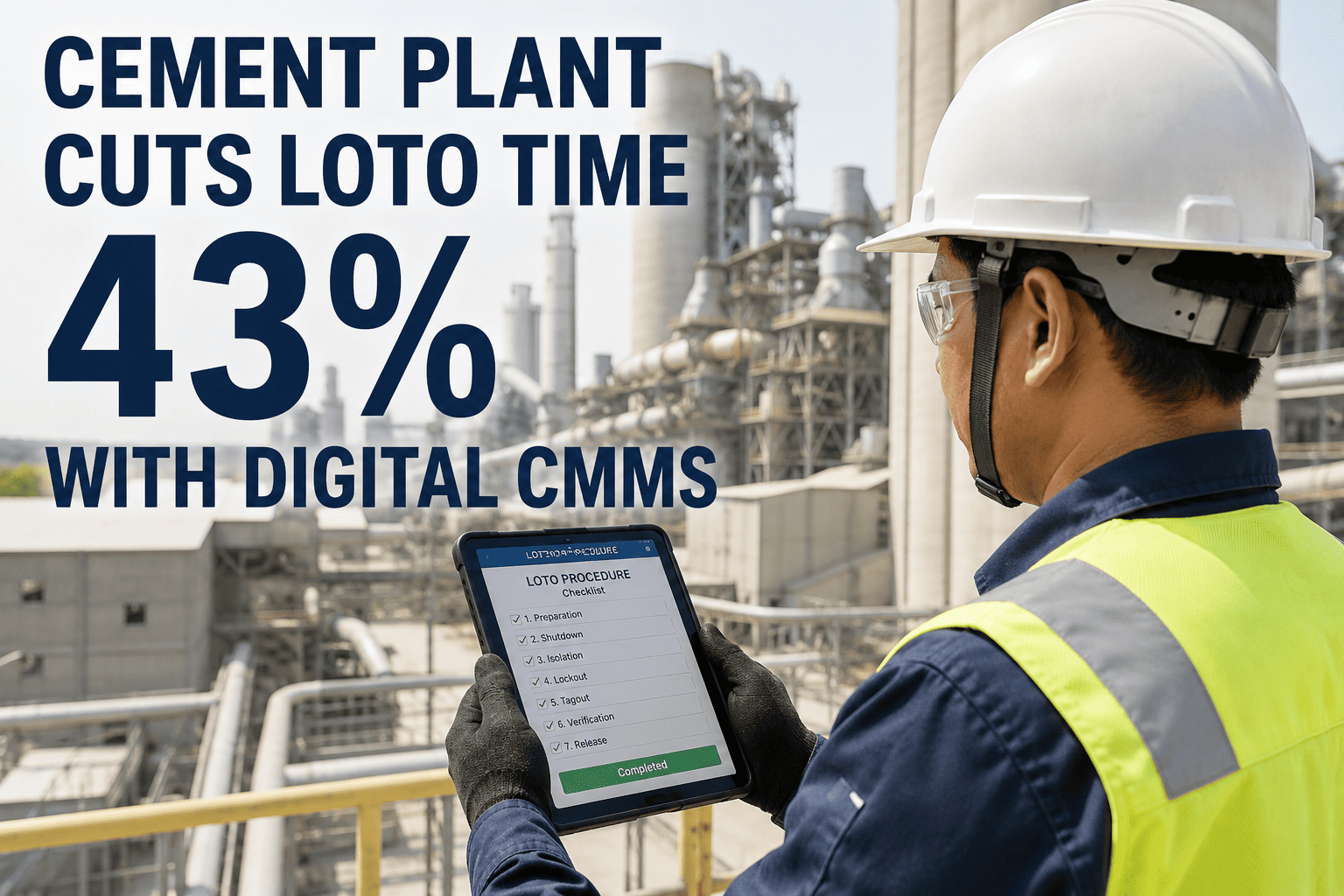
Your cement plant's best maintenance technician just retired — and 34 years of institutional knowledge about restarting the #3 boiler after a flame-out, aligning the VRM separator, and diagnosing girth gear vibration patterns walked out the door with him. His replacement will spend the next six months rediscovering through trial and error what the veteran knew intuitively — while mean time to repair climbs 45% and emergency callouts double. An AI maintenance chatbot integrated with your CMMS work order history and equipment manuals gives every technician on every shift instant access to that knowledge — through natural language conversation, right on the shop floor.
AI Maintenance Chatbot: Your Cement Plant Technicians' 24/7 Expert Colleague
Conversational AI that connects your SOPs, work order history, and equipment manuals into one instant-answer assistant — reducing MTTR, preserving tribal knowledge, and auto-generating work orders from natural language.
What Actually Slows Down Cement Plant Repairs
A rotary kiln girth gear repair targeting 6 hours runs to 14 hours — not because the technician lacks skill, but because 2 hours go to locating parts, 90 minutes to reviewing repair history on a desktop in the control room, and 45 minutes coordinating a specialist who could have been pre-assigned. Every delay compounds. An AI chatbot eliminates the information bottleneck that inflates every repair window.
How an AI Chatbot Changes the Repair Cycle
The difference is not just speed — it is the quality of information available at the point of need. A technician standing in front of a faulted kiln drive at 2 AM should not have to call a sleeping supervisor or flip through binder manuals in the control room.
See the chatbot answer real maintenance questions from your plant's own documentation and work order history.
Five Capabilities That Change How Technicians Work
An AI maintenance chatbot is not a generic search engine — it is a CMMS-integrated assistant trained on your plant's specific equipment, repair history, and procedures. Here is what it does on a cement plant shop floor.
Instant SOP and Manual Lookup
Technicians ask in natural language — "How do I replace the VRM roller assembly?" — and get the exact step-by-step procedure from your uploaded OEM manuals and SOPs. No flipping through binders. No searching shared drives. The chatbot returns the relevant section with diagrams, safety warnings, and the specific tools required.
Work Order History at the Point of Need
Ask "What were the last three repairs on Kiln Drive Motor #2?" and the chatbot pulls the complete work order history — parts used, time taken, technician notes, and root cause — directly from OxMaint. Diagnosis starts with context, not guesswork.
Voice-to-Work-Order Creation
Technicians speak their observations — "Bearing on Clinker Cooler Fan 3 showing high vibration, east side, needs replacement" — and the chatbot auto-generates a complete work order with asset code, fault description, parts list, and priority level. Admin time drops by 38% within six months of deployment.
AI-Guided Troubleshooting Sequences
When an error code appears, the chatbot does not just define it — it ranks the most probable causes based on your plant's actual repair data and guides the technician through the resolution sequence that has worked fastest on this specific asset in the past.
Knowledge Preservation on Autopilot
Every resolved work order, every technician note, every voice observation feeds back into the AI knowledge base. When the next senior technician retires, their institutional knowledge stays — structured, searchable, and available to every team member on every shift.
What Changes in the First 90 Days
AI chatbot deployment is not a multi-year transformation project. Cement plants typically see initial productivity gains within 2 to 4 weeks as technicians begin using the chatbot for documentation lookup and work order creation. Here is what the numbers look like across the first quarter.
| Metric | Before AI Chatbot | After 90 Days | Impact |
|---|---|---|---|
| Mean Time to Repair (MTTR) | 6 - 14 hrs average | 4.5 - 9 hrs average | 22% reduction |
| Documentation lookup time | 15 - 45 min per task | Under 30 seconds | 95% faster |
| Work order creation time | 12 - 20 min manual entry | 2 min voice-to-order | 85% reduction |
| New hire ramp-up period | 6 - 12 months | 3 - 4 months | 50% faster |
| First-time fix rate | 55 - 65% | 75 - 85% | 25% improvement |
Your CMMS already holds years of maintenance intelligence. OxMaint's AI chatbot extracts it, structures it, and makes it searchable — from your technicians' phones.
CMMS Integration — Not a Standalone Tool
An AI chatbot that cannot read your work orders, asset records, and inventory data is just a fancy search engine. OxMaint's chatbot sits inside your CMMS — it reads and writes to the same system your planners, supervisors, and technicians already use.
Equipment Manuals and SOPs
Upload OEM manuals, internal SOPs, and safety procedures. The chatbot indexes them and returns exact sections — with page references and diagrams — when technicians ask questions in plain language.
Work Order History
Every past repair, parts list, time log, and technician note is searchable through conversation. The chatbot surfaces the most relevant work orders for the specific asset and fault type being investigated.
Spare Parts Inventory
Ask "Do we have a bearing for Mill Fan 2 in stock?" and get an instant answer with location, quantity, and reorder status — without leaving the shop floor or calling the storeroom.
DCS, SCADA, and Sensor Data
OxMaint connects to existing plant control systems via OPC-UA, Modbus TCP, and REST API. The chatbot can reference live sensor readings alongside maintenance history to provide context-aware troubleshooting guidance.
Frequently Asked Questions
Give Every Technician a 24/7 Expert Colleague
OxMaint's AI chatbot turns your SOPs, work order history, and equipment manuals into an instant-answer assistant that lives on your technicians' phones — reducing repair time, preserving knowledge, and keeping your cement plant running.