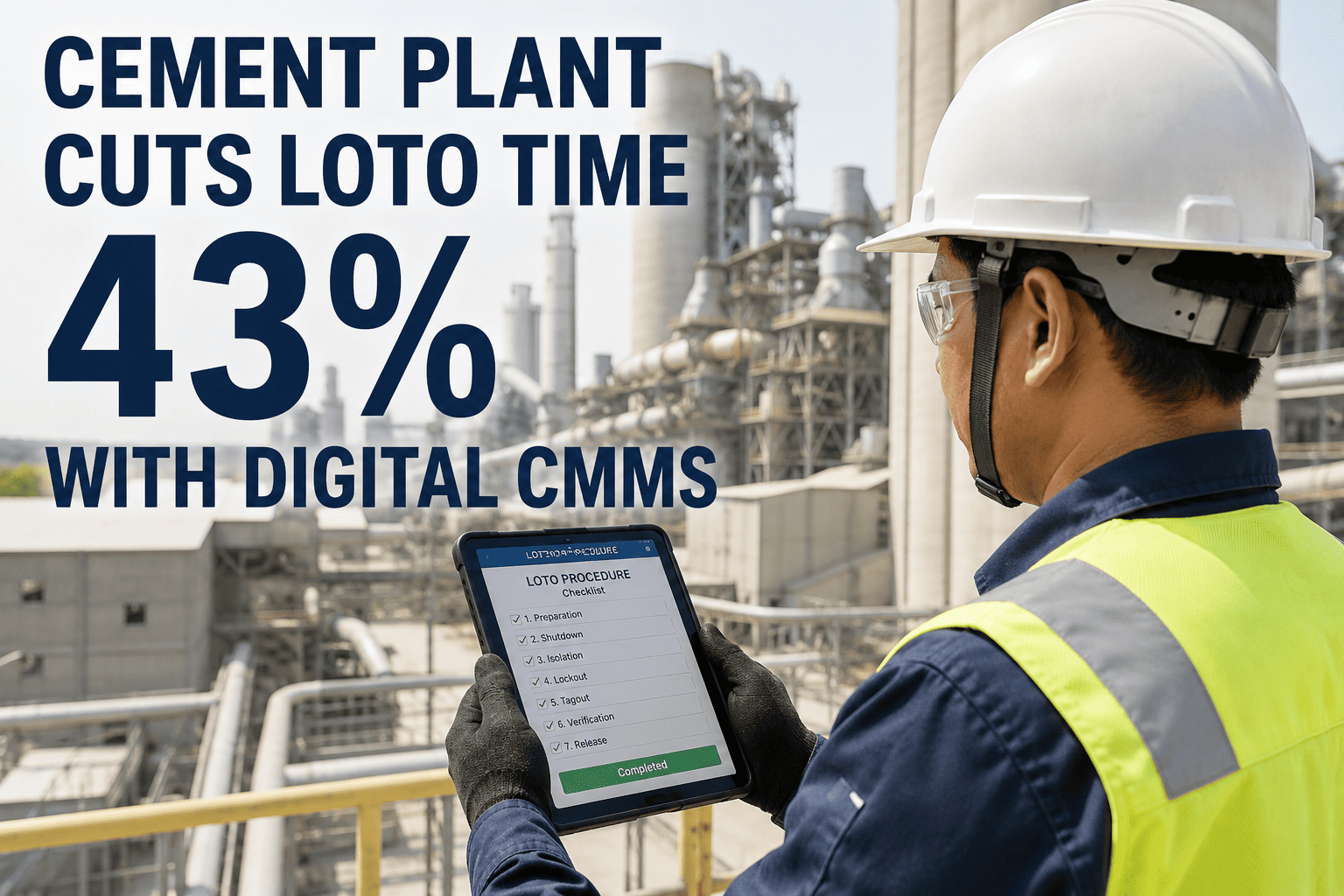
Ninety minutes. That's how long it took a maintenance crew at a 5,000 TPD integrated cement plant to isolate and de-isolate a single ball mill for routine service, start to finish, using paper tags and a control room log book. Multiply that across 40+ major isolations a month and the plant was losing hundreds of technician-hours a year to a process that added zero value beyond paperwork. Fourteen months after switching to a digital CMMS-driven LOTO workflow, that same cycle takes 51 minutes on average — a 43% reduction with no change to the underlying safety standard. Here's exactly how the isolation time disappeared, and what it looked like on the plant floor.
5,000 TPD
Integrated Plant Capacity
340
Maintenance & Ops Staff
1,850
Isolation Points Mapped
Before digitization, nobody on shift could say with confidence where the time was going — it just felt slow. A time-and-motion study during the plant's pre-implementation audit broke the paper-based cycle into its component parts, and the results reframed the whole project from a "safety upgrade" into an efficiency one.
Locating the current isolation procedure
18 min
Walking down and confirming each isolation point
27 min
Applying locks, tags, and logging manually
20 min
Verifying zero energy and try-start
15 min
Shift handover communication
10 min
Curious what your own isolation cycle time actually looks like broken down by step? A guided walkthrough shows you where your crew is losing minutes.
Before picking a platform, the maintenance and EHS teams evaluated three CMMS vendors against a short list of non-negotiables specific to a 1,850-point isolation program. Speed wasn't even on the original list — it showed up as a side effect once the other criteria were met.
01
Mobile-First Checklists
Technicians needed the current isolation procedure on their own device at the point of work, not a printed copy that could be out of date.
02
Work Order Integration
Isolation had to be tied directly to the job it supported, so a lock couldn't be cleared while the related work order was still open.
03
Offline Reliability
Signal is patchy inside a kiln shell and mill housing, so the workflow had to keep functioning without a live connection and sync later.
04
Group LOTO Support
The annual shutdown alone puts 90+ workers under lockout simultaneously, so the platform needed a group lockbox model, not just single-worker logic.
1
Months 1–3: Isolation Point Mapping
Every energy source on the kiln, mills, and conveyor network was walked down, photographed, and loaded into the CMMS against its asset record.
2
Months 4–6: Pilot on Kiln & Cement Mill
The two highest-complexity assets went digital first, running in parallel with the paper process to catch gaps before scaling up.
3
Months 7–10: Mobile Rollout Plant-Wide
Every technician moved to mobile checklists with photo-verified isolation steps, replacing the printed binder in the control room.
4
Months 11–14: Group LOTO & Shutdown Integration
The annual shutdown ran on the digital workflow for the first time, coordinating 90+ workers and confirming the time savings held at scale.
The real stress test wasn't a single technician isolating one mill — it was the plant's annual shutdown, where mechanical, electrical, instrumentation, and contractor crews all needed simultaneous access to interconnected equipment. This is where paper systems had failed hardest in the past, and where the time savings mattered most.
260+
Active Locks Tracked Live
31%
Faster Shutdown Isolation
See the same step-by-step breakdown applied to your own asset list before you commit to a rollout timeline.
At roughly 40 major isolations a month and a fully loaded technician rate, the 39-minute-per-cycle reduction translated into an estimated $180,000 in recovered maintenance labor annually — time redirected to backlog PM work instead of paperwork and searching for procedures.
$180K
Annual Labor Recovered
312 hrs
Technician Hours Freed Monthly
99%
Verified Step Completion
Nobody set out to save time — we set out to stop losing lock tags. The speed was the surprise. Our guys aren't hunting for a binder anymore, they're just working.
— Maintenance Manager
Does a faster LOTO cycle mean steps get skipped?
No — the digital checklist requires photo confirmation of every isolation point before advancing, so the process is faster because it's guided, not because it's shortened. Speed came from removing paperwork friction, not from removing steps. You can review the full step list on the
platform overview.
How long before a plant this size sees results?
This plant saw pilot-phase time savings within the first month on the kiln and cement mill, with full plant-wide results by month ten. Smaller sites with fewer isolation points typically see results sooner.
Did the crew resist moving off paper tags?
Some initial resistance is normal. Running the digital and paper systems in parallel during the pilot phase let technicians build confidence before the binder was retired, which is why adoption stayed high through rollout.
What's included in the isolation point mapping phase?
Every energy source per asset is walked down, photographed, and linked to the equipment record in the CMMS, creating the digital procedure library the mobile checklist pulls from during every future isolation.
Can this run alongside an existing work order system?
Yes. The LOTO workflow ties directly to the work order it supports, so isolation cannot be released while the linked job is still open. Book a walkthrough via
a live demo to see the integration.
See What 43% Faster Looks Like at Your Plant
Map your isolation points, pilot on your highest-risk asset, and measure the same kind of time recovery — without changing a single OSHA requirement.