A cement packaging line running 3,200 bags per hour has no human eye fast enough to catch a torn seam at bag 847, a low-fill at bag 1,203, and a broken handle at bag 2,991 — not reliably, not across an 18-hour shift. The defects ship. The customer calls. The replacement bags cost more than the original order. AI Vision cameras operating at line speed catch each of these in real time, flag the defect, stop or divert the bag, and raise a work order in the CMMS for the machine condition that caused it. This is not a future technology — cement plants running OxMaint's AI Vision for packaging line inspection are closing the loop between detected defects and corrective maintenance within the same shift. The result is fewer customer complaints, less material waste, and a packaging line that gets better over time because the equipment causing defects is tracked and fixed. Book a demo to see AI Vision defect detection on a cement packaging line.
AI Quality Defect Detection in Cement Packaging
At 3,200 bags per hour, human inspection misses what AI Vision catches every time. OxMaint's AI Vision detects packaging defects at line speed, raises maintenance work orders for the root-cause equipment, and closes the loop between quality and maintenance — automatically.
What AI Vision Detects on a Cement Packaging Line
Modern cement packaging defects fall into three categories — bag integrity failures, fill accuracy issues, and print and label errors. AI Vision cameras cover all three simultaneously at line speed, inspecting 100% of output rather than the 2-5% that sampling programmes typically cover.
Every Defect Is Evidence of an Equipment Problem. Are You Tracking Both?
OxMaint's AI Vision raises a maintenance work order automatically when a defect pattern points to a specific machine condition — so quality data drives preventive maintenance, not just rejection counts.
How AI Vision Closes the Loop with Maintenance
Defect detection without maintenance integration just produces rejection logs. OxMaint connects AI Vision findings directly to work order management — so the equipment causing defects gets fixed, not just counted.
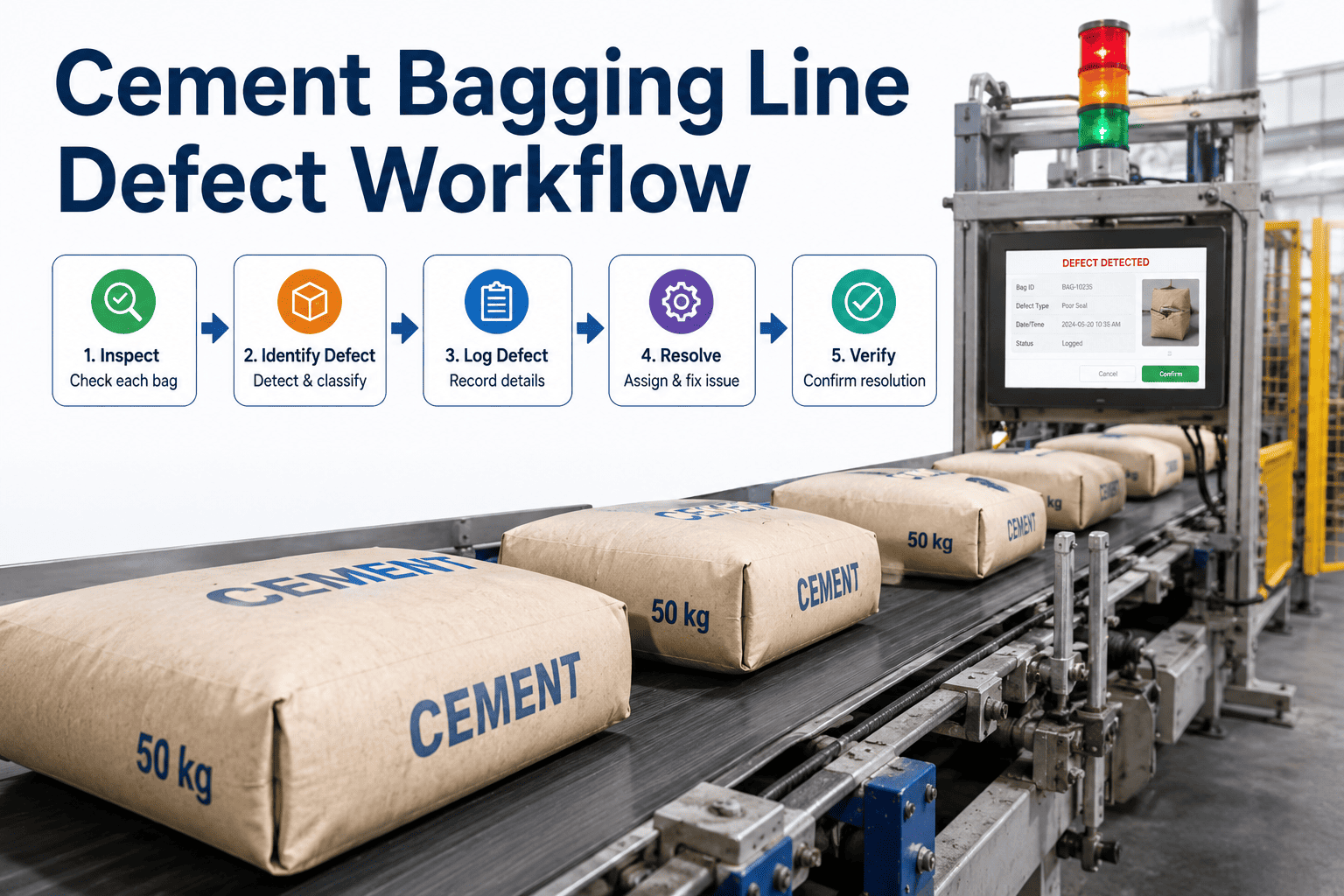
Camera inspects every bag at line speed. A torn seam, low-fill shape, or print anomaly is identified in under 50 milliseconds. The bag is flagged, diverted, or rejected automatically — without stopping the line.
OxMaint tracks defect frequency, type, and location on the line. When a pattern emerges — 14 torn valve seams in one hour from the same packer head — the system identifies the probable equipment root cause.
A maintenance work order is raised automatically for the linked asset — the packer head, weigher, or label applicator — with the defect evidence attached. No manual handoff between quality and maintenance teams.
Maintenance technician receives the work order on mobile with defect images and machine history. Corrective action is completed, logged, and tied back to the AI Vision defect trend — confirming the fix worked.
Because each defect trend now drives a maintenance action, equipment causing repeat defects is corrected faster. Over weeks, the overall defect rate drops — not because inspection got better, but because the machines got better.
Packaging Equipment That AI Vision Monitors and OxMaint Maintains
| Equipment | Defect Types Linked | OxMaint PM Interval | AI Vision Trigger |
|---|---|---|---|
| Rotary packer heads | Torn valves, underfill, seam failures | Every 50,000 bags | Defect rate above 0.3% |
| Impeller and fill nozzles | Overfill, dust contamination, shape error | Monthly inspection | Fill shape anomaly cluster |
| Bag applicator and spout | Misaligned bags, broken handles | Weekly check | Handle tear pattern on one head |
| Print and coding system | Faded print, missing batch codes | Daily ink check, monthly head clean | Print legibility failure rate above 0.5% |
| Label applicator | Misaligned labels, BIS mark errors | Weekly alignment check | Label position deviation trend |
| Discharge conveyor | Crushed bags, surface damage | Monthly belt and roller check | Impact damage pattern at fixed point |
Frequently Asked Questions
Stop Sampling. Start Inspecting Every Bag, Every Shift, Automatically.
OxMaint AI Vision detects torn seams, broken bags, fill errors, and print defects at line speed — then automatically raises maintenance work orders for the equipment causing them. Better quality and better maintenance, from the same system.