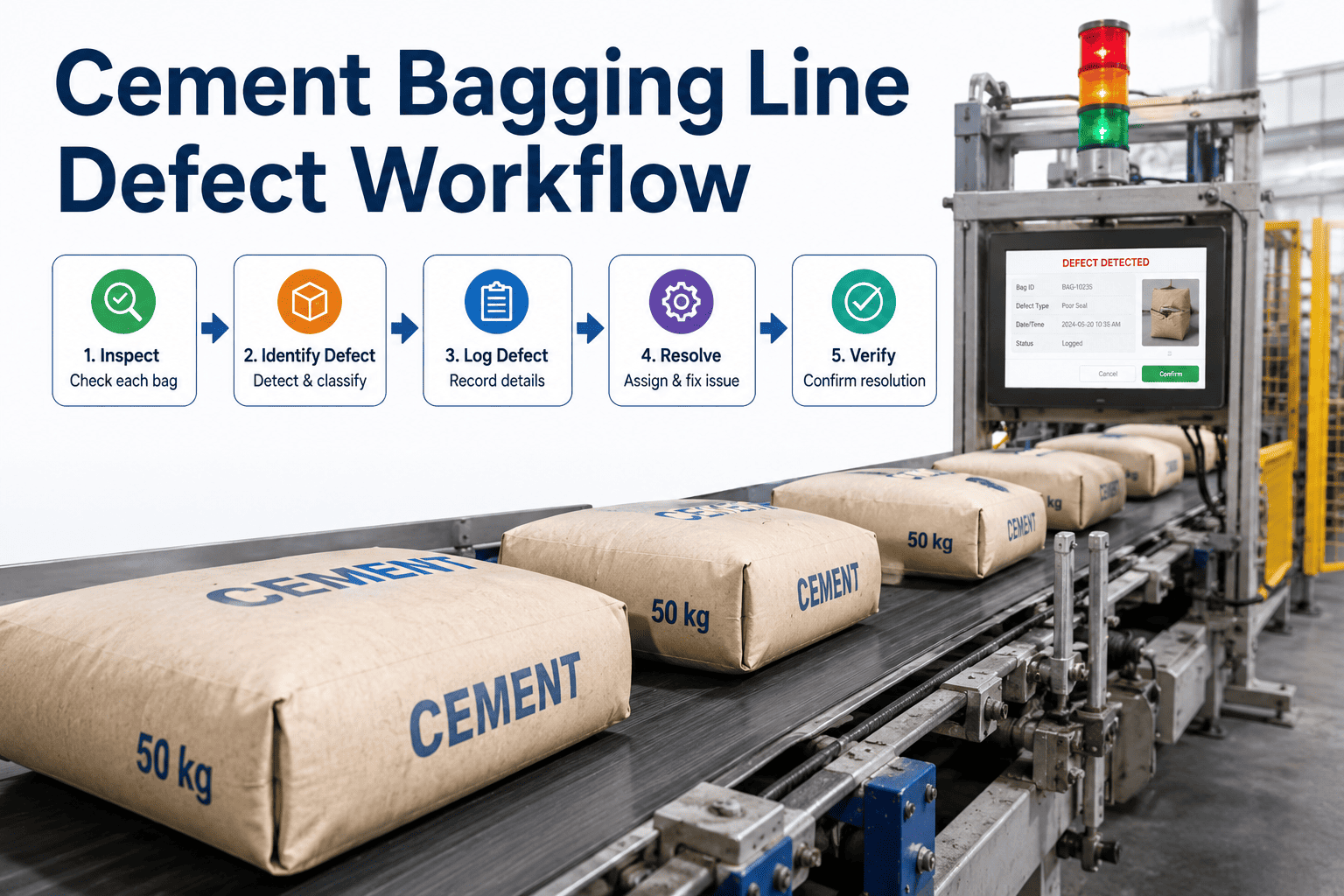
Cement Bagging Line Defect Workflow

By Johnson on June 16, 2026

cement-bagging-line-defect-workflow

A broken bag at the packer spout wastes 50 kg of cement and contaminates the conveyor in under 60 seconds. A weight error not caught before truck loading triggers a customer complaint, a return shipment, and a regulatory weight compliance review. A dust leak at a bag sealing station accumulates over weeks until filter bags saturate and a full line shutdown becomes unavoidable. Cement bagging defects are not random events — they follow patterns that repeat shift after shift when no structured corrective workflow exists. OxMaint's Bagging Line Defect Workflow converts every broken bag, weight error, dust leak, and line jam into a tracked corrective maintenance work order — with root cause, repair action, and recurrence prevention built into the workflow. Book a demo to see bagging defect workflows in OxMaint.

Work Order Management · Packing & Dispatch · OxMaint

Cement Bagging Line Defect Workflow — From Fault Detection to Corrective Action

Broken bags. Weight deviations. Dust leaks. Line jams. Every bagging defect becomes a structured corrective work order — tracked, resolved, and prevented from recurring.

Bagging Line Defect Types

Broken / Burst Bags
34%

Weight Errors (>±0.5 kg)
27%

Dust Leaks at Sealing
21%

Conveyor / Line Jams
18%
50 kg
Cement wasted per burst bag event — plus conveyor contamination cleanup adding 30–90 min of downtime
3–8%
Weight error rate in plants relying on manual spot checks without automated defect logging
72%
Bagging defects caused by repeat equipment faults not resolved at root cause — recurring across shifts
6 hrs
Average line downtime when a dust leak escalates to filter bag saturation due to delayed corrective action
Workflow Design

How OxMaint Converts Bagging Defects into Corrective Work Orders

1
Defect Detection and Logging
Operator detects a bagging defect — broken bag, weight alarm, dust cloud at sealing station, or conveyor jam — and opens a defect report in OxMaint mobile app in under 60 seconds. Defect type selected from predefined categories. Photo of the defect attached at point of detection. Timestamp, shift, and packer unit auto-captured.
→
2
Automatic Work Order Generation
OxMaint creates a corrective maintenance work order automatically from the defect report. Work order assigned to the appropriate maintenance technician or team based on defect type and equipment. Priority set based on defect severity — a line-stopping jam generates a high-priority work order, a minor weight deviation generates a standard-priority task.
→
3
Root Cause and Repair Documentation
Technician documents root cause before closing the work order — worn spout rubber, feeder calibration drift, torn dust seal, or jammed bag conveyor flight. Repair action recorded with parts used. Work order cannot be closed without root cause entry, creating a mandatory structured corrective workflow for every defect.
→
4
Recurrence Prevention Trigger
If the same defect type occurs on the same equipment more than twice in 30 days, OxMaint triggers a recurrence prevention task assigned to the reliability engineer. Root cause history from all prior work orders attached to the prevention task — giving the engineer full context to design a permanent fix rather than another reactive repair.

Turn Every Bagging Defect Into a Closed-Loop Corrective Action

Detect, log, assign, repair, prevent — the complete bagging defect workflow in OxMaint. No defect goes unresolved or untracked.

Defect Breakdown

Four Bagging Defect Types — What Causes Them and How OxMaint Tracks Them

Broken / Burst Bags
Root Causes: Worn spout rubber, excessive fill pressure, incorrect bag material for cement grade, conveyor impact damage after filling
OxMaint tracks burst bag events per spout, flags spouts exceeding 3 burst bags per shift, and triggers spout rubber inspection work order. Burst bag rate trended per packer to identify equipment requiring mechanical overhaul.
Weight Errors
Root Causes: Feeder load cell calibration drift, air purge system blockage affecting fill speed, screw feeder wear causing inconsistent feed rate
OxMaint logs weight deviation magnitude per event and trends deviation over time per packer. When average deviation exceeds ±0.3 kg for 20 consecutive bags, a calibration work order is auto-generated before regulatory threshold is breached.
Dust Leaks
Root Causes: Worn bag sealing clamps, torn dust collection hoods, cracked spout body, inadequate negative pressure at filling station
OxMaint captures dust leak defect reports with photo evidence and links them to equipment components. Dust leak frequency per station tracked — stations with weekly recurrence flagged for seal replacement scheduled in next maintenance window.
Line Jams
Root Causes: Bag conveyor flight wear, bag saddle sensor misalignment, downstream palletizer miscount, filled bag belt speed mismatch
OxMaint logs jam events with location — filling station, bag conveyor, or palletizer infeed — and duration. Jam frequency per location trended weekly. High-frequency jam locations prioritized for equipment inspection in planned maintenance schedule.
FAQ

Bagging Line Defect Workflow — Common Questions

Can OxMaint track bagging defects across multiple packer lines in a single plant?
Yes — OxMaint creates separate asset records for each packer and bagging line. Defect work orders are assigned to the specific packer unit, allowing defect rate comparison across lines. Plants with 4–8 packer spouts can track per-spout defect frequency to identify which spouts need overhaul priority. Sign in to configure multi-packer defect tracking in OxMaint.
How does OxMaint ensure technicians document root cause before closing a work order?
OxMaint enforces mandatory root cause field completion as a work order closure requirement. Technicians cannot change work order status to "Completed" without selecting a root cause category and entering repair details. This creates a complete corrective action record for every defect without relying on discipline. Book a demo to see mandatory root cause enforcement in OxMaint.
Can production supervisors view bagging defect trends in real time during shifts?
Yes — OxMaint's supervisor dashboard shows defect work orders by status, equipment, and shift in real time. Production supervisors can see active defect work orders, time since defect was reported, and technician assignment status — enabling proactive escalation before a minor defect causes a line shutdown. Sign in to access the bagging defect supervisor dashboard in OxMaint.
Does OxMaint integrate with packer PLC systems to auto-generate defect reports from alarms?
OxMaint supports API-based integration with packer control systems where available. When a PLC weight alarm or jam fault triggers, OxMaint can auto-create a defect work order. For plants without PLC integration, operator logging via mobile app achieves the same structured workflow. Book a demo to discuss PLC integration options for your packer lines.
How quickly can a plant configure the bagging defect workflow in OxMaint?
A basic bagging defect workflow — defect categories, work order templates, and equipment asset structure — can be configured in one day. Adding recurrence prevention triggers and supervisor dashboards typically requires one additional configuration session. Most plants complete their first defect work order within the first week of go-live. Sign in to start your bagging defect workflow setup in OxMaint.

End Repeat Bagging Defects — Build Closed-Loop Corrective Workflows in OxMaint

Defect logging · Auto work order creation · Mandatory root cause documentation · Recurrence prevention triggers. Every bagging fault tracked from detection to permanent resolution.


Share This Story, Choose Your Platform!