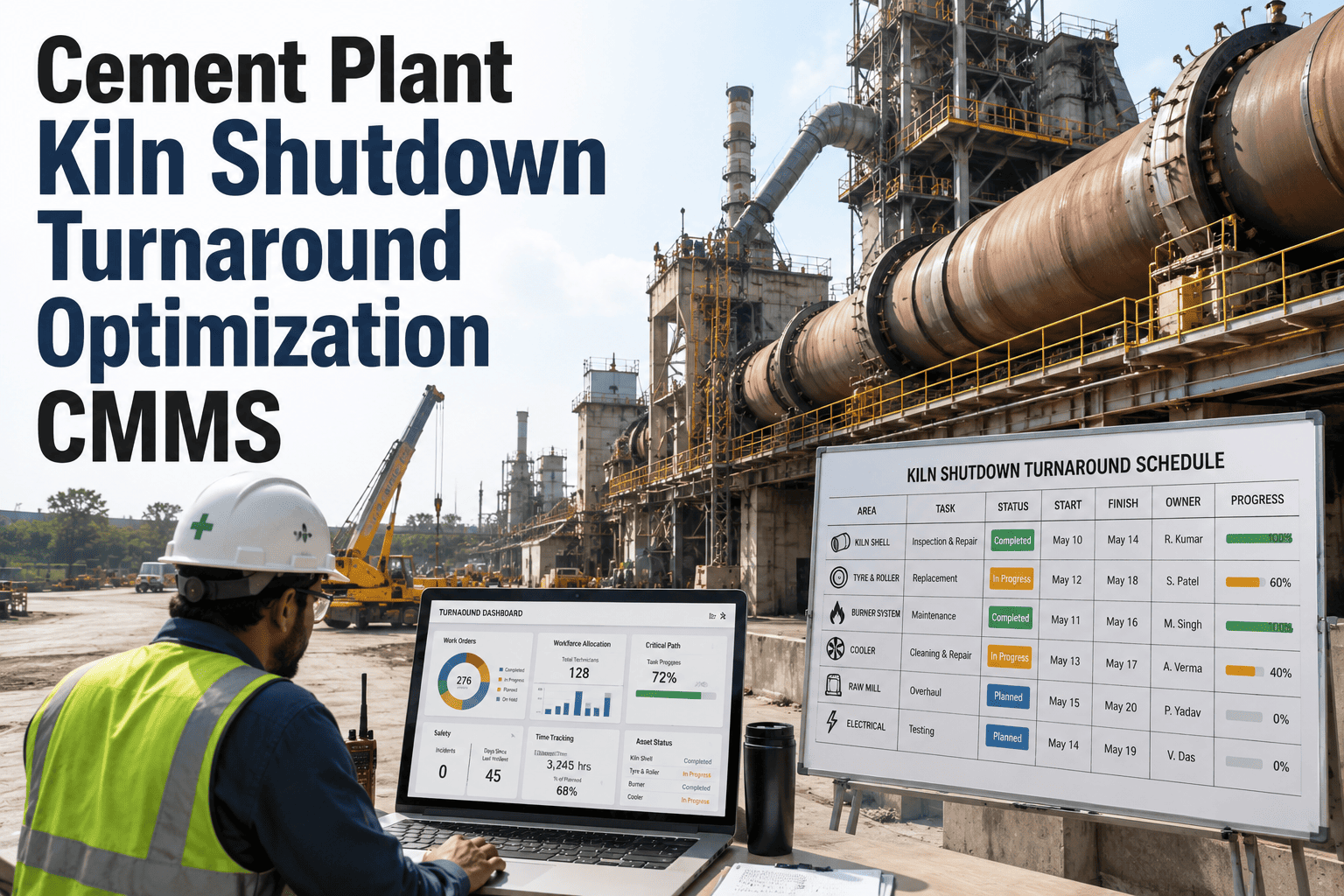
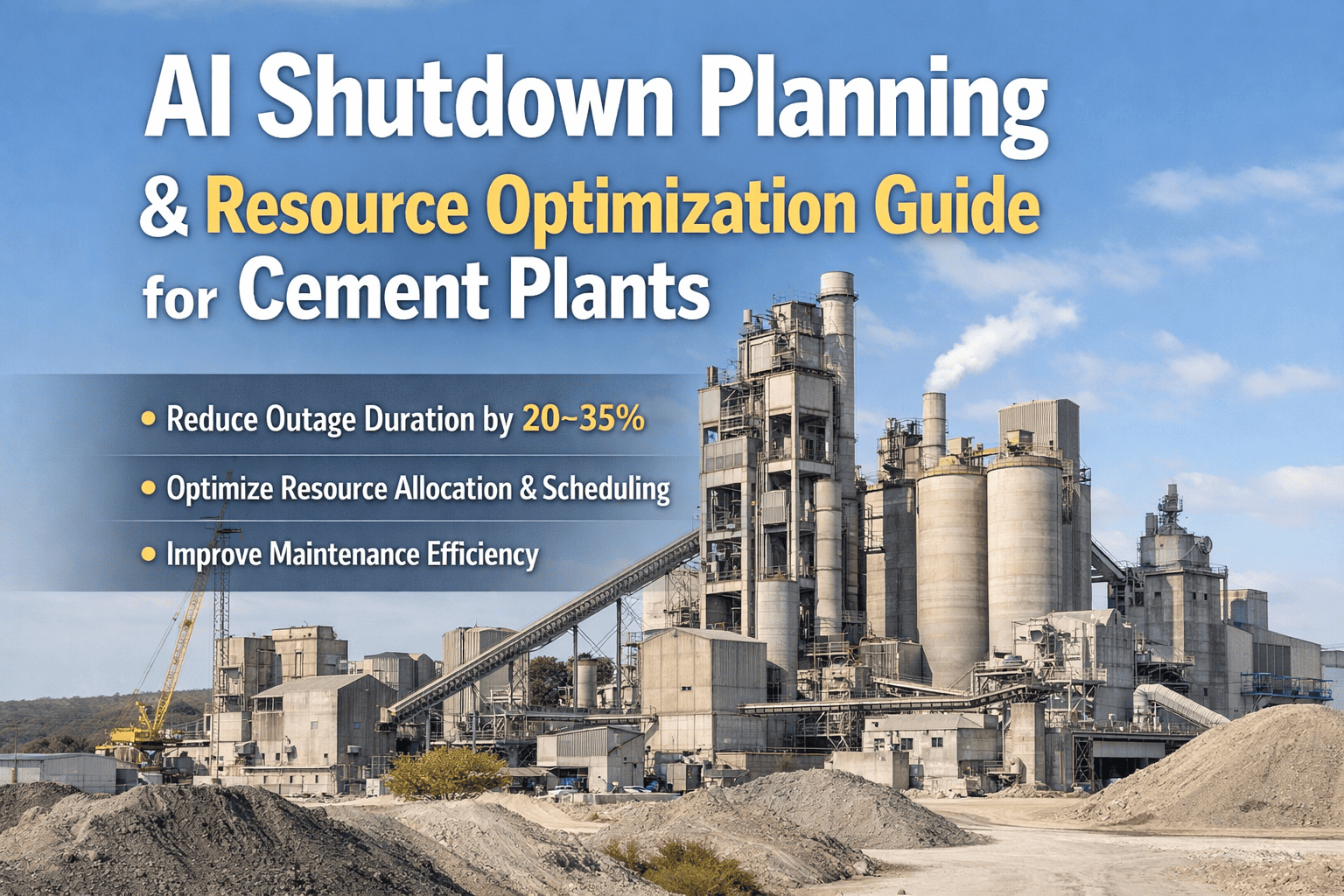
Cement plant shutdowns cost between $500,000 and $2 million per event, yet 20–40% of planned tasks are unnecessary or could be deferred. Traditional scope planning relies on fixed schedules and manual checklists, leading to bloated work lists that drain budgets and extend downtime. AI-powered shutdown scope optimization uses machine learning to analyze equipment health data, failure probabilities, and remaining useful life—eliminating low-priority tasks while protecting critical assets. Plants using predictive scope planning reduce turnaround costs by 25–35% and cut shutdown duration by 15–20%, turning maintenance from a cost center into a strategic advantage.
The Hidden Cost of Bloated Shutdown Scopes
Most cement plants plan shutdowns using calendar-based intervals—annual kiln inspections, biennial crusher overhauls, quarterly conveyor replacements. This approach generates massive work lists because it assumes all equipment degrades at the same rate.
Over-Maintenance Waste
23–38% of scheduled tasks target equipment still in good condition
Extended Downtime
Unnecessary tasks add 2–4 days to typical 10-day shutdowns
Resource Strain
Inflated scopes require 30–50% more contractors and parts
A 5,000 TPD cement plant typically schedules 380–520 tasks per major shutdown. Analysis of CMMS data shows that 140–190 of these tasks could be safely deferred or eliminated based on actual equipment condition.
How AI Optimizes Shutdown Scopes
Machine learning models ingest data from CMMS work orders, vibration sensors, thermal cameras, oil analysis, and operator logs to calculate real-time equipment risk scores. Tasks are dynamically prioritized based on failure probability and business impact.
Data Aggregation
System pulls 12–24 months of maintenance history, sensor readings, and runtime data for all critical assets
Health Scoring
AI models assign 0–100 health scores using vibration trends, temperature anomalies, wear patterns, and failure histories
Risk Calculation
Each asset receives a risk rating combining failure probability, consequence severity, and remaining useful life
Scope Generation
Tasks are auto-ranked by risk score—high-risk items become mandatory, low-risk items are deferred or eliminated
Reduce Your Next Shutdown Scope by 30%
OxMaint's AI scope optimizer analyzes your CMMS data and equipment sensors to generate risk-based task lists. Plants achieve 25–35% cost reduction and 15–20% shorter shutdowns.
Traditional vs AI-Driven Scope Planning
| Criteria | Calendar-Based Planning | AI Scope Optimization |
|---|---|---|
| Task Selection | Fixed intervals (every 6/12/24 months) | Dynamic based on equipment health & risk |
| Scope Accuracy | 60–75% of tasks actually needed | 92–97% of tasks justified by condition data |
| Planning Time | 3–5 weeks for maintenance team | 2–3 days with automated recommendations |
| Cost Predictability | ±25% variance from budget | ±8% variance with ML forecasting |
| Deferral Decisions | Subjective, based on planner experience | Data-driven with failure probability models |
| Asset Prioritization | All critical assets treated equally | Risk-weighted based on impact & likelihood |
The Risk-Based Scope Reduction Framework
AI systems categorize every potential shutdown task into four priority tiers using a matrix of failure probability and consequence severity.
Critical Priority
Risk Score: 80–100
Execute immediately—high failure probability with severe safety or production impact
- Kiln shell repairs showing thermal expansion
- Gearbox oil analysis indicating bearing wear
- Conveyor systems with vibration beyond alarm limits
High Priority
Risk Score: 60–79
Include in shutdown—moderate failure risk or moderate impact if deferred
- Crusher liners at 70% wear threshold
- Dust collector bags with pressure drop trends
- Pump seal replacements based on leak rates
Medium Priority
Risk Score: 35–59
Defer to next shutdown—low failure probability or minor impact
- Routine bearing lubrication on healthy motors
- Visual inspections of non-critical supports
- Belt alignments showing acceptable tracking
Low Priority
Risk Score: 0–34
Eliminate from scope—equipment in good health with low business impact
- Calendar-driven rebuilds of recently serviced units
- Preventive parts replacement on new assets
- Redundant inspections with clean sensor data
Real-World Scope Optimization Results
Case Study: 4,200 TPD Dry Process Plant
Southeast Asian cement manufacturer, 6-month shutdown cycle
Tasks reduced by 37% using AI risk scoring
Direct shutdown costs decreased 35%
Shutdown duration cut by 23%
Equipment failures in 18 months post-optimization
Key Interventions
- Deferred 118 tasks identified as low-risk by vibration analysis and oil testing
- Eliminated 56 tasks targeting equipment replaced in prior 12 months
- Accelerated 23 tasks on degrading assets not yet on shutdown list
- Consolidated 34 tasks into multi-skilled job packages reducing contractor overlap
Calculate Your Shutdown Savings Potential
Connect OxMaint to your CMMS and get a scope optimization report in 48 hours. See exactly which tasks are low-risk and how much you can save on your next turnaround.
Machine Learning Models Behind Scope Optimization
The AI engine uses three core algorithms to transform maintenance data into actionable scope recommendations:
Survival Analysis Models
Predicts remaining useful life using Weibull distributions and Cox proportional hazards models. Ingests failure histories, operating hours, and stress cycles to calculate time-to-failure probabilities.
Anomaly Detection Algorithms
Identifies deviations from normal operating patterns using isolation forests and autoencoders. Flags equipment exhibiting abnormal vibration, temperature, or power consumption trends.
Impact Scoring Frameworks
Quantifies business consequence using production loss models, safety risk matrices, and spare parts lead times. Assigns weighted criticality scores to prioritize high-impact assets.
Connecting AI to Your Existing Systems
Scope optimization works with any CMMS platform and common industrial sensors. No equipment replacement required—AI layers on top of existing infrastructure.
CMMS Integration
Pulls work order history, PM schedules, and asset hierarchies from SAP, Maximo, Fiix, or similar systems via API or CSV export
Sensor Data Streams
Connects to vibration monitors, thermal cameras, oil analyzers, and SCADA systems for real-time condition data
ERP & Inventory
Links to spare parts databases to factor lead times and stock availability into task prioritization
Output Formats
Generates shutdown scopes as CSV, Excel, or direct CMMS uploads with risk scores and justification notes
Frequently Asked Questions
How much historical data is needed to start scope optimization?
Minimum 6–12 months of CMMS work orders and 3–6 months of sensor data for critical assets. Models improve accuracy with 18–24 months of history. Start with existing records and refine predictions as more data accumulates over subsequent shutdown cycles.
Can AI handle unique or custom equipment not in standard databases?
Yes, the system learns failure patterns from your specific equipment using transfer learning. It adapts generic models to your plant's unique assets by analyzing your maintenance records. Custom equipment often shows the biggest savings because manual planning relies heavily on guesswork for non-standard items.
What if the AI recommends deferring a task that later causes a failure?
Models include confidence intervals and conservative buffers for high-consequence assets. Failure rates on AI-optimized scopes are 2–4% lower than calendar-based planning because risk scoring catches degrading equipment that fixed schedules miss. System flags borderline decisions for human review before finalization.
How long does it take to implement scope optimization for a plant?
Initial setup takes 1–2 weeks including CMMS integration and sensor connection. First AI-generated scope typically ready 2–3 weeks before planned shutdown. Full ROI realized within first optimized turnaround event as unnecessary tasks are eliminated and costs drop 25–35%.
Does this replace the maintenance planning team?
No, AI augments planners by handling data analysis and risk calculations. Planners retain final approval authority and add context AI cannot access (contractor availability, material constraints, strategic timing). Technology reduces planning time by 60–70%, letting teams focus on execution quality rather than spreadsheet management.
Transform Your Next Shutdown Into a Strategic Win
Stop overspending on unnecessary maintenance tasks. OxMaint's AI scope optimizer delivers data-driven shutdown plans that cut costs by 25–35% while protecting asset reliability. Join cement plants worldwide that have eliminated millions in wasted turnaround spend.