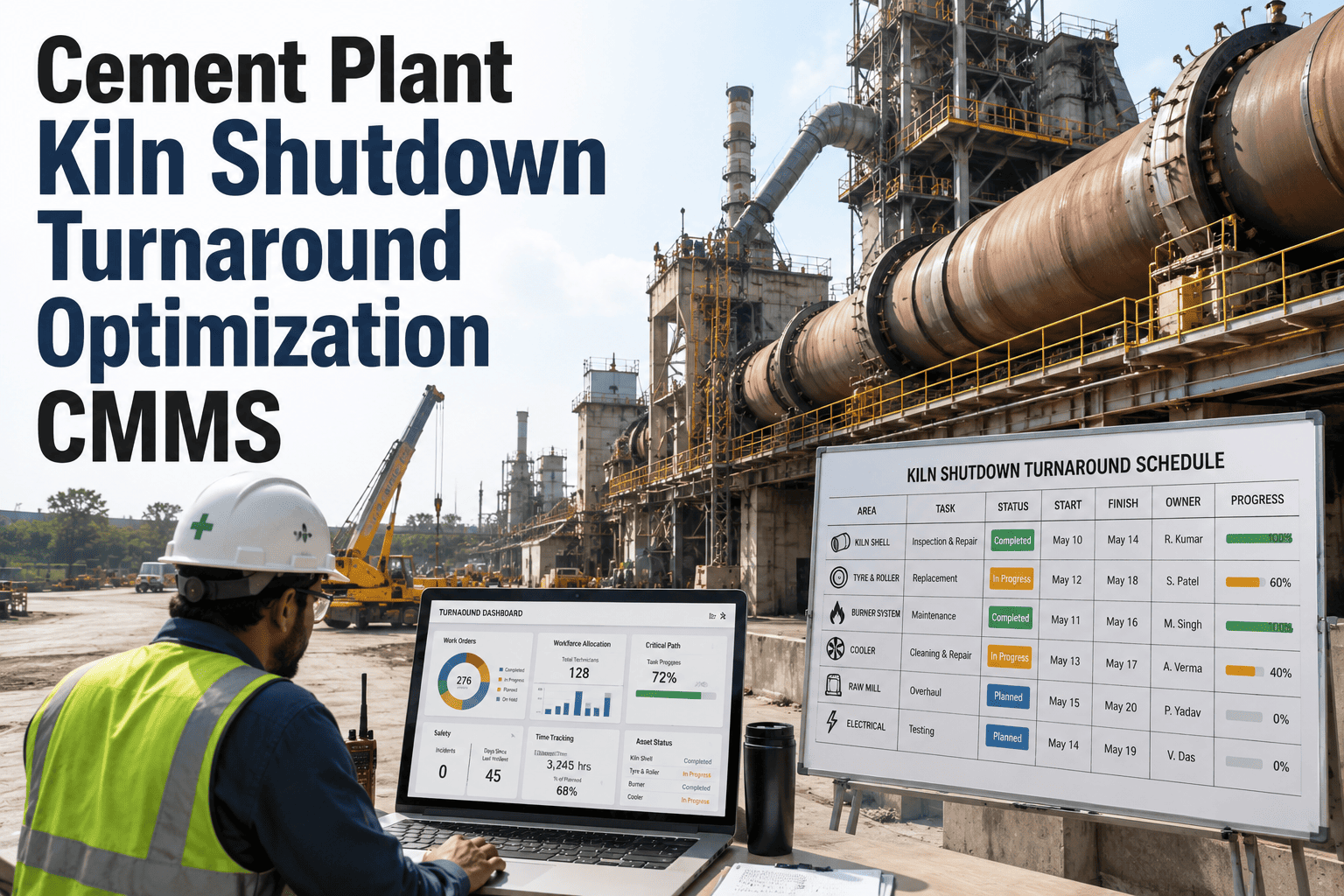
Cement plant turnarounds that run over schedule or over budget are not bad luck — they are the predictable outcome of planning with incomplete information. AI shutdown planning engines analyze work scope, contractor availability, spare part lead times, and historical task durations simultaneously — cutting average turnaround overruns by 40% and reducing contractor idle time by over 30%.
AI Shutdown Planning for Cement Plants: Smarter Turnarounds, Lower Costs
How AI-driven scheduling engines are transforming cement plant turnaround planning — optimizing work scope sequencing, contractor deployment, and spare part timelines to deliver shutdowns that finish on time and on budget.
The Shutdown Planning Gap in Cement Plants
A cement plant major shutdown involves 800 to 2,000 work orders, 30 to 80 contractors, and 400 to 1,200 spare parts — all coordinated across a compressed 10 to 21-day window. The planning variables are too interdependent for spreadsheets to optimize. A delay in one critical path task cascades across 15 dependent activities. A spare part that arrives two days late stops a crew for half a shift. AI removes the guesswork by modeling all interdependencies simultaneously and recommending the schedule that minimizes total risk.
Scope Underestimation
72% of cement turnarounds discover additional work scope after shutdown begins — typically refractory damage, bearing wear, or gearbox deterioration not visible during operation. AI pre-analysis of inspection history and predictive models surfaces scope additions before shutdown day.
Resource Conflicts
Contractor crews and specialist tradespeople are finite. Manual scheduling regularly creates situations where three tasks need the same crane, the same welder, or the same refractory crew at the same time. AI scheduling detects and resolves these conflicts before they become delays.
Spare Part Timing
The most common cause of shutdown overruns in cement plants is not labor — it is a part that arrives late. AI scheduling integrates supplier lead times into the critical path, flagging procurement risk weeks before shutdown and suggesting alternatives when standard lead times are incompatible with shutdown windows.
What an AI Shutdown Planning Engine Actually Does
AI shutdown planning is not a smarter spreadsheet. It is a constraint-satisfaction and optimization engine that simultaneously balances work scope, resource availability, part timelines, equipment criticality, and historical task duration data to generate an executable schedule — and updates it dynamically as conditions change during the shutdown itself.
Work Scope Ingestion
AI pulls work orders from CMMS, classifies tasks by equipment type, criticality, and skill requirement, and identifies dependencies between tasks that must be sequenced. Historical completion times from past shutdowns calibrate duration estimates.
Resource Mapping
Contractor availability windows, crew sizes, and specialist certifications are mapped against task requirements. AI identifies over-allocation conflicts days ahead and proposes resequencing or crew additions to resolve them.
Parts Timeline Integration
Each work order's required spare parts are matched against inventory and supplier lead times. Tasks dependent on late-arriving parts are flagged as schedule risk. Procurement is triggered automatically for items not yet on order.
Critical Path Optimization
AI generates the optimized shutdown schedule with full critical path identification — showing exactly which tasks, if delayed, will extend total shutdown duration. Every task's float is visible, so supervisors know where buffer exists and where it does not.
Live Execution Tracking
During the shutdown, actual task completion times update the AI model in real time. When a task runs over, the engine immediately recalculates downstream impact and recommends resequencing to recover the schedule.
AI Shutdown Planning Outcomes in Cement Operations
Across cement plants that have deployed AI-driven turnaround planning, the performance improvements are consistent — and the financial impact is significant given the cost of every additional day of shutdown.
Stop Planning Your Turnaround in a Spreadsheet
Oxmaint's AI shutdown planning module connects your work orders, contractor roster, and spare parts inventory into a single optimized schedule — updated dynamically as your shutdown progresses. Cement plants using it consistently finish 1–3 days ahead of spreadsheet-based plans.
Traditional Shutdown Planning vs AI-Optimized Planning
The difference between traditional and AI-driven shutdown planning is not just speed — it is the quality of decisions that get made during the high-pressure pre-shutdown and execution phases.
| Planning Dimension | Traditional Planning | AI-Optimized Planning |
|---|---|---|
| Scope Discovery | Gaps found on shutdown day | Gaps surfaced 4–6 weeks ahead |
| Resource Conflicts | Resolved manually during execution | Detected and resolved in pre-planning |
| Critical Path Visibility | Estimated by experienced planners | Calculated from actual task data |
| Spare Part Risk | Discovered when part does not arrive | Flagged 3–5 weeks before shutdown |
| Schedule Updates | Overnight replanning by schedulers | Real-time reoptimization as tasks complete |
| Historical Learning | Informal knowledge in planners' heads | Every shutdown improves the model |
Scroll right to see all columns
Contractor and Workforce Optimization During Cement Shutdowns
Contractor costs in major cement shutdowns typically represent 40–60% of total turnaround spend. AI resource optimization directly attacks this cost by eliminating idle time, preventing overtime caused by poor sequencing, and ensuring the right skills are deployed to the right tasks at the right time.
Skill-to-Task Matching
AI matches contractor certifications and specializations to work order requirements automatically. No more certified welders assigned to mechanical tasks because a supervisor made a quick call under pressure.
Shift Leveling
AI distributes work evenly across shifts to prevent the situation where Day 1 is overloaded and Day 5 has crews waiting for upstream tasks to complete. Smooth crew utilization reduces overtime and fatigue-related rework.
Equipment Access Sequencing
Scaffolding, cranes, and isolation systems are shared resources that create bottlenecks. AI sequences tasks to minimize simultaneous demand for the same equipment — reducing waiting time that does not show up in any work order but adds hours to shutdown duration.
Dynamic Reallocation
When a task finishes early or a scope addition emerges mid-shutdown, AI immediately identifies available crew capacity and recommends reallocation — keeping the critical path moving and idle crews productive.
Frequently Asked Questions
Optimal AI-assisted planning starts 10–12 weeks before a major shutdown. This allows enough time to surface scope gaps, trigger procurement for long-lead items, and confirm contractor availability. Oxmaint's planning module can be activated for any upcoming shutdown with existing work order data as the starting point.
Yes. Oxmaint integrates with major CMMS and ERP platforms via API and standard data export. Work orders, spare parts records, and contractor rosters can be imported directly — avoiding double data entry. Book a demo to discuss your specific integration and we will confirm compatibility before you commit to anything.
When new scope is added during execution, AI recalculates the full schedule in real time — showing impact on critical path, identifying which planned tasks can absorb the scope addition, and recommending resource reallocation. Supervisors see the updated plan within minutes, not the next morning. Start a free trial to see the live execution dashboard.
Major kiln overhauls with refractory replacement, large-scale mill maintenance windows, and multi-equipment campaign shutdowns benefit most — particularly where contractor headcount exceeds 50 and work order volume exceeds 500. Smaller shutdowns still benefit, but the ROI is clearest at scale. Discuss your shutdown profile with our team to get a realistic estimate.
No. AI augments planners by handling the computational optimization — constraint resolution, critical path calculation, risk flagging — that consumes most of a planner's time. Planners focus on judgment calls: scope prioritization, contractor relationships, safety decision-making. The role becomes more strategic and less administrative. See how Oxmaint works with your planning team in a free trial.
Your Next Cement Plant Shutdown Can Finish On Time and Under Budget
Oxmaint's AI shutdown planning module helps cement plants optimize work scope, contractor scheduling, and spare part timelines — turning complex turnarounds into executable plans that deliver. Start with your next shutdown and see the difference structured AI planning makes.