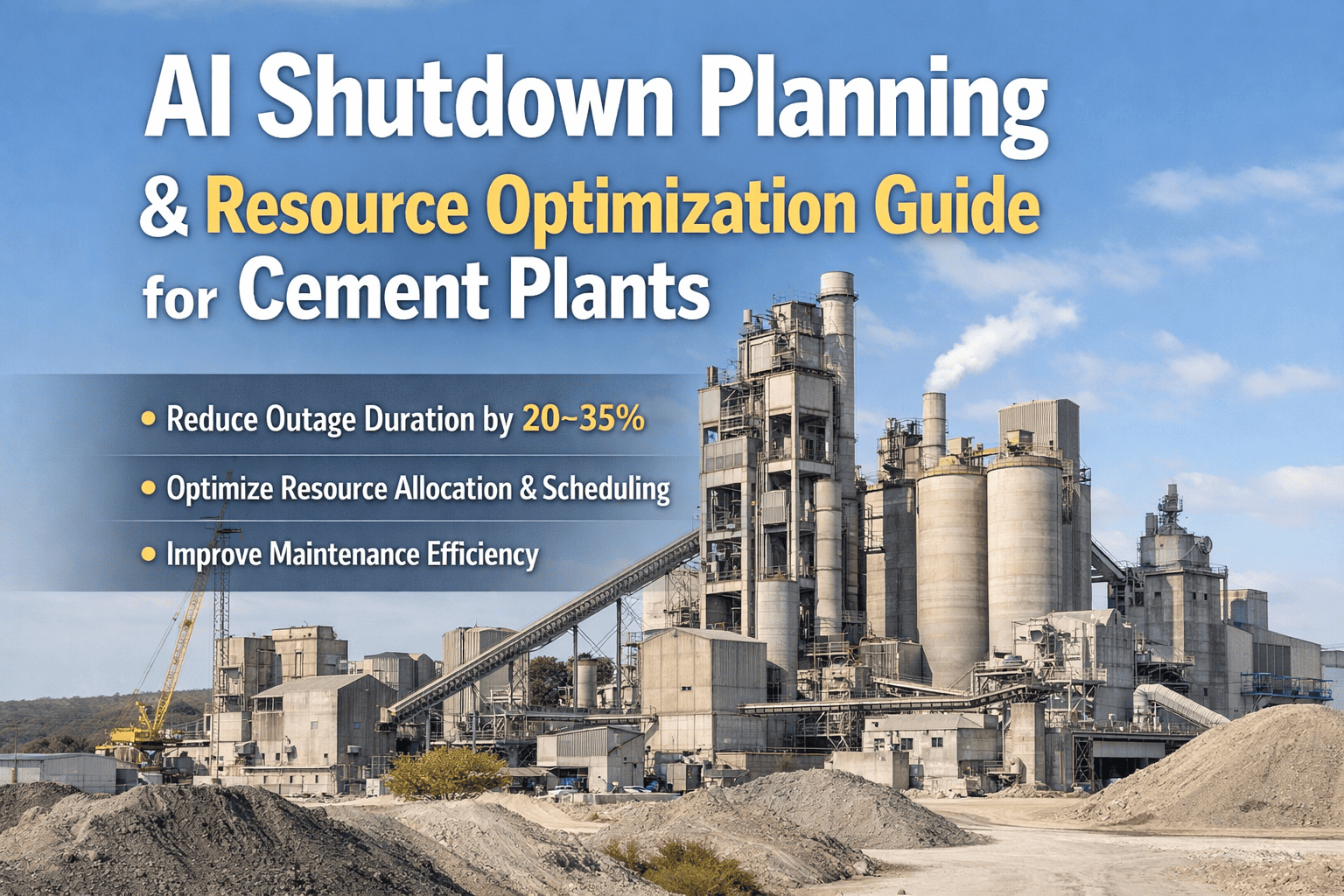
Every cement plant turnaround that runs on gut feeling and last year's scope list leaves money on the table — or worse, misses a kiln shell crack that surfaces three weeks after restart. AI shutdown scope optimization changes this by analyzing real equipment health signals, failure probability curves, and historical maintenance data to build a turnaround scope that is precise, defensible, and cost-efficient. Start building AI-driven shutdown scopes in Oxmaint free and stop padding turnarounds with work that does not reduce risk.
AI Guided Shutdown Scope Optimization for Cement Turnarounds
How AI failure risk modeling, equipment health analysis, and predictive data replace guesswork in cement plant turnaround scoping — cutting scope by 20–35% while improving reliability.
Why Traditional Shutdown Scoping Fails Cement Plants
Traditional cement plant turnaround scoping is driven by three forces: OEM calendar intervals, maintenance manager memory, and "we did it last time" logic. None of these factors reliably connect task selection to actual failure risk. The result is a scope that is simultaneously over-inclusive — full of tasks on equipment that has years of residual life — and under-inclusive — missing components showing early degradation that do not appear on any standard checklist.
The financial cost is direct. A 10-day cement kiln turnaround that runs two days over schedule due to scope creep costs $400,000–$600,000 in lost production alone. Padding scope with low-risk tasks is not conservative — it is expensive. Equally, a shutdown that misses a developing fault on the kiln thrust roller or preheater cyclone outlet drives an unplanned outage within 6 months at 3–5× the cost of the planned intervention.
Calendar-Based Padding
Tasks added because "it's been 18 months" with no assessment of whether the component actually needs intervention. Up to 40% of scope items in a typical turnaround have no data-supported justification.
Missing Degradation Signals
Vibration trends, thermography findings, and oil analysis results that exist in scattered systems but are never consolidated into the scope-building process. Faults are missed because data is siloed.
No Risk Prioritization
All scope items treated with equal urgency. A lubrication check on a non-critical conveyor gets the same attention as kiln shell inspection. Resources are misallocated and critical work gets rushed.
Scope Creep During Shutdown
Without a defensible scope baseline, every finding during the outage triggers "while we're in here" additions. AI-scoped shutdowns reduce in-outage scope additions by 50–60% because more is found before entry.
The Four-Layer AI Shutdown Scope Engine
AI shutdown scope optimization is not a single algorithm — it is a layered analytical process that aggregates condition monitoring data, maintenance history, failure mode libraries, and production criticality into a ranked, justified scope recommendation. Each layer adds a dimension of intelligence that no single engineer or spreadsheet can replicate at scale across hundreds of cement plant assets.
Equipment Health Scoring
AI continuously scores each asset — kiln, mill, fans, conveyors, crushers — against its health baseline using vibration data, thermal imaging, lube analysis, and operating parameter trends. Assets below the health threshold enter the shutdown scope automatically. Assets above threshold with no degradation signals are flagged for scope removal review.
Failure Probability Modeling
For each asset, AI calculates the probability of failure before the next planned outage window based on degradation rate, historical mean time between failures for similar equipment at similar operating hours, and failure mode patterns. Assets with failure probability above the defined threshold (typically 15–25%) enter the mandatory scope tier.
Consequence and Criticality Weighting
Failure probability alone is not enough — a fan on a bypass line failing has a different consequence than the main kiln ID fan failing. AI weights each risk score by asset criticality: production impact, safety consequence, and lead time for parts or specialist resources. High-consequence assets enter scope at lower probability thresholds than low-consequence assets.
Historical Scope Intelligence
AI mines previous turnaround records — what was found, what was missed, which tasks delivered reliability gains, which were repeated unnecessarily — to refine scope recommendations. Plants that run 3+ turnarounds through the AI scope engine see progressive improvement in scope accuracy as the model learns fleet-specific failure patterns.
AI Shutdown Scope Recommendations by Cement Plant Equipment Type
Different cement plant equipment types generate different data signals and require different scope decision logic. The table below outlines the primary health indicators, failure modes, and scope decision thresholds AI applies to the major equipment categories in a cement turnaround. Configure your asset hierarchy in Oxmaint to activate AI scope recommendations tailored to your plant.
| Equipment | Primary Health Signals | Key Failure Modes | AI Scope Trigger | Typical Scope Impact |
|---|---|---|---|---|
| Rotary Kiln | Shell temperature profile, thrust roller load, tyre migration, ovality measurement | Shell ovality, hot spot, tyre slip, drive gear wear | Shell temp deviation >50°C or tyre migration >OEM limit | Added to scope with specialist contractor requirement |
| Raw Mill | Vibration on main bearings and gearbox, separator drive current, roller pressure | Gearbox gear wear, separator bearing failure, roller surface wear | Vibration trending up 20% over baseline for 30 days | Gearbox inspection added; separator bearing replacement |
| Preheater Cyclones | Differential pressure per stage, outlet temperature deviation, refractory thermography | Refractory lining failure, cone wear, feed pipe blockage | DP deviation >15% from design or thermography hotspot >60°C above baseline | Refractory relining added — high consequence of in-campaign failure |
| Kiln ID Fan | Vibration, bearing temperature, impeller erosion rate, blade inspection interval | Blade erosion, imbalance, bearing failure, shaft fatigue | Vibration 1X amplitude rising >15% or bearing temp trending above 85°C | Impeller inspection mandatory — failure stops kiln |
| Cement Mill | Gearbox oil analysis, main bearing vibration, separator efficiency trending | Main bearing failure, gearbox pinion wear, liner wear | Oil analysis showing iron particles >200 ppm or viscosity deviation | Liner measurement; gearbox oil sample at scope decision |
| Coal Mill | Bearing vibration, classifier drive current, refractory condition, explosion vent status | Bearing failure, classifier blade wear, safety system degradation | Bearing condition below threshold OR explosion vent overdue for test | Safety-driven scope — non-negotiable regardless of health score |
| Bucket Elevators | Belt/chain tension monitoring, boot pulley bearing condition, cup wear inspection | Cup wear, chain/belt failure, boot bearing seizure | Chain elongation >2% or cup loss rate above historical average | Scope added based on chain inspection result only if threshold exceeded |
Swipe to view all columns on mobile
Build your cement turnaround scope from equipment health data, not guesswork
Oxmaint connects condition monitoring signals, CMMS history, and failure risk models to generate a ranked, justified shutdown scope — so every task in your turnaround has a data reason to be there.
What a Data-Driven Cement Turnaround Scope Looks Like
The difference between a traditional and AI-optimized scope is not just fewer tasks — it is a scope where every task has a documented justification tied to a health signal, failure probability, or safety requirement. This changes the conversation between maintenance, operations, and finance from "we always do this" to "here is why this task is in scope and here is the risk of deferring it."
How to Implement AI Shutdown Scope Optimization at Your Cement Plant
AI shutdown scope optimization does not require replacing existing systems or a 12-month implementation project. The practical path runs through three phases that most cement plants can complete within one turnaround cycle. Book a demo with Oxmaint to walk through the implementation path for your plant configuration.
Data Consolidation (4–8 Weeks Before Scope Freeze)
Connect condition monitoring data sources — vibration, thermography, oil analysis, process historian — to the CMMS asset records for each major equipment item. Establish health baselines where they do not exist. Import last 2–3 turnaround scope records to build the historical pattern database. This phase requires engineering input to define asset criticality classifications and consequence weights.
AI Scope Generation (6–8 Weeks Before Outage)
Run the AI scope recommendation against the consolidated data set. Review the output by zone: mandatory scope (safety and high-risk), recommended scope (condition-triggered), and deferred scope (healthy assets with documented deferral justification). Maintenance engineering reviews and approves each tier. Finance and operations review the deferred scope for risk acceptance. Final scope is frozen with full justification record attached.
Scope Learning and Refinement (Post-Outage)
After the turnaround, log all findings against each scope item — what was found, condition at intervention, whether the AI recommendation was validated or contradicted. Feed this data back into the model. Deferred scope items are tracked for post-outage monitoring — did any show accelerated degradation after deferral? Over 2–3 cycles, the AI scope model becomes calibrated to your fleet's specific failure patterns and operating context.
Frequently Asked Questions
Even 6–12 months of vibration and process data from critical assets — kiln, mills, ID fans — is enough to generate meaningful health scores for a first AI-assisted scope. Oxmaint's scope tools work with partial data sets, flagging gaps and still scoring assets where data exists. Plants with 2+ years of data see the highest accuracy, but the first cycle still outperforms pure calendar-based scoping.
AI deferral recommendations always include a post-deferral monitoring protocol — increased inspection frequency, added condition monitoring checkpoints, and a defined decision trigger that re-escalates to the scope. Book a demo to see how Oxmaint tracks deferred scope items with live health monitoring, so deferral is a managed risk decision rather than a blind one.
Yes — AI scope tools apply data quality scoring and work with the best available information, flagging low-confidence recommendations separately from high-confidence ones. Incomplete history means the first cycle relies more on health scoring and failure probability models than on historical patterns. As data quality improves through systematic recording in Oxmaint, recommendation confidence rises progressively.
Safety-regulatory scope items — statutory inspections, pressure vessel certifications, explosion vent testing, fire suppression checks — are hard-coded in the scope engine as non-deferrable regardless of AI health scores. The AI optimization applies only to condition-based and calendar-based maintenance tasks, never to safety-mandatory items. Book a demo to see scope tier configuration in Oxmaint.
Your next cement turnaround scope should be built on data, not tradition
Oxmaint brings AI health scoring, failure risk modeling, and scope history intelligence into one platform — so your turnaround scope is lean, justified, and reliably complete.