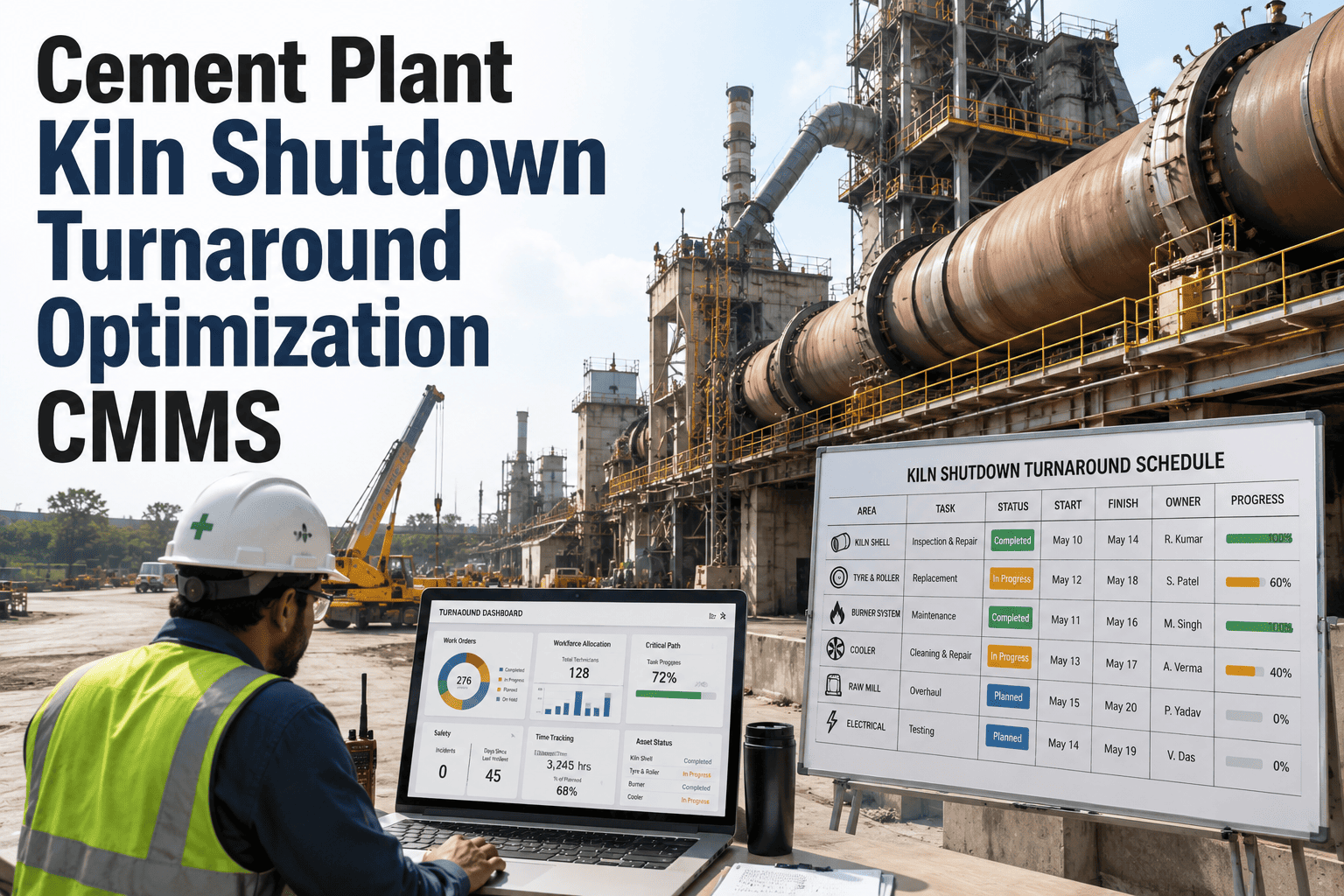
A cement plant shutdown that runs 3 days over schedule does not just cost labour hours — it costs kiln production at $40,000 to $120,000 per day depending on clinker output and market pricing. AI-driven shutdown planning tools are eliminating the guesswork from outage management: plants using data-informed resource allocation and schedule optimisation are cutting outage durations by 20 to 35% and reducing costly last-minute scope changes that have historically turned 10-day turnarounds into 14-day budget disasters. Sign in to OxMaint to manage your next shutdown from work order creation through resource assignment and close-out, or book a demo to see how AI-assisted planning integrates with your existing maintenance data.
Guide · AI Operations · Cement Plant
AI Shutdown Planning & Resource Optimization for Cement Plants
How AI tools analyse contractor performance, part lead times, historical productivity, and schedule dependencies to cut outage duration 20–35% — and eliminate the conflicts that turn planned shutdowns into expensive overruns.
20–35%
Outage duration reduction with AI schedule optimisation
$40K–$120K
Daily lost production cost per day of unplanned extension
68%
Of shutdowns that exceed planned duration due to scope gaps and resource conflicts
3–6×
ROI on AI shutdown planning tools vs traditional spreadsheet methods
Why Cement Plant Shutdowns Run Over — And What AI Changes
01
Scope Discovered Late
40% of shutdown scope additions are items that were accessible but not inspected before the outage began. AI models flag inspection gaps in the pre-shutdown window using asset condition data and work order history.
02
Parts Not Ready on Day One
Refractory bricks, kiln tyres, and fan impellers have 8–16 week lead times. AI planning tools back-calculate procurement deadlines from the scheduled shutdown date — automatically.
03
Contractor Conflicts
Scaffolding, inspection, and installation crews competing for the same access windows create cascading delays. AI scheduling assigns resources using historical productivity rates, not optimistic estimates.
04
No Baseline to Improve Against
Without structured historical data, every shutdown starts from scratch. CMMS-stored shutdown records give AI models the data needed to build and refine accuracy with every outage cycle.
What AI Shutdown Planning Optimises: The Full Scope
| Planning Area |
What AI Analyses |
Output |
Time Saved |
| Work Scope Definition |
Asset condition data, overdue WOs, inspection records, failure history |
Prioritised scope list with risk-weighted task ordering |
3–5 days pre-shutdown |
| Parts & Materials |
BOM data, supplier lead times, past consumption rates per shutdown |
Procurement deadline schedule with auto-triggered purchase orders |
Eliminates day-1 wait time |
| Contractor Scheduling |
Crew size, historical task durations, access zone conflicts, permit requirements |
Conflict-free resource Gantt with buffer tasks for variable scope |
15–25% duration reduction |
| Critical Path Analysis |
Task dependencies, parallel work potential, crew transitions |
Dynamic critical path that updates as tasks complete or slip |
Prevents 2–4 day cascades |
| Risk Flagging |
Weather windows, single-source parts, specialist crew availability |
Pre-shutdown risk register with mitigation actions and contingency tasks |
Eliminates surprise delays |
| Post-Shutdown Review |
Planned vs actual task durations, cost variance, scope changes |
Accuracy report feeding next shutdown's AI model baseline |
Compounds over time |
Plan Your Next Shutdown in OxMaint — Not a Spreadsheet
OxMaint centralises work orders, resource assignments, parts tracking, and shutdown history in one system — giving your AI planning tools the data quality they need to deliver accurate schedules.
The AI Shutdown Planning Process: Phase by Phase
12–16 Weeks Out
Scope & Procurement
AI analyses asset condition scores, open work orders, and failure prediction outputs to define the shutdown scope. Long-lead-time items are flagged immediately — kiln tyres, refractory bricks, and imported components are ordered with calculated buffer against the shutdown start date. Plants that complete this phase with AI assistance report 85–90% of required parts on-site before day one.
6–8 Weeks Out
Resource & Contractor Planning
Contractor requirements are matched against historical productivity data stored in the CMMS. A refractory crew that averaged 85% planned task completion in the previous shutdown gets a more conservative schedule buffer than one with a 98% track record. AI also identifies single-point-of-failure contractors — specialists with no qualified alternative — and flags them as schedule risks requiring contingency plans.
2–4 Weeks Out
Schedule Lock & Risk Review
The AI-generated schedule is frozen for execution, with dynamic critical path analysis identifying which tasks, if delayed, will extend overall shutdown duration. A risk register highlights open procurement items, permit dependencies, and access conflicts that have not been resolved. This review meeting typically catches 3–5 issues that would have caused delays during execution.
During Shutdown
Live Tracking & Replanning
Work orders in OxMaint are updated in real time as tasks complete, slip, or expand in scope. The AI model recalculates the critical path after each status update and surfaces tasks that are approaching schedule risk. Shift handovers use the live schedule rather than whiteboard notes, reducing the communication losses that typically add half a day to every multi-shift shutdown.
Post-Shutdown
Data Capture & Model Improvement
Actual durations, cost variances, and scope changes are recorded against each work order in OxMaint. This structured data feeds the AI model for the next shutdown — improving contractor productivity estimates, refining lead time buffers, and flagging scope items that were missed in this cycle. Each shutdown makes the next one more accurate.
Resource Optimization: How AI Allocates People, Equipment & Time
Workforce Allocation
AI matches task skill requirements to contractor capabilities and availability, creating crew assignments that minimise idle time between tasks. Simulated schedules show the optimal crew size per phase — often smaller and more focused than historical intuition suggests.
Equipment & Tool Scheduling
Cranes, scaffolding, and specialist tools are high-conflict shared resources. AI schedules equipment usage across all concurrent tasks, preventing the common situation where two critical path jobs need the same crane at the same time.
Access Zone Management
Cement plants have physical constraints — a preheater scaffold limits who can work in adjacent zones simultaneously. AI maps these physical constraints and builds schedules that respect them, rather than assuming unlimited parallel access.
Budget vs Actuals Tracking
Planned labour hours and contractor rates are set at schedule lock. OxMaint tracks actuals against plan in real time — giving shutdown managers early visibility of cost overruns before they become material variances requiring board approval.
Frequently Asked Questions
How much historical shutdown data does AI planning need to work effectively?
AI planning tools deliver value from the first shutdown even without historical data — by structuring scope definition, flagging procurement deadlines, and applying industry-average productivity benchmarks. Accuracy improves significantly from the second shutdown onward, as the model learns your plant's specific contractor performance and task durations.
Sign in to OxMaint to begin capturing structured shutdown data today.
Can AI planning tools integrate with existing CMMS or ERP systems?
Yes — most AI planning tools connect to existing CMMS and ERP systems via API or data export. OxMaint is designed to be the operational layer where work orders and resources are managed, with AI analysis tools drawing on that structured data.
Book a demo to discuss your specific integration requirements.
What is the typical ROI timeline for implementing AI shutdown planning?
Most cement plants see measurable returns within the first AI-planned shutdown — typically from avoided overrun costs alone. A 2-day reduction in a 12-day shutdown at $60,000 per day lost production represents $120,000 in direct value, which covers most annual licensing costs for AI planning tools in a single event.
How does AI handle scope changes discovered during the shutdown?
When new scope is identified during execution, the AI model recalculates the impact on the critical path and resurfaces resource availability across the revised schedule. Plant managers see the projected new completion date and cost impact immediately — enabling faster decisions on whether to proceed, defer, or accelerate other tasks to compensate.
Your Next Shutdown Starts With Better Data. OxMaint Builds That Foundation.
Every work order closed, every contractor task recorded, every part consumed — this is the data that makes AI shutdown planning accurate. OxMaint captures it automatically, so your next outage plan is built on evidence, not estimates.