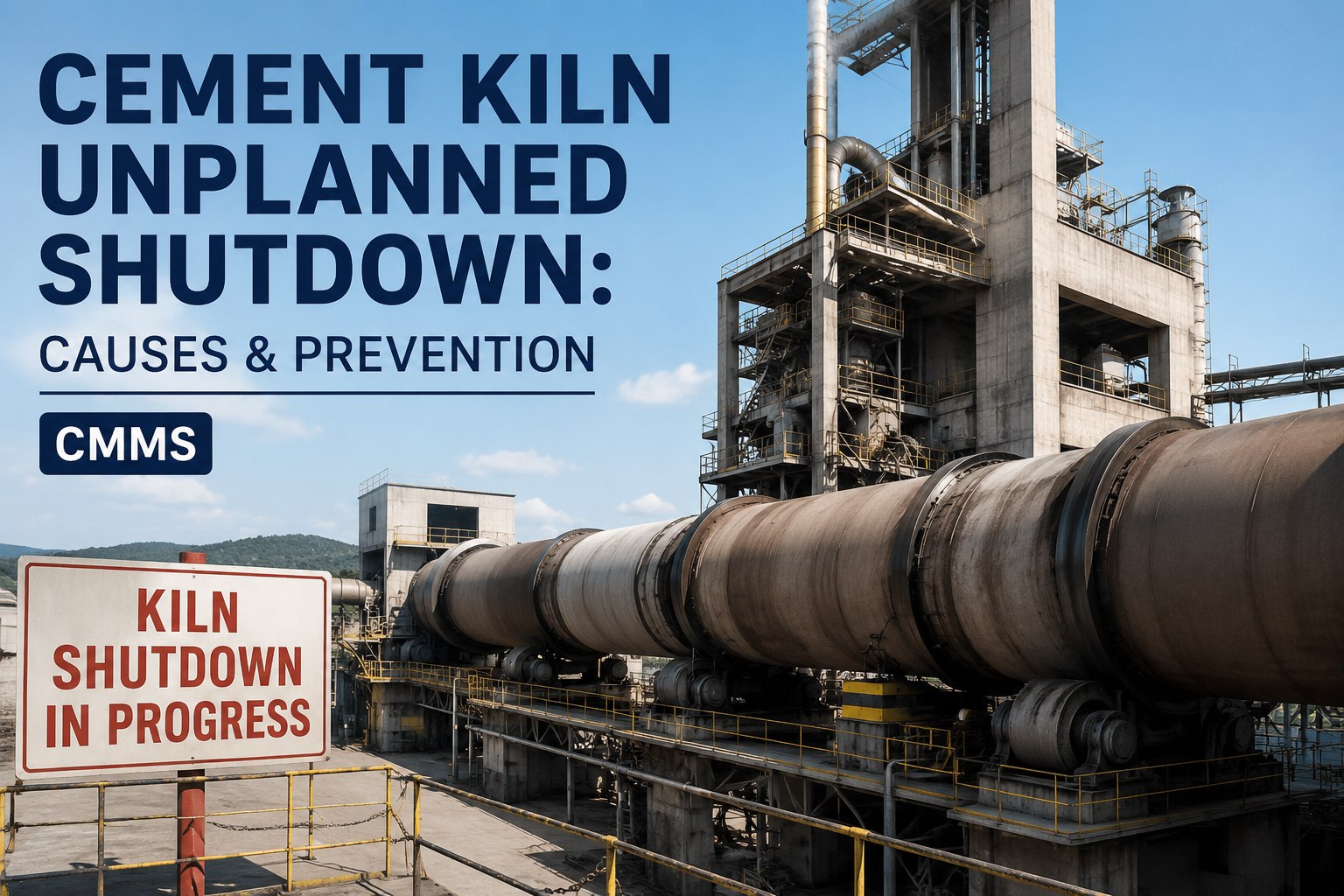
A cement kiln shutdown turnaround is the most maintenance-intensive event on the plant calendar — typically 2,500–4,500 discrete work orders compressed into a 21- to 35-day outage window, with direct contractor and lost-production costs running $40,000–$90,000 per day. Industry benchmarking shows that unoptimized turnarounds overrun their planned duration by 18–28% and their budget by 22–35%, while best-in-class plants using scope-based planning, critical-path scheduling, and pre-staged parts via CMMS routinely finish 8–12% early and recover 15–20% of outage cost. This guide walks through the full turnaround optimization stack — from work-package structure and contractor coordination to CMMS integration — so you can compress outage duration, control spend, and restart clinker production on schedule. Ready to put it into practice? Start Free Trial and configure your next shutdown in OxMaint today.
Every day your kiln is down costs up to $90K Are you planned to the hour — or planned to overrun?
Scope-based outage planning, critical-path discipline, and pre-staged parts in a single CMMS cut typical turnaround overruns from 25% to under 5% — and recover 15–20% of outage spend on the first shutdown.
Why turnaround optimization is the highest-leverage maintenance event of the year
A single kiln shutdown concentrates 35–45% of annual maintenance spend into 3–6 weeks. Small planning gains compound into millions of dollars of recovered production.
A 25-day outage on a 4,500 tpd kiln at $38/t margin ≈ $4.3M in lost production alone — plus $1.8–2.6M in labor, contractor, and refractory spend.
A 3-day duration reduction + 12% parts variance recovery on a mid-size kiln turnaround returns roughly $612K per outage cycle.
The optimized kiln shutdown runs nine months before the kiln cools
Best-in-class plants treat turnaround as a 9-month project, not a 3-week event. Every phase has hard deliverables, named owners, and CMMS milestones.
The 600–900 activities that decide whether you restart on day 25 or day 31
Of the thousands of WOs in a turnaround, only a subset sits on the critical path. Losing 8 hours on any one of them extends the entire outage.
Kiln shell alignment and tire resurfacing
Hot-kiln alignment, tire and roller grinding, and shell ovality correction typically consume 9–14 calendar days and gate refractory installation. Pre-stage laser alignment crews and machining contractors at T-2 days.
Brick demolition and castable installation
Brick tear-out and reline accounts for 40–55% of outage duration on the critical path. Pre-stage 100% of brick, anchors, and castable by T-14. Track masons' installed meters/hour against the CMMS progress curve twice daily.
Girth gear, pinion, and main drive inspection
Gear mesh inspection, backlash adjustment, and root crack NDT on the main drive is a 3–5 day critical-path task that gates motor reconnection. Schedule NDT vendor on day 2 of the outage — not day 6.
Cyclone coating removal and meal-line repair
Preheater cleaning, dip-pipe replacement, and meal-line refractory can be parallelized — but only if scaffold access is pre-built and permits are pre-issued. CMMS tracks parallel-path WOs separately from critical-path.
Grate plate and hammer crusher overhaul
Cooler grate replacement and crusher hammer change are off-critical-path but resource-constrained. Schedule them in the back half of the outage to avoid labor contention with refractory crews.
What a turnaround-ready work package actually contains
A work package is not a work order. It's the complete, permit-ready, parts-staged, labor-estimated instruction set that lets a crew walk on-site at 06:00 and start work at 06:05.
| Work Package Element | What It Contains | CMMS Field | Ready Target |
|---|---|---|---|
| Scope & task steps | Step-by-step procedure with torque values, tolerances, acceptance criteria | Job Plan / Standard Job | T-30 days |
| Parts & materials | Reserved BOM items, shelf-verified, staged at kitting area | Reservation + Kit ID | T-7 days |
| Permits & isolations | Hot work, confined space, LOTO sequence, gas-test records | Permit Template + Isolation List | T-3 days |
| Labor & contractor | Crew composition, shift hours, contractor PO, competency verification | Labor Assignment + Vendor PO | T-5 days |
| Tools & equipment | Special tools, cranes, scaffolding, welding rigs — reserved and tagged | Tool Reservation | T-2 days |
| Safety & JHA | Job hazard analysis, MOC reference, pre-job safety briefing template | JHA Template + MOC ID | T-7 days |
| QA / inspection | NDT requirements, alignment tolerances, sign-off authority | Inspection Checklist | T-10 days |
Managing 200–600 contractor workers without chaos or overtime blowout
Contractor labor is 60–75% of turnaround spend. Without CMMS-tracked scope, hour estimates, and daily progress, you're paying overtime for work that should have been day-shift.
Pre-qualification & onboarding
Verify insurance, safety records, and competencies 60 days out. CMMS vendor portal collects OSHA 300 logs, confined-space certs, and respirator fit-tests before gate access is issued.
Scope-locked POs
Each contractor PO maps to named CMMS work packages — not a labor category. Progress is reported at the WO level, so disputes are settled against documented completion, not timesheet claims.
Daily progress vs. estimate
Foremen update WO percent-complete at every shift handover. Variance >10% auto-triggers a turnaround manager alert — catching a 2-day slip while there's still time to recover it.
Crew density planning
CMMS labor-loading heat map shows where 200+ workers overlap in tight zones (burner hood, cooler throat). Stagger shifts or re-sequence to avoid the safety and productivity penalty of congestion.
What 28% overrun actually looks like on the P&L
The gap between a managed and unmanaged turnaround is rarely visible in the maintenance budget — it shows up in lost clinker margin, overtime, and the refractory life you sacrifice on a rushed restart.
- 28% duration overrun = 7 extra days at $90K/day = $630K lost margin
- 22% parts variance — wrong brick grade, short-shipped castable = $340K expedite & rework
- Contractor overtime blowout — 38% of hours billed at 1.5× = $520K
- Rushed refractory dry-out → 4% shorter brick life → next outage pulled forward 5 weeks
- 2% duration overrun = 0.5 day, recovered within the planned window
- Parts variance <4% — 100% pre-staged, CMMS reservation-verified at T-7
- Overtime held to 11% of hours via shift-staggered critical-path scheduling
- Controlled dry-out → full refractory campaign life → next outage on plan
Delta per outage cycle: $1.8M recovered · across a 2-shutdown-per-year cadence, that's $3.6M annually on a single kiln line.
Your next kiln turnaround starts in 9 months — or it starts today.
Load your scope, build work packages, pre-stage parts, and track critical-path in a CMMS built for cement plant shutdowns.
Cement kiln turnaround optimization, answered
How early should turnaround planning begin for a cement kiln shutdown?
Best-in-class plants start at M-9 — nine months before the planned outage date. The first 90 days are scope definition and long-lead procurement (refractory, tires, roller assemblies, burner pipe), followed by work-package buildout at M-6 and readiness review at M-1. Plants that compress planning to 90 days routinely overrun by 20%+ because parts arrive late and work packages are incomplete at T-0. Book a Demo to see OxMaint's 9-month turnaround template.
How many work orders are typical in a cement kiln turnaround, and how does CMMS handle that volume?
A mid-size kiln (3,000–5,000 tpd) turnaround typically runs 2,500–4,500 work orders, of which 600–900 are on the critical path. CMMS handles this by grouping WOs into scope blocks (shell, refractory, drive, preheater, cooler), each with its own readiness dashboard, parts reservation report, and daily progress curve. Bulk WO creation from templates and automated permit/isolation linking are what make 4,000 WOs manageable.
What does a CMMS readiness dashboard show at T-14 days before the outage?
At T-14, the dashboard should show four metrics: % work packages package-complete (target 95%+), % parts staged at the kitting area (target 90%+), % permits pre-issued (target 80%+), and % contractor onboarding complete (target 100%). Any WO below "ready" is flagged red and escalated to the turnaround manager for daily resolution until cleared.
How much can turnaround optimization actually save per shutdown?
On a 4,500 tpd kiln with a 25-day planned outage, moving from an unmanaged turnaround (28% overrun) to a CMMS-optimized one (under 5% overrun) typically recovers $1.2–1.8M per cycle — split roughly 40% from duration reduction, 30% from parts variance control, and 30% from contractor overtime avoidance. Plants running two kiln shutdowns per year recover $2.4–3.6M annually. Start Free Trial to model your own savings.
Can CMMS integrate with our existing ERP for parts procurement and contractor POs?
Yes — a turnaround-grade CMMS integrates with SAP, Oracle, Maximo, and common cement-industry ERPs via REST or file-based exchange. Parts reservations in CMMS sync to ERP purchase requisitions; contractor POs created in ERP sync back as vendor-linked labor assignments on each work package. This closed loop is what prevents the "parts ordered but not reserved against the WO" gap that causes 15–25% of outage-day delays.
Stop planning turnarounds in spreadsheets Start recovering $1.8M per shutdown.
OxMaint gives cement plants scope-based outage planning, critical-path tracking, pre-staged parts, and contractor coordination in one CMMS — purpose-built for kiln shutdowns.
Free 14-day trial · No credit card