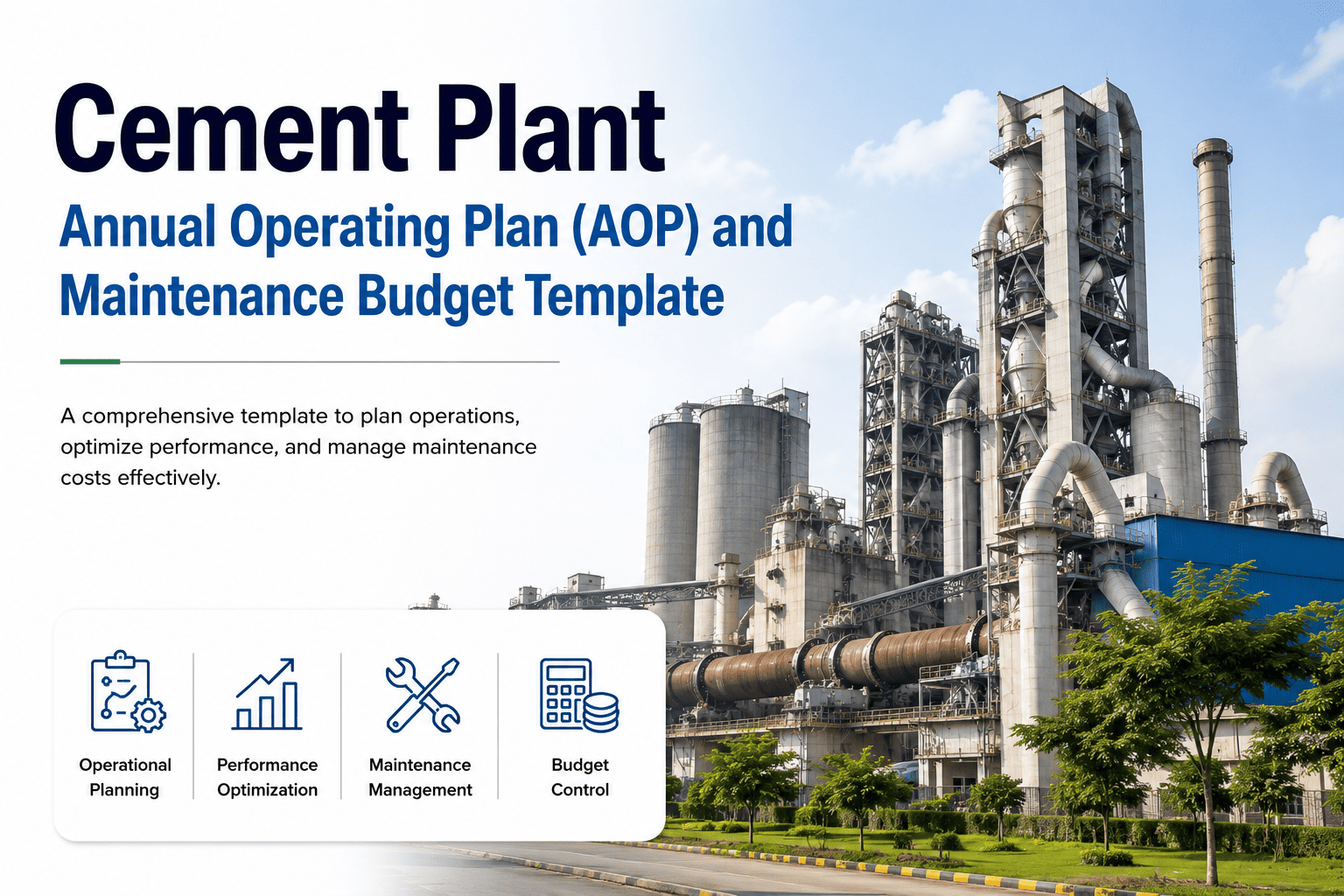
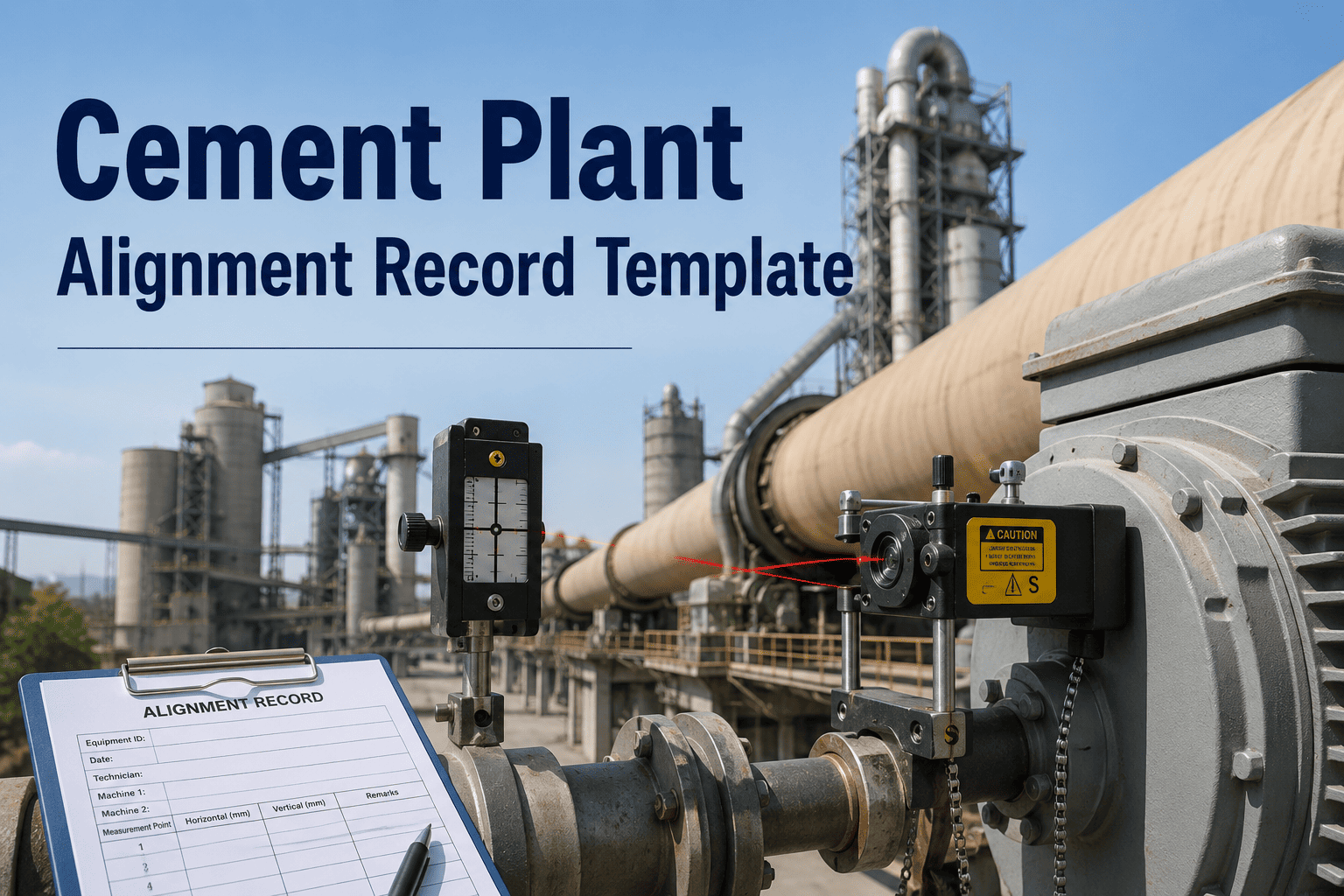
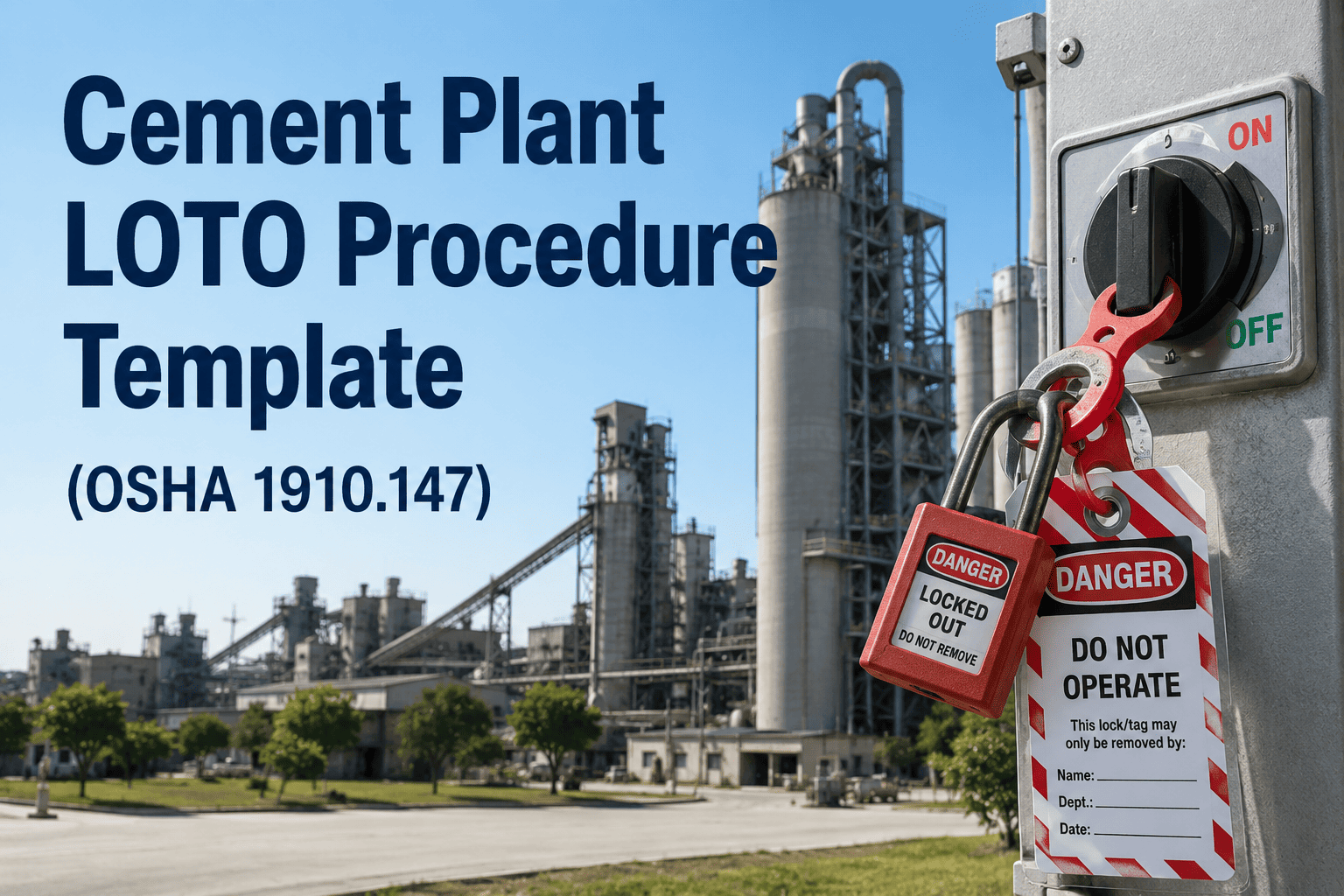
The annual operating plan (AOP) and maintenance budget define what your cement plant can and cannot do for the next twelve months — and yet most plants submit them using a prior-year spreadsheet adjusted by a percentage, with no connection to actual asset condition, planned major maintenance windows, or the headcount needed to execute the PM schedule. The result is a budget that is wrong before January ends: over-committed on routine PM labor, under-funded for the corrective maintenance that predictably arrives, and disconnected from the CapEx timing that determines when major cost events occur. This page provides a free editable cement plant AOP and maintenance budget template covering OpEx, CapEx, headcount planning, KPI targets, and year-end variance analysis — with guidance on connecting all inputs to your CMMS for a budget that reflects your plant's actual maintenance reality. For plants ready to replace spreadsheet budgeting with real CMMS-driven planning, start a free Oxmaint account today, or book a 30-minute walkthrough with our cement plant maintenance planning team.
Free Template · Annual Maintenance Planning
Cement Plant AOP & Maintenance Budget Template
OpEx, CapEx, headcount, maintenance KPIs, and year-end variance — built on your actual asset register, not last year's spreadsheet.
42%
Of cement plants exceed maintenance OpEx budget by more than 15% annually
$18–35/t
Maintenance cost per tonne of clinker — wide range driven by PM program quality
60 days
Before year-end: ideal AOP submission window for cement plants
Why Cement Plant Maintenance Budgets Miss Their Targets
Cement maintenance budgets fail for three predictable reasons that have nothing to do with cost discipline — and everything to do with how the budget is built in the first place.
Problem 1
Prior-Year Plus Percentage
Budgets built by applying an inflation adjustment to last year's actuals ignore changes in asset age, equipment condition, and planned major maintenance windows. A plant with a kiln shell replacement scheduled in Q3 that uses prior-year actuals will be catastrophically under-funded in both parts and contractor spend.
Problem 2
No Planned vs. Corrective Split
Most cement budgets lump all maintenance spend in one line. Without a structured split between planned PM labor, planned PM parts, corrective maintenance labor, and corrective maintenance parts, it is impossible to identify whether the budget is being consumed by reactive work or whether the PM program is underfunded.
Problem 3
No KPI Budget Connection
The budget is set without defining what KPI performance the spend is expected to deliver — no target MTBF, no target PM compliance rate, no planned-to-reactive ratio. This makes year-end variance analysis meaningless because there is no performance outcome to compare against the spend.
AOP Template: Budget Structure for Cement Plants
The template organizes maintenance spend across five budget line groups, each with sub-categories that map to CMMS work order types. This structure allows monthly variance tracking from CMMS actuals against the plan.
PM Labor — internal technician hours × loaded rate
PM Parts & Consumables — lubricants, filters, seals, wearing parts
Routine Inspection Services — vibration analyst, thermography contractor
PM Tools & Instruments — calibration, special tooling rental
Corrective Labor — internal and contractor hours for unplanned repairs
Emergency Parts — storeroom issues and external emergency purchases
Corrective Contractor Services — specialist repairs, re-refractory
Consequential Damage Parts — secondary damage from primary failures
Annual kiln stop — refractory, mechanical, instrument work packages
Major mill reline — liner replacement, media charge, classifier overhaul
Cooler rebuild — grate plate replacement, fan maintenance
Shutdown contractor mobilization and project management costs
Critical spare replenishment — insurance spares consumed during year
Slow-moving inventory write-off provision (typically 3–5% of inventory value)
New critical spare builds — spares for new equipment commissioned in year
Maintenance technician headcount — current FTE and any planned changes
Contract labor budget — anticipated contract hours by trade
Technical training — OEM courses, certification programs, MSHA Part 46
Safety-related training — confined space, hot work, electrical safety
KPI Targets Built Into the Budget
A credible AOP submission includes the maintenance KPI targets that the budget is designed to achieve — not just the cost numbers. This gives finance and plant management a way to evaluate whether the maintenance spend is delivering the expected equipment performance, and creates accountability for both maintenance spend and equipment availability.
| KPI |
Current Year Actual |
AOP Target |
Budget Driver |
| Kiln availability |
86.2% |
88.5% |
Annual stop window, refractory budget |
| PM compliance rate |
71% |
85% |
PM labor hours budget, CMMS scheduling |
| Planned vs. reactive ratio |
62:38 |
72:28 |
PM investment reducing corrective spend |
| Maintenance cost per tonne |
$28.40/t |
$25.80/t |
PM compliance reducing emergency costs |
| Critical spare availability |
88% |
95% |
Spare parts replenishment budget |
| Work order backlog (weeks) |
6.4 weeks |
4.0 weeks |
Contractor labor budget supplement |
Build your AOP from real CMMS data, not last year's spreadsheet. Oxmaint generates maintenance cost actuals, PM compliance rates, planned-vs-reactive ratios, and work order backlog metrics — all filterable by asset group and time period, ready to export directly into your budget template.
Year-End Variance Analysis: What to Track Monthly
The AOP is only useful if it is compared to actuals every month and the variance explained before the next month ends. These are the five variance lines that matter most in cement plant maintenance budgets.
Corrective vs. PM spend ratio
If corrective spend rises above plan while PM spend is on budget, the PM program is not preventing failures as modeled. Root cause must be identified within the period, not at year-end.
Emergency parts purchases vs. plan
Emergency purchases at cost premiums of 20–40% above planned procurement indicate either storeroom gaps or unexpected failure modes. Track by asset category monthly.
Contractor labor vs. budget
Contractor budget overruns in Q1–Q2 usually mean emergency repair mobilizations. In Q3–Q4 they often mean major stop scope growth. Both must be explained separately in the variance narrative.
Major stop final cost vs. estimate
Track major stop cost variance as a standalone line — not absorbed into the routine corrective budget. Major stop overruns are driven by scope growth found during the stop and must be managed with contingency reserves in the AOP.
Frequently Asked Questions
What is a reasonable maintenance cost per tonne for a cement plant?
Industry benchmarks for integrated cement plants typically range from $18 to $35 per tonne of clinker produced, with world-class operations at $18–22/t and average performers at $26–32/t. The primary driver of the gap is planned maintenance execution — plants with PM compliance above 85% consistently achieve the lower half of this range.
Oxmaint tracks your maintenance cost per tonne automatically from work order data.
How far in advance should the cement plant maintenance budget be submitted?
Most cement plant AOP cycles run 60–90 days before year-end — typically September to October for a January fiscal year start. The maintenance budget requires input from the asset inspection program, the planned major stop schedule, and the CMMS spare parts inventory valuation. Starting the data pull in August gives sufficient time for a credible submission.
Book a demo to see how Oxmaint automates the data extraction for AOP preparation.
Should the annual kiln stop be budgeted as OpEx or CapEx?
This depends on the scope and your organization's accounting policy. Routine kiln stops for refractory replacement, mechanical servicing, and instrument calibration are typically OpEx. Scope that extends asset life or improves capability (kiln shell section replacement, tyre and roller replacement, significant structural upgrades) may qualify as CapEx under most accounting frameworks. Work with your finance team to classify major stop line items correctly — misclassification creates budget reconciliation problems at year-end.
How do I include energy costs in the cement maintenance AOP?
Energy costs driven by maintenance decisions — grinding media charge level affecting specific power, fan damper position due to filter condition, compressed air leakage from unmaintained systems — should appear in the maintenance section of the AOP as an energy efficiency impact line. Use your CMMS to identify assets with documented energy-related defects and quantify the cost of leaving them unaddressed. This builds a stronger case for PM investment with the finance team.
Sign up free to track energy-related work orders in Oxmaint.
What headcount metrics should the cement maintenance AOP include?
Include: current FTE by trade (mechanical, electrical, instrumentation, civil), planned overtime hours as a percentage of base hours (target below 12%), contractor labor FTE-equivalent hours planned, and training days per technician. Benchmark: top-quartile cement plants target 1 maintenance technician per 8,000–10,000 tonnes per year of clinker capacity. Plants below this ratio typically struggle with PM compliance and work order backlog.
Book a session to discuss headcount planning for your plant size.
Build a Maintenance Budget That Holds All Year
Oxmaint gives cement plant maintenance managers the cost actuals, PM compliance data, and asset history to build an AOP that reflects your plant's real maintenance requirements — not an adjusted copy of last year's spreadsheet.