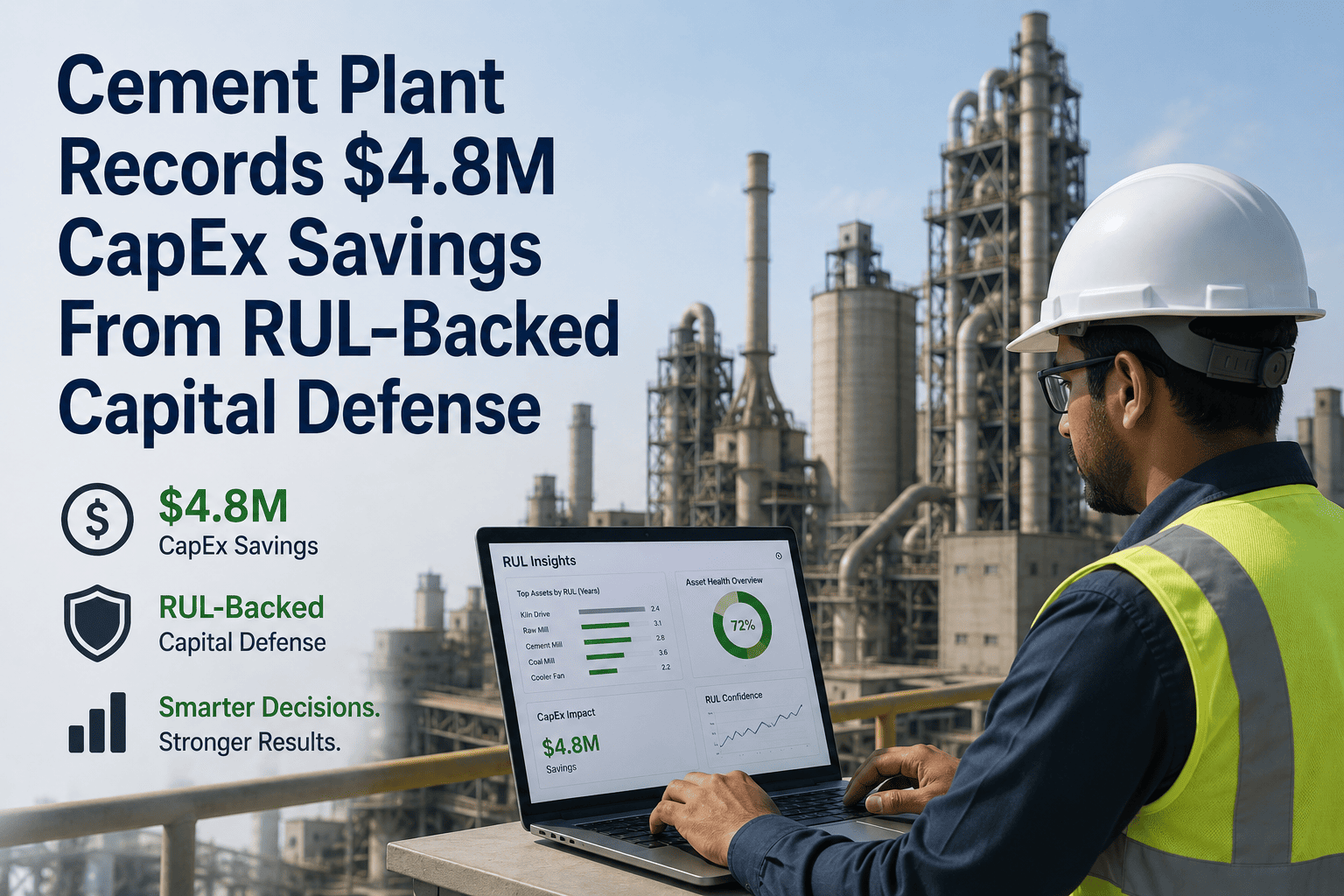
A kiln drive gearbox replacement costing $1.4 million is easy to approve when the previous one failed and took the plant offline for 11 days. The same project is rejected 70% of the time when submitted as a proactive replacement before failure — unless the maintenance team builds a complete justification document with lifecycle math, remaining useful life analysis, NPV calculation, and CMMS-sourced evidence of deteriorating condition. This page provides a free editable CapEx justification template built specifically for cement plant major equipment replacement and upgrade projects, with guidance on structuring the financial narrative your finance and board teams need to approve the spend. If your team is still building CapEx requests from scratch in PowerPoint with no connection to your maintenance history data, start a free Oxmaint account to pull equipment history, failure records, and cost data directly into your CapEx narrative, or book a 30-minute session to see how cement plants build winning CapEx cases with maintenance data.
Free Template · Capital Project Justification
Cement Plant CapEx Justification Template
Scope, lifecycle math, NPV, IRR, remaining useful life, and CMMS-backed evidence — everything finance needs to approve your next major equipment project.
70%
Of proactive CapEx requests are rejected without lifecycle financial evidence
3.2×
Higher total cost of reactive replacement vs. planned proactive replacement
$2–8M
Typical cement kiln major equipment CapEx range requiring board approval
Why Most Cement CapEx Requests Are Rejected
Finance teams reviewing cement plant capital requests see the same three failures repeatedly: the maintenance case is made in isolation without business impact framing, the financial analysis is limited to simple payback without NPV or IRR, and the evidence of current asset condition relies on engineer judgment without objective maintenance history data. The result is a request that feels like a technical opinion rather than a business case.
01
No Business Impact Frame
Maintenance describes the equipment problem. Finance wants to see lost production value, unplanned downtime cost, and risk exposure in dollar terms — not equipment condition scores.
02
Insufficient Financial Model
Simple payback ("back in 18 months") is rejected in most organizations above $500K. Approvers require NPV, IRR, and scenario analysis for reactive vs. proactive replacement paths.
03
03
No Objective Evidence
Requests built on engineer opinion without CMMS work order history, vibration trend data, or visual inspection records are treated as speculative. The same evidence that drives a maintenance decision must appear in the CapEx document.
CapEx Justification Template: Section-by-Section
The template is structured in eight sections that map directly to the review sequence used by plant finance, corporate engineering, and board approval committees. Each section has a one-page maximum target and a required data source.
Project title, asset ID, proposed spend, key financial return (NPV and payback), and a one-paragraph plain-language statement of what happens if the project is not approved. Finance reads this section first and often only this section. Make it decisive.
Asset installation date, original cost, current book value, number of corrective work orders in last 24 months, total maintenance spend on this asset, most recent inspection results, and remaining useful life (RUL) assessment. Pull all cost data directly from CMMS — do not estimate or approximate.
Primary failure mode driving the CapEx request, historical failure frequency, consequence severity (production impact, safety risk, regulatory exposure), and probability of failure within the next 12–24 months without the capital intervention. Include actual kiln downtime hours caused by this asset class in the last 3 years.
Document at least three options: do-nothing (run to failure), repair or refurbishment, and replacement. For each option, state total 10-year cost including maintenance, downtime risk exposure, and operational performance impact. The recommended option must be selected on NPV, not on maintenance convenience.
10-year cash flow model comparing status quo vs. proposed investment. Key inputs: avoided downtime value ($/hour × expected hours saved), reduced O&M spend, energy efficiency improvement if applicable, and asset residual value. Apply your plant's hurdle rate for IRR comparison. Show base case, optimistic, and pessimistic NPV scenarios.
Preferred installation window (aligned to planned kiln stop), estimated installation duration, contractor selection process, pre-ordering lead time for long-lead components, and commissioning plan. Cement plant CapEx approvals accelerate significantly when the implementation plan shows the work slots into a scheduled maintenance window rather than requiring an additional production stop.
Attach: 24-month work order cost report filtered to this asset, last three inspection reports with condition ratings, vibration trend data (if applicable), and any RCA reports. These documents provide the objective evidence that separates a credible CapEx request from an engineer's opinion. Oxmaint generates this package from work order history in under 10 minutes.
Document the approval chain required at your organization's spend thresholds — plant manager, VP Operations, CFO, and board approval levels. Include signature blocks for each approver and the target approval date to keep the request on schedule for the implementation window identified in Section 06.
Pull your CapEx evidence package from Oxmaint in minutes.
24-month work order cost history, failure records, corrective maintenance spend, and asset condition trend — all filterable by asset and exportable for your CapEx submission.
Remaining Useful Life (RUL): The Key Number Finance Wants
RUL is the estimated time before an asset reaches the end of its serviceable life under current operating conditions and maintenance regime. It is the single most persuasive number in a proactive CapEx request because it converts "the equipment is getting old" into "we have 14 months before this becomes a reactive emergency."
Method 1
Age-Based RUL
Compare current asset age against manufacturer design life and actual population data for similar cement plant equipment. Best used for consumable components with well-established failure age distributions (gearbox bearings, kiln tyres, fan impellers).
Method 2
Condition-Based RUL
Use current vibration levels, wear measurements, or inspection ratings to extrapolate time to failure limit. Requires trend data. CMMS work order data showing increasing corrective maintenance frequency is strong supporting evidence for this method.
Method 3
Cost-Based RUL
Asset has exceeded economic life when annual O&M cost exceeds 15–20% of replacement value. Document cumulative corrective maintenance spend from CMMS and divide by replacement cost. A ratio above 0.6 over three years is strong evidence for replacement approval.
Frequently Asked Questions
What financial metrics are most important for cement plant CapEx approval?
NPV and IRR are the primary metrics for most cement plant organizations above $500K spend. Simple payback is accepted as a secondary metric but rarely drives approval alone. For safety or compliance-driven projects, IRR is less relevant — the justification focuses on regulatory risk quantification and consequence cost avoidance.
Oxmaint generates the maintenance cost inputs for your NPV model automatically from work order history.
How do I value unplanned downtime in the CapEx financial model?
Use your plant's contribution margin per tonne of clinker or cement multiplied by the production rate loss per hour. For a 3,500 tpd kiln at $30/tonne contribution, the downtime value is approximately $4,375 per hour. Apply this rate to the expected failure frequency and duration under the do-nothing scenario in your alternatives analysis. Be conservative — finance teams that know the number will challenge inflated estimates and reject the whole submission.
Should I include energy savings in cement plant CapEx financial models?
Yes, but only when the energy saving is measurable and project-specific. Equipment upgrades that reduce specific power consumption (new separator, VFD on large fans, higher-efficiency grinding media) generate real energy savings worth including. Be specific about the kWh/tonne baseline, the expected improvement, and the energy unit cost. Vague energy saving claims reduce credibility of the entire submission.
Book a demo to see how energy data integrates with Oxmaint maintenance dashboards.
How long should a cement plant CapEx justification document be?
Eight to twelve pages for the main narrative, plus supporting appendices. Each of the eight template sections should be one page maximum. Appendices can include detailed financial model spreadsheets, CMMS work order reports, and inspection photos. Finance approvers read the executive summary and section headers first — the appendices validate the numbers for engineers and auditors.
What CMMS data is most useful as CapEx evidence?
The three most persuasive data pulls are: 24-month cumulative corrective maintenance cost by asset (showing accelerating spend trend), total unplanned downtime hours attributed to the asset over 3 years, and failure frequency trend (work orders per quarter, showing increasing frequency). All three are available in Oxmaint standard reports.
Sign up free to access the CapEx evidence report template.
Build a CapEx Case That Gets Approved
Oxmaint gives cement plant maintenance teams the work order history, failure data, and cost records to build compelling CapEx justifications — with the evidence package that finance and boards need to approve the spend.