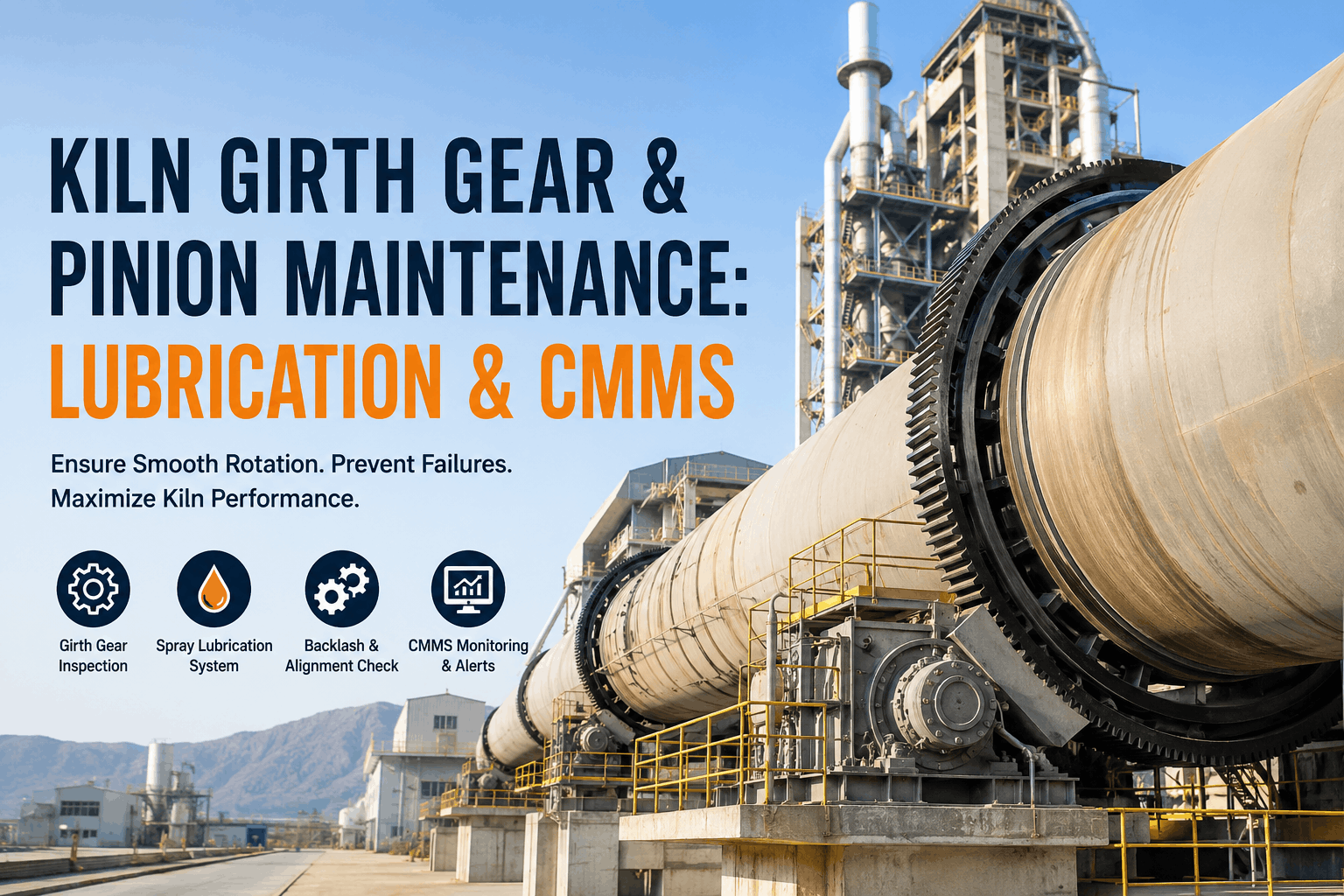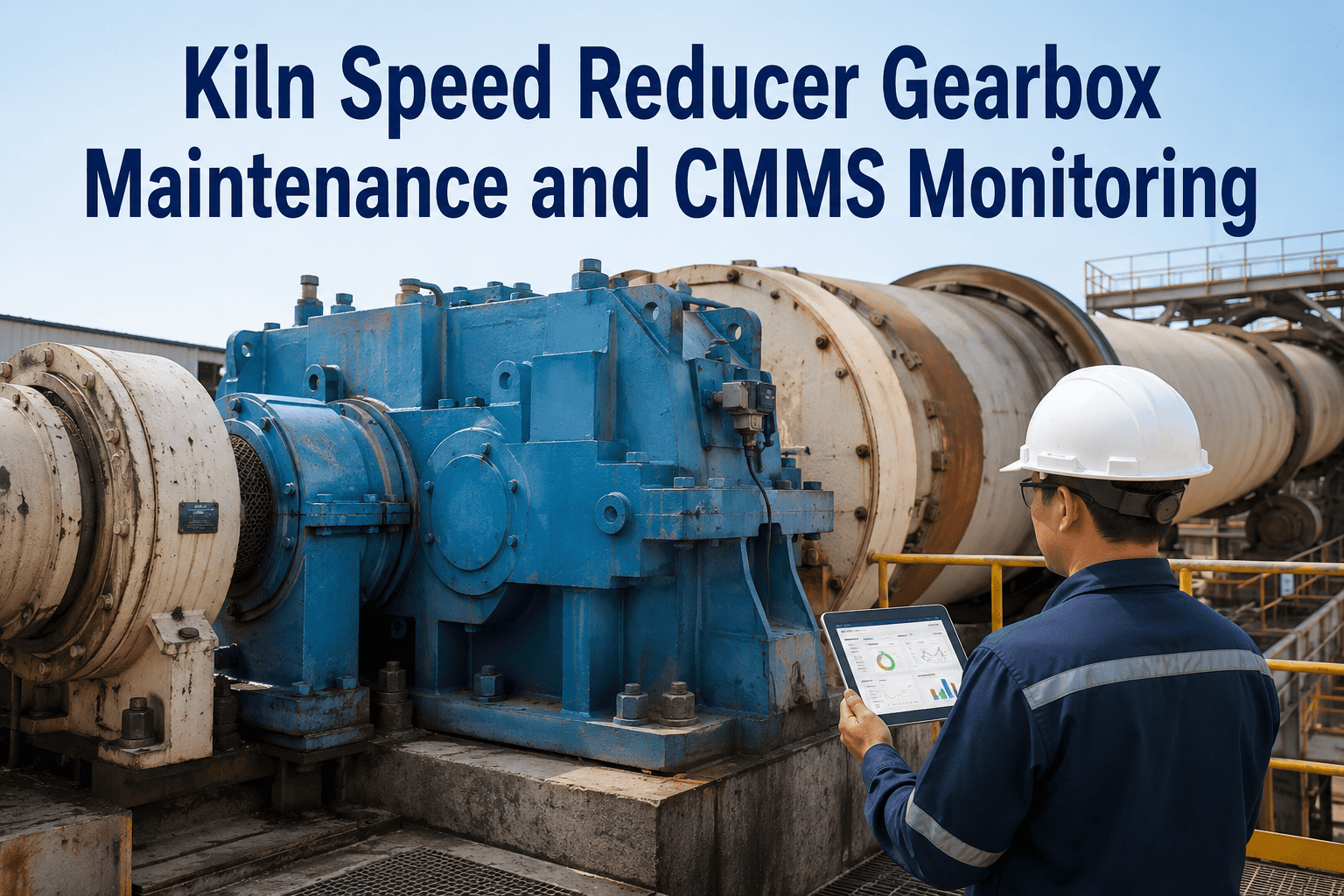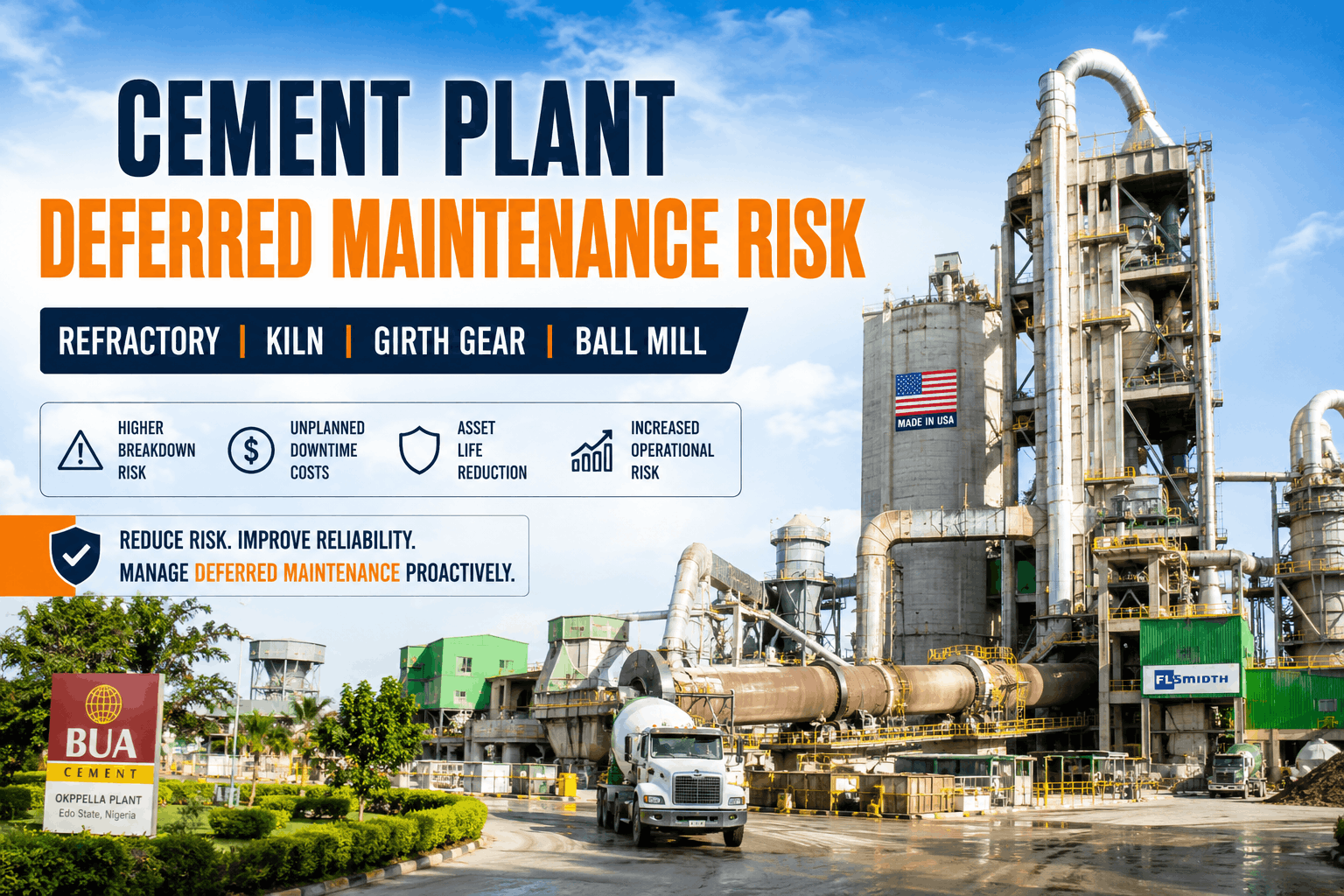
Deferred maintenance in cement plants accumulates silently until a single triggering event exposes what was always deteriorating in the background. A kiln refractory lining that could have been replaced in a controlled 7-day planned outage instead collapses catastrophically, forcing an emergency 21-day shutdown and $2.1 million in shell damage repair. A girth gear that could have been replaced during coordination with raw mill maintenance instead fails unexpectedly, destroying the pinion and secondary gearbox — a $1.8 million cascading failure that was preventable. A ball mill grate support that should have been inspected quarterly instead cracks under fatigue after three years of deferred inspection, spilling clinker internally and contaminating the cooler system. Deferred maintenance is not a cost reduction strategy — it is a financial time bomb where every month of deferral reduces the plant's margin for managing the inevitable failure event. Quantifying deferred maintenance exposure requires a structured risk framework that assigns severity scores based on equipment criticality, aging condition evidence, and the specific cost of the corrective action that gets deferred. This guide shows cement plant reliability managers how to measure deferred maintenance exposure using CMMS-integrated risk scoring and convert that quantified risk into capital justification for preventive work that boards and finance committees will fund.
The Four Categories of Deferred Maintenance in Cement Plants
Not all deferred work carries equal risk. A delayed lubrication schedule on a kiln bearing creates different exposure than deferred refractory replacement in the burning zone. Cement plant deferred maintenance breaks into four distinct categories, each requiring different risk assessment approaches and board communication strategies. Sign Up Free to begin tracking deferred maintenance by category and building the risk exposure dashboard that senior management needs to approve preventive capital spending.
Why Deferred Maintenance Becomes Invisible Until Crisis
Cement plant maintenance teams track open work orders and overdue PM schedules, but few plants quantify the total financial exposure represented by deferred work. A refractory reline scheduled for Q3 gets deferred to Q4 as kiln throughput ramps up. A girth gear backlash measurement scheduled monthly gets skipped for three consecutive months due to labor constraints. A ball mill bearing overhaul originally planned for Year 2 is repeatedly pushed to "next year" for six consecutive years. These deferrals accumulate across 50–100 asset maintenance items simultaneously, creating a maintenance backlog that no single manager can see holistically. Only when one deferred item fails catastrophically does senior management realize the plant has been steadily reducing its safety margin. OxMaint solves this visibility gap by translating deferred maintenance items into risk scores and financial exposure metrics — turning abstract "deferred work list" into "we currently have $4.2 million in quantified equipment replacement risk, with $800K in high-severity deferral at imminent risk of cascading failure." Book a Demo to see how OxMaint converts your deferred maintenance backlog into a board-ready risk exposure dashboard.
Deferred Item Severity Score (Critical / High / Medium / Low)
Each deferred maintenance item is scored 1–100 based on: equipment criticality (kiln vs. auxiliary), current condition evidence (bearing temperature trending upward, refractory thinning observed, oil analysis showing wear particles), days overdue, and financial impact of failure. Scores are updated monthly as conditions change. This quantified severity replaces subjective "important" vs. "not important" discussions.
Financial Exposure by Equipment Class
OxMaint aggregates deferred maintenance by asset: "Kiln-related deferral $2.1M, Raw mill deferral $680K, Cooler systems deferral $340K." Each category's exposure is calculated as (cost of preventive action if executed now) vs. (estimated cost if failure occurs before correction). For a refractory reline: $340K preventive cost vs. $2.1M emergency shell damage repair cost = $1.76M exposure if deferred beyond Month 4.
Deferral Timeline Risk (Months Until Cascading Failure Likely)
For each deferred item, OxMaint estimates the remaining margin before catastrophic failure becomes probable. A girth gear with backlash deferral has 4–8 months before pinion damage becomes irreversible; a kiln refractory with visible cracking has 6–12 weeks before thermal runaway becomes possible. These timelines force capital planning conversations from theoretical to urgent.
Multi-Asset Failure Cascade Risk
OxMaint identifies scenarios where failure of one deferred item triggers cascading failures in dependent equipment. Example: deferred kiln bearing replacement → increased kiln vibration → premature girth gear wear → girth gear failure → kiln stop → cascade to raw mill and cooler systems. Single deferred item can trigger $3–5M in collateral damage.
Deferral Period Aging Analysis
Maintenance items deferred for 6–12 months show measurable degradation in OxMaint condition scores; items deferred 12+ months typically enter critical zone. OxMaint tracks "months overdue" against historical data for your plant to project when deferral becomes untenable. This data lets plant leadership commit to a realistic remedy schedule.
Cement Plant Deferred Maintenance Risk by Asset Class
Different cement equipment generates different deferral risk profiles. Kiln-related deferrals escalate rapidly to catastrophic risk; mill equipment deferrals develop more gradually. Understanding your plant's specific deferral risk profile by asset helps prioritize capital allocation and communicate urgency to boards and finance committees. Sign Up Free to start mapping your deferred maintenance by asset and equipment class.
| Asset Class | Typical Deferred Work | Preventive Cost | Failure Cost (Worst Case) | Time to Critical Risk |
|---|---|---|---|---|
| Kiln Refractory Lining | Burning zone reline, patch repair | $280K–$420K | $1.8M–$2.6M (shell damage) | 8–16 weeks |
| Kiln Main Bearing & Supports | Bearing replacement, roller realignment | $180K–$240K | $1.2M–$1.8M (cascade failure) | 6–12 weeks |
| Girth Gear & Drive System | Gear replacement, backlash correction | $320K–$480K | $1.6M–$2.1M (pinion/gearbox damage) | 10–20 weeks |
| Raw Mill Gearbox | Gearbox overhaul, bearing replacement | $150K–$220K | $680K–$940K (secondary damage) | 14–24 weeks |
| Ball Mill Liners & Grates | Liner replacement, grate support repair | $120K–$180K | $420K–$680K (cooler contamination) | 12–20 weeks |
| Clinker Cooler System | Fan bearing replacement, grate overhaul | $90K–$140K | $340K–$520K (cooler shutdown) | 16–32 weeks |
How to Build a Board-Approved Capital Plan Using Deferred Maintenance Risk Data
Cement plant finance committees reject maintenance capital requests phrased as "we need to replace this equipment." They approve requests framed as "we have identified $4.2 million in quantified equipment failure risk; here is our risk mitigation plan and the specific capital allocation that reduces exposure by 60% within 12 months." The difference is data: specific deferral items with severity scores, financial impact calculations, and failure timelines. OxMaint generates these supporting documents automatically from your CMMS data. Book a Demo to see how OxMaint assembles deferred maintenance risk metrics into a capital plan presentation that board finance committees will fund.
Inventory All Deferred Maintenance Items in CMMS (Weeks 1–3)
Conduct a complete audit of your maintenance backlog: equipment inspections overdue 2+ months, PM schedules missed consecutively, capital projects deferred from previous years, and condition monitoring items flagged as concerning. Log each item in OxMaint with: description, equipment criticality, current condition evidence, days overdue, and cost of both preventive action and likely failure scenario.
Score Each Deferred Item by Severity and Financial Exposure (Weeks 4–5)
Use OxMaint's deferral risk scoring model: equipment criticality (1–10 scale) × months overdue × financial exposure ratio = severity score. High-criticality items overdue 6+ months with >$1M failure cost register as Critical. Medium-criticality items overdue 3–6 months with $500K–$1M exposure register as High. This scoring creates quantified risk exposure dashboard.
Model Failure Cascade Scenarios and Multi-Asset Risk (Weeks 6–7)
For each Critical-severity deferred item, model the cascading failure scenario: if kiln bearing fails unplanned, what is the probability that girth gear sustains secondary damage? If raw mill gearbox fails, what is impact on cement mill? This cascade modeling often reveals that "fixing just the kiln bearing" is insufficient; a larger coordinated outage is actually more economical.
Build 12-Month and 24-Month Mitigation Capital Plans (Weeks 8–9)
Create two scenarios: (1) Capital allocation plan that addresses all Critical and High severity items within 12 months (typical cost: $2.5–3.8M for a mid-size plant), and (2) deferred-mitigation plan if budget constraints require prioritization (address Critical items only in Year 1, High items in Year 2). Show board the risk remaining under each scenario.
Present to Finance Committee With Risk Reduction Metrics and ROI (Weeks 10–11)
Frame capital request as risk mitigation: "We have identified $4.2M in quantified equipment failure risk. This $2.8M capital plan reduces that exposure by 64% by addressing all Critical items and 70% of High items. Failure to execute increases our expected annual downtime loss by $600K–$1.2M and creates regulatory exposure in three compliance areas."
Frequently Asked Questions: Deferred Maintenance Risk Assessment
How do you calculate the financial impact of deferred maintenance?
Financial impact = (preventive repair cost if executed now) - (cost of failure corrective action). A $340K refractory reline deferred is typically $1.76M exposure (emergency shell repair $2.1M minus planned reline cost $340K). The longer deferral persists, the ratio escalates as underlying condition worsens.
What is the typical time window before deferred maintenance becomes critical risk?
Critical-risk timeline varies by asset: kiln refractory deferral reaches critical stage within 8–16 weeks; bearing deferrals within 6–12 weeks; gearbox deferrals within 10–20 weeks; mill equipment deferrals within 12–24 weeks. Condition monitoring data from OxMaint provides facility-specific timelines rather than generic estimates.
Can you defer maintenance without increasing downtime risk?
Minor deferrals (pushing planned PM by 2–4 weeks) carry minimal risk if supported by condition monitoring showing equipment is healthy. Deferrals exceeding 3–6 months on critical assets almost always increase unplanned downtime probability. Only condition-based deferral (supported by sensor data showing extended safety margin) is defensible to boards.
How much deferred maintenance exposure is typical for a cement plant?
Industry benchmarks show plants with reactive maintenance have $2–5M in deferred maintenance exposure per kiln line. Plants with mature CMMS programs maintain <$500K exposure by addressing items proactively. Exposure under $1M is considered healthy; >$3M indicates systematic deferral trend that requires capital intervention.
Do finance committees approve capital based on deferred maintenance risk?
Yes, if presented with specific data: equipment description, failure probability timeline, financial impact calculation, and board-level risk score. Generic maintenance requests get rejected; quantified risk mitigation plans with dollar exposure metrics typically achieve 70%+ board approval rates when properly documented.
What is the ROI on preventive capital spending to address deferred work?
ROI for preventive work averages 150–300% within first 24 months by avoiding failures that would cost 3–6× the preventive work cost. A $340K refractory reline preventing $2.1M emergency repair is 6.2× ROI. Most cement plants achieve full capital cost recovery within 12–18 months of addressing high-severity deferrals.
How often should deferred maintenance risk be reassessed?
OxMaint recommends monthly reviews for Critical-severity items, quarterly reviews for High-severity items, and semi-annual reviews for Medium-severity items. Risk scores typically increase monotonically with time, so deferral that was "High risk" at Month 6 becomes "Critical risk" by Month 12 if not addressed.
Can regulatory agencies penalize deferred maintenance if an incident occurs?
Yes. If a deferred inspection results in an environmental release or safety incident, regulatory agencies typically investigate whether adequate maintenance programs were in place. Plants with CMMS records showing deferred items identified and quantified recover faster from investigations; plants with no maintenance records face compounded penalties for negligent maintenance practices.