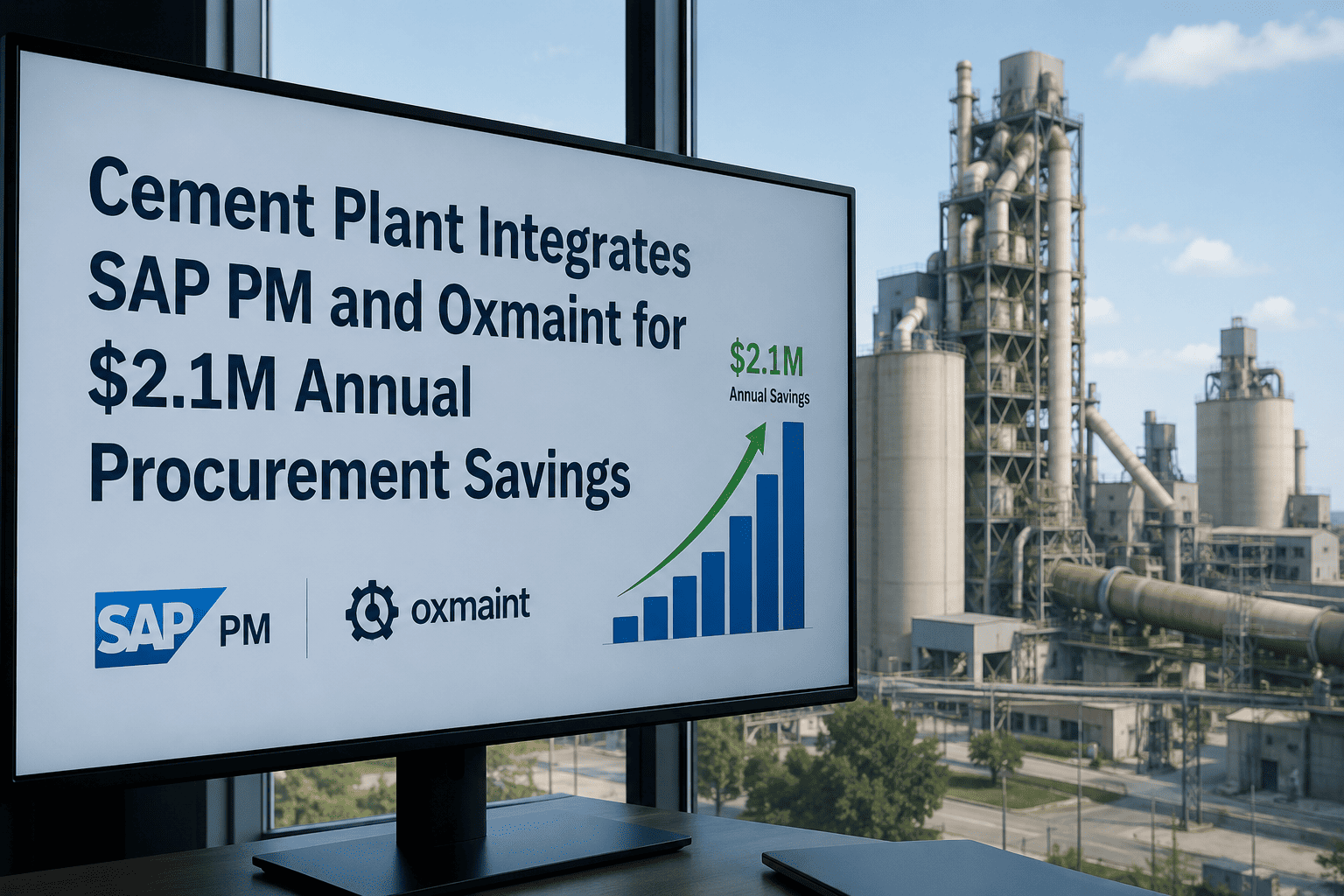
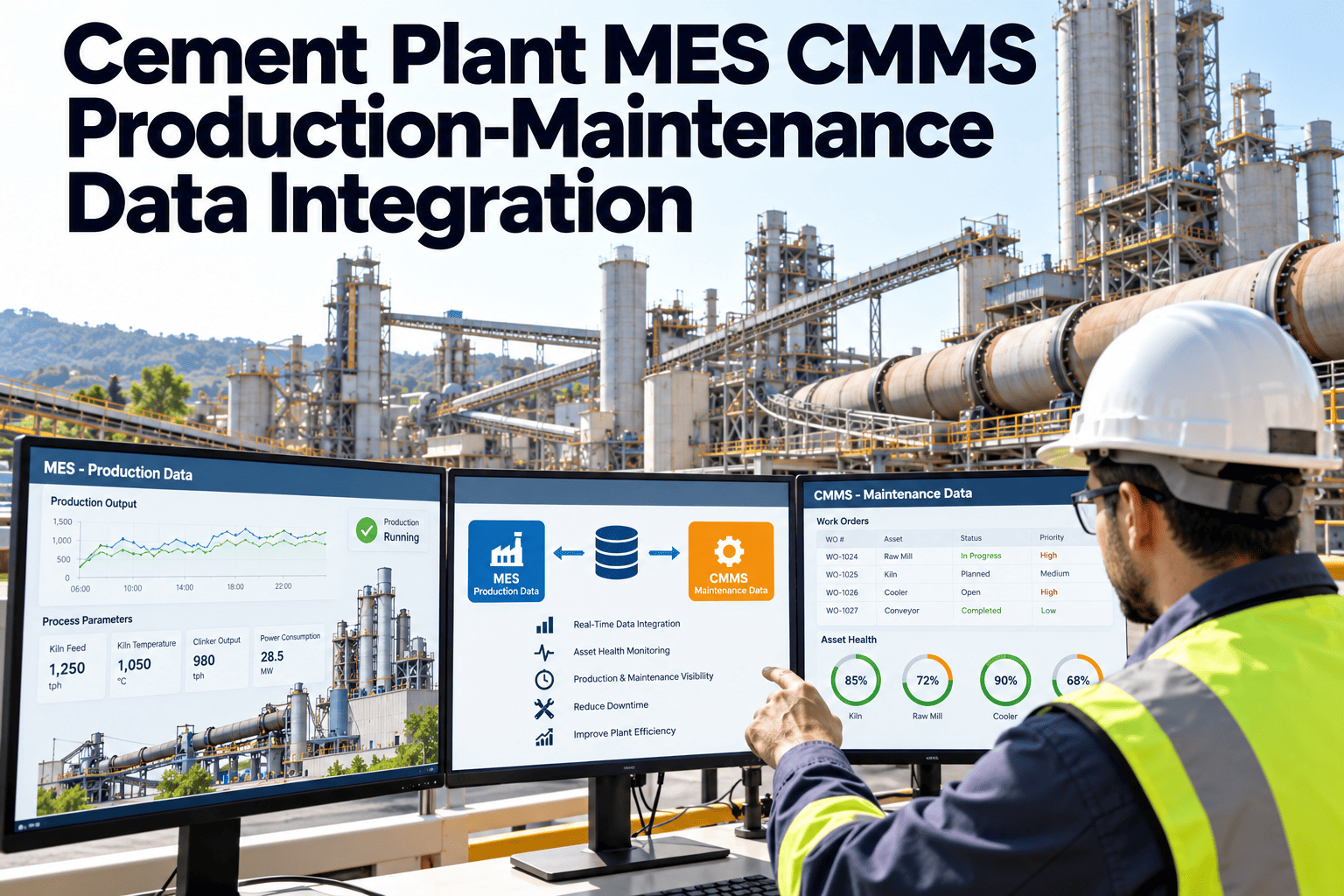
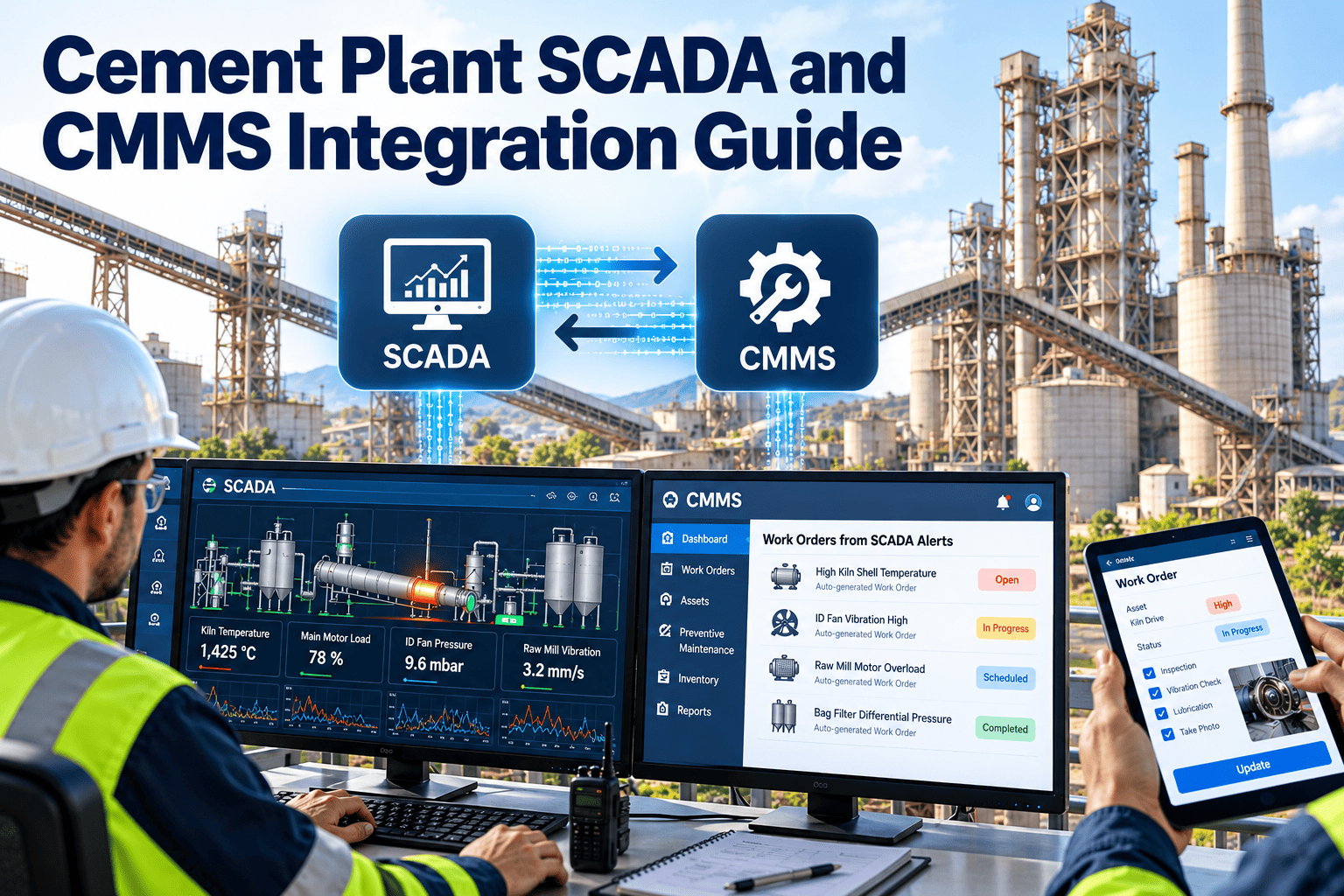
A 3.8 MTPA integrated cement plant in the midwest had been running SAP PM for six years when their procurement controller flagged an anomaly: $2.1 million in parts spend annually was untraceable to any asset on the maintenance register. The equipment master had 14,200 entries, but fewer than 40% carried a complete functional location, spare parts catalog linkage, or vendor contract reference. Every purchase order was being raised against a cost centre — not an asset — making spend analysis impossible and duplicate stock invisible. The maintenance team was ordering parts they already owned. The stores team was receiving parts with no work order to attach them to. The finance team was writing off stock that had simply been miscoded. Six months after OxMaint was integrated as the field-execution layer over SAP PM — cleaning the equipment master, linking the parts catalog, and routing every mobile work order through a structured asset hierarchy — the plant's procurement controller ran the same analysis. The answer came back clean. Sign in to OxMaint to begin your equipment master audit, or book a demo to see the SAP PM integration live.
$2.1M
Annual procurement savings recovered through equipment master cleanup and parts catalog deduplication
40%
Equipment master completion rate before integration — leaving 60% of assets with no traceable parts linkage
6 months
Time from OxMaint integration go-live to full procurement spend traceability across all asset classes
98%
Work order to asset linkage rate achieved 90 days after mobile workflow deployment on the plant floor
Plant Profile
3.8 MTPA Cement Plant — SAP PM State Before Integration
Plant Capacity
3.8 MTPA · 10,400 TPD clinker
SAP PM Version
SAP ECC 6.0 · PM Module active 6 years
Equipment Master Records
14,200 entries · 40% complete
Annual Parts Spend
$5.5M · 38% untraced to asset
Work Order Compliance
54% closed with asset reference
Duplicate Stock Identified
$480K of duplicate storeroom inventory
Why SAP PM Alone Could Not Solve the Procurement Leak
SAP PM is an enterprise system built for structured, desk-based maintenance planning. When field teams bypass it — using paper, radio, or informal verbal requests — the equipment master degrades faster than any cleanup project can repair it. Three structural gaps drove the $2.1M annual leak at this plant.
01
Mobile Bypass
Technicians on the plant floor had no mobile access to SAP PM. Work orders were written on paper, transferred to the SAP system hours or days later by planners — often with incomplete asset references. By the time the work order was closed in SAP, the parts had already been consumed and the cost coded to a generic bucket.
02
Catalog Fragmentation
The SAP MM parts catalog and the SAP PM equipment BOM were maintained by different teams with no synchronisation process. The same bearing appeared under eleven different material numbers across six vendors. Stores issued whichever number was available — creating phantom depletion signals that triggered duplicate purchase orders.
03
No Field Feedback Loop
When a technician replaced a part that was not on the equipment BOM, there was no mechanism to flag the gap. The part was consumed, the BOM stayed wrong, and the next replacement generated another untraceable purchase order. Over six years, this compounded into a catalog with over 3,200 orphaned material entries.
OxMaint · SAP PM Integration
Every untraced parts spend is a gap in your equipment master. OxMaint connects SAP PM to your plant floor so every work order closes against an asset, every part consumption updates the BOM, and every procurement decision is backed by real usage data.
How OxMaint Closed the SAP PM Execution Gap in 6 Steps
OxMaint did not replace SAP PM. It became the structured field-execution layer that SAP PM was never designed to be — feeding clean, asset-referenced data back into the enterprise system from the first day a technician opened the mobile app.
1
Equipment Master Audit
OxMaint's onboarding team extracted the full SAP PM equipment master and ran a completeness audit against five required fields: functional location, equipment category, manufacturer reference, criticality class, and parts BOM linkage. 8,520 of 14,200 records failed on at least one field. A remediation priority list was produced in week one.
2
Mobile Work Order Deployment
Every technician received the OxMaint mobile app pre-loaded with their asset hierarchy. Work orders could only be raised against a valid functional location — eliminating cost-centre-only entries at the source. The app worked offline and synced to SAP PM on reconnection, removing the paper transcription step entirely.
3
Parts Catalog Deduplication
OxMaint's catalog matching engine compared the SAP MM material master against the equipment BOMs by manufacturer part number, cross-reference code, and description similarity. 3,200 candidate duplicates were identified. The stores team validated and merged 2,840 of them over six weeks — collapsing eleven bearing entries to one.
4
BOM Update from Field Consumption
When a technician consumed a part not listed on an equipment BOM during a work order, OxMaint flagged the BOM gap and queued a planner review task. Approved additions were written back to the SAP PM equipment BOM automatically. Within 90 days, the BOM coverage rate rose from 40% to 87%.
5
Procurement Signal Cleaning
With clean BOMs and deduplicated material numbers, SAP MM's reorder signals became reliable. Min/max stock levels were recalibrated against actual consumption data from OxMaint work orders — reducing safety stock value by $310K while eliminating the emergency procurement incidents that had cost $280K the prior year.
6
Closed-Loop Spend Reporting
Finance received a monthly spend-by-asset report built from OxMaint work order data reconciled against SAP FI cost postings. For the first time, the procurement controller could trace every maintenance part purchase to a functional location, a work order, and a failure mode — making budget defence and vendor negotiations evidence-based.
Before vs After — 12 Months Post-Integration
Measured against the pre-integration baseline across procurement, stores, and maintenance planning performance metrics.
| Metric |
Before Integration |
After 12 Months |
Change |
| Annual Untraced Parts Spend |
$2.1M (38% of total) |
$140K (2.5% of total) |
93% reduction |
| Equipment Master Completion Rate |
40% |
96% |
+56 points |
| Work Order to Asset Linkage |
54% |
98% |
+44 points |
| Duplicate Material Numbers |
3,200 identified |
2,840 consolidated |
89% resolved |
| Safety Stock Value |
Baseline |
$310K reduction |
Demand-calibrated |
| Emergency Procurement Spend |
$280K / year |
$42K / year |
85% reduction |
| BOM Coverage Rate |
40% |
87% |
+47 points |
| Year-1 Net Savings (Finance Audited) |
Baseline |
$2.1M documented |
Validated |
Scroll right to see all columns
The Finance Case — Investment Against Recovered Spend
The approval memo used three numbers. The same three apply to any cement plant with a degraded SAP PM equipment master and untraced procurement spend.
One-Time Integration Cost
$88K
OxMaint configuration, SAP PM API connection, equipment master audit tooling, mobile app rollout, and technician training across all three production departments.
Annual Platform Cost
$32K
OxMaint subscription, SAP integration maintenance, and annual BOM audit service. Less than 1.5% of the procurement spend recovered in year one.
Year-1 Recovered Value
$2.1M
Untraced spend eliminated, duplicate stock liquidated, safety stock rightsized, and emergency procurement reduced. Finance-audited figure. Payback in under 3 weeks of recovered spend.
Frequently Asked Questions — SAP PM and OxMaint Integration
OxMaint · SAP PM Integration · Cement Plant Procurement
Every cement plant running SAP PM with a field team that bypasses it is writing off procurement spend it can never trace. OxMaint closes the gap between the enterprise system and the plant floor — and the savings show up in year one.
Equipment master audit. Mobile work order execution. Parts catalog deduplication. BOM update from field consumption. Closed-loop SAP PM spend reporting. All in one integration.