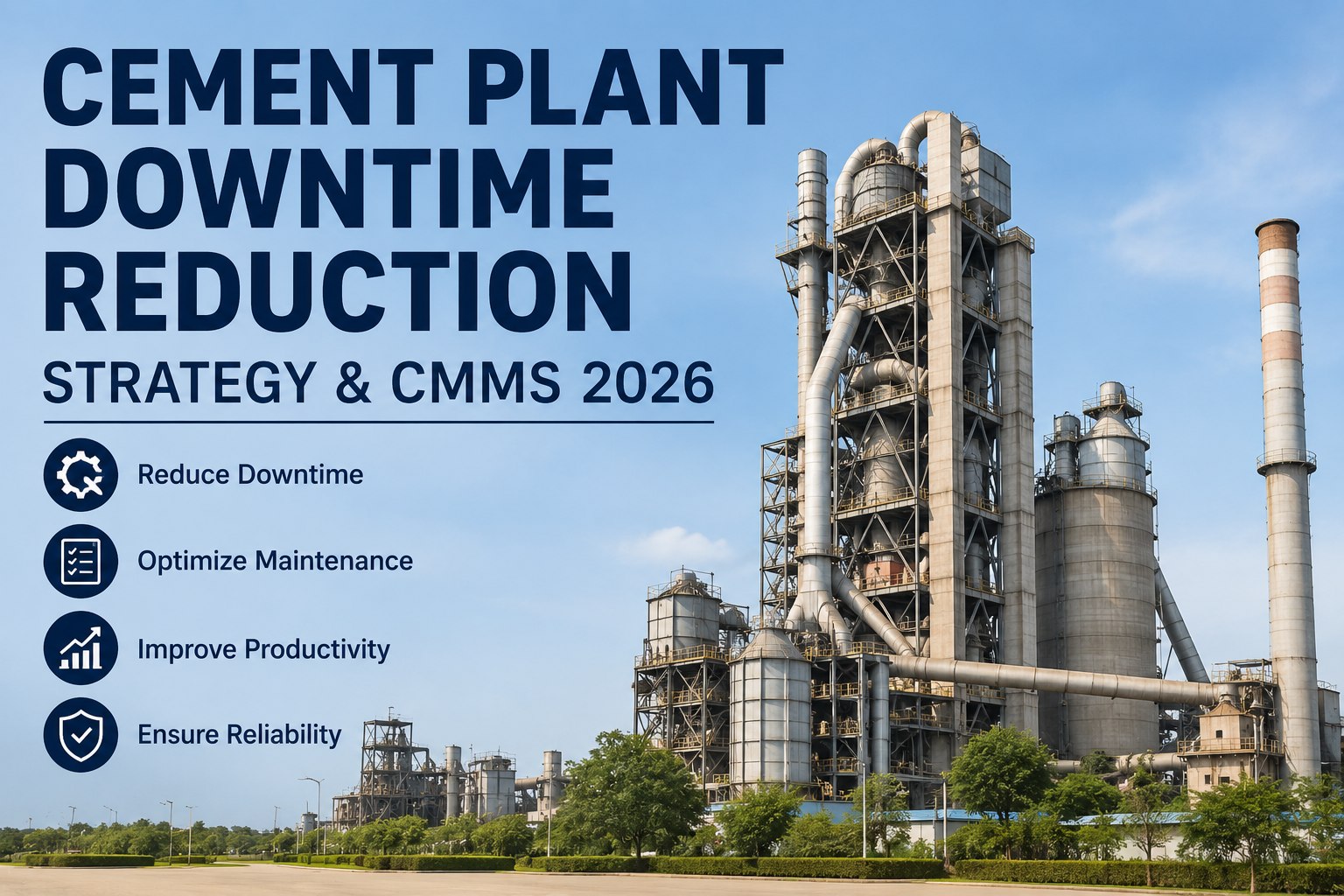
Cement Industry Case Study: OxMaint CMMS Implementation Success
By Samuel Jones on March 5, 2026
The global cement industry produces over 4.2 billion tonnes annually — and yet, most plants still lose 18–22% of production time to unplanned equipment failures. A single kiln shutdown in a mid-size cement facility costs an average of $85,000 per day in lost output and emergency labour. For Meridian Cement Group, a 2.8 MTPA multi-kiln operation, those numbers were no longer acceptable. In 2023, their maintenance director put it plainly: "We were spending $4.2 million a year firefighting breakdowns we should have seen coming three weeks earlier." This is the documented story of how Meridian deployed OxMaint CMMS across their full plant operations — from raw material crushers and rotary kilns to finish grinding circuits and bag-filter systems — and what happened over the 12 months that followed. If your plant faces similar challenges, sign up for OxMaint free and begin your own transformation today.
Documented Industry Case Study — Cement Sector
Cement Industry Case Study: OxMaint CMMS Implementation Success
How a 2.8 MTPA cement manufacturer cut unplanned downtime by 64%, reduced maintenance spend by 31%, and achieved 91% kiln utilization within 12 months of deploying OxMaint CMMS.
Rotary Kiln OptimizationPreventive MaintenanceWork Order AutomationAsset Lifecycle ManagementHSE Compliance
Client Profile: Meridian Cement Group
Annual Capacity
2.8 MTPA
Production Lines
3 Kiln Lines
Workforce
640 Employees
Maintenance Team
84 Technicians
Registered Assets
2,200+ Equipment Items
CMMS Go-Live
Q1 2023
The Breaking Point: Why the Old System Failed
Before OxMaint, Meridian operated on a hybrid of paper-based work orders, disconnected Excel maintenance logs, and a decade-old legacy CMMS that could not run on mobile devices. Maintenance supervisors spent an estimated 11 hours per week manually compiling reports. Field technicians carried printed checklists. Spare parts were stockpiled without consumption data — and yet critical components still ran out during emergency repairs. Three systemic failures drove leadership to act.
Reactive-Only Culture
78% of all maintenance work orders were reactive emergency repairs. PM schedules existed on paper but completion rates averaged only 41% — meaning most preventive tasks were skipped entirely.
41% PM Completion Rate
Kiln Utilization Crisis
Rotary kiln lines averaged 74% utilization due to unscheduled stops. Each major unplanned kiln outage triggered cascading delays across grinding, packing, and dispatch — costing $85K–$120K per incident.
74% Kiln Utilization
Compliance & Audit Gaps
HSE audit trails were fragmented across three departments. LOTO procedure records, confined space permits, and emission-related calibration logs existed in separate systems — creating recurring regulatory exposure.
3 Disconnected Systems
Industry Context: According to the Global Cement and Concrete Association, maintenance-related downtime accounts for 60–70% of all unplanned production losses in cement plants. Plants operating without a digital CMMS report 2.3× higher emergency repair frequency than digitally-managed facilities.
The Implementation: 4 Phases Across 12 Months
Meridian's deployment was structured as a phased rollout to minimise operational disruption. OxMaint's implementation team embedded on-site for the first 60 days to configure asset hierarchies, build PM templates, and train maintenance supervisors. Want to see how this rollout would look at your facility? book a personalised demo with OxMaint's cement specialists.
Phase 1
Asset Registry & Digital Foundation Weeks 1–6
2,200+ assets catalogued with QR codes, criticality ratings, and OEM maintenance specifications. Equipment hierarchy built: Plant → Area → System → Component. Historical failure data imported to seed predictive baselines.
Outcome: 100% asset visibility for the first time in the plant's history
Phase 2
PM Programme Digitalisation Weeks 7–14
450 preventive maintenance task templates created covering kiln drives, refractory inspection, ball mill lubrication, crusher liner monitoring, and bag-filter pulse-jet cleaning. OEM schedules mapped to OxMaint trigger rules (calendar, runtime hours, and condition-based).
Outcome: PM backlog eliminated; auto-scheduling activated for 84 technicians
Phase 3
Work Order Automation & Mobile Rollout Weeks 15–24
All 84 technicians issued OxMaint mobile access. Work orders auto-generated from PM triggers and sensor alerts. Technicians close jobs on-site with photo evidence, parts consumed, and time logged. Supervisors receive real-time completion dashboards.
Outcome: Average work order turnaround cut from 4.8 days to 18 hours
Real-time KPI dashboards deployed for plant manager, area supervisors, and HSE team. LOTO permit workflows, confined space entry checklists, and emission-calibration logs fully digitised. Monthly performance reports auto-generated for board-level review.
Outcome: Audit preparation time reduced from 3 weeks to 2 days
The Results: 12-Month Performance Data
The numbers below represent verified operational data from Meridian's 12-month post-implementation review. These figures reflect real improvements across maintenance efficiency, asset reliability, energy consumption, and safety performance. Facilities ready to replicate these outcomes can start a free trial of OxMaint and configure their own asset registry within hours.
64%
Reduction in Unplanned Downtime
From 22% to 8% of production time
31%
Reduction in Annual Maintenance Cost
From $4.2M to $2.9M per year
91%
Kiln Utilization Rate
Up from 74% pre-implementation
94%
PM Completion Rate
Up from 41% — 2.3× improvement
Before OxMaint CMMS
Unplanned Downtime22% of runtime
PM Completion Rate41%
Kiln Utilization74%
Annual Maintenance Cost$4.2M
Emergency Work Orders78% of total
Work Order Turnaround4.8 days avg
Mean Time Between FailureLow — undocumented
Audit Preparation Time3 weeks
HSE Safety Incidents14 per year
Energy Cost per TonneBaseline (Index 100)
After OxMaint CMMS (12 Months)
Unplanned Downtime8% of runtime
PM Completion Rate94%
Kiln Utilization91%
Annual Maintenance Cost$2.9M
Emergency Work Orders22% of total
Work Order Turnaround18 hours avg
Mean Time Between Failure+67% improvement
Audit Preparation Time2 days
HSE Safety Incidents6 per year (−57%)
Energy Cost per TonneIndex 88 (−12%)
ROI Snapshot: Where the $1.3M Annual Saving Came From
Emergency Repair Labour Reduction
$462,000 / yr
Spare Parts Inventory Optimisation
$290,000 / yr
Kiln Uptime Revenue Recovery
$238,000 / yr
Energy Efficiency Gains
$172,000 / yr
Compliance & Audit Cost Savings
$138,000 / yr
Total Verified Annual Savings
$1,300,000
Proven in Cement. Ready for Your Plant.
See How OxMaint Transforms Cement Plant Maintenance
Join the growing number of cement manufacturers using OxMaint to eliminate reactive maintenance, protect kiln uptime, and cut maintenance spend by up to 35%. Your implementation roadmap starts with a 30-minute conversation.
Department-Level Impact: What Changed on the Ground
Kiln Operations
Refractory brick inspection intervals shifted from visual monthly walks to condition-triggered OxMaint work orders. Kiln shell scanning data was integrated directly into asset records, extending average lining life by 18% and preventing two unscheduled kiln shutdowns in Year 1.
+17% Lining Life Extension
Grinding & Milling
Ball mill lubrication schedules, liner wear tracking, and separator maintenance were consolidated into OxMaint. Technicians received automated task reminders with step-by-step mobile checklists — eliminating the "I forgot" failures that had been causing premature bearing replacements.
−44% Bearing Failures
HSE & Compliance
Digital LOTO permits, confined space entry procedures, and environmental calibration records replaced fragmented paper trails. OxMaint's compliance module auto-escalated overdue safety checks to the plant HSE manager, ensuring 100% of critical safety tasks were documented before job execution.
−57% Safety Incidents
Spare Parts & Procurement
Real consumption data from closed work orders allowed the stores team to right-size inventory for the first time. Over-stocked items were reduced by 28%, while critical spares availability increased to 97%. Stockout-related delays dropped by 71% in the second half of the year.
−71% Stockout Delays
Energy & Utilities
Compressed air leaks and inefficient drive scheduling were flagged through OxMaint's recurring inspection tasks for utilities. Motor efficiency degradation was tracked across 180+ drives, and replacement decisions were data-backed — contributing to the 12% energy cost reduction per tonne.
−12% Energy Cost/Tonne
Management & Reporting
The plant manager's weekly board pack shifted from manual compilation (8 hours) to automated OxMaint dashboard export (15 minutes). Board-level KPIs — OEE, maintenance cost per tonne, PM compliance, and incident rates — updated in real-time, enabling faster capital allocation decisions.
−94% Reporting Time
Key Adoption Challenges — and How They Were Overcome
01
Technician Resistance to Mobile Devices
Approximately 30% of senior technicians were initially reluctant to adopt mobile work order management, preferring paper job cards. OxMaint's onboarding team ran hands-on workshops at the plant, using real assets from Meridian's own registry as training scenarios. Within 6 weeks, mobile adoption reached 96%.
02
Incomplete Historical Asset Data
Much of Meridian's equipment history existed only in the minds of long-serving technicians or in filing cabinets. OxMaint's structured data-capture templates and QR code scanning allowed the team to build a complete asset register progressively — starting with critical Tier 1 assets and expanding outward over 90 days.
03
Integrating OEM Documentation at Scale
With 2,200+ assets across three kiln lines, attaching OEM manuals and maintenance specifications felt overwhelming. OxMaint's bulk upload and document-linking features allowed the maintenance planning team to attach PDFs directly to asset records in batches, completing the documentation library in 8 weeks.
"
Within six months of OxMaint going live, our maintenance manager knew — for the first time — which assets were costing us the most, where our technicians' time was actually going, and what we needed to order before the next shutdown. That visibility changed everything.
— Operations Director, Meridian Cement Group
Month-by-Month: Unplanned Downtime Reduction (%)
22%
M1
20%
M2
18%
M3
16%
M4
14%
M5
12%
M6
10%
M7
9%
M8
8.5%
M9
8%
M10
8%
M11
8%
M12
Unplanned downtime as % of scheduled production time. Target threshold: below 10%.
5 Transferable Lessons From Meridian's Implementation
1
Start with critical assets only. Meridian began with the 180 assets that caused 80% of downtime events. Full asset coverage came later — but ROI was visible within 60 days.
2
Win supervisors before technicians. When shift supervisors championed OxMaint, technician adoption followed within weeks. Supervisor buy-in was achieved through a live dashboard demo using their own plant data.
3
PM template quality matters more than quantity. 450 well-structured PM templates outperformed their previous 900 vague paper checklists. Fewer tasks completed with higher fidelity produces better reliability outcomes.
4
Spare parts data is a CMMS multiplier. Connecting consumption data to inventory unlocked $290,000 in annual savings that had been invisible under the old system. This benefit was not anticipated at project start.
5
Define your KPIs before go-live. Teams that established clear success metrics in Week 1 (downtime %, PM rate, cost/tonne) had 40% faster improvement cycles than teams tracking retroactively.
Ready to Write Your Own Case Study?
OxMaint is purpose-built for heavy industrial operations. Whether you operate one kiln line or ten, our platform deploys in weeks — not months — and delivers measurable ROI within the first quarter. No long-term contracts. No IT team required.
How long does OxMaint CMMS take to deploy in a cement plant of this size?
For a plant with 2,000–3,000 assets, initial deployment typically takes 6–8 weeks from kick-off to first live work orders. Meridian completed their Phase 1 asset registry and PM template setup within 6 weeks using OxMaint's cement-specific onboarding programme. Full adoption across 84 technicians was achieved by Week 14.
Q
Does OxMaint integrate with existing DCS or SCADA systems used in cement plants?
Yes. OxMaint provides API-based integrations with major industrial control systems, historian databases, and IoT sensor platforms. Condition-based maintenance triggers can be configured to automatically generate work orders when sensor readings cross defined thresholds — connecting your process control data directly to maintenance execution without manual intervention.
Q
What is the typical ROI timeline for a cement plant implementing OxMaint?
Most cement plant customers see their OxMaint investment pay back within 6–10 months of go-live, primarily through reductions in emergency repair labour, spare parts rationalisation, and kiln uptime recovery. Meridian's documented payback period was 8 months on a $1.3M annual saving against total implementation and licensing costs.
Q
Can OxMaint handle cement-specific assets like rotary kilns, ball mills, and bag-filter systems?
OxMaint includes a library of cement industry asset templates covering rotary kilns, vertical roller mills, ball mills, cyclone preheaters, bag-filter and electrostatic precipitator systems, clinker coolers, and crushers. Each template includes pre-built PM tasks aligned to common OEM maintenance schedules, which can be customised to match your specific equipment configurations.
Q
How does OxMaint support HSE compliance in cement manufacturing environments?
OxMaint's compliance module digitalises LOTO permit-to-work workflows, confined space entry procedures, hot work permits, and environmental calibration records. Overdue safety tasks auto-escalate to designated HSE managers. All completed safety documentation is stored with timestamps and technician sign-off — providing the audit-ready evidence trail required for OSHA, ISO 45001, and local regulatory inspections.
Q
What happens to existing maintenance data when migrating to OxMaint?
OxMaint supports bulk data import via CSV and Excel, enabling migration of existing asset lists, historical work order records, spare parts catalogues, and maintenance schedules. For facilities with legacy CMMS data, the OxMaint onboarding team provides a structured data migration service to ensure historical failure records are preserved and accessible in the new system from day one.
Q
Is OxMaint suitable for smaller cement plants with fewer than 500 employees?
Absolutely. OxMaint scales from single-kiln operations to multi-plant enterprises. Smaller plants benefit from the same PM automation, mobile work order management, and KPI dashboards — often achieving faster adoption timelines due to simpler organisational structures. OxMaint's pricing model means smaller operations are not paying for enterprise feature sets they do not need.
Related Resources for Cement Plant Optimization
Explore these in-depth guides built specifically for cement plant maintenance and operations professionals.