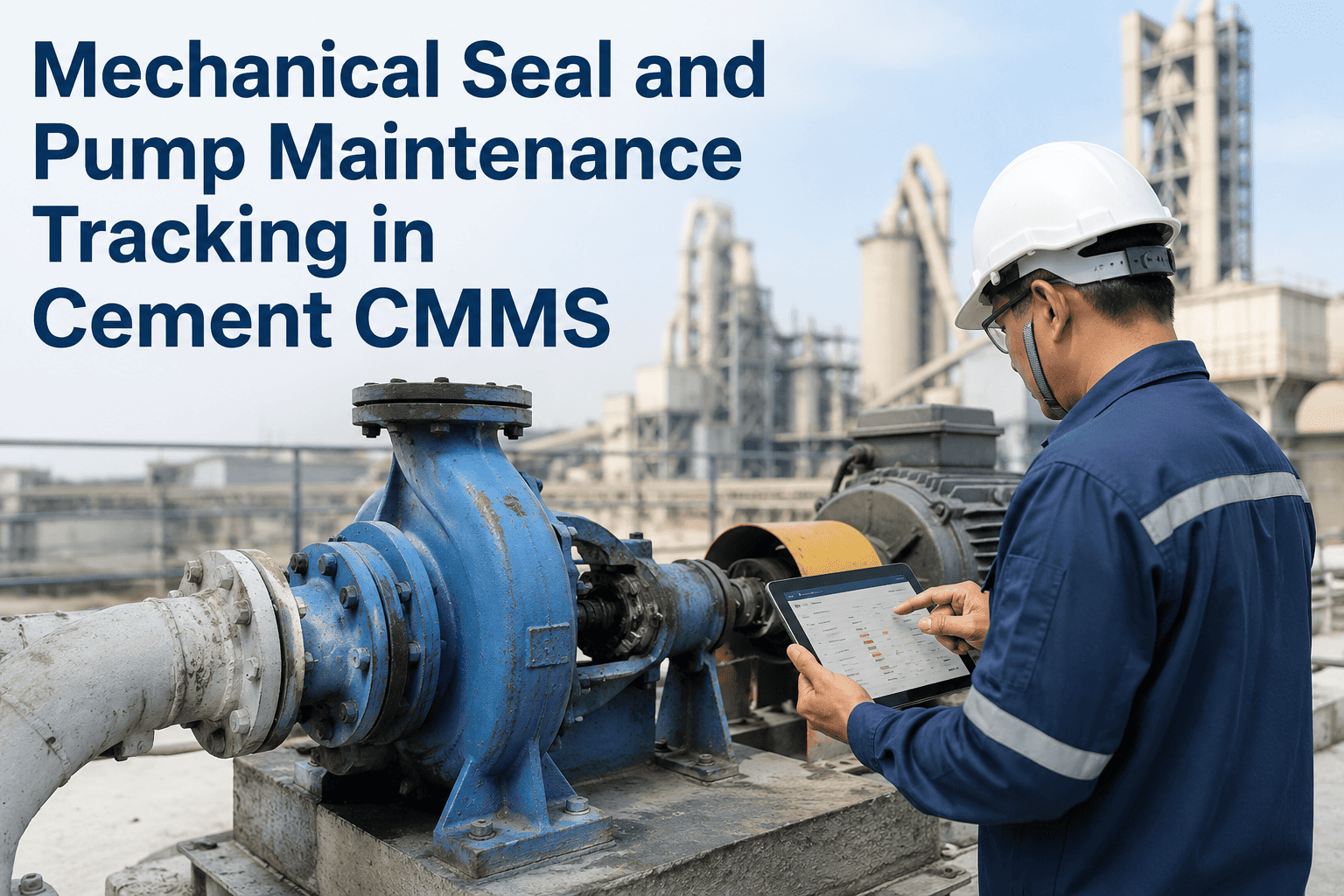
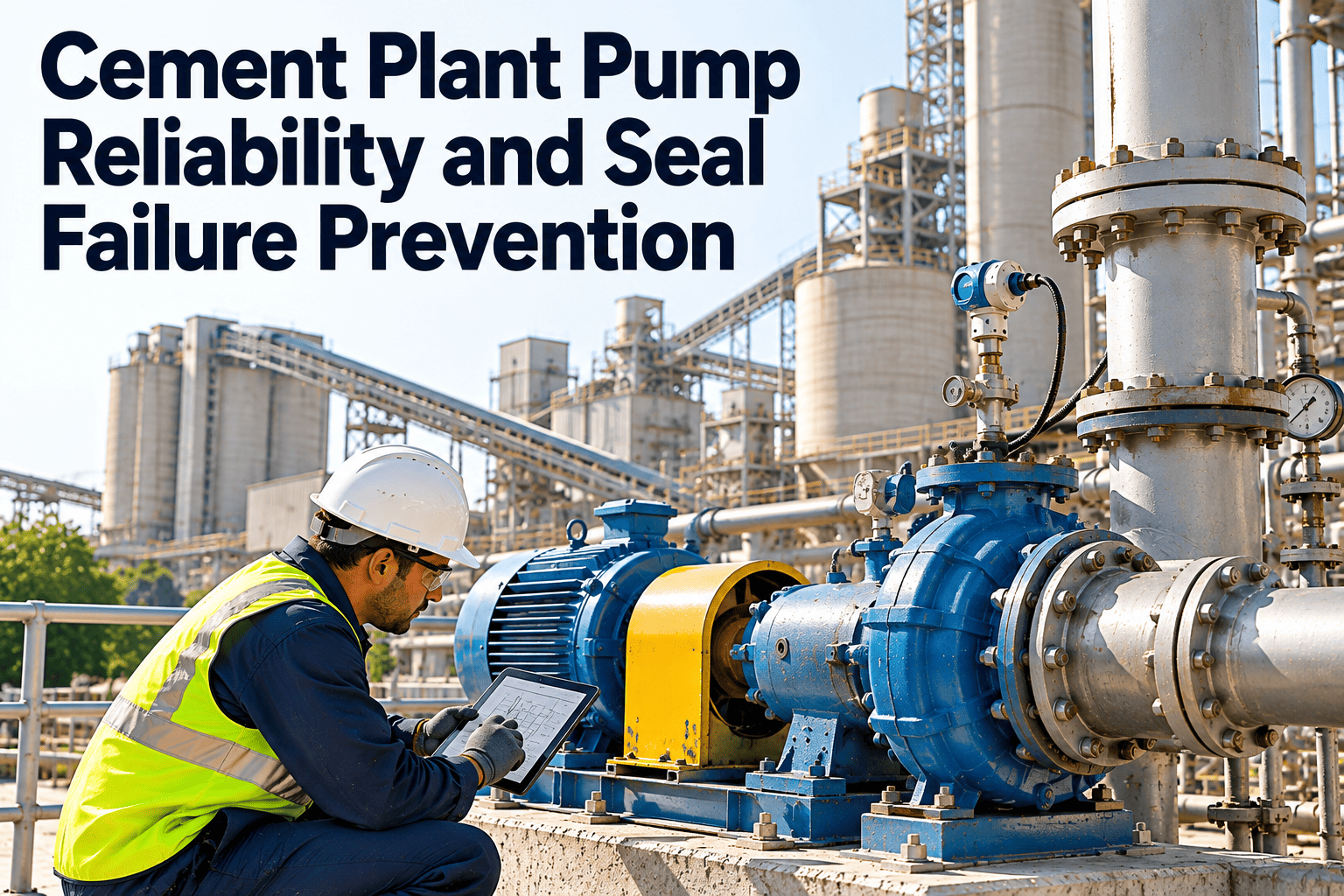
Pump and mechanical seal failures are among the most frequent reactive work order categories in cement plant maintenance — yet they remain among the least systematically managed. In cooling water, lubrication, and slurry pump systems, seals are routinely treated as consumable spare parts: replaced when they leak, binned without failure cause data, and scheduled for the next replacement on a manufacturer's default interval that bears no relationship to your plant's actual fluid conditions, operating temperatures, or duty cycles. This approach guarantees repeat failures from the same root causes. A CMMS-integrated seal life tracking programme treats every mechanical seal as the rotating asset it actually is — with its own installation record, service history, failure cause log, and data-driven replacement interval calibrated to your specific pump-fluid combinations. Plants that make this transition consistently report 35–50% extension in mean seal life and 60–75% reduction in emergency pump repairs within 12 months. OxMaint's asset management system captures seal data automatically from normal work order workflow — no separate tracking system, no additional data entry burden on your technicians.
Pump Reliability — Cement Plants
Pump Seal Failures Account for 12% of All Cement Plant Work Orders — and Most Plants Have No Data on Why They Keep Happening.
In a typical cement plant, a slurry pump seal fails, the technician replaces it, the pump goes back online — and within 800 hours the same seal fails again from the same cause in the same circuit. No failure mode was recorded. No root cause was identified. No replacement interval was adjusted. The seal was treated as a consumable, so the failure was treated as routine. It is not routine — it is a systematic gap in how cement plants manage pump assets. OxMaint CMMS tracks every mechanical seal as a rotating asset with installation data, operating conditions, accumulated service hours, and failure cause — building the circuit-specific data set that extends mean seal life by 35–50% and converts your worst pump circuits from chronic failure generators into predictable, planned maintenance events.
Why Treating Seals as Consumables Is an Expensive Mistake
In most cement plants, a failed mechanical seal triggers the same workflow as a used-up filter bag — it gets replaced, the pump goes back online, and no data is captured. The next seal fails in the same way, from the same cause, in the same timeframe. And the cycle repeats indefinitely.
How Most Plants Treat Seals
Seals binned by item number — no individual tracking
Replacement triggered by visible leakage — after fluid contact with bearings
Failure cause undocumented — root cause never identified
Service life unknown — intervals based on manufacturer spec, not actual conditions
Repair cost absorbed into "pump maintenance" — no per-asset visibility
Next failure happens for the same reason, on the same schedule
How CMMS-Tracked Plants Treat Seals
Each seal tracked as a rotating asset with installation date, fluid service, and operating conditions
Replacement scheduled from actual hours-in-service, not visible failure
Failure cause logged per event — wear patterns mapped to root cause
Service life intervals updated from plant-specific data, not generic specs
Seal cost tracked per pump, per system — financial visibility by asset
Mean seal life extended 35–50% within 12 months of systematic tracking
Cement Plant Pump Systems That Require Seal Life Tracking
Not all seal environments carry equal risk. In a cement plant, fluid type, operating temperature, and suspended solids concentration determine seal life — and these conditions vary dramatically across systems.
FluidRaw meal slurry — abrasive, variable pH
Temp Range40–90°C
Primary FailureAbrasive wear on seal faces, solids intrusion
Typical Seal Life800–1,400 hrs without CMMS tracking
With Tracking1,200–2,100 hrs — 50%+ improvement
FluidTreated water — scale-forming potential
Temp Range20–55°C
Primary FailureScale buildup on seal faces, dry-run events
Typical Seal Life2,000–3,500 hrs without systematic tracking
With Tracking3,000–5,000 hrs — 40–45% improvement
FluidMineral oil — cleanliness critical
Temp Range35–80°C
Primary FailureThermal degradation, O-ring compatibility issues
Typical Seal Life4,000–7,000 hrs without tracking
With Tracking6,000–10,000 hrs — 35–40% improvement
FluidHeavy fuel oil or coal water mixture
Temp Range60–130°C
Primary FailureHigh-temperature degradation, coking on faces
Typical Seal Life1,500–2,500 hrs without systematic replacement
With Tracking2,200–3,800 hrs — 35–52% improvement
Start Tracking Seal Life the Way You Track Rotating Assets
OxMaint treats every mechanical seal as a rotating asset with its own maintenance record — installation date, fluid service, operating conditions, and failure cause. No additional system required.
Cement Plant Seal Failure Modes — and What CMMS Data Reveals
Every failed mechanical seal tells a story. CMMS failure cause logging converts that story into a data set — identifying chronic failure patterns across pump fleets that single-event observation never catches.
| Failure Mode |
Root Cause |
CMMS Detection Signal |
Preventive Action |
Frequency Without CMMS |
| Abrasive face wear |
Solids in slurry exceeding face material rating |
Repeat seal failures in same pump, short intervals |
Upgrade to harder face material, review flush plan |
Every 800–1,000 hrs |
| Dry-run damage |
Pump run without fluid — startup errors or cavitation |
Immediate post-startup seal failure pattern |
CMMS startup checklist gate — fluid confirmed before start |
3–6 events per year |
| Thermal cracking |
Operating temperature above seal material rating |
Seal life shortening trend correlated to summer months |
Material upgrade, cooling flush plan adjustment |
Every 6–12 months |
| Scale deposit failure |
Scaling on faces from hard water — cooling systems |
Progressive seal life shortening in cooling water circuit |
Water treatment review, flush plan upgrade |
Annual pattern — missed without tracking |
| Misalignment fatigue |
Pump shaft misalignment — mechanical or thermal |
Short seal life with corresponding bearing wear notes |
Alignment verification added to PM task list |
Chronic — never identified without CMMS |
| O-ring incompatibility |
Elastomer material reacting to fluid chemistry |
Systematic failures in specific fluid circuits only |
Material selection review — circuit-specific seal spec |
One-time — identified only by circuit pattern |
How OxMaint Tracks Mechanical Seal Life in Cement Plants
OxMaint converts seal tracking from a manual logging exercise into an automatic output of normal maintenance workflow — capturing the data that drives interval optimisation without creating a separate data entry burden.
1
Seal Installed as Asset Record
When a seal is installed, the work order captures pump ID, seal serial/lot number, fluid service, operating temperature range, and installation date. This creates the seal's individual asset record — the starting point for all life tracking.
2
Operating Hours Accumulate Automatically
Linked to pump run-hour data or estimated from work order dates, OxMaint accumulates operating hours against each seal record — enabling hour-based replacement scheduling rather than calendar or failure-triggered replacement.
3
Replacement Alert Before Failure Window
When accumulated hours approach the plant-calibrated replacement threshold for that seal-fluid combination, OxMaint generates a planned replacement work order — before the seal enters the statistically high failure risk window. No leak required to trigger replacement.
4
Failure Cause Logged at Removal
If a seal fails before the planned replacement window, the removal work order captures failure mode, visual condition, and probable cause from a structured field list. This data updates the failure pattern database for that pump-fluid circuit.
5
Interval Optimisation from Fleet Data
After 10–15 seal replacement events per circuit, OxMaint's analytics show the actual distribution of seal life for that pump-fluid combination — enabling replacement intervals calibrated to your plant's specific conditions, not generic manufacturer specifications.
What Systematic Seal Tracking Delivers in 12 Months
35–50%
Mean seal life extension
From data-driven replacement intervals calibrated to actual fluid conditions in your plant
60–75%
Reduction in emergency pump repairs
Planned seal replacement eliminates the cascade of bearing damage from late-detected seal leakage
5–9×
Cost multiplier eliminated
A seal that runs to failure contaminates fluid, damages bearings, and can require full pump rebuild
73%
Root cause findings closed correctly
Sensor-backed RCA with CMMS history closes repeat failures — the same failure stopped from recurring
Every Seal You Replace Without Logging Its Cause Is a Failure You Will Repeat
OxMaint captures failure mode, operating conditions, and seal life at every replacement event — building the data set that ends chronic failures in your worst pump circuits. Start free today.
Frequently Asked Questions
Why should mechanical seals be tracked in a CMMS rather than as spare parts?
Because seals are repairable, have individual failure histories, and fail due to system conditions — not random chance. Treating them as spare parts groups them by item number in a bin, capturing only inventory consumption. Tracking them as rotating assets in
OxMaint captures failure cause, operating conditions, and service life — the data that drives interval optimisation and eliminates repeat failures from the same root cause.
What data should be captured when a mechanical seal is replaced in a cement plant?
Minimum data: pump ID, seal ID or lot, installation date, fluid service, operating temperature, and hours in service at removal. If the seal failed before its planned replacement window: failure mode, visual condition at removal, and probable root cause. This set of fields — captured at every replacement event — is what enables interval optimisation and chronic failure elimination within 12–18 months of consistent tracking.
Which cement plant pump systems have the highest seal failure rates?
Slurry pumps in raw material circuits carry the highest failure rate due to abrasive solids contact with seal faces. Kiln burner fuel pumps are the highest consequence failures — a burner pump seal failure can force a kiln shutdown. Cooling water pumps are the highest volume replacement event. All three warrant dedicated CMMS tracking and
interval optimisation programmes.
How long does it take to see seal life improvement from CMMS tracking?
Interval optimisation requires 10–15 seal replacement data points per pump-fluid circuit — typically 6–12 months in high-frequency circuits like slurry pumps. Root cause elimination from failure mode logging starts delivering results within the first 3 months, as chronic repeat failures from the same cause are identified and addressed.
Can OxMaint trigger automatic seal replacement work orders based on operating hours?
Yes. OxMaint generates planned replacement work orders when accumulated operating hours approach the configured threshold for each seal-fluid combination. As your plant's actual service life data accumulates, those thresholds update from real performance data — creating a continuously improving replacement schedule rather than a fixed manufacturer-default interval.
Stop Replacing Seals. Start Eliminating Seal Failures.
OxMaint deploys in cement plants within 48 hours — first pump seal records active before end of week one. No manual spreadsheets, no separate tracking system, no configuration consultants required.