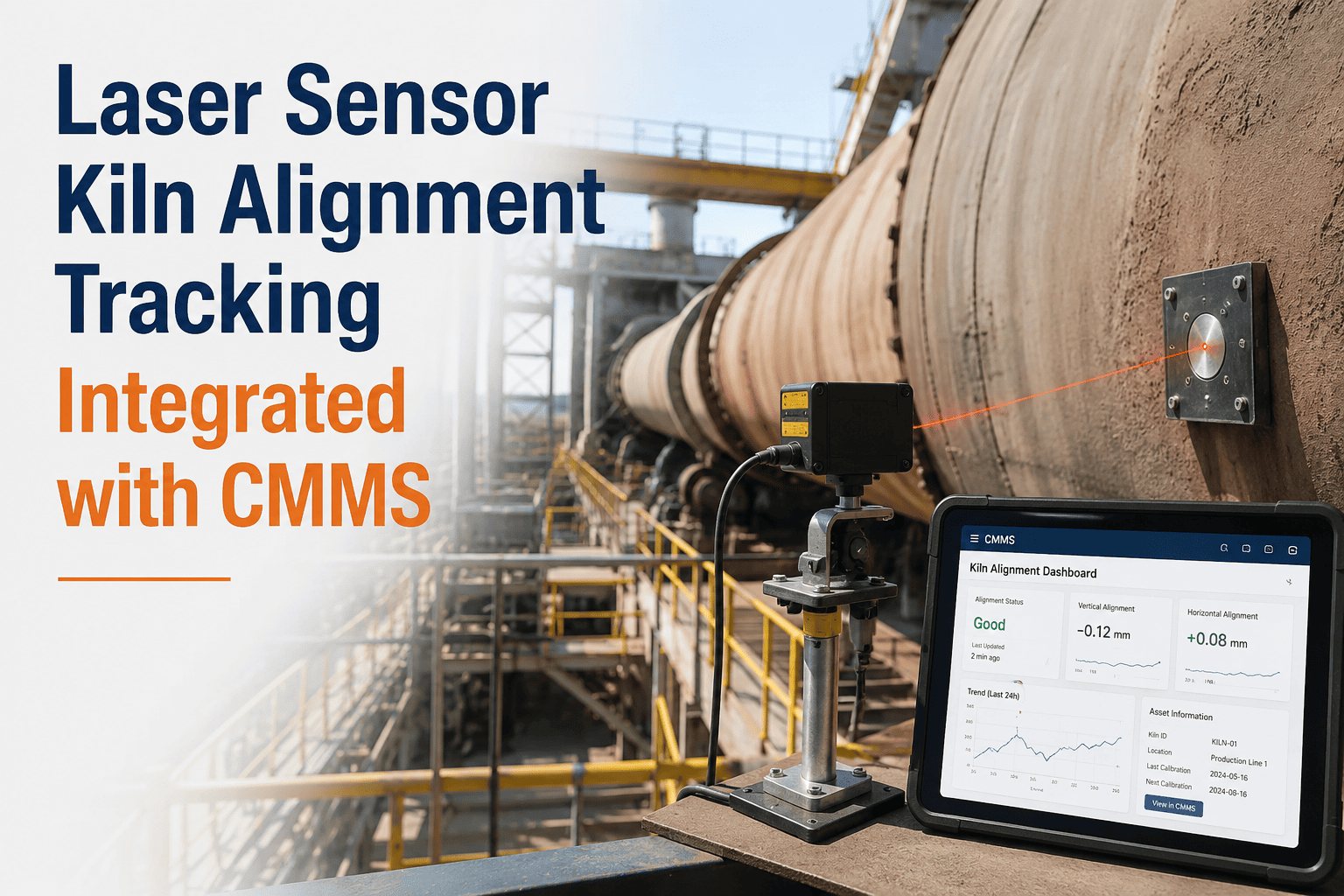
Rotary kiln misalignment is one of the most expensive mechanical failures a cement plant can experience — damage to the shell, destruction of refractory lining, and unplanned downtime combine to produce losses between $180,000 and $420,000 per misalignment event. The problem with traditional alignment surveys is that they happen quarterly or annually, long after deviation has already caused damage. Continuous laser sensor alignment monitoring changes this completely: real-time tyre and roller position data feeds directly into a CMMS platform like OxMaint, triggering corrective maintenance scheduling the moment deviation approaches a critical threshold — not after it crosses one.
Cement Plant · Rotary Kiln · Laser Alignment Monitoring
Laser Sensor Kiln Alignment Tracking Integrated with CMMS
Traditional kiln alignment surveys are snapshots in time. Continuous laser monitoring is a live feed — catching drift as it begins, not after it has already cracked your shell or destroyed your refractory. Integrated with CMMS, it becomes automatic corrective action.
$180K – $420K
per misalignment event (shell, refractory, downtime combined)
0.5 mm
laser sensor detection threshold — catches what manual surveys miss
24/7
continuous monitoring vs once-per-quarter manual surveys
Why Misalignment Happens
Six Root Causes of Rotary Kiln Misalignment — and Why Manual Surveys Miss Them All
Kiln misalignment rarely happens in a single event. It accumulates gradually through operating conditions that change between survey windows — which is why quarterly manual alignment checks leave plants exposed for months at a time.
01
Foundation Settlement
Differential settling of kiln pier foundations shifts support points by 1–3 mm over months, bending the kiln axis out of the designed straight line.
02
Thermal Expansion Cycling
Daily start-stop cycles cause the shell to expand and contract unevenly — gradually shifting roller positions relative to the original alignment baseline.
03
Tyre and Roller Wear
As tyres and rollers wear unevenly, the contact geometry changes — progressively shifting the kiln axis even when foundation and shell are intact.
04
Shell Ovality
Tyre creep-induced ovality changes the effective centre of the shell at each tyre station — creating apparent misalignment that is actually a deformation problem.
05
Roller Skew Drift
Roller skew adjustments made to control axial thrust gradually accumulate into angular misalignment if not tracked systematically across all stations.
06
Liner and Refractory Loading
Heavy refractory relining at one station without re-alignment survey shifts the load distribution and bends the kiln axis by 0.5–2 mm at adjacent stations.
Laser Technology
How Continuous Laser Sensors Monitor Kiln Alignment in Real-Time
Laser sensor systems establish a fixed reference line along the kiln axis — typically via a precision-mounted laser tracker or multiple fixed-point laser displacement units at each tyre station. Deviation from this reference is measured continuously and transmitted to the CMMS.
What Laser Sensors Measure
Radial deviation of tyre centre from kiln axis reference — horizontal and vertical planes simultaneously
Roller centre position relative to tyre contact line — detects skew before it becomes thrust-bearing damage
Shell deflection profile between tyre stations — identifies intermediate sag or bend in the shell body
Tyre face runout — quantifies ovality at each revolution for shell deformation trending
Laser Sensor Accuracy Specs
Measurement Resolution
±0.1 – 0.5 mm
Operating Temperature
Up to 150°C ambient
Sampling Rate
1 – 10 Hz continuous
Communication
4–20 mA, OPC-UA, Modbus
CMMS Trigger Threshold
Configurable per station
Real-Time Alignment + CMMS Automation
Connect your laser sensors to automatic work order scheduling — corrective action happens before your kiln breaks, not after.
OxMaint receives continuous laser sensor data, compares it against your plant-specific alignment thresholds, and auto-generates correction work orders with full technician assignment and audit logging — no manual monitoring required.
CMMS Integration
Laser Sensor Data to CMMS Work Order — The Complete Integration Path
Step 1
Data Ingestion
Laser sensor outputs connect to plant historian or directly to OxMaint via OPC-UA or Modbus TCP. Each tyre station reports independently at configurable intervals.
Step 2
Deviation Trending
OxMaint tracks rolling deviation averages per station, distinguishing one-revolution noise from genuine progressive misalignment trends that require corrective action.
Step 3
Threshold Alert
When deviation crosses the configured watch or alarm threshold, CMMS sends immediate notification to the responsible shift supervisor and maintenance planner simultaneously.
Step 4
Work Order Creation
A pre-configured alignment correction work order is auto-generated with the affected tyre station, current deviation value, recommended adjustment direction, and assigned crew.
Step 5
Post-Correction Logging
After adjustment, sensor data is automatically logged against the closed work order — creating a full audit trail of deviation history, corrective action, and outcome in one record.
Manual vs Continuous
Traditional Alignment Survey vs Continuous Laser Monitoring
| Parameter |
Manual Survey (Traditional) |
Continuous Laser Monitoring |
| Measurement frequency |
Quarterly or at shutdown |
Continuous — every revolution |
| Time between deviation and detection |
Up to 90 days |
Minutes to hours |
| Detection threshold |
2 – 5 mm (operator dependent) |
0.1 – 0.5 mm (sensor dependent) |
| Requires kiln shutdown |
Yes — full cold survey |
No — operates at full production |
| CMMS work order trigger |
Manual entry after survey |
Automatic when threshold breached |
| Historical trend data |
Point-in-time snapshots only |
Continuous trend with full history |
| Cost of missed deviation |
$180,000 – $420,000 per event |
Near-zero — deviation caught early |
Common Questions
Laser Alignment Monitoring & CMMS Integration — FAQs
Can laser alignment sensors be installed while the kiln is running at full production?
Yes. Laser displacement sensors and laser tracker reference systems are designed for installation on operating kilns. Sensor brackets mount to the fixed kiln pier structure — not to the rotating shell — so installation does not require a shutdown. Most plants commission sensor systems during a routine inspection window rather than a full cold stop.
Discuss installation planning with our team.
What deviation threshold should trigger a CMMS work order for kiln alignment correction?
Industry practice sets a watch-zone trigger at 1.5 – 2.0 mm radial deviation per station and an alarm-zone work order at 3.0 mm or greater. Thresholds vary by kiln diameter, shell thickness, and operating temperature — OxMaint allows plant-specific threshold configuration per tyre station.
Configure your thresholds in a free trial.
How does laser alignment monitoring integrate with existing SCADA or historian systems?
Laser sensors with OPC-UA, Modbus TCP, or 4–20 mA outputs connect directly to plant historians (OSIsoft PI, Ignition, etc.), which then forward trend data to OxMaint via read-only integration. Plants without historian infrastructure can connect sensors directly to OxMaint's data gateway.
Will continuous laser monitoring eliminate the need for manual alignment surveys entirely?
Continuous monitoring reduces manual survey frequency dramatically — from quarterly to annually — but does not eliminate planned cold surveys entirely. A full cold alignment survey at major relines remains best practice for validating sensor calibration and capturing sub-surface foundation data that sensors cannot measure directly.
How quickly does OxMaint generate a work order after a laser sensor alarm?
Work order generation is near-instantaneous — typically within 60 seconds of the sensor value exceeding the configured threshold. Notification reaches the assigned shift supervisor via mobile push notification simultaneously with work order creation.
See a live demo of the alert and work order flow.
Stop Surveying. Start Monitoring Continuously.
Every Day Without Continuous Laser Monitoring Is a Day Misalignment Can Grow Undetected.
OxMaint connects your laser alignment sensors to automated CMMS scheduling — so deviation triggers corrective action in minutes, not months. Avoid the $180,000–$420,000 misalignment event cost with a monitoring system that never takes a quarter off.