Centralized lubrication systems are the circulatory system of every cement plant — the moment oil pressure drops, filter differential rises, or heat exchanger performance degrades, the kiln trunnion bearings and mill gearboxes driving your entire production chain begin to wear at accelerated rates. Yet structured maintenance attention for lube systems remains rare at most plants: oil filter condition, pump pressure consistency, and heat exchanger performance are typically checked only when something fails. A CMMS platform that tracks lube system health parameters transforms this reactive pattern into a predictive one — preventing the 80% of premature bearing failures that originate directly from lubrication system deficiencies, not bearing defects themselves.
Cement Plant Maintenance · Kiln & Mill · Lubrication Systems
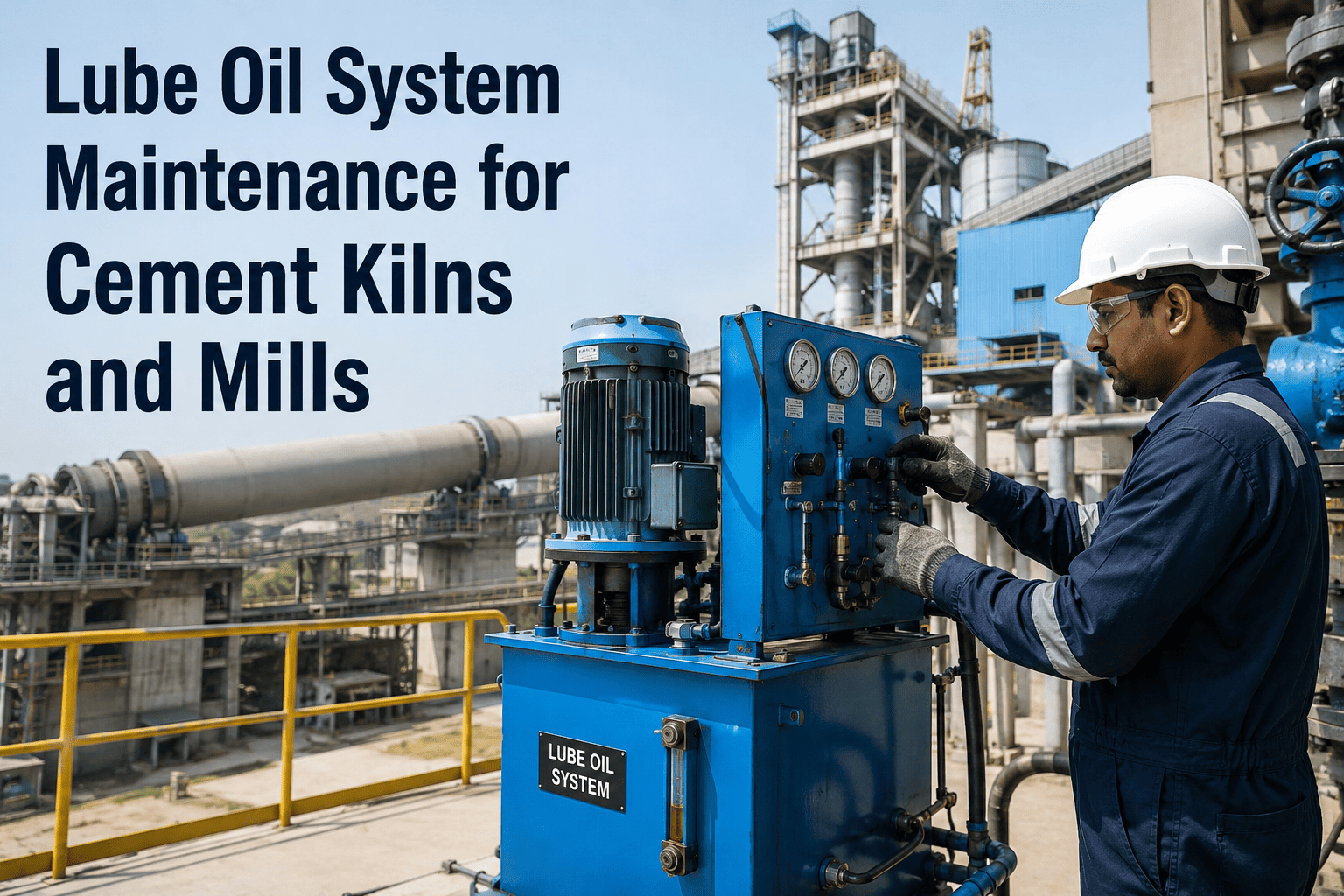
Lube Oil System Maintenance for Cement Kilns and Mills
80% of premature bearing failures trace back to lubrication system problems — not the bearings themselves. If your CMMS is not tracking lube system health, you are managing symptoms while the root cause runs unchecked every shift.
80%
of premature bearing failures caused by lube system deficiencies
3×
faster bearing wear when oil viscosity drops 10% below specification
$40K+
trunnion bearing replacement cost per kiln — excluding downtime losses
6 mo
typical reduction in bearing life from contaminated lube oil at ISO 22/21/18
System Overview
The Four Critical Components of a Cement Kiln Lube System — and What Fails First
A centralized kiln lubrication system is not a single component — it is a chain of interdependent parts. When CMMS maintenance covers only the oil sample and not the delivery system, failure modes accumulate in the gaps between oil analysis intervals.
Lube Pump
Delivers oil at design pressure (typically 2 – 4 bar) to all trunnion bearing pads. Pressure drop below 1.5 bar starves bearings even when the oil reservoir is full.
Common Failures
Worn pump gears — gradual pressure decay over weeks
Seal leakage — oil loss and air ingestion into oil circuit
Relief valve stuck open — full flow bypasses bearings
Filter Assembly
Removes particulate contamination before oil reaches bearing surfaces. Differential pressure across the filter is the primary CMMS-tracked health indicator.
Common Failures
Bypass valve opens before filter is replaced — unfiltered oil to bearings
Filter element collapse from excessive differential pressure
Incorrect replacement interval — overloaded or prematurely changed
Heat Exchanger
Controls oil temperature within the operating window (typically 40 – 60°C). Oil above 70°C loses viscosity rapidly; oil below 35°C becomes too thick for reliable distribution to bearing pads.
Common Failures
Scale fouling on cooling water side — reduced heat transfer over months
Tube leaks — water contamination of lube oil
Cooling water valve failure — no temperature control during hot season
Reservoir & Oil Quality
The oil reservoir holds the circulating oil volume (typically 500 – 2,000 L for kiln systems). Contamination, water ingress, and viscosity degradation all originate here.
Common Failures
Water contamination from heat exchanger leaks or condensation
Oxidation — viscosity increase over 12 months in high-temp environments
Particle accumulation — ISO cleanliness degradation between oil changes
CMMS-Tracked Lube Health
Schedule every filter, pump check, and oil analysis from one CMMS — before lube system deficiencies start destroying your bearings.
OxMaint manages lube system maintenance schedules, tracks oil analysis history, monitors differential pressure trends, and auto-generates work orders when any parameter approaches its alarm limit — kiln and mill systems on one platform.
CMMS Monitoring Parameters
What Your CMMS Should Track for Every Kiln and Mill Lube System
| Parameter |
Normal Range |
Watch Zone |
CMMS Action at Alarm |
| Pump discharge pressure |
2.0 – 4.0 bar |
Below 1.8 bar |
Immediate pump inspection work order |
| Filter differential pressure |
Below 1.5 bar DP |
1.5 – 2.0 bar DP |
Schedule filter replacement within 24 hours |
| Oil inlet temperature |
40 – 60°C |
60 – 70°C |
Heat exchanger inspection and cooling water check |
| Bearing pad temperature |
Below 70°C |
70 – 80°C |
Immediate flow check and load review |
| Oil ISO cleanliness (particle count) |
ISO 18/17/14 or better |
ISO 20/19/16 |
Oil analysis and emergency filtration work order |
| Viscosity at 40°C |
Within ±10% of spec grade |
±15% deviation |
Oil change work order with root cause investigation |
| Water content (Karl Fischer) |
Below 200 ppm |
200 – 500 ppm |
Water removal filtration and heat exchanger inspection |
Maintenance Schedule
CMMS-Recommended Lube System Maintenance Frequencies
These frequencies are based on typical cement kiln and ball mill operating conditions. CMMS platforms should allow each frequency to be adjusted per asset based on operating severity, oil analysis trends, and site-specific experience.
Daily
Operator checks — logged in CMMS
Pump pressure reading and trending
Filter differential pressure visual check
Oil inlet and bearing pad temperatures
Reservoir level and visual leak inspection
Weekly
Technician inspections — CMMS work orders
Pump seal condition and coupling check
Filter housing integrity and bypass valve test
Cooling water flow rate to heat exchanger
Oil sample collection for rapid analysis
Monthly
Planned maintenance — CMMS scheduled
Full oil analysis (viscosity, water, particle count, metals)
Heat exchanger performance check (ΔT across HX)
Relief valve and pressure switch calibration check
Lube line inspection for seepage and blockage
Annually
Overhaul tasks — major CMMS work orders
Oil drain, reservoir clean, and full refill
Pump internal inspection and seal replacement
Heat exchanger tube bundle inspection and descaling
All instrumentation calibration and loop check
Oil Analysis
Using Oil Analysis Results to Drive CMMS Work Orders — Not Just Reports
Oil analysis reports are only useful if they trigger maintenance action. Most plants receive lab reports by email, review them periodically, and file them. A CMMS-integrated oil analysis process turns every out-of-spec result into a work order the same day the report arrives.
Sample Collection
CMMS schedules oil sample work orders at defined intervals. Technician collects from live system mid-line — not from drain port. Sample ID logged in CMMS asset record.
Lab Analysis
Laboratory tests for viscosity, water content, particle count, wear metals (Fe, Cu, Al, Pb), and oxidation markers. Results returned in 24 – 72 hours.
CMMS Result Entry
Results entered into OxMaint against the asset's oil analysis record. Out-of-spec values auto-flag against configured limits and generate corrective work orders immediately.
Corrective Action
Work orders specify exact action — oil change, top-up with specified grade, additional filtration, or component inspection — linked to the analysis result for full traceability.
Common Questions
Lube Oil System Maintenance & CMMS — FAQs
How often should kiln trunnion bearing lube oil be changed?
Oil change interval is determined by oil analysis results, not calendar time. Most kiln lube systems require full oil changes every 6,000 – 12,000 operating hours under normal conditions — but water contamination, high particle counts, or viscosity degradation identified in analysis can trigger an early change.
Manage your oil change schedules in OxMaint.
What ISO cleanliness target should cement kiln lube systems maintain?
Kiln trunnion bearing lube systems should target ISO 4406 cleanliness of 18/17/14 or better. Mill gearbox systems with rolling element bearings require ISO 17/16/13 or better. Cleanliness above ISO 20 accelerates bearing surface fatigue and significantly reduces component service life.
Discuss lube system targets for your specific assets.
Can OxMaint receive oil analysis data automatically from the laboratory?
OxMaint supports manual entry of oil analysis results with full parameter tracking and auto-flagging against configured limits. API-based automatic data import from major oil analysis labs is available on enterprise deployments. Contact the OxMaint team to confirm compatibility with your preferred laboratory provider.
What is the most commonly missed lube system maintenance task in cement plants?
Heat exchanger performance tracking is the most consistently overlooked task. Plants change oil filters and sample oil regularly, but rarely measure heat exchanger effectiveness (ΔT across the cooler) as a scheduled CMMS task. Fouled heat exchangers allow oil to run 10–20°C above specification for months before anyone investigates why bearing temperatures are rising.
Add heat exchanger checks to your CMMS schedule today.
How does OxMaint help prove lube system maintenance compliance during an audit?
Every completed lube system work order in OxMaint creates an immutable, timestamped record showing who performed the task, what was found, and what action was taken — along with the full oil analysis history linked to each asset. Audit evidence is exportable in a structured format that auditors can review directly without manual report compilation.
Stop Reactive Lube Maintenance — Start Predictive
80% of Bearing Failures Are Preventable. Your CMMS Should Be Preventing Them.
OxMaint gives cement plant maintenance teams a structured, audit-ready lube system maintenance program — tracking pump pressure, filter health, oil analysis, and heat exchanger performance as scheduled CMMS work orders, not reactive responses. Protect your kiln bearings and mill gearboxes with the maintenance system they deserve.