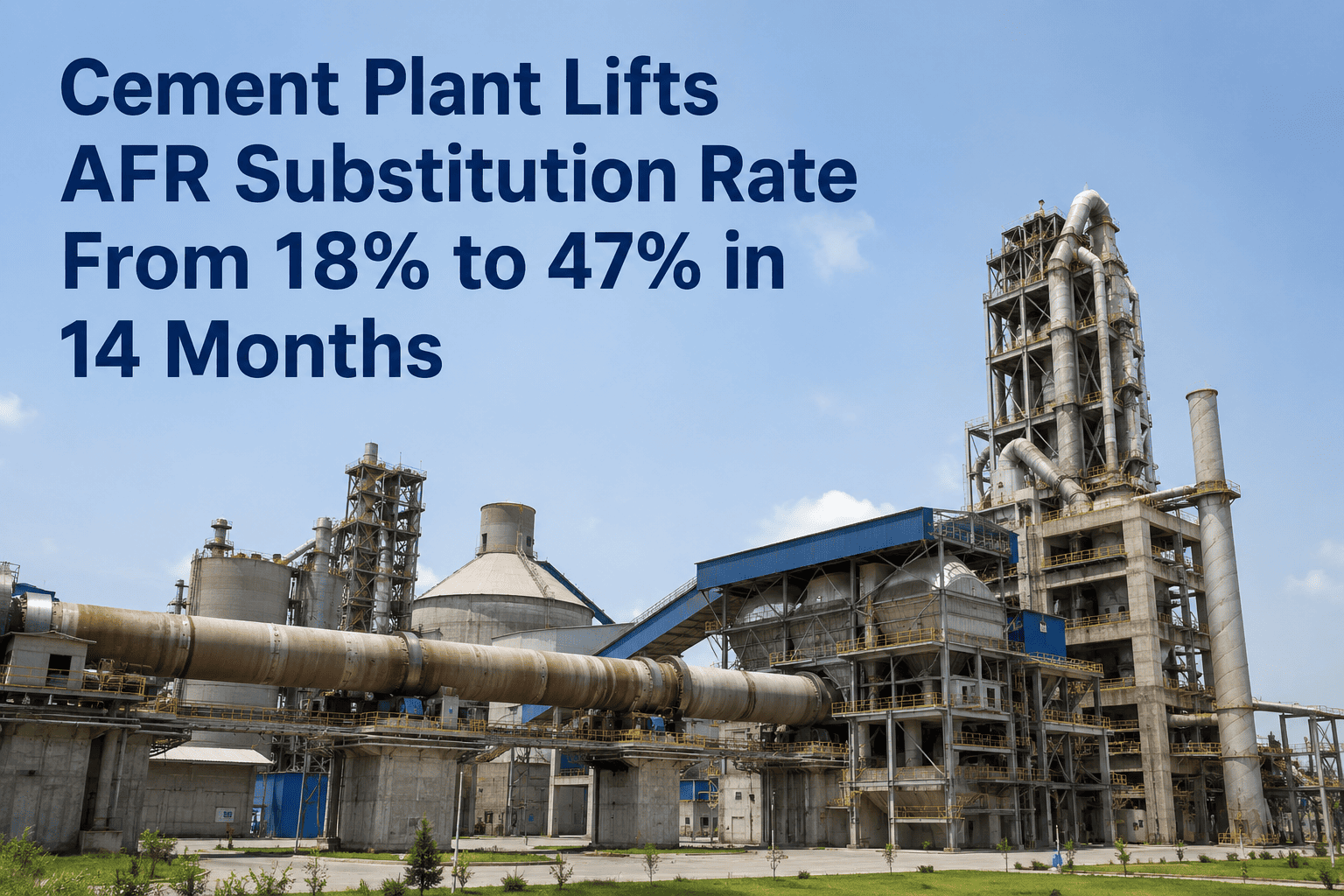
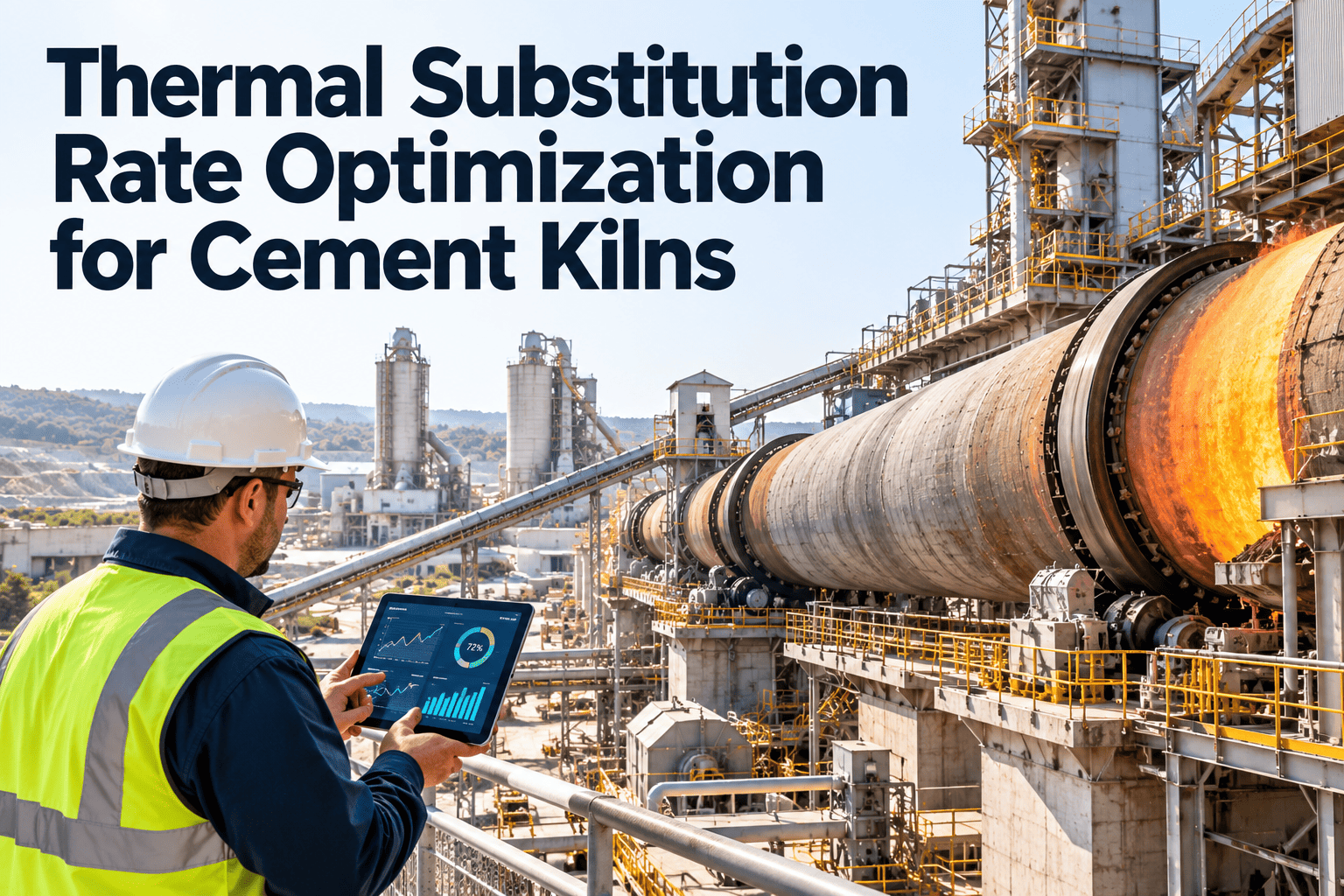
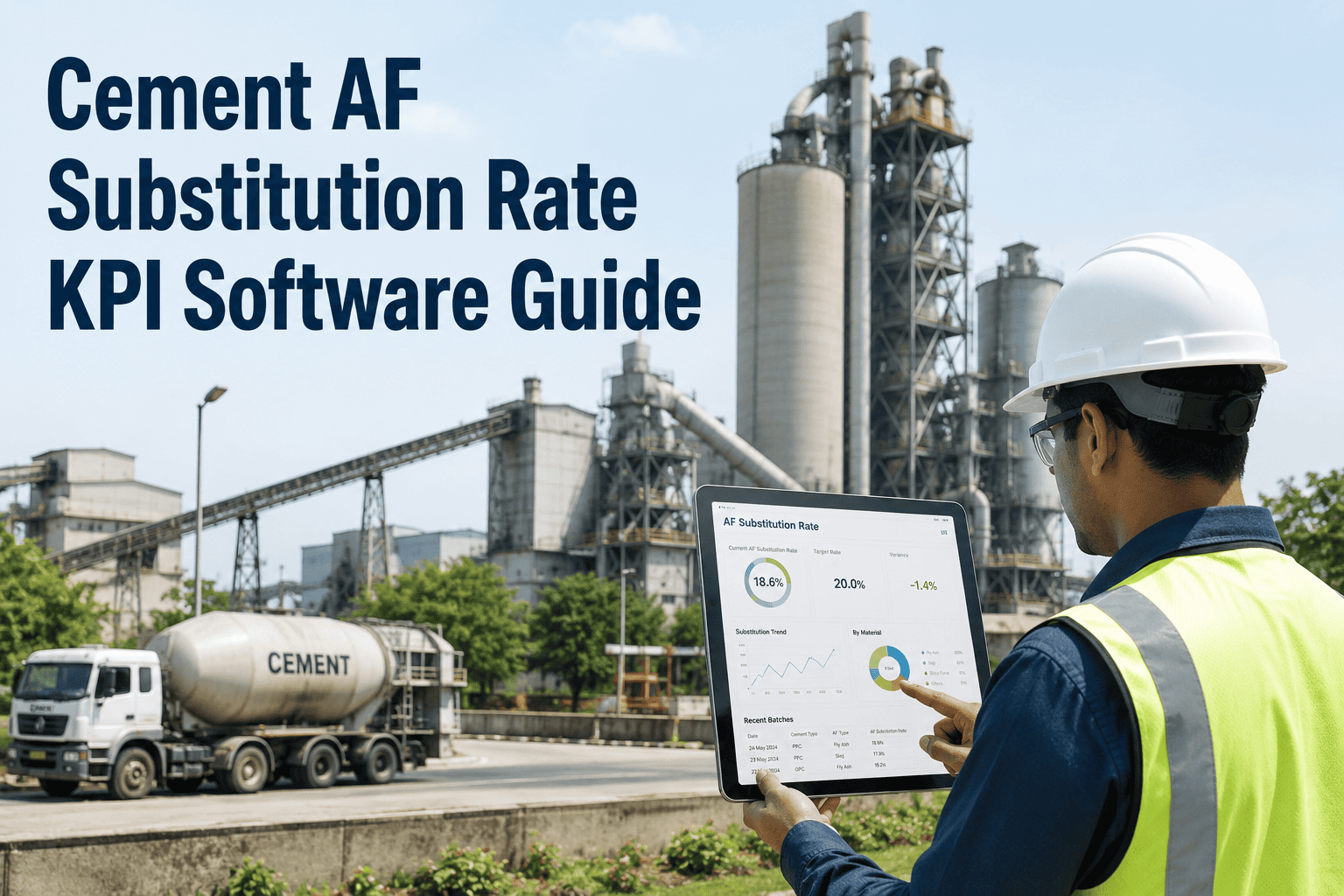
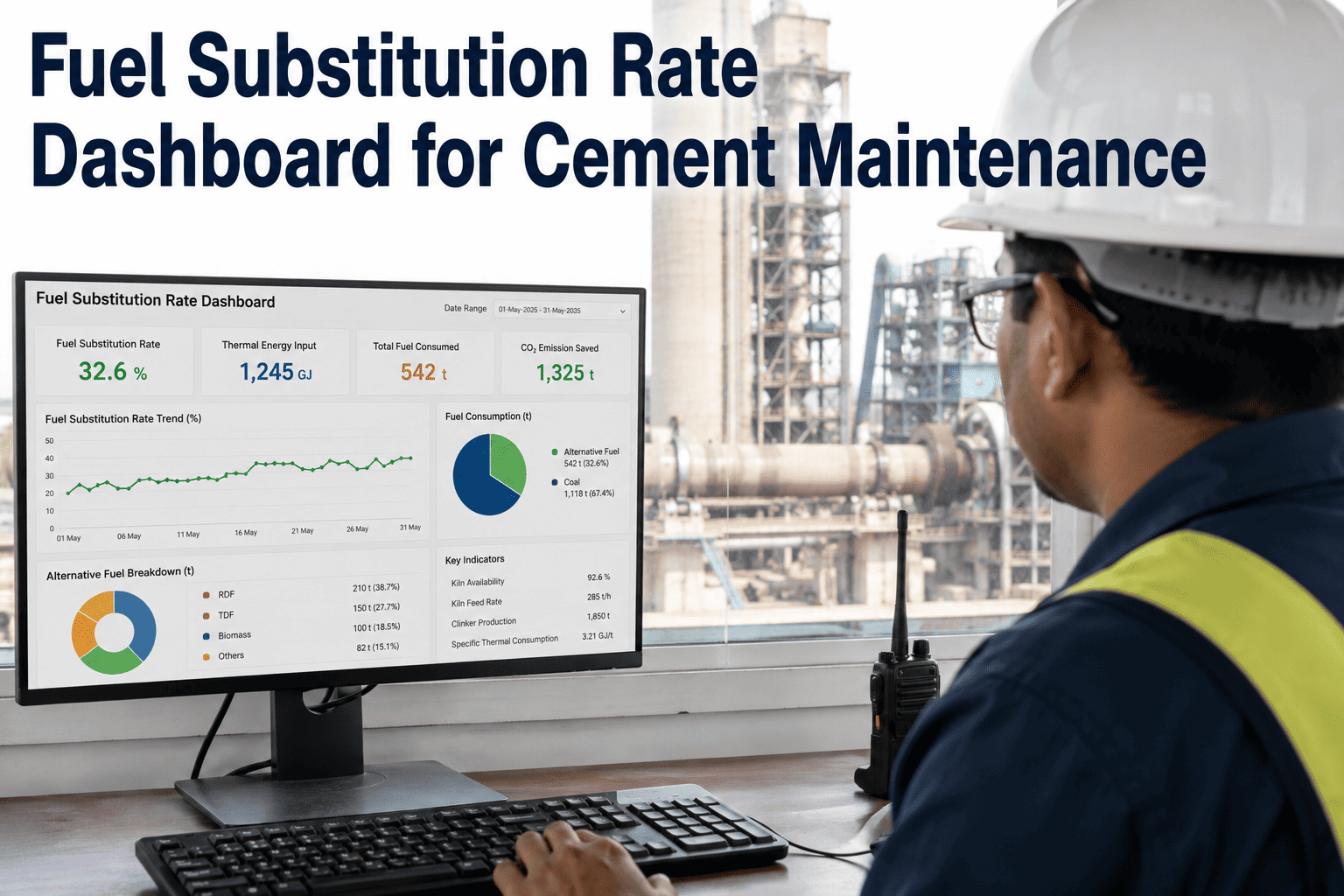
A cement plant in Eastern Europe operating two 3,200 TPD kilns faced a persistent barrier — alternative fuel and raw material (AFR) substitution stuck at 18% thermal substitution rate despite having secured municipal solid waste (MSW) contracts, imported refuse-derived fuel (RDF) procurement agreements, and local agricultural waste collection programmes. The plant's environmental permit allowed up to 60% AFR thermal substitution, but operational reality delivered less than one-third of that ceiling. The constraint was not fuel availability or regulatory approval — it was feed system reliability, quality consistency documentation for auditors, and real-time composition tracking that the existing manual logging system could not provide at the granularity required. After deploying OxMaint's AFR feed management and quality record system in month one, the plant lifted thermal substitution rate from 18% to 47% over 14 months while maintaining clinker quality specifications and passing all third-party sustainability audits without corrective findings. Sign in to OxMaint to configure AFR feed tracking, quality documentation, and thermal substitution reporting for your cement kiln — or book a demo to see the complete AFR management workflow running on live plant data with automated audit trail generation.
Case Study · AFR Substitution
How One Cement Plant Lifted AFR Thermal Substitution From 18% to 47% in 14 Months
Eastern European cement producer transforms AFR programme performance using AI-powered feed reliability monitoring, real-time quality documentation, and automated sustainability audit compliance — cutting fossil fuel costs by €4.2M annually while meeting all emissions and clinker quality targets.
18% → 47%
AFR Thermal Substitution Rate
14 months
€4.2M
Annual Fuel Cost Reduction
Year 1 savings
Zero
Audit Corrective Findings
3 third-party audits
94%
AFR Feed System Uptime
vs 67% baseline
The Starting Position — Why AFR Substitution Was Stuck at 18%
The plant had everything in place on paper — environmental permits approved for 60% thermal substitution, contracts signed with MSW processors delivering 15,000 tonnes per month of RDF, agricultural waste collection agreements with local cooperatives, and a €6.5M capital investment in AFR handling infrastructure including dual-lane conveyor systems, bag openers, and metal separators. Yet actual thermal substitution rate averaged just 18% across both kilns. The gap between permitted capacity and operational reality traced to three interlocking failures that manual AFR management could not resolve.
01
Feed System Reliability Failures
AFR feed system downtime averaged 33% — jams in the bag opener from oversized items, metal separator overload trips, and conveyor belt misalignment stopped AFR flow multiple times per shift. Without real-time monitoring, operators reverted to 100% coal feed during every AFR system fault rather than isolating the affected lane and continuing on the backup system. Each fault converted to full production hours lost on AFR rather than minutes of lane-switching.
Impact: 22 hours per week of unnecessary coal-only operation
02
Quality Documentation Gaps
Sustainability auditors required traceability from AFR batch delivery through kiln combustion with composition analysis, moisture content, and calorific value documented for each batch. Manual logging by operators produced incomplete records — missing batch timestamps, undocumented composition variances, and no linkage between delivered AFR batches and actual kiln feed events. Two audits in 18 months resulted in corrective action requests delaying carbon credit certification.
Impact: €340K in delayed carbon credit revenue per audit cycle
03
Real-Time Composition Blindness
AFR composition varies batch to batch — municipal waste streams shift weekly based on collection patterns, agricultural residue moisture content changes seasonally, and imported RDF quality fluctuates by supplier. Without real-time composition tracking integrated with kiln control, operators set conservative AFR feed rates to avoid clinker quality excursions, leaving 30–40% of permitted substitution capacity unused as operational margin against uncertainty.
Impact: 29 percentage points of unused AFR substitution capacity
AFR Feed Reliability and Quality Documentation — Solved
OxMaint connects AFR feed system sensors, composition analyzers, and kiln control data into a unified real-time monitoring and documentation platform — detecting feed system faults before they stop production, auto-generating audit-ready quality records for every batch, and optimizing AFR substitution rates within clinker quality limits continuously.
The OxMaint Deployment — What Changed in Month One
OxMaint deployment began with sensor integration across the AFR feed system — vibration sensors on conveyor drives, metal separator load monitoring, bag opener jam detection, and NIR composition analyzers on each feed lane connected via OPC-UA to the central monitoring platform. Configuration took 11 days. Training for operators and lab technicians required 3 days. The system went live on both kilns simultaneously in week three. Changes to operational practice were immediate and measurable.
Week 1–2
Sensor Integration and Baseline Mapping
Vibration sensors, metal separators, NIR analyzers connected. OxMaint mapped baseline AFR system behavior — jam frequency by feed material type, metal contamination rates by supplier batch, and conveyor misalignment patterns by operating hour. AI established normal operating signatures for fault detection.
Week 3
Live Monitoring and Operator Training
Real-time AFR feed monitoring dashboard deployed to control room screens. Operators trained on lane-switching protocols — when one AFR lane faults, OxMaint alerts to switch AFR feed to backup lane rather than reverting to 100% coal. Fault isolation time dropped from 45 minutes to 3 minutes average.
Month 2
Automated Quality Documentation
Every AFR batch linked to NIR composition scan, moisture reading, and calorific value measurement automatically. OxMaint generates batch record with timestamp, supplier ID, composition profile, and kiln feed event log — creating complete audit trail without manual operator logging. First month produced 1,847 auto-generated batch records.
Month 3–6
Dynamic AFR Rate Optimization
AI analyzes real-time AFR composition data against clinker quality sensor feedback — LSF, silica modulus, alumina modulus — and recommends optimal AFR substitution rate adjustments every 15 minutes. Operators increased average substitution rate from 18% to 32% while maintaining clinker specs within ±0.5% of target.
Month 7–14
Supplier Quality Feedback Loop
OxMaint supplier scorecards — tracking moisture content, contamination rates, and calorific value variance by AFR supplier — enabled procurement team to renegotiate contracts with quality incentives. Two low-performing RDF suppliers replaced. Average AFR quality improved 23%. Substitution rate reached 47% by month 14.
Results After 14 Months — Measured Performance Improvements
Performance improvements were tracked across four categories — AFR substitution rate progression, fuel cost reduction, audit compliance, and feed system reliability. All metrics showed sustained improvement from month one through month 14. The plant documented every change in monthly sustainability reporting to corporate management and third-party auditors.
18% → 47%
AFR Thermal Substitution Rate
Starting point: 18% average substitution across both kilns in baseline quarter. Ending point: 47% average substitution in month 14. Peak daily substitution reached 52% on high-quality RDF delivery days. Progressive monthly increases tracked in OxMaint sustainability dashboard with zero clinker quality excursions.
€4.2M
Annual Fuel Cost Reduction
Coal cost: €185 per tonne thermal equivalent. Average AFR cost: €48 per tonne thermal equivalent including handling. 29 percentage point substitution increase across 2.3M tonnes annual clinker production delivered €4.2M year-one savings at Q4 fuel prices. Payback on OxMaint deployment: 2.7 months.
Zero
Audit Corrective Findings
Three third-party sustainability audits conducted in months 6, 10, and 14 — ISO 14064 carbon verification, GNR (Green National Registry) compliance, and customer-requested AFR traceability audit. All three audits passed with zero corrective action requests. Auditors cited OxMaint auto-generated batch records as exemplary documentation.
94%
AFR Feed System Uptime
Baseline uptime: 67% (33% downtime from jams, trips, misalignments). Month 14 uptime: 94%. Predictive maintenance alerts on conveyor bearing vibration and bag opener blade wear enabled planned interventions before faults occurred. Average fault resolution time reduced from 45 minutes to 11 minutes via faster fault isolation.
How OxMaint Solved Each AFR Barrier
The 29 percentage point substitution rate increase resulted from removing three specific operational barriers that manual AFR management could not address — feed system reliability, quality documentation, and real-time composition tracking. OxMaint attacked all three simultaneously rather than sequentially, producing compounding effects across the AFR programme.
33% downtime. Every fault → full coal reversion for hours. No predictive maintenance.
Real-time vibration, load, jam sensors. Lane-switching alerts. Predictive bearing/blade replacement.
94% uptime. 11-minute average fault resolution. 22 hours/week AFR recovery.
Manual logs incomplete. No batch-to-kiln traceability. Audit corrective actions.
Auto-generated batch records. NIR composition + timestamp + kiln feed linkage. Audit export.
1,847 records/month. Zero audit findings. €340K carbon credit acceleration.
Conservative AFR rates to protect clinker quality. 29pp unused substitution headroom.
Real-time NIR analysis. AI optimization within clinker specs. 15-minute rate adjustments.
47% substitution achieved. Clinker quality variance ±0.5%. 29pp headroom captured.
Your AFR Programme Has Unused Capacity — OxMaint Unlocks It
Most cement plants run AFR substitution 15–30 percentage points below permitted limits because manual systems cannot deliver the feed reliability, quality documentation, and real-time composition control required to safely maximize substitution rates. OxMaint removes all three barriers simultaneously.
Key Success Factors — What Made This AFR Transformation Work
The plant's AFR programme manager identified four factors that separated this deployment from previous improvement initiatives that delivered temporary gains before reverting to baseline performance. All four factors involved changing the operating cadence from reactive manual intervention to continuous automated monitoring with operator oversight.
01
Sensor Integration Before Process Change
Previous AFR improvement programmes started with process changes — new operating procedures, revised feed rate targets, operator retraining — before instrumenting the system to verify compliance. OxMaint reversed the sequence. Sensors deployed first established truth data on actual AFR system behavior, then process changes were designed around measured constraints rather than assumed constraints. Result: zero procedure revisions required after initial rollout.
02
Operator Alerts, Not Operator Logging
Manual AFR management required operators to log batch arrivals, record composition data, document feed system faults, and calculate substitution rates at shift handover. OxMaint eliminated 90% of manual logging burden by auto-generating records from sensor data, freeing operators to respond to alerts rather than document events. Operator acceptance of the new system was immediate because workload decreased while control improved.
03
Supplier Quality Scorecards
OxMaint supplier dashboards ranking AFR suppliers by moisture content variance, contamination rate, and calorific value consistency gave procurement leverage in contract renegotiations. Two low-performing suppliers were replaced within six months based on objective data rather than subjective complaints. Remaining suppliers received monthly scorecards and quality incentive payments. Average AFR batch quality improved 23% year-over-year.
04
Audit Trail as Operational Byproduct
Sustainability audit compliance shifted from a quarterly scramble to prepare documentation to an automatic byproduct of daily operations. Every AFR batch processed generated a complete audit record — composition, timestamp, kiln feed event, clinker quality outcome — without additional effort. When auditors arrived, the plant exported 90 days of records in 15 minutes. Audit preparation time dropped from 120 hours per audit to under 2 hours.
Frequently Asked Questions
How long does OxMaint AFR deployment take from contract signature to live operation?
Sensor integration and system configuration require 11 to 18 days depending on existing instrumentation. Operator and lab technician training adds 3 days. Most plants go live within 4 weeks of contract signature.
Book a demo to see deployment timeline for your specific kiln configuration.
Does OxMaint work with all AFR types — RDF, agricultural waste, municipal solid waste, biomass?
Yes. OxMaint NIR composition analysis handles all common AFR categories. The system learns normal composition signatures for each fuel type your plant uses, then flags batches with unusual moisture, ash, or calorific value for lab verification before kiln feed.
Sign in to configure AFR type profiles.
What AFR substitution rate increase should a cement plant expect in the first year?
Results vary by starting baseline and AFR availability. Plants starting below 20% substitution typically gain 15 to 30 percentage points in year one. Plants starting above 35% see smaller absolute gains but improved feed system reliability and audit compliance. The case study plant gained 29 percentage points from 18% baseline.
How does OxMaint ensure AFR quality documentation meets third-party sustainability audit requirements?
OxMaint auto-generates batch records compliant with ISO 14064, GNR, and major carbon credit standards. Each record includes composition analysis, batch timestamp, supplier ID, kiln feed event linkage, and clinker quality outcome. Auditors can export records by date range, supplier, or AFR type in audit-ready format.
Sign in to preview audit export formats.
Can OxMaint integrate with existing kiln control systems and CMMS platforms?
Yes. OxMaint connects to kiln DCS via OPC-UA, Modbus, or REST API. CMMS integration supports SAP PM, IBM Maximo, Infor EAM, and other major platforms for work order generation and maintenance scheduling. No replacement of existing control infrastructure is required.
Book a demo to verify integration compatibility.
Every Percentage Point of AFR Substitution You Leave on the Table Costs Money Every Day
If your cement plant runs AFR substitution below permitted limits because of feed system reliability concerns, quality documentation gaps, or composition uncertainty — you are burning fossil fuel you do not need to burn and paying for it at fossil fuel prices. OxMaint connects real-time AFR monitoring, automated quality records, and AI optimization to unlock the substitution capacity you already have permitted.