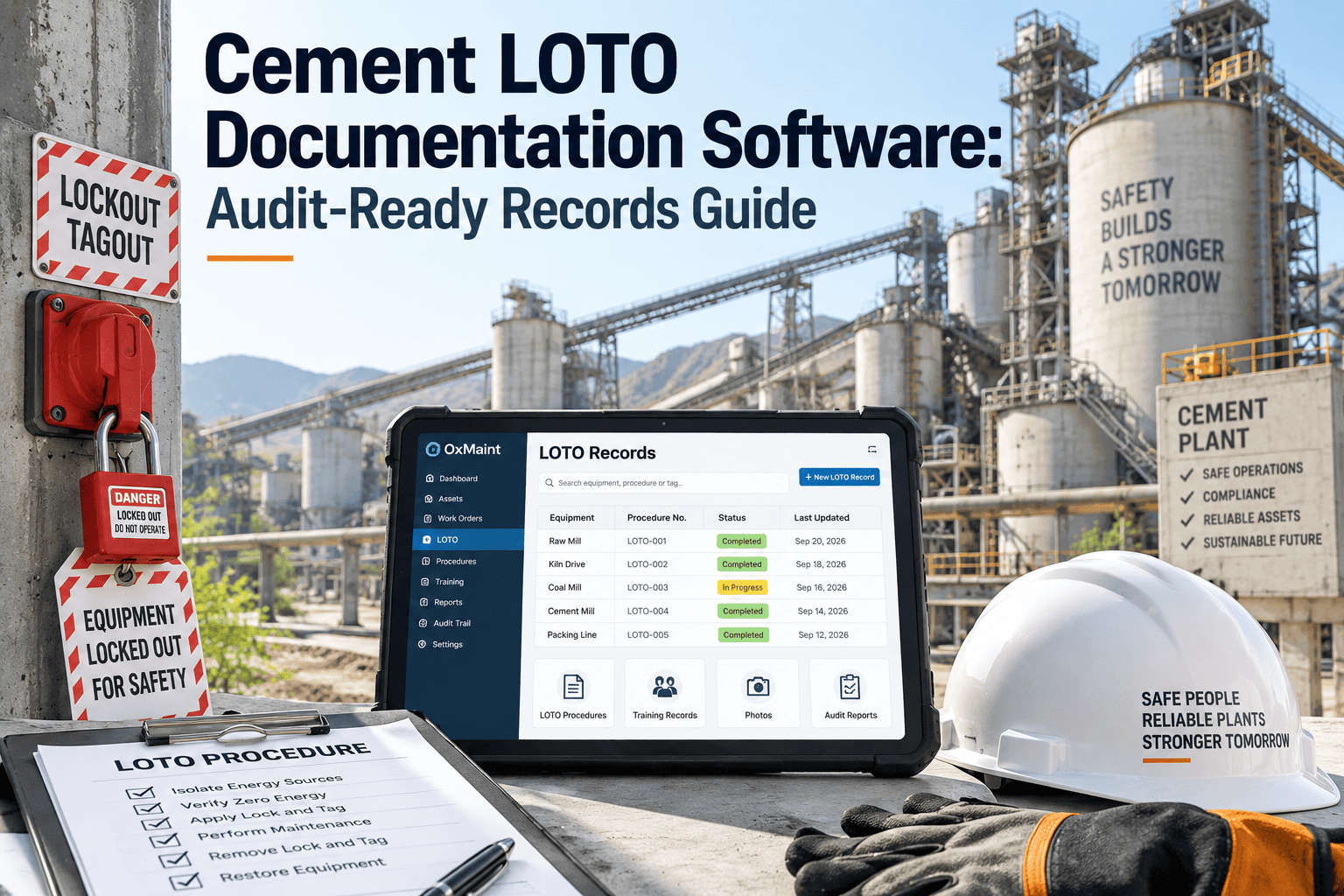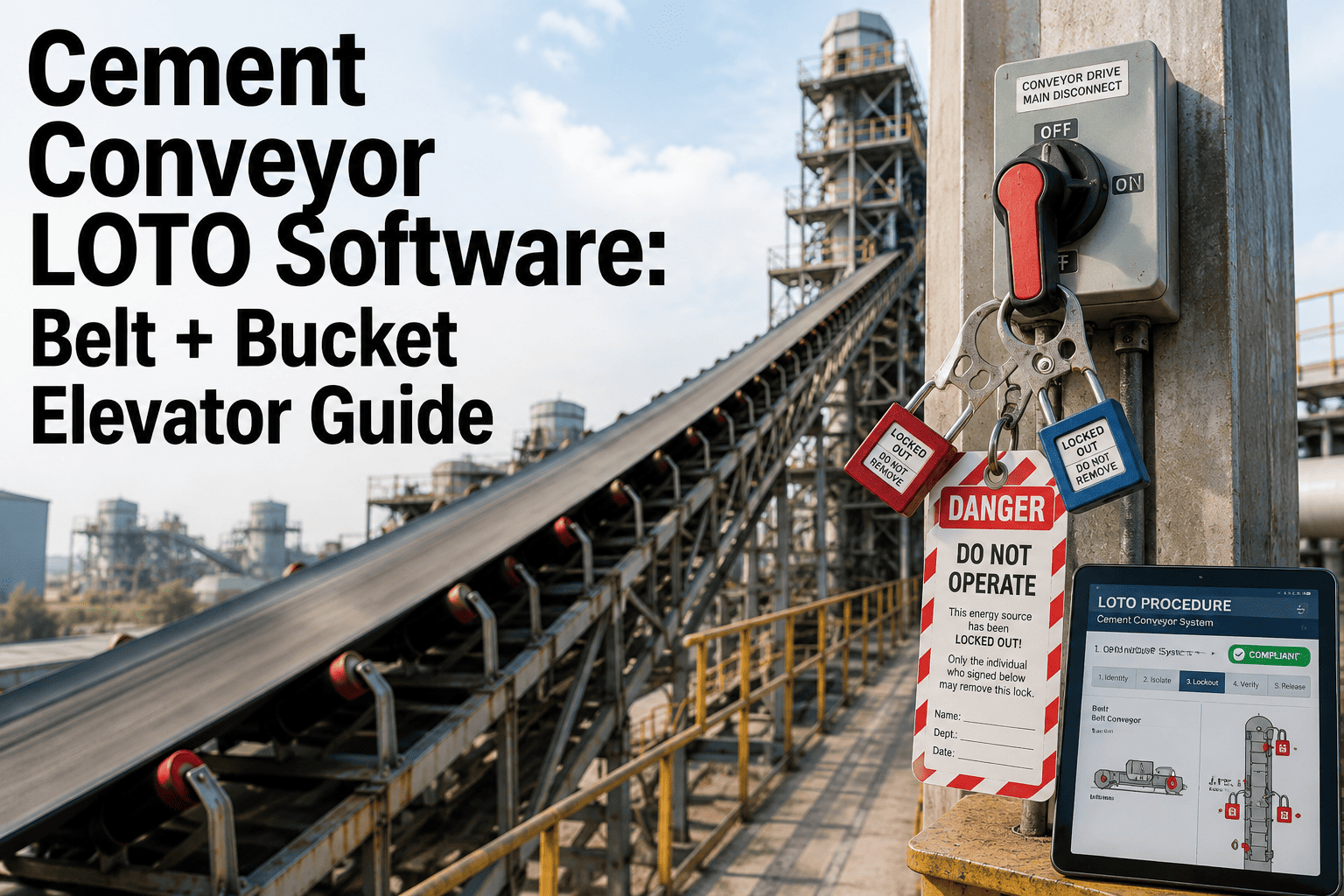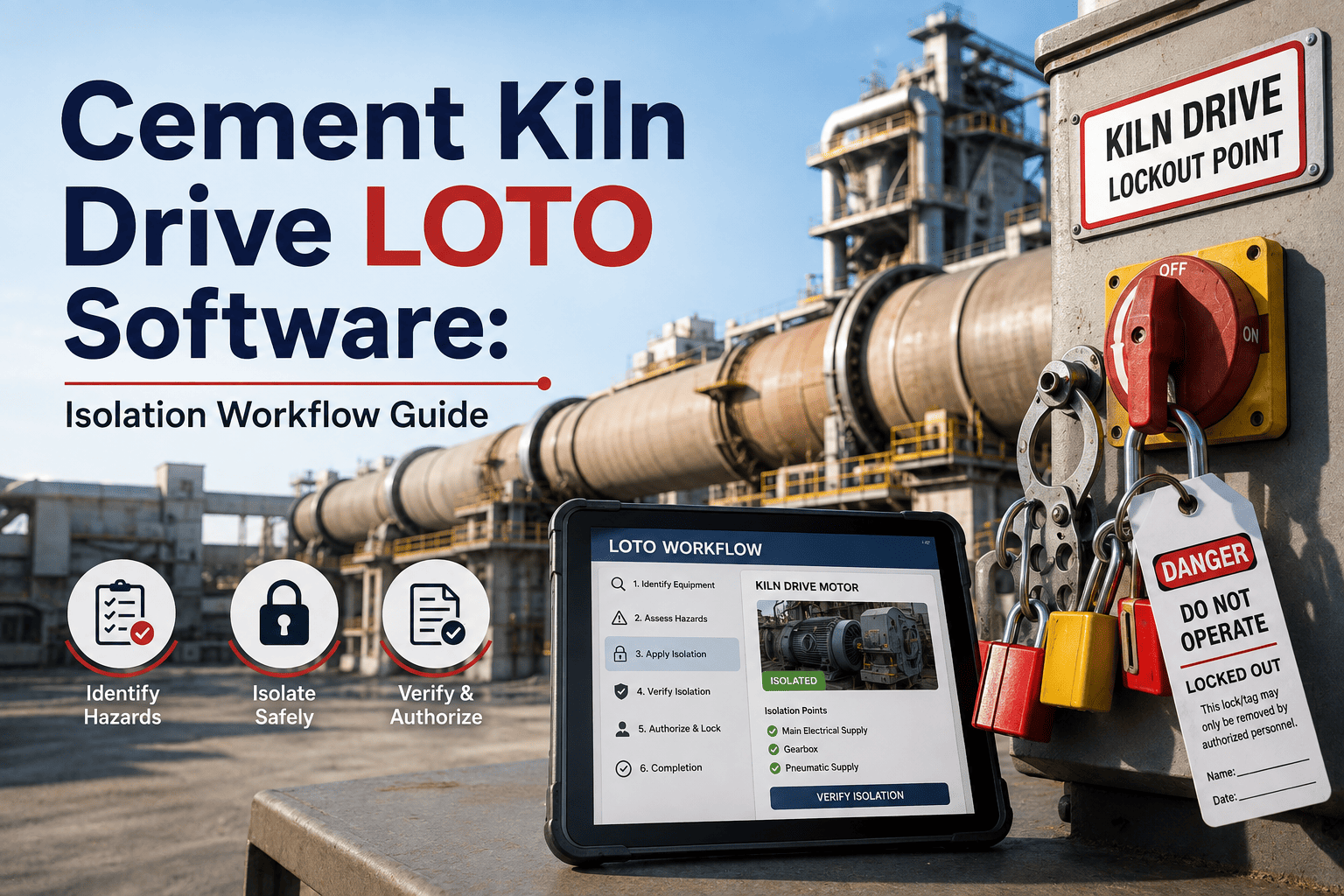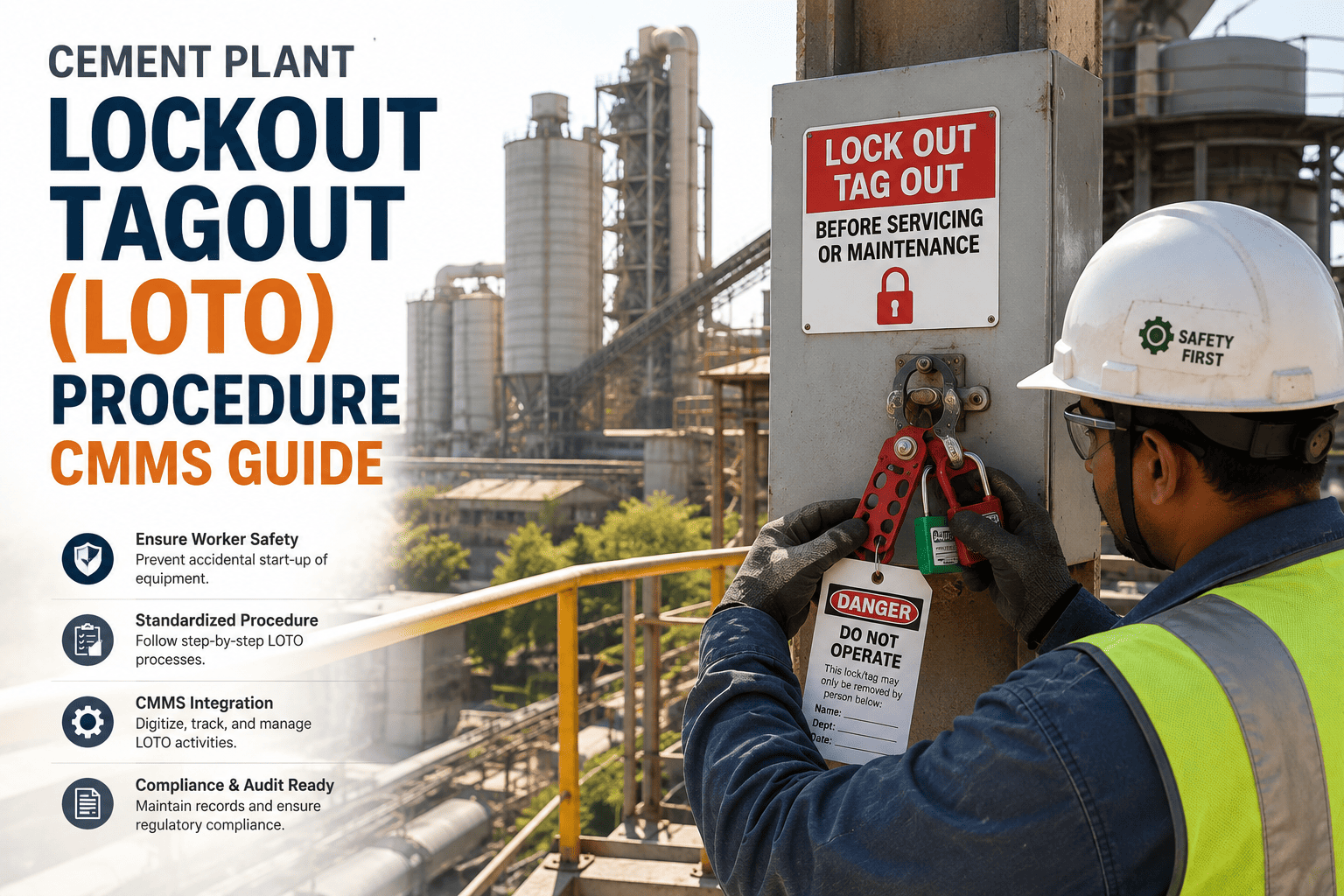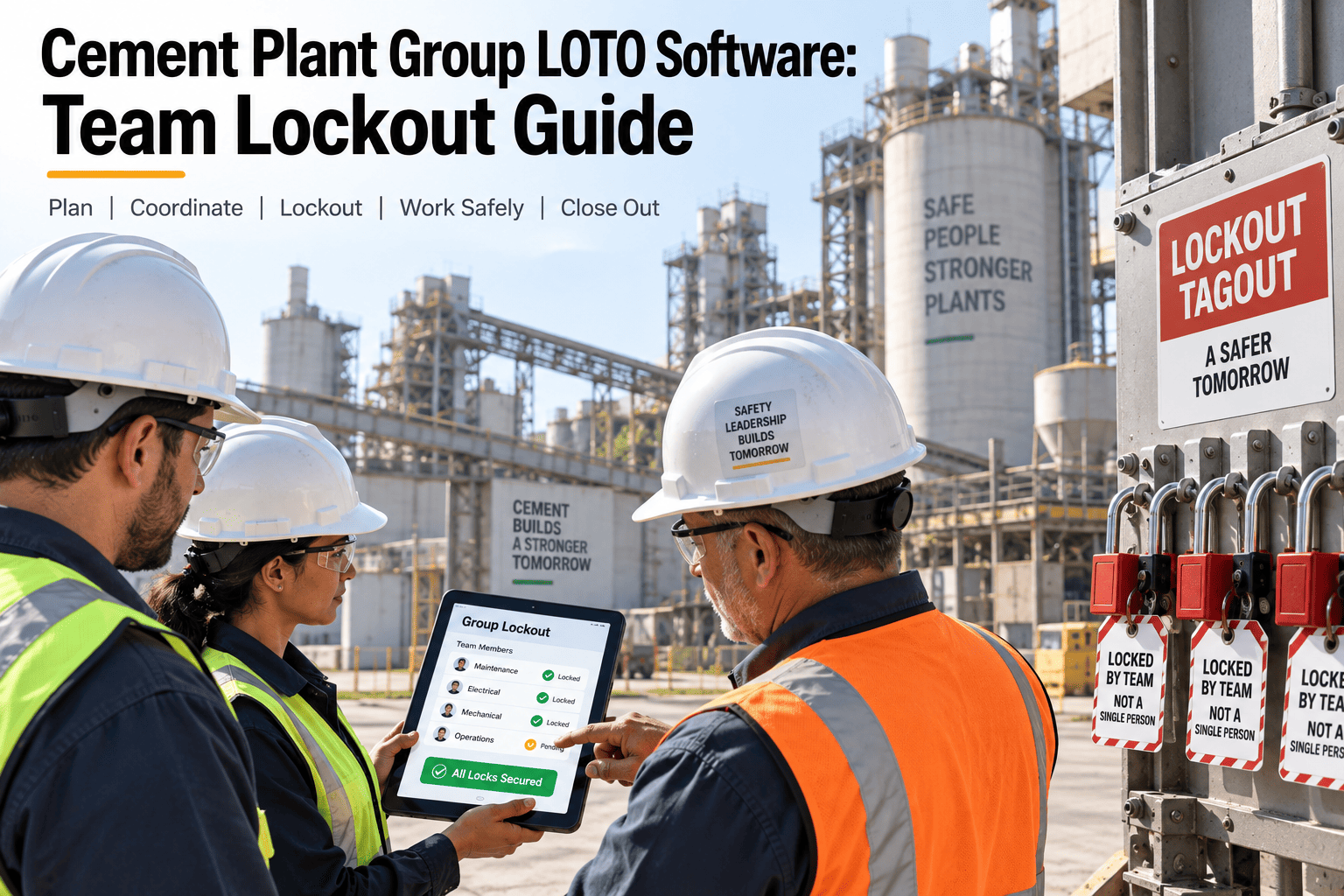
A single kiln overhaul can put twelve electricians, six mechanical fitters, four instrument technicians, and two outside contractors inside the same energized boundary within the same eight-hour shift. When that many trades rotate through one isolation point, a personal padlock on a breaker is no longer enough — cement plants need a documented, auditable group lockout process that tracks every hand that touches the equipment, not just the first one that locks it out.
Group LOTO for Cement Plants
Multiple crews, one kiln line, zero coordination gaps
OxMaint gives cement plant EHS and maintenance teams a digital group lockout workflow built around OSHA 1910.147(f)(3) — a group lockbox that tracks every authorized employee's personal device, a single point of accountability for the crew, and an audit trail that survives a turnaround, a shift change, and an inspector's visit.
Why cement plants can't run group LOTO on paper anymore
A cement plant overhaul is not a single-trade job. Kiln relining, raw mill roller replacement, ID fan bearing work, and preheater cyclone inspections all draw electricians, riggers, mechanics, and vendor technicians into the same isolation boundary at once, often across two or three shifts before the equipment is released back to production.
Crew rosters change mid-shift
A contractor crew signs onto the group lockbox at 7am and a second crew relieves them at 3pm. On paper, nobody can prove who was actually exposed at any given hour, which is exactly what an incident investigation asks first.
One authorized employee, dozens of names
1910.147(f)(3)(ii)(A) requires a single authorized employee to hold primary responsibility for the group. During a turnaround with 40+ names rotating through a lockbox, tracking that manually on a clipboard is where errors creep in.
Contractors add an outside layer
Outside contractor crews working a kiln shell or cooler grate replacement need to be folded into the plant's energy control program without assuming the plant already trusts their own tagging conventions.
Auditors want proof, not memory
When OSHA or an insurance auditor asks for evidence that a specific isolation point was under group lockout for the full 30 hours of a mill overhaul, "the foreman remembers" is not a compliant answer.
What OSHA 1910.147(f)(3) actually requires for group lockout
Group lockout is not a relaxed version of individual lockout — it is required to give every employee in the crew a level of protection equivalent to locking the device out personally. Four elements make that possible, and each one maps directly to a step a CMMS can enforce.
Single point of primary responsibility
One authorized employee is designated to hold primary responsibility for the group and to know the exposure status of every member at any moment during the job.
Personal device on the group lockbox
Each authorized employee affixes a personal lock or tag to the group lockout device when work begins and removes it the moment they stop working on that specific machine.
Continuity across shifts and crews
When more than one crew, craft, or department is involved, a single authorized employee coordinates across all of them so protection never lapses at a shift change or crew rotation.
No single point of removal control
No individual employee controls the means to remove the group lockout devices while any group member is still exposed — the equipment cannot be re-energized until every personal lock is gone.
Digital Group Lockbox Workflow
How a group LOTO job moves through OxMaint from isolation to release
Instead of a physical clipboard beside the group lockbox, the sign-on/sign-off record lives inside the work order — timestamped, name-attached, and visible to the authorized employee coordinating the job in real time.
01
Isolation points identified
The work order for the kiln, mill, or fan job lists every energy source that must be isolated, pulled from the asset's documented isolation procedure.
02
Authorized employee assigned
A single named authorized employee is assigned primary responsibility for the group before the group lockbox is applied to the isolation point.
03
Crew signs on to the lockbox
Each technician — plant employee or outside contractor — logs their own device onto the group lockbox digitally as they begin work, creating an individual timestamp.
04
Shift handover recorded
When one crew relieves another mid-overhaul, the outgoing and incoming authorized employees confirm the handover inside the same job record, with no gap in coverage.
05
Sign-off and verification
Every crew member removes their device as they finish, and the job cannot move to equipment release until the record shows zero personal locks remaining on the box.
06
Audit-ready record closed
The completed job — every name, every timestamp, every isolation point — is archived against the asset history, ready for the next internal audit or regulatory review.
See your kiln overhaul's group lockout record before the next turnaround
Walk through how OxMaint's digital lockbox handles crew rotations, contractor sign-ons, and shift handovers on a live kiln, mill, or fan work order.
Where cement plants apply group LOTO most often
Not every isolation is a group job, but in a cement plant, a handful of recurring work scopes almost always require it because of the number of trades and the physical scale of the equipment involved.
| Work Scope | Typical Crew Size | Isolation Points | Duration |
|---|---|---|---|
| Kiln shell / refractory reline | 15–40 workers | Kiln drive, ID fan, burner, cooling air fans | 3–10 days |
| Raw mill or cement mill overhaul | 8–20 workers | Mill drive, classifier, separator, feed system | 1–4 days |
| Clinker cooler grate replacement | 6–15 workers | Grate drive, undergrate fans, crusher | 1–3 days |
| Preheater cyclone / riser duct entry | 4–10 workers | ID fan, feed system, gas analyzers | 4–12 hours |
| Silo or hopper confined space entry | 3–8 workers | Feeder, discharge gate, aeration system | 2–8 hours |
What changes when the group lockbox goes digital
The physical hasp and padlocks on the equipment don't disappear — the paperwork wrapped around them does. Here is the practical difference plants see once the sign-on record moves off a clipboard.
Paper-Based Group LOTO
- Clipboard sign-in sheet lives at the job site and can be misplaced during a shift change
- Authorized employee tracks exposure status from memory or handwritten notes
- Contractor crews use their own tagging convention, creating two records for one job
- Audit response means digging through binders for the right turnaround week
CMMS-Managed Group LOTO
- Sign-on and sign-off record lives inside the work order, visible to the authorized employee in real time
- Exposure status is a live count of personal devices still on the digital lockbox
- Contractor crews sign onto the same job record as plant employees, one unified log
- Audit response is a search by asset, date range, or authorized employee name
Building group LOTO into your wider CMMS program
Group lockout doesn't sit in isolation from the rest of plant maintenance — the same work order that triggers the isolation procedure should also carry the permit-to-work, the isolation drawing, and the equipment's maintenance history.
Isolation procedures attached to the asset
Each kiln, mill, and fan carries its own documented isolation procedure in OxMaint, so the crew opens the correct energy-source checklist instead of relying on institutional memory.
Mobile sign-on for field crews
Technicians and contractors sign onto the group lockbox from a mobile device at the equipment, so the record reflects who is physically on site rather than who was scheduled.
Shift handover checkpoints
Outgoing and incoming authorized employees confirm the handover inside the same job, preventing the gap in coverage that paper handovers are most prone to.
Audit trail by asset and by name
Every group lockout event is searchable by equipment, date, or employee, giving EHS teams an answer in minutes instead of a search through overhaul binders.
Common group LOTO mistakes that show up in cement plant audits
Most group lockout citations don't come from a plant ignoring 1910.147(f)(3) outright — they come from small procedural gaps that only surface once an inspector or an incident investigator starts asking detailed questions.
- No documented isolation procedure for the specific asset. A generic "lock it out" instruction doesn't satisfy the requirement for asset-specific energy control procedures on complex equipment like a kiln drive or raw mill.
- Exposure status tracked from memory. The authorized employee holding primary responsibility must be able to state, at any moment, who is currently exposed — a mental tally during a 40-person turnaround is not a reliable system.
- Contractor locks not integrated into the plant's program. Outside crews using their own tagging convention on the same isolation point as plant employees creates two incomplete records instead of one complete one.
- No formal handover when the coordinating employee changes. If the authorized employee responsible for the group goes off shift without a documented handover, continuity of protection is broken even if the physical locks stay in place.
- Annual procedure review skipped or undocumented. 1910.147(c)(6)(i) requires periodic inspection of energy control procedures, and a group lockout program is not exempt from that review cycle.
Training expectations for authorized employees in a group lockout program
Group LOTO adds a layer of responsibility on top of standard lockout training, and cement plants running frequent overhauls need that training to be current across a wider pool of employees than a single-crew operation would.
Authorized employee refreshers
Employees who may be designated to hold primary responsibility for a group need refresher training that specifically covers exposure tracking and multi-crew coordination, not just individual lockout steps.
Contractor orientation before turnaround
Outside crews arriving for a scheduled overhaul should be walked through the plant's specific group lockbox procedure before the job starts, not handed a written policy to read on their own.
Affected employee awareness
Operators and other affected employees near the isolation boundary need to understand what a group lockout in progress means for equipment they might otherwise assume is available to run.
Documented training records tied to the CMMS
Keeping training completion records linked to the same system that manages group lockout jobs makes it straightforward to confirm every crew member on a lockbox was actually qualified to be there.
Group LOTO and permit-to-work: keeping the two systems aligned
A kiln overhaul rarely involves lockout alone. Hot work, confined space entry, and working-at-height permits often run in parallel with the group lockout job, and disconnecting those systems is where a lot of practical confusion happens on the floor.
Permit expiry vs. lockout duration
A hot work permit issued for a single shift can expire while the group lockout on the same equipment is still active for a multi-day job, creating a gap where work continues without a valid permit unless the two are tracked together.
Confined space entry inside a locked-out vessel
Entry into a kiln, silo, or preheater cyclone under group lockout still requires its own atmospheric testing and attendant log, layered on top of the isolation record rather than replacing it.
Multiple permits, one isolation boundary
A single kiln shell job might carry a hot work permit for welding, a confined space permit for interior access, and the group lockout record all referencing the same equipment — keeping them cross-linked avoids a permit being closed while lockout is still active, or vice versa.
One coordinator, multiple systems to track
The authorized employee coordinating the group already has primary responsibility for exposure status — asking them to separately track permit status in a different system multiplies the chance something gets missed.
When the permit-to-work record and the group lockout record live inside the same job in a CMMS, the coordinating authorized employee sees both statuses in one place, and equipment release can be gated on every permit being closed as well as every personal lock being removed.
Frequently asked questions
Does a digital group lockbox replace the physical padlocks on the equipment?
No. Physical isolation, hasps, and personal padlocks remain exactly as required under 1910.147. The digital record tracks who has signed onto the group device and when, which is the accountability layer that paper logs struggle to maintain across shifts.
How does group LOTO handle outside contractors on a kiln overhaul?
Contractor crews sign onto the same group lockbox record as plant employees under the coordination of the designated authorized employee, so the plant maintains one unified exposure log rather than two separate systems.
What happens if a crew changes mid-shift during a multi-day overhaul?
The outgoing authorized employee and the incoming authorized employee confirm the handover inside the same digital work order before the outgoing crew removes their personal devices, keeping continuity of protection intact as required under 1910.147(f)(3)(ii)(C).
Can OxMaint track group LOTO for confined space entries like silos?
Yes. Confined space entries into silos, hoppers, or preheater risers can carry the same group lockbox structure alongside entry permits, atmospheric readings, and attendant logs inside one job record. Book a demo to see a silo entry workflow.
How long does it take to set up group LOTO workflows in OxMaint?
Most plants configure isolation procedures for their critical assets and run their first digital group lockout job within two to three weeks, starting with the highest-risk equipment such as kilns and mills.
Start Your Group LOTO Rollout
Give every crew on your kiln line the same protection, every shift
From the first isolation point to the last device removed, OxMaint keeps your group lockout record complete, current, and ready for the next audit.
Free trial available · No credit card required