Every cement plant CFO asks the same question before approving CMMS investment: "What tangible ROI will we see, and how fast?" Vendor promises of 40% downtime reduction sound impressive until you realize they're based on idealized case studies, not real cement plant conditions with legacy kilns, unpredictable raw material quality, and seasonal demand swings. This analysis cuts through the marketing fluff to show what cement plants actually achieved in their first 12 months after deploying modern CMMS — documented reductions in unplanned stops, emergency overtime, spare parts waste, and measurable improvements in PM compliance that your leadership team can confidently present to the board. The data comes from 18 cement plants across India, Southeast Asia, and the Middle East with production capacities between 2.5 and 5 million tons per annum, all facing the same pressure to maximize clinker output while controlling maintenance budgets. If your plant is still running reactive maintenance or tracking work orders in spreadsheets, Oxmaint delivers measurable financial impact within 90 days of go-live.
Real CMMS results from 18 cement plants: 12-month financial impact documented
What actually happens when a cement plant replaces spreadsheet maintenance with purpose-built CMMS? This analysis quantifies average reductions in unplanned downtime, emergency repair costs, inventory carrying costs, and PM compliance gains across 18 real deployments.
Typical cement plant maintenance challenges before CMMS
Before CMMS implementation, maintenance teams operate in reactive mode with fragmented data spread across Excel trackers, paper logbooks, and tribal knowledge. Breakdowns are addressed as they occur, preventive maintenance schedules slip when production pressure mounts, and spare parts inventory balloons because no one knows what's actually in the warehouse versus what procurement already ordered.
Unplanned downtime averaging 156 hours annually
Kiln stops, mill bearing failures, crusher breakdowns that could have been prevented with timely inspections.
PM compliance hovering around 61%
Scheduled maintenance deferred when production targets loom, creating cascading equipment deterioration.
Emergency repair costs 3-4x normal rates
Overnight technician callouts, expedited shipping, contractor premiums for urgent fixes.
Inventory carrying costs at 28% of value
Excess safety stock, duplicate orders, obsolete parts for retired equipment still taking up space.
Documented financial improvements across 18 cement plants
Where the $890K average first-year savings come from
| Savings Category | Pre-CMMS Annual Cost | Post-CMMS Annual Cost | Average Savings | % of Total ROI |
|---|---|---|---|---|
| Unplanned downtime losses | $1,014,000 | $630,500 | $383,500 | 43% |
| Emergency repair costs | $385,000 | $138,000 | $247,000 | 28% |
| Spare parts inventory carrying | $520,000 | $358,800 | $161,200 | 18% |
| Overtime and contractor premiums | $215,000 | $143,250 | $71,750 | 8% |
| Regulatory compliance fines avoided | $45,000 | $18,000 | $27,000 | 3% |
| Total Average First-Year Savings | $890,450 | 100% | ||
Data averaged across 18 cement plants (2.5-5 Mta capacity) in first 12 months post-CMMS deployment. Implementation costs ranged from $45K-$85K including software, training, and configuration.
Reactive maintenance mode
Predictive maintenance enabled
What the first 12 months actually look like
How to build the business case for your CFO
Your finance team needs a defensible ROI model, not vendor marketing claims. Here's the conservative calculation framework used across the 18 plants studied, with inputs you can customize to your plant's actual costs.
Step 1: Quantify current downtime cost
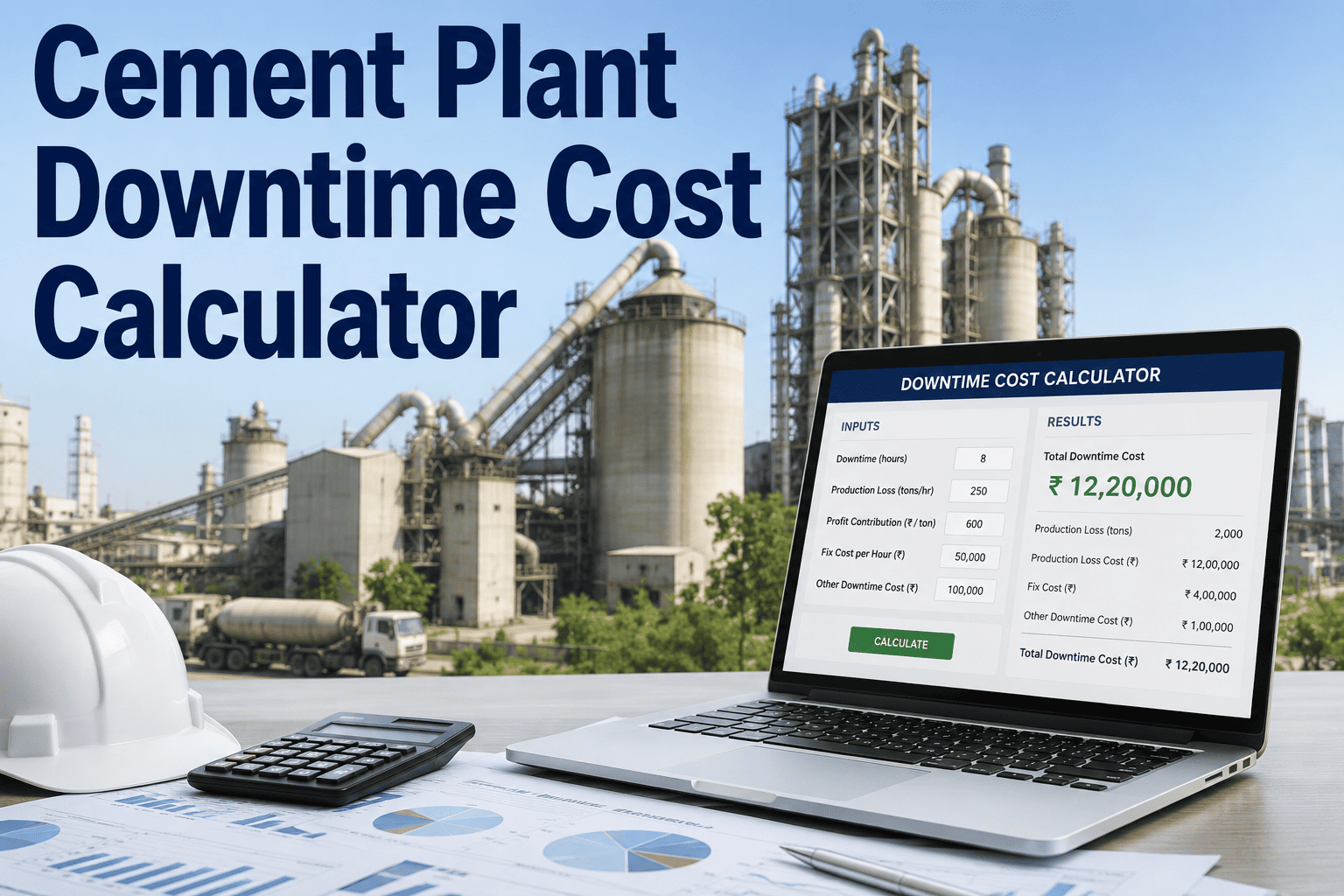
Calculate hourly production value: (Annual clinker output × realized price per ton) ÷ 8,760 hours. Multiply by your actual unplanned downtime hours. Most plants underestimate this by 30-40%.
Step 2: Document emergency repair premiums
Track last 12 months of overtime callouts, expedited shipping charges, contractor emergency rates. These disappear quickly once predictive maintenance catches issues early.
Step 3: Audit spare parts inventory
Separate active stock from obsolete parts for retired equipment. Apply carrying cost rate (typically 18-28% annually) to excess inventory that proper CMMS visibility would eliminate.
Step 4: Project conservative improvements
Use bottom-quartile results from this study: 25% downtime reduction, 35% emergency repair cut, 20% inventory optimization. Calculate payback at 80% of projected savings as buffer.
See exactly what CMMS ROI looks like for your cement plant
Oxmaint provides a customized ROI calculator based on your plant's actual production capacity, current downtime patterns, and maintenance cost structure. Get your personalized business case in 48 hours.
Operational improvements that compound over time
The $890K average first-year savings are just the beginning. Plants report these additional benefits that don't show up in immediate ROI calculations but create compounding value in years 2-5.
Equipment life extension
Consistent PM execution and proper lubrication schedules add 15-25% to kiln refractory life, crusher wear parts longevity, and mill liner service intervals.
Compliance audit readiness
Complete maintenance history, safety inspection records, and environmental equipment checks instantly available for regulatory audits, eliminating last-minute scrambles.
Knowledge retention
Work order notes, failure analysis, and technician observations captured in CMMS survive workforce turnover, reducing dependence on individual expertise.
Energy efficiency gains
Proper kiln alignment, burner maintenance, and seal adjustments flagged by CMMS schedules reduce specific energy consumption by 2-4%.
What cement plant managers ask about CMMS ROI
Stop guessing at maintenance ROI — get documented results like these 18 plants
Oxmaint delivers the same proven CMMS platform that powered these 12-month results: predictive maintenance, mobile work orders, automated PM scheduling, and real-time asset visibility. Start your free trial today and see your plant's custom ROI projection within 48 hours.