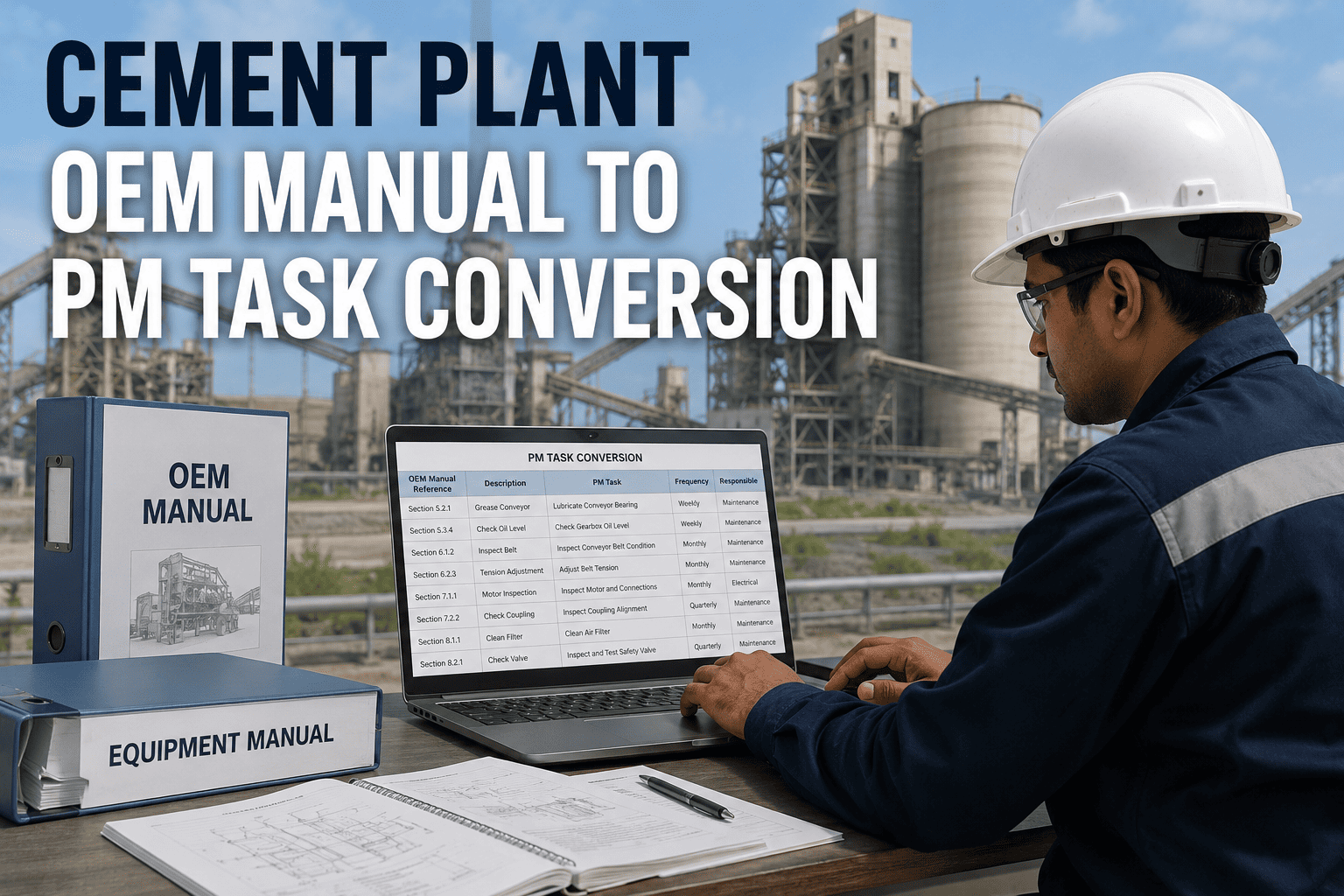
Most cement plants still run maintenance off a 400-page OEM manual that nobody fully reads. Critical lubrication intervals, torque values, and inspection points sit buried in PDF appendices while technicians rely on memory and tribal knowledge. The result is missed PM tasks, wrong spare parts pulled, and breakdowns that the manual actually warned you about three pages before the index. Turning that manual into structured, scheduled PM tasks is one of the highest-leverage things a maintenance team can do, and OxMaint makes the conversion fast.
OEM Manual → PM Program
From 400-Page PDF to a Living PM Schedule
Extract intervals, parts, and instructions from OEM manuals and turn them into trackable preventive maintenance tasks technicians actually follow.
Why OEM Manuals Fail as a Maintenance Strategy
A manual is a reference document, not an execution system. It tells you a gearbox needs an oil sample every 2,000 hours, but it doesn't tell anyone when the clock started, who is responsible, or what parts to stage in advance.
62%
of cement plants report PM tasks skipped because nobody tracked the OEM-specified interval
3.5 hrs
average technician time lost searching manuals for the correct torque spec or part number
41%
of unplanned breakdowns trace back to a PM task that existed in the manual but was never scheduled
The Manual-to-Task Conversion Workflow
Converting a manual into a working PM program follows a repeatable sequence. Skipping steps is exactly how plants end up with PM programs that look complete on paper but don't match reality on the floor.
Step 1
Extract every interval-based task
Pull every lubrication, inspection, calibration, and replacement interval from the manual, including the ones buried in appendices and footnotes.
Step 2
Attach the correct asset
Map each task to a specific tag in your asset hierarchy — not a generic equipment type — so the task triggers at the right location every time.
Step 3
Link spare parts and torque specs
Attach the exact part number, quantity, and torque or fill value to the task so technicians never have to flip back to the PDF mid-job.
Step 4
Schedule and assign ownership
Convert the static interval into a recurring work order with a named owner, due date, and escalation if the task runs overdue.
Stop re-reading PDFs on the plant floor. OxMaint lets you upload OEM manuals, extract PM intervals, and push them straight into a scheduled checklist with parts and instructions attached.
Manual-Based vs. Structured PM Tasks
The difference between a manual sitting in a filing cabinet and a structured PM program is not effort — it's structure. Here's what changes when intervals become tasks.
| Aspect | OEM Manual Only | Structured PM Task in OxMaint |
| Interval tracking |
Manual memory or spreadsheet |
Automatic recurrence with due-date alerts |
| Spare parts |
Looked up at time of job |
Pre-attached part number and quantity |
| Torque / fill specs |
Found mid-task in PDF |
Embedded directly in the checklist step |
| Accountability |
Unclear ownership |
Assigned technician and supervisor sign-off |
| Audit trail |
No record of completion |
Timestamped history per asset |
Where Cement Plants Get the Highest Return
Kiln Drive Train
Gearbox oil analysis intervals, alignment checks, and bearing lubrication pulled directly from OEM drive documentation.
Raw Mill & Cement Mill
Liner inspection cycles, separator bearing greasing, and hydraulic system checks scheduled from manufacturer specs.
ID Fans & Dampers
Vibration baseline checks and damper actuator calibration converted into recurring inspection tasks.
Packing & Dispatch
Bag placer and weigh-head calibration intervals scheduled to avoid mid-shift quality rejects.
Common Mistakes When Digitizing OEM Manuals
Plants that rush the conversion often end up with a digital PM list that looks complete but quietly carries the same gaps as the paper manual it replaced.
Copying intervals without context
Pasting the OEM interval as-is without checking it against actual plant duty cycle leads to over- or under-maintaining equipment from day one.
Skipping the parts linkage
A task without an attached part number just relocates the search problem from a PDF to a screen — technicians still have to go hunting.
No review cycle after go-live
PM tasks built once and never revisited drift out of sync with how the equipment is actually run a year later.
What Plants See After Three to Six Months
28%
Fewer PM tasks marked overdue once intervals are tracked automatically
2x
Faster technician response when parts and torque specs are already attached
19%
Drop in repeat breakdowns on assets with converted PM tasks
Frequently Asked Questions
Do we need to manually re-type every PM task from the manual?
No. Most plants start by prioritizing critical and high-cost assets first, then expand coverage over time.
OxMaint lets your team build out the PM library incrementally rather than requiring a full manual conversion before go-live, which is usually the biggest blocker to getting started at all.
What if our OEM manual is outdated or in a foreign language?
Many cement plants run equipment from European or Chinese OEMs with manuals that haven't been updated to match field conditions. In these cases, plants typically combine the original interval as a baseline with experience-based adjustments from senior technicians, then track both versions in the PM history to see which performs better over time.
How do we handle parts that the OEM manual lists but the plant no longer stocks?
This is common after years of substituting equivalent parts. The task should reference both the OEM part number and the current approved substitute, so technicians and storekeepers are never working from two different lists.
Book a session to see how this is structured in practice.
Can this work for second-hand or unbranded equipment with no manual?
Yes. In these cases, the PM tasks are built from a combination of similar-equipment OEM guidance, vendor recommendations, and the plant's own failure history. This approach is often more accurate than a generic manual since it reflects how the specific machine actually behaves on site.
How long does it take to convert a manual for one major asset?
A single major asset like a kiln drive or raw mill typically takes a few hours of structured review to extract the core intervals, parts, and instructions. Most plants complete their top 10–15 critical assets within the first two to three weeks of setup.
Turn Your OEM Manuals Into a Working PM Program
Stop relying on memory and filing cabinets. Build a structured, trackable preventive maintenance schedule with parts and instructions attached to every task.