Cement plants lose millions in unrecoverable warranty claims every year — not because equipment didn't fail within warranty periods, but because maintenance teams cannot produce the documentation OEMs require to honor them. A single missing inspection record, an undated photo, or a gap in service history is enough for an OEM to deny a claim on a ₹40–80 lakh gearbox, kiln drive, or vertical roller mill separator. OxMaint's asset management module captures every inspection, service event, and failure observation at the point of work — timestamped, geotagged, and linked to the asset's full lifecycle record. Start building your warranty evidence library free or book a 15-minute demo to see how cement plants use OxMaint to defend and win OEM warranty claims.
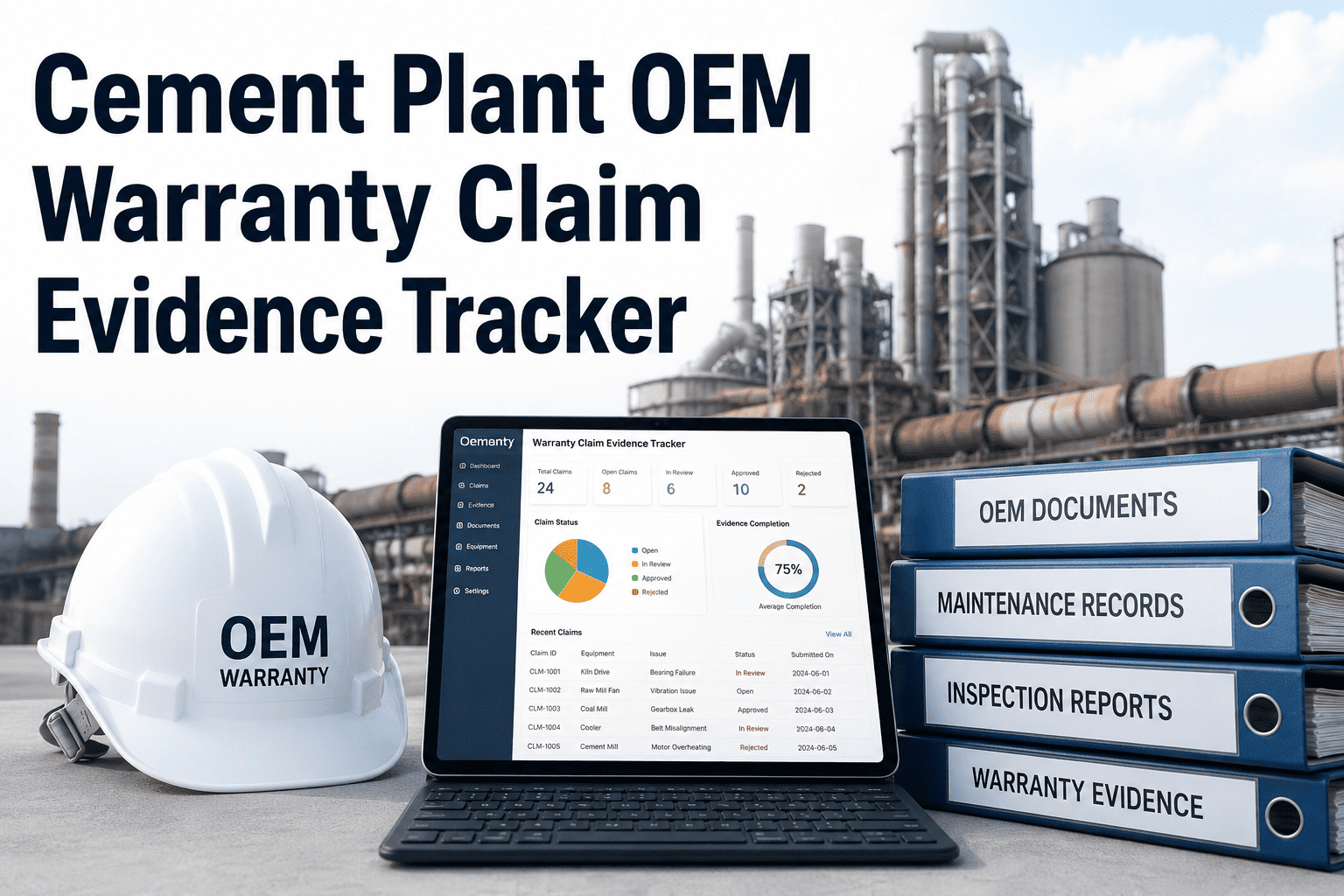
Cement Plant OEM Warranty Claim Evidence Tracker
Structured, timestamped, and photo-backed maintenance records that OEMs cannot reject. Built into every work order your technicians already complete.
Why Cement Plants Lose Warranty Claims They Should Win
OEM warranty agreements are precise contracts. They specify service intervals, approved lubricants, vibration limits, temperature thresholds, and inspection requirements. A cement plant that performed every required maintenance task — but logged it in a paper register or a disconnected spreadsheet — has almost no ability to reconstruct a defensible evidence package when the equipment fails within warranty. The OEM's legal and service teams know exactly what to look for — and exactly what gaps to exploit.
Paper registers lack the metadata OEMs require. Date, time, technician identity, and observed conditions must be recorded at the moment of service — not reconstructed afterward.
OEMs routinely request inspection photos taken before the failure event. Without a systematic photo capture workflow during PM and inspections, this evidence simply does not exist.
A missed or delayed PM — even by a few days — is used to void warranty coverage. If the CMMS shows no PM record for a scheduled interval, the OEM assumes the task was not completed.
Kiln drives, gearboxes, and separators have strict lubrication specs. If work orders do not capture the lubricant grade and quantity used, OEMs can claim improper lubrication voided the warranty.
The timeline leading to the failure — vibration readings, temperature trends, unusual noises — is critical evidence. Without structured condition monitoring records, the failure looks sudden and unexplained.
Any repair performed before notifying the OEM can void coverage. A complete work order history showing what was done — and in what sequence — is essential to demonstrate that proper escalation procedures were followed.
What OxMaint Captures That Builds an Unrejectable Warranty Claim
Every maintenance event executed through OxMaint automatically generates the evidence layer that OEM warranty claims require. The system doesn't need a separate warranty tracking workflow — because the standard maintenance workflow produces warranty-grade documentation by default.
When equipment is commissioned, OxMaint captures the OEM, model number, serial number, purchase date, warranty start and expiry date, and applicable OEM warranty conditions. All subsequent maintenance records link to this master asset record automatically.
Every PM task completed in OxMaint records the exact date and time, the technician who performed the work, the tasks completed, observations noted, parts consumed, and lubricants applied. This creates the service interval evidence chain that OEMs require.
During inspections, technicians capture photos directly inside OxMaint work orders. Vibration readings, temperature measurements, oil samples, and visual observations are entered as structured data — not free text — making them searchable and auditable.
When a failure occurs, the breakdown work order captures the failure mode, the immediate observations, photos of the failed component, and links back to the complete service history. This creates an unbroken evidence chain from commissioning to failure.
OxMaint generates a complete asset history report — all PMs, inspections, parts consumption, failure records, and photos — in a structured PDF export. This becomes the evidence package submitted with the warranty claim, eliminating the scramble to reconstruct records from scattered sources.
High-Value Cement Plant Assets Where Warranty Evidence Matters Most
Warranty claims are most financially significant on large rotating equipment, kiln systems, and capital-intensive mechanical assemblies. These are also the assets most likely to have strict OEM service documentation requirements built into their warranty agreements.
| Asset | Typical Warranty Period | Key Evidence Required | Common Denial Trigger | OxMaint Capture Method |
|---|---|---|---|---|
| Kiln Main Drive Gearbox | 18–24 months | Oil change intervals, vibration records, temperature logs | Missed oil change or wrong lubricant grade | PM work orders with lubricant fields |
| Vertical Roller Mill Separator | 12–18 months | Bearing inspection records, vibration amplitude history | No pre-failure vibration data | Inspection checklists with measurement entry |
| Raw Mill / Cement Mill Motors | 24 months | Winding insulation tests, temperature monitoring, load records | Overload condition not documented | Structured inspection with reading capture |
| Clinker Cooler Fans | 12 months | Blade inspection photos, balancing records, bearing lubrication | No photographic inspection record | Photo-mandatory inspection checklists |
| Preheater ID Fan | 18 months | Vibration baseline at commissioning, interval readings | No commissioning baseline record | Asset commissioning record with baseline |
| Compressors (Blasters, Process Air) | 12–24 months | Service intervals, filter change records, oil analysis | Filter change interval exceeded | PM schedules with parts consumption logging |
Scroll horizontally on mobile · Warranty periods are indicative — refer to specific OEM agreements
OxMaint can help you consolidate and export existing maintenance records to build the strongest possible evidence package — even for equipment maintained before your OxMaint implementation.
How to Set Up OxMaint as Your Warranty Evidence System in 3 Steps
Getting your warranty evidence infrastructure in place does not require a long implementation project. The three steps below can be completed in a single week and will immediately begin building the documentation layer you need for future claims.
Create asset records in OxMaint for every piece of equipment still within its warranty period. For each asset, capture the OEM name, model number, serial number, purchase date, warranty start and end dates, and any OEM-specified service requirements. Set automated alerts for warranty expiry 90 and 30 days in advance so your team never misses a claim window.
For each warranted asset, create PM checklists in OxMaint that mirror the OEM's service requirements exactly. Include mandatory fields for lubricant grade and quantity, measurement readings, photo capture, and technician sign-off. Making these fields mandatory — not optional — ensures the evidence is captured on every service event, not just the ones where technicians remember to document thoroughly.
Set up breakdown work order templates for warranted assets that prompt technicians to capture failure mode, pre-failure observations, photos of the failed component, and the timeline of events leading to the failure. This structured failure capture is what transforms a breakdown report into warranty claim evidence. Configure the template to automatically flag the work order for warranty review when the asset is still within its warranty period.
What Systematic Warranty Claim Evidence Is Worth to a Cement Plant
The ROI of a warranty evidence system is straightforward to calculate once you examine the failure rates and claim values of major cement plant equipment over a 5-year capital cycle.
Frequently Asked Questions
Every PM your team completes is potential warranty evidence. OxMaint makes sure that evidence is captured, organized, and ready to defend — so the next time an OEM tries to deny your claim, you have the documentation to win it.