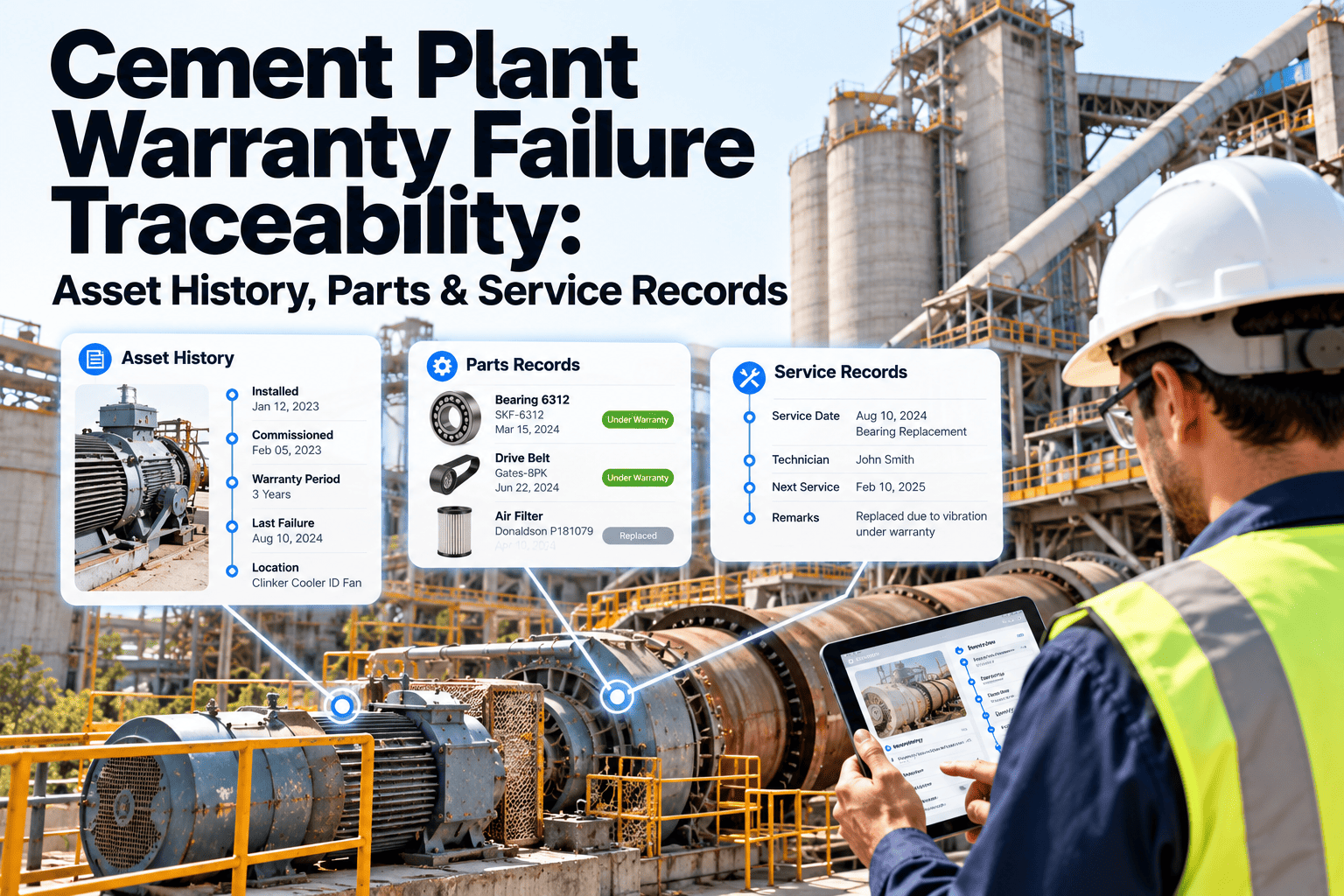
Cement Plant Warranty Failure Traceability: Asset History, Parts & Service Records

By Corin Hale on October 10, 2026

cement-plant-warranty-failure-traceability-asset-history-parts-service-records

A gearbox fails fourteen months after commissioning, and the supplier asks a simple question: can you prove it was maintained and operated as specified? In many cement plants the honest answer is scattered across logbooks, spreadsheets, contractor emails and the memory of someone who has since moved on. Warranty value is lost not because the claim was wrong, but because the evidence could not be assembled in time. This article shows how asset history, parts and service records can be organised in OxMaint maintenance management software so a claim file is always ready.

Warranty Traceability · Asset History · Cement Plant Maintenance

Cement Plant Warranty Failure Traceability: Asset History, Parts and Service Records

Keep the evidence chain intact from commissioning to failure, so every eligible warranty claim is supported by dated, linked and retrievable records.

1
Asset Identity
Serial number, supplier, warranty terms
2
Commissioning
Start-up date, alignment and test records
3
Maintenance Proof
Scheduled tasks done and signed off
4
Failure Event
Time, conditions, readings and photos
5
Parts Trail
Which parts were fitted and when
6
Claim File
Complete record ready to submit

Where Warranty Evidence Disappears

Evidence rarely vanishes in one event. It leaks away in small gaps that look harmless at the time and become expensive when a supplier asks for proof.

At handover
Commissioning reports stay with the project team and never reach the maintenance system.
During operation
Lubrication rounds and inspections are noted on paper or not recorded at all.
At repair
A part is swapped from another asset and the change is never written down.
At staff change
The person who knew the history leaves and the context leaves with them.
At failure
The failed part is scrapped before anyone photographs or retains it.

What a Supplier Usually Asks For

Terms differ between contracts, so always read your own warranty document. The questions below appear in most claim reviews.

Supplier QuestionEvidence That Answers ItWhere to Keep It
Was it installed and started correctly?Installation checks, alignment values, start-up and test recordsAsset record attachments
Was it maintained as required?Completed preventive tasks, lubrication logs, inspection resultsClosed work orders and inspection history
Was it operated within limits?Load, temperature and vibration readings around the failure dateCondition readings and operator notes
Were approved parts and lubricants used?Part numbers, supplier references, lubricant gradesWork order parts lines and inventory records
What exactly happened?Failure description, photos, timeline and first findingsCorrective work order
Who worked on it?Technician and contractor reports with dates and signaturesService reports linked to the asset

Warranty Evidence Map for Cement Plant Assets

Different assets fail in different ways, so the evidence worth holding differs too.

Gearboxes and drives
Oil change and sampling history, alignment records, temperature and vibration trends, load history.
Electric motors
Insulation test results, bearing lubrication records, protection settings and start counts.
Fans and blowers
Balance reports, vibration readings, coupling and bearing records, operating conditions.
Hydraulic systems
Oil cleanliness results, filter changes, working pressures, leak and top-up records.
Wear parts
Fitting date, running hours or tonnage, wear measurements and removal condition photos.
Instruments and controls
Calibration certificates, firmware or setting changes, and loop test records.

Stop Rebuilding the Story After the Failure

Keep asset identity, maintenance proof and service records in one place, so the claim file builds itself as the work gets done.

Anatomy of a Claim-Ready Failure Record

A failure record is strongest when it is written at the time, by the person who saw the fault, with fields that never get skipped.

Asset and serial
Exact asset tag, serial number and model so the claim is tied to the right unit.
Dates
Commissioning date, last service date, failure date and date reported.
Operating context
Load, speed, temperature and any abnormal condition before the failure.
Symptoms and findings
What was seen, heard or measured, with photos taken before dismantling.
Parts and consumables
Part numbers, lubricant grades and quantities used in earlier work.
Retention note
Where the failed part is stored and who authorised its release.

Parts Traceability From Purchase to Removal

If a supplier questions the part, you need to show where it came from and where it went.

Purchase
Record supplier, order and part number.
Receipt
Check the item and note batch or serial references where available.
Storage
Keep stock levels and storage location current in inventory.
Issue
Charge parts to a specific work order and asset.
Removal
Log the removed part, its condition and where it is held.

Contractor and OEM Service Reports

Typical practice
  • Reports are emailed to one person
  • File names differ and dates are unclear
  • Findings are not linked to the asset
  • Recommendations are never converted to work
Traceable practice
  • Reports are attached to the asset and work order
  • Visit date, scope and technician are recorded
  • Findings are searchable from the asset history
  • Recommendations become tracked corrective tasks

The First Hours After a Suspected Warranty Failure

What happens in the first shift often decides whether the evidence survives. Check your contract for notice periods and any procedures the supplier requires.

Immediately
Make the asset safe, stop the fault progressing and raise a corrective work order.
Same shift
Photograph the asset, record readings and note operating conditions.
Before dismantling
Confirm whether the supplier wants to witness or approve the inspection.
During repair
Tag and retain failed parts and log every part fitted.
Within the notice period
Submit the claim file with history, parts and reports attached.

Audit Readiness Checklist

Every warranted asset has its serial number, supplier and warranty dates on record
Commissioning documents are attached to the asset record
Required preventive tasks are scheduled and closed with sign-off
Parts consumed are linked to work orders and assets
Contractor reports are stored against the asset, not in personal inboxes
Warranty expiry dates are reviewed before they pass

Metrics That Show Whether Traceability Is Working

Warranted assets with complete records
Share of assets with identity, commissioning and maintenance proof on file.
Warranty tasks closed on time
Shows whether supplier-required maintenance is actually done.
Claims submitted and outcome
Tracks claims raised, accepted, partly accepted or rejected, with reasons.
Time to assemble a claim file
A shrinking number means records are being kept as work happens.

Why Cement Plants Carry Particular Warranty Risk

Cement equipment works in abrasive, hot and continuous conditions, so failures are common and costly. That makes warranty recovery valuable and also makes suppliers careful about how equipment was run.

High-value rotating equipment
Mill drives, kiln drives and large fans often carry extended terms, which makes complete history worth the effort.
Harsh duty conditions
Dust, heat and vibration give suppliers reasons to question operation and maintenance, so records should show conditions.
Contractor-heavy projects
Installation and shutdown work is often done by third parties, so reports must reach the plant asset record.
Long equipment lives
Staff, systems and suppliers change over the life of an asset, and early records are the first to be lost.

Warranty Types and What Each Needs From Your Records

Contracts use different structures. Knowing which type applies tells you which evidence to prioritise.

Warranty TypeTypical BasisEvidence Emphasis
Standard defect warrantyDefects in material or workmanship for a stated periodCommissioning date, failure description, installation and operating records
Extended warrantyAdditional period or scope, often with conditionsRequired maintenance completed on schedule with proof
Performance guaranteeOutput, efficiency or availability targetsProduction, availability and operating condition data
Wear part guaranteeLife stated in hours, tonnage or timeFitting date, usage measure, wear measurements and removal condition
Repair or service warrantyQuality of a workshop or contractor repairService report, parts used and post-repair test results

Setting Up Warranty Fields in the Asset Register

Warranty tracking starts when the asset is created. A few consistent fields make every later search quicker.

Identity
Asset tag, manufacturer, model, serial number and installed location.
Warranty terms
Supplier, start date, end date, coverage type and a link to the contract document.
Conditions
Required maintenance tasks, lubricant specification and operating limits stated by the supplier.
Contacts
Supplier service contact, claim route and internal owner of the warranty.
Reminders
Review tasks ahead of expiry, so inspections can reveal defects while cover still applies.

Preventive Maintenance as Warranty Proof

A schedule that exists on paper proves little. A schedule with completed, dated and signed tasks proves a lot. Preventive work orders therefore double as compliance evidence.

Weak evidence
  • A planned maintenance list with no completion records
  • Generic checklists without asset details
  • Lubrication noted as done but not dated
  • No record of readings at the time of the task
Strong evidence
  • Closed work orders with completion dates and sign-off
  • Asset-specific checklists with measured values
  • Lubricant grade and quantity recorded for each task
  • Photos and readings attached to the work order

Handling Disputes and Partial Rejections

Some claims are questioned or partly rejected. Good records shorten the discussion and show which parts of the argument are supported.

Rejection reason
Record what the supplier cited, such as misuse, missed maintenance or non-approved parts.
Counter evidence
Attach the closed tasks, readings and parts records that answer each point.
Independent findings
Store any third-party inspection or laboratory analysis of the failed part.
Outcome and learning
Note the result and update checklists so the same gap does not repeat.

Who Owns Which Record

Traceability breaks down when nobody owns a record. Assign responsibility by role and make the system the shared home for all of it.

RoleRecords They OwnHow OxMaint Supports It
Maintenance techniciansTask completion, readings, photos and failure notesMobile work orders and inspections
PlannersScope, scheduling and contractor reportsWork order planning and attachments
Stores and purchasingPart receipts, issues and supplier referencesInventory and parts-to-work-order links
Reliability engineersFailure analysis, trends and claim preparationAsset history, reports and dashboards

Warranty Traceability FAQs

Is this legal advice on warranty claims?

No. Warranty terms vary by contract, so confirm obligations and deadlines with your supplier and legal team.

What is the most valuable record to keep?

Completed maintenance tied to the asset with dates and sign-off. Start free to build that history.

Can older assets be added?

Yes. Register the asset, attach existing documents and begin recording work from today. Book a demo for guidance.

How do we trace part swaps between assets?

Issue and remove parts through work orders so every movement is dated and linked to an asset.

Should failed parts be kept?

Usually yes, until the supplier confirms release. Record the storage location on the failure work order.
Warranty Evidence

Be Ready With the Proof Before the Claim Is Needed

Give maintenance, stores and reliability one shared asset history, so warranty claims are backed by records that were kept as the work was done.

Share This Story, Choose Your Platform!