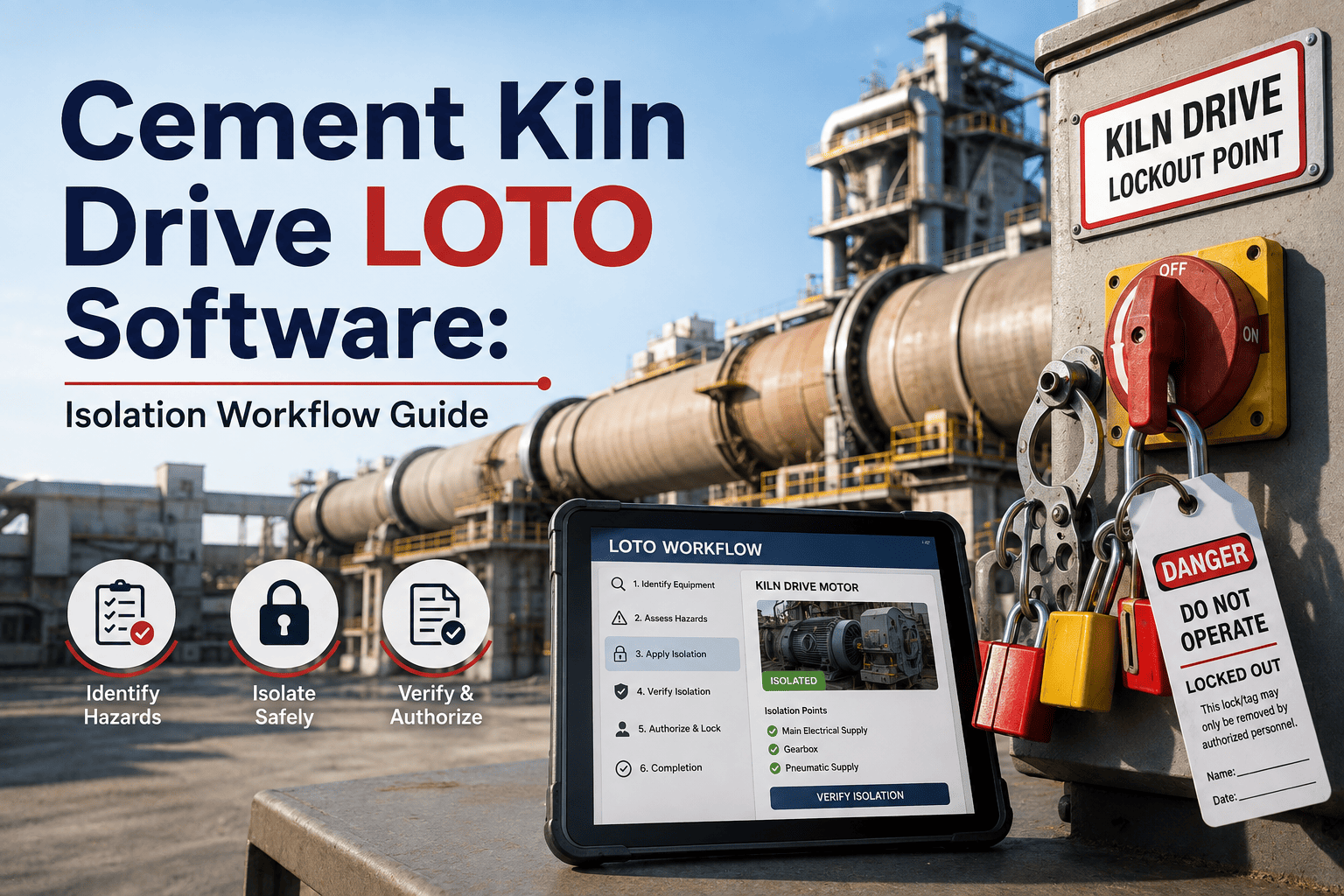
7-Step LOTOTO Workflow for Cement Kiln Maintenance Safety
By John Snow on February 21, 2026
A cement plant in Indonesia prevented a fatal electrical contact incident when a maintenance technician followed the 7-step LOTOTO verification process and discovered the kiln drive motor remained energized despite the main breaker being open—a faulty VFD bypass circuit had maintained power to the motor terminals. OSHA data shows that 10% of serious workplace injuries in industrial settings result from inadequate lockout/tagout procedures, with cement kilns presenting exceptional hazards due to multiple energy sources including high-voltage electrical systems, rotating mechanical components, hydraulic pressure, pneumatic systems, and extreme thermal energy that persists for hours after shutdown. Structured LOTOTO workflows ensure every energy source is identified, isolated, and verified before maintenance work begins. Sign up for Oxmaint to digitize your LOTOTO procedures with mobile checklists and permit management.
Critical Safety Procedure
This checklist documents the 7-step LOTOTO workflow required before any cement kiln maintenance. Never bypass steps. All energy sources must be isolated and verified before work begins. When in doubt, STOP and verify with supervision.
7
Required Steps
6+
Energy Sources
100%
Verification Required
Zero
Shortcuts Allowed
7-Step LOTOTO Workflow
Complete each step in sequence before proceeding to maintenance activities
1
Step
Preparation
Identify all energy sources, review equipment-specific LOTOTO procedures, and gather required lockout devices before approaching the equipment.
Review equipment-specific LOTOTO procedure
Obtain the written procedure for the specific kiln system and verify it matches the equipment to be serviced.
Identify all energy sources
Document electrical, mechanical, hydraulic, pneumatic, thermal, and gravitational energy sources using the energy source matrix.
Gather lockout devices and tags
Collect personal locks, hasps, tags, and any specialized lockout devices required for identified isolation points.
Notify affected personnel
Inform control room operators, affected production staff, and any other workers who may be impacted by the shutdown.
2
Step
Shutdown
Perform an orderly shutdown of the kiln system using normal operating procedures before isolation begins.
Coordinate shutdown with control room
Confirm with operators that the system is ready for shutdown and all upstream/downstream processes are prepared.
Stop feed systems and fuel supply
Shut down raw meal feed and fuel supply (coal, gas, or alternative fuels) using standard operating procedures.
Stop kiln rotation
Bring kiln drive to controlled stop, confirm rotation has ceased, and engage barring gear if required for cool-down.
WARNING: Kiln shell remains extremely hot for 12-24 hours after shutdown. Thermal energy hazard persists throughout cooldown period.
3
Step
Isolation
Physically disconnect or isolate all energy sources using isolation devices such as breakers, valves, and blocks.
Open main circuit breakers
Open and rack out main drive motor breaker, auxiliary motor breakers, and control power supply breakers.
Close hydraulic isolation valves
Isolate hydraulic systems for thrust roller, support roller adjustment, and kiln seals.
Close pneumatic supply valves
Isolate compressed air supply to kiln seal air systems, instrumentation, and control actuators.
Block mechanical energy sources
Engage mechanical blocks on girth gear, install chocks on support rollers if required.
4
Step
Lockout/Tagout Application
Apply personal locks and danger tags to all isolation devices. Each worker applies their own lock.
Apply personal lock to each isolation point
Each authorized worker installs their personal padlock on every isolation device. Use hasps for multiple workers.
Attach danger tags with worker information
Complete danger tags with name, date, department, and expected duration. Attach to each lock.
Document all lockout points
Record lock numbers, locations, and worker assignments on the LOTOTO permit form.
WARNING: Never use another worker's lock. Only the person who applied a lock may remove it.
5
Step
Stored Energy Release
Release, restrain, or dissipate all stored or residual energy that could cause injury.
Bleed hydraulic pressure
Open bleed valves to release hydraulic pressure. Verify pressure gauges read zero before proceeding.
Vent pneumatic pressure
Open vent valves to release compressed air from lines, cylinders, and accumulator tanks.
Discharge electrical capacitors
Verify VFD capacitor banks are discharged. Use grounding devices on high-voltage systems.
Secure suspended loads
Lower or block any suspended components, counterweights, or materials that could fall.
6
Step
Verification
Confirm that isolation is complete and all energy sources are at zero energy state before work begins.
Verify electrical isolation with meter
Use a calibrated voltage tester to confirm zero voltage at all electrical isolation points and motor terminals.
Verify hydraulic isolation with gauges
Confirm pressure gauges read zero on all isolated hydraulic circuits.
Verify pneumatic isolation
Confirm zero pressure on all pneumatic gauges and verify vent valves are open.
Verify mechanical blocking
Physically confirm that mechanical blocks, chocks, and restraints are properly positioned.
7
Step
Try Out
Attempt to restart equipment using normal controls to confirm isolation is effective.
Clear personnel from danger zones
Ensure all workers are clear of equipment before attempting restart. Sound audible warning.
Attempt to start equipment from control panel
Press start buttons for main drive and auxiliary systems. Equipment must not respond.
Return controls to safe position
Return all start/stop switches to OFF or neutral position after try-out.
Authorize work to begin
Sign LOTOTO permit to authorize maintenance work. Communicate status to all workers.
Cement Kiln Energy Sources
All energy sources must be identified, isolated, and verified before maintenance
Electrical
Main drive motor (2-6 MW)
VFD and control systems
Auxiliary motors and fans
Mechanical
Kiln shell rotation (4-5 RPM)
Girth gear and pinion
Support roller assemblies
Hydraulic
Thrust roller system (200+ bar)
Support roller adjustment
Kiln seal systems
Pneumatic
Seal air systems (6-8 bar)
Control valve actuators
Instrumentation air
Thermal
Kiln shell (250-400°C surface)
Clinker cooler (hot zones)
Preheater tower
Gravitational
Material in preheater
Suspended components
Counterweights
Digitize your LOTOTO procedures. Oxmaint provides mobile checklists, permit management, and complete audit trails for LOTOTO workflows—ensuring every step is documented and verified before work begins.
Ensure all lockout devices and personal protective equipment are available before beginning the LOTOTO procedure. Sign up for Oxmaint to manage safety equipment inventory and inspections.
Personal Padlocks
Individually keyed locks assigned to each authorized worker
Danger Tags
Standardized tags with worker identification fields
Lockout Hasps
Multi-lock hasps for group lockout situations
Voltage Tester
Calibrated tester for electrical verification
Digital LOTOTO Documentation
Oxmaint digitizes LOTOTO permits with mobile completion, photo documentation, and electronic signatures—creating audit-ready records that prove compliance.
Mobile Checklist Completion
Photo Evidence Capture
Electronic Signatures
Audit-Ready Records
LOTOTO PERMIT
EquipmentKiln #2 Drive
Work OrderWO-4821
Issued06:30 AM
Lock Count8 Locks
Authorized Signature
Frequently Asked Questions
Who is authorized to perform LOTOTO procedures?
Only workers who have completed LOTOTO training and authorization are permitted to apply locks and perform energy isolation. Training must cover the specific hazards and isolation procedures for cement kiln systems. Oxmaint tracks training records and authorization status for all personnel.
What happens during shift changes with locks still in place?
Locks must remain in place until work is complete and verified. For shift changes, outgoing workers transfer lockout responsibility to incoming workers through a documented handover process. Incoming workers apply their own locks before outgoing workers remove theirs. Book a demo to see how Oxmaint manages shift handover documentation.
Can locks ever be removed by someone other than the person who applied them?
Lock removal by anyone other than the worker who applied it requires a formal lock removal procedure involving verification that the worker is not on-site, supervisor authorization, and documented safety verification. This should only occur in exceptional circumstances and is never routine.
How does Oxmaint help with LOTOTO compliance?
Oxmaint provides digital LOTOTO permits linked to work orders, mobile checklists that enforce step completion sequence, photo documentation requirements, electronic signatures with timestamps, and complete audit trails. Sign up for Oxmaint to implement digital LOTOTO management.
Protect Your Workers with Digital LOTOTO
Paper-based LOTOTO procedures leave gaps. Oxmaint digitizes the entire workflow with enforced step sequences, photo documentation, and electronic signatures—creating audit-ready records that prove compliance and protect your workers.