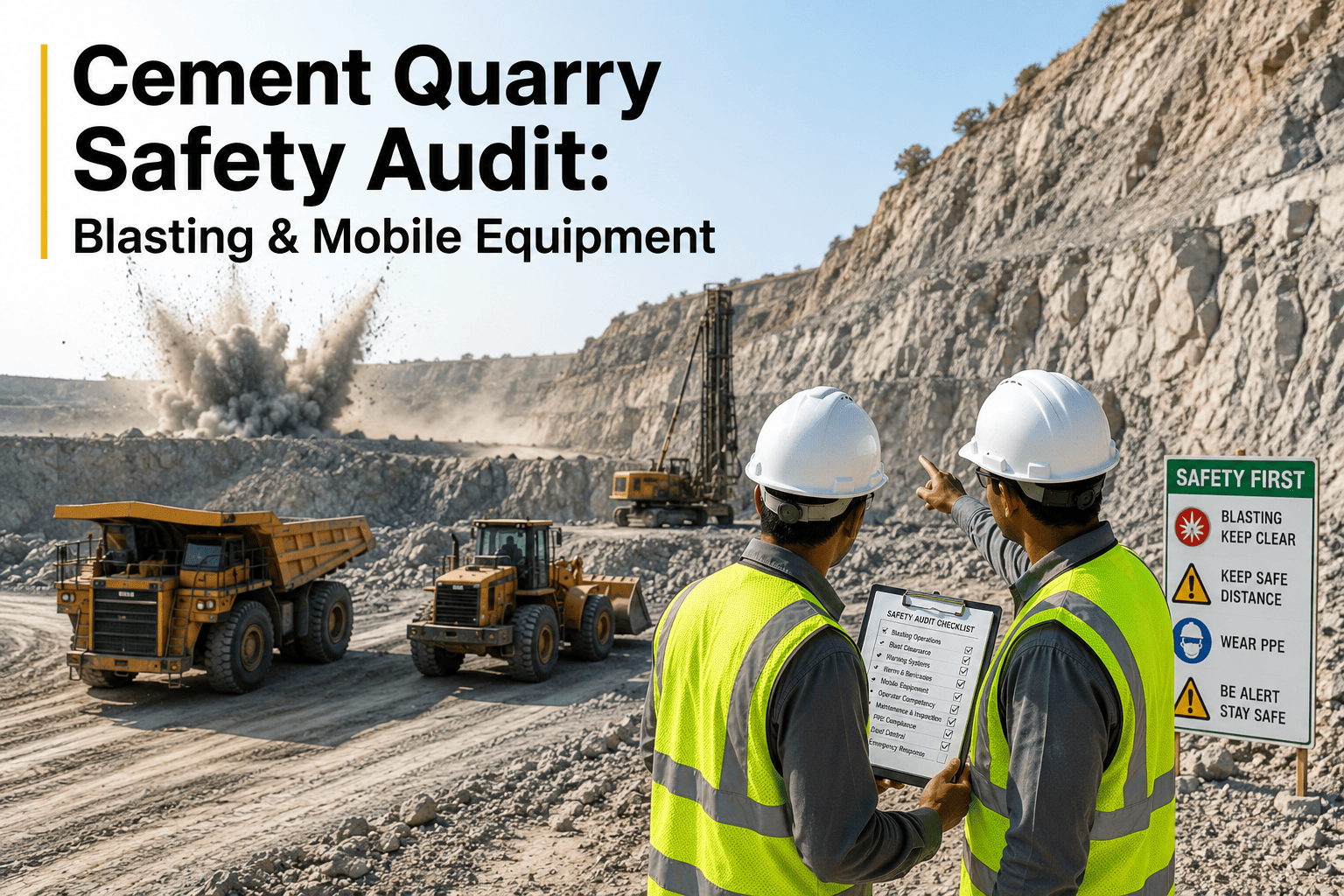
Cement quarry operations live and die by the integrity of their safety program — one unstable high-wall, one missed brake inspection on a 400-ton haul truck, or one flyrock event during a blast can turn a productive shift into a MSHA-reportable incident within minutes. A rigorous cement quarry safety audit ties together the four highest-risk domains on site: blasting procedures, mobile equipment PM, slope stability, and dust/fatigue exposure, then routes every finding through a CMMS so corrective actions actually close. Plants that run quarterly audits backed by maintenance software typically cut recordable injuries by 25–40% and reduce MSHA citation penalties — which average $4,200 per serious violation — by half. The audit framework below maps each risk area to specific inspection points, KPIs, and corrective-action workflows you can launch today; Start Free Trial to load the full template into your CMMS.
Is your quarry audit actually closing blast and mobile-equipment risks — or just documenting them?
MSHA Part 56 enforcement now issues citations for 7 of every 10 quarry inspections, and over 60% involve blasting procedures, haul-truck maintenance, or high-wall condition. A CMMS-driven audit converts each finding into a tracked work order with owner, deadline, and verification — so nothing slips between the blast log and the next shift.
Where MSHA citations cluster in a cement quarry
Analysis of MSHA enforcement data for metal/non-metal mines shows four domains account for roughly 82% of all quarry citations. Your audit must weight inspection time toward these areas — not spread evenly across 200 low-risk items.
Blasting procedure audit: from plan to post-blast sign-off
A defensible blast procedure covers six sequential checkpoints. Each generates a CMMS record — if any step is missing when MSHA arrives, the entire blast is non-compliant regardless of outcome.
Blast plan & permit
Licensed blaster signs a written plan specifying hole pattern, burden, spacing, stemming depth, delay sequence, and maximum charge weight per delay. Plan uploaded to CMMS with GPS-tagged bench location and a 1,500-foot clearing radius documented.
Pre-blast site clearance
All personnel removed from the blast site and guarded access points. Verbal clearance confirmed via radio log and CMMS checklist with timestamp. Misfire procedures and escape routes briefed to every worker within the exclusion zone.
Initiation & seismograph monitoring
Seismograph deployed at the nearest structure or sensitive receptor. Peak particle velocity recorded against the per-delay charge weight; any reading above 2.0 in/sec triggers an immediate investigation and blast-design revision before the next shot.
Post-blast inspection & muckpile
Blasted material inspected for undetonated explosives, sympathetic detonation, and excessive flyrock. Return-to-work authorized only after the blaster-in-charge signs the CMMS post-blast form and the all-clear is broadcast.
Misfire & hang-fire protocol
Documented procedure requiring 30-minute minimum wait, isolation of the area, and controlled re-entry by the blaster only. Every misfire — even resolved — logged in CMMS with root-cause and corrective action assigned to prevent recurrence.
Explosive magazine inventory
Detonators and boosters stored in Type-1 or Type-2 magazines with weekly inventory reconciliation. Any variance over 1 unit triggers a theft/loss report to ATF and an internal CMMS-flagged investigation within 24 hours.
Haul truck & loader PM inspection matrix
Mobile equipment is the single largest source of quarry fatalities — 40% of all surface-mine deaths involve haulage. The inspection matrix below maps each MSHA-critical component to a PM interval, CMMS trigger, and the citation risk if skipped.
| Component / System | Inspection Frequency | Critical Failure Mode | CMMS Trigger | MSHA Citation Risk |
|---|---|---|---|---|
| Service & emergency brakes | Each shift (pre-op) | Inadequate stopping distance | Auto work order on fail | $13,000+ unwarrantable failure |
| Steering & hydraulics | Each shift + 250 hr PM | Loss of directional control | Fluid-level sensor alert | $5,800 serious violation |
| Fire suppression system | Monthly visual + annual cert | Engine/hydraulic fire | Cert-expiry countdown | $12,600 if absent/failed |
| ROPS / FOPS integrity | Quarterly visual | Operator crushing injury | Photo log in CMMS | $7,200 per unit |
| Backup alarm & cameras | Each shift (pre-op) | Struck-by fatality | Operator checklist flag | $4,200 per occurrence |
| Tire condition & pressure | Each shift + weekly thermal | Blowout / fire from heat | TPMS integration alert | $4,200 serious violation |
| Headlights, strobes, horn | Each shift (pre-op) | Reduced visibility at dust | Checklist with photo | $2,800 per deficiency |
| Operator restraint system | Each shift (pre-op) | Ejection during rollover | Replace-by-date WO | $5,800 serious violation |
Worked example — a 12-truck fleet
A mid-size cement quarry running 12 haul trucks and 3 front-end loaders typically budgets $42,000/year in MSHA penalties when pre-op inspections are paper-based and 18% of defects go unrepaired before the next shift. Moving the same checklist into a CMMS with mandatory photo evidence and auto-generated work orders drops uncorrected defects to under 4% and recovers roughly $31,000 in avoided citations — payback in under 90 days on a typical CMMS subscription.
Slope stability inspection checklist
High-wall failures are low-frequency but catastrophic — a single bench collapse can bury equipment and operators. A competent person must inspect every active face after each blast, after heavy rainfall (>1 inch/24h), and at minimum weekly. Use this tiered checklist inside your CMMS.
Daily face conditions
- Loose material / overhangs scaled before access
- Tension cracks along bench crest mapped & dated
- Water seepage or springs flagged for drainage
- Bench width meets design (≥1.5× truck width)
Weekly structural audit
- Joint / bedding orientation logged vs. face azimuth
- Potential wedge / plane failure zones flagged
- Scaling work orders closed within 24-hour SLA
- Berm height ≥ mid-axle of largest truck (42 in min.)
Post-rainfall review
- Full high-wall walk within 4 hours of rainfall event
- Piezometer readings reviewed if installed
- Access restricted until competent-person sign-off
- Photo documentation uploaded to CMMS record
Quarterly geotech review
- Drone photogrammetry of all active faces
- Slope-angle vs. design (typically 60–75° max)
- Fault / karst features reviewed with geologist
- Bench-creep displacement trended in CMMS
Worker exposure control tiers
Respirable crystalline silica at the drill, crusher, and haul road regularly exceeds the 0.05 mg/m³ PEL. Pair engineering controls with CMMS-scheduled water-truck routes and a documented respiratory program — not just PPE handed out at the gate.
Source elimination
Enclosed cabs with HEPA filtration on drills and loaders, water-spray rings at crusher discharge, and road-dust suppression via automated water-truck scheduling in the CMMS. Target: reduce ambient silica by 60% before PPE is considered.
Rotation & monitoring
Shift rotation to limit individual exposure time at the face, annual audiograms for noise zones above 85 dBA, and fatigue-management scheduling that caps consecutive shifts at 12 hours with mandatory 10-hour rest periods.
Last line of defense
Half-mask APRs (P100) where TWA exposures remain above 0.05 mg/m³ after engineering controls. Fit-test records, cartridge change-out schedules, and high-visibility Class-3 apparel tracked as CMMS-managed PPE inventory with expiry alerts.
From audit finding to closed corrective action in 5 steps
An audit is only as good as its closeout rate. Without a CMMS, the average quarry closes 54% of audit findings within 30 days. With a structured CMMS workflow that number climbs to 92%.
Audit trigger & scope
Quarterly full-site audit or MSHA-driven spot inspection launched from a CMMS template that pre-loads all 120+ quarry inspection points across blasting, equipment, slope, and exposure domains.
Finding capture with evidence
Inspector logs each deficiency with photo, GPS tag, severity rating (1–4), and applicable MSHA standard reference. Mobile app works offline at the bench face and syncs when back in range.
Auto-generated corrective work order
Each severity 1–3 finding auto-creates a CMMS work order with assigned owner, due date (24h for S1, 72h for S2, 7d for S3), required parts, and safety permit if hot work or lockout is needed.
Verification & sign-off
Closing a corrective work order requires a verification photo and supervisor electronic signature. CMMS blocks closure without both — eliminating "closed on paper, still broken in the field" failures.
Trend reporting & MSHA readiness
Dashboard tracks closeout rate, repeat findings, and citation-risk exposure by area. Export a MSHA-ready audit packet — findings, WOs, verifications, and signatures — in under 60 seconds.
Run your next quarry safety audit inside a CMMS that closes findings — not files them.
Load the cement quarry audit template, assign owners, and watch corrective-action closeout rates climb past 90% in the first quarter.
Frequently asked questions
How often should a cement quarry safety audit be conducted?
A full-site audit should run at least quarterly, with targeted monthly inspections on the four high-risk domains — blasting, mobile equipment, high-wall, and dust exposure. Post-incident audits are mandatory after any recordable injury, near-miss involving flyrock or equipment, or any rainfall event exceeding 1 inch in 24 hours. MSHA can arrive unannounced, so your CMMS audit records should be export-ready at any time.
What does a CMMS actually do for quarry blasting safety?
A CMMS converts every blasting-procedure checkpoint — from signed blast plan to post-blast seismograph reading — into a digital record with timestamp, GPS location, and responsible party. Misfire events auto-generate root-cause work orders, magazine inventory variances trigger 24-hour investigations, and the entire blast history is exportable as a single MSHA-ready packet. You can Book a Demo to see the blasting module configured for a cement quarry.
What are the most common MSHA citations for quarry mobile equipment?
The top three are defective service brakes (56.14101), inoperative backup alarms (56.14132), and missing or expired fire-suppression systems (56.14104). Pre-operational inspection failures account for over 60% of these citations, almost always because a defect was noted on paper but never routed to a repair work order before the truck re-entered service.
How is high-wall stability monitored between formal audits?
A competent person inspects every active high-wall after each blast and after any significant rainfall. Between formal inspections, look for tension cracks at the crest, water seepage, loose overhangs, and bench-width violations. Quarterly drone photogrammetry provides a slope-angle baseline, and any displacement trend exceeding 2 inches between flights triggers a geotechnical review before the next bench is advanced.
Can the audit template be customized for our specific quarry layout?
Yes — the CMMS template ships with 120+ standard quarry inspection points, but every checklist, severity scale, SLA, and assigned owner can be edited to match your bench geometry, equipment fleet, and local regulatory requirements. Custom fields for GPS coordinates, photo evidence, and MSHA standard references are built in. Start a free trial at https://app.oxmaint.ai to configure it for your site.
Turn your next quarry safety audit into closed corrective actions — not a binder on a shelf.
Deploy the cement quarry safety audit template in your CMMS today and see closeout rates climb past 90% within the first quarter.
Free 14-day trial · No credit card