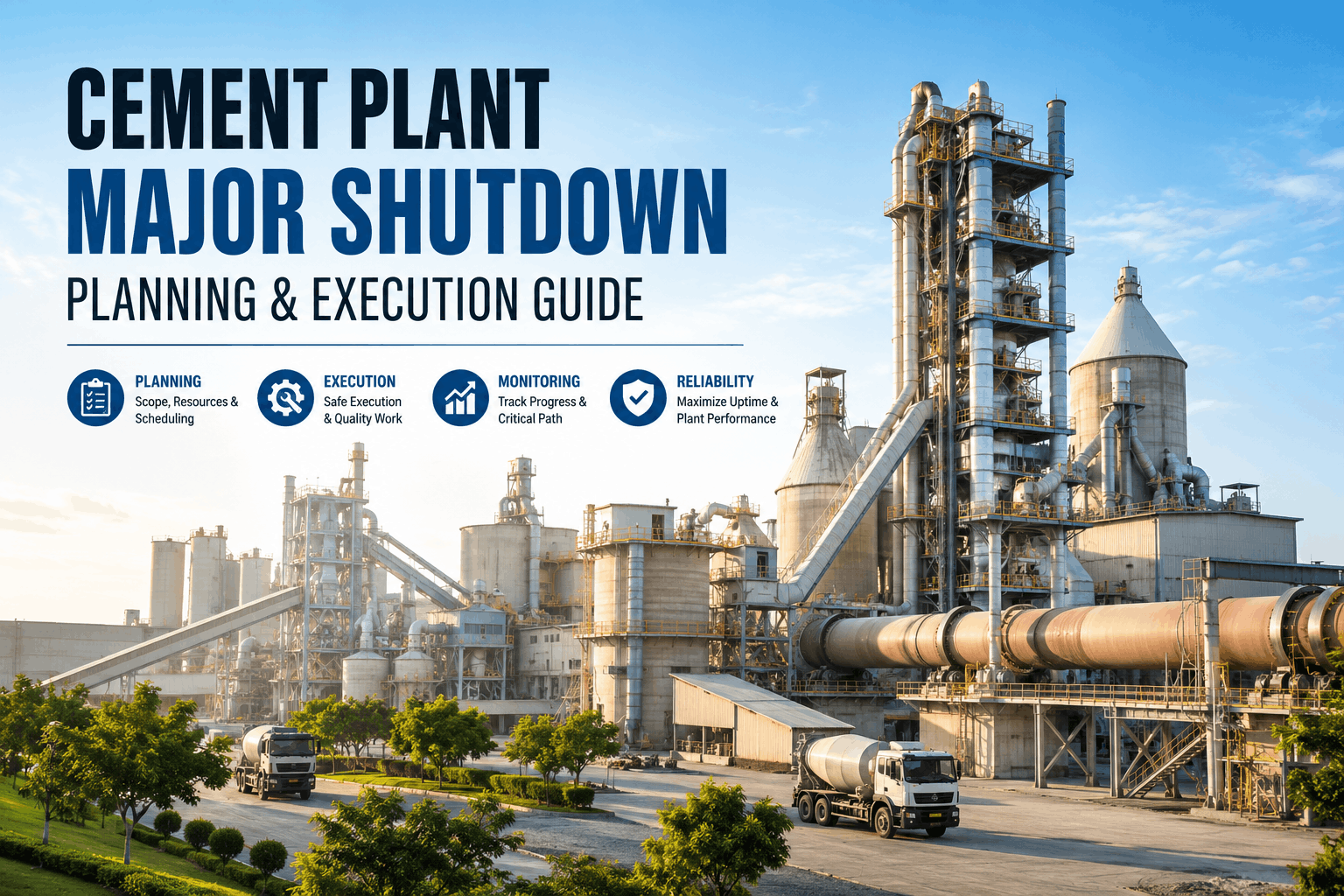
A well-executed shutdown is the difference between a cement plant that runs 330+ days a year and one that struggles to hit 300. Yet most plants treat shutdowns as chaotic fire drills—scrambling for parts two weeks before the outage, discovering scope creep on day one, and watching the timeline stretch from 14 days to 21. The financial impact is staggering: every additional day of unplanned shutdown extension costs the average cement plant $350,000–$500,000 in lost production. Plants that adopt structured shutdown planning methodologies consistently finish on time and under budget, with some reducing turnaround duration by 25% or more. This pillar guide walks through the complete shutdown lifecycle—from 6-month advance planning to post-shutdown analysis—giving your maintenance and operations teams a repeatable framework for world-class turnaround execution.
============ COST COMPARISON BANNER ============
Planned Shutdown
14
Days Avg.
Scope defined 90+ days ahead
Parts pre-staged on site
Contractor crews pre-qualified
Budget variance <10%
VS
Unplanned Extension
21+
Days Avg.
Scope creep discovered at start
Emergency parts expediting
Untrained labor on critical tasks
Budget overrun 40–80%
The gap between these two outcomes isn't luck—it's process. Cement plants using a CMMS to coordinate shutdown planning, track work orders in real time, and manage resource allocation consistently outperform those relying on spreadsheets and tribal knowledge. Start your free OXmaint trial to build your shutdown plan on a platform designed for turnaround excellence.
============ 6-PHASE TIMELINE ============
The 6-Phase Shutdown Planning Framework
World-class cement plant shutdowns follow a structured lifecycle. Rushing or skipping phases is the single biggest predictor of cost overruns and timeline extensions. The framework below maps the complete journey from initial scoping to post-shutdown analysis.
6–4 Months Before
Scope Definition & Work List Development
This phase determines everything that follows. Incomplete scoping is the root cause of 60% of shutdown overruns. Every department—production, maintenance, quality, safety, and environmental—must submit and justify their shutdown work requests during this window.
Key Deliverables
☐ Complete equipment condition assessment using inspection data and CMMS history
☐ Master work list with every job categorized (mandatory, high-priority, opportunistic)
☐ Preliminary cost estimate for each work package (±30% accuracy)
☐ Shutdown duration target based on critical path analysis
☐ Go/no-go criteria for each work item with clear ownership
4–2 Months Before
Detailed Planning & Resource Procurement
This is where plans become actionable. Every work order gets detailed task breakdowns, labor estimates, material requirements, and safety procedures. Late procurement is the second most common cause of shutdown delays—if a part has a 6-week lead time and you order it 4 weeks out, you've already failed.
Key Deliverables
☐ Detailed work orders with step-by-step procedures in CMMS
☐ Bill of materials for every job—all long-lead items ordered
☐ Contractor selection complete; mobilization dates confirmed
☐ Critical path schedule developed and resource-leveled
☐ Safety plans, permits, and LOTO procedures prepared for each area
☐ Budget finalized (±10% accuracy)
2 Weeks Before
Pre-Shutdown Mobilization
The final sprint before kiln cooldown. Everything that can be done while the plant is still running should be completed now—scaffolding erected, staging areas prepared, temporary utilities installed. Every hour of pre-work done here saves two hours during the actual shutdown.
Key Deliverables
☐ All spare parts received, inspected, and staged by work area
☐ Scaffolding and access equipment erected where possible
☐ Contractor safety orientations and site inductions completed
☐ Communication plan distributed (daily meeting schedule, escalation paths)
☐ Progress tracking boards and KPI dashboards set up in CMMS
Day 0 → Day 14+
Execution & Real-Time Management
Execution discipline separates good shutdowns from great ones. Daily progress tracking against the critical path, immediate escalation of scope changes, and rigorous management of added work are essential. Plants that track work order completion rates hourly during shutdown finish 20% faster than those tracking daily.
Daily Execution Rhythm
☐ 6:00 AM — Area supervisor readiness check and safety briefing
☐ 7:00 AM — Shift start; all crews deployed to assigned work areas
☐ 12:00 PM — Midday progress review; critical path status update
☐ 5:00 PM — End-of-day debrief; next-day work package distribution
☐ Continuous — Work order status updates in CMMS (real-time mobile)
☐ As needed — Scope change approval through formal change control
Final 48 Hours
Startup & Commissioning
The most dangerous phase. Rushing startup to "make up time" causes more equipment damage than the problems the shutdown was meant to fix. Every system needs methodical verification before the kiln lights again.
Key Deliverables
☐ All work orders closed out with completion notes and photos in CMMS
☐ Punch list items categorized (must-fix vs. can-run-with)
☐ System-by-system startup checklist executed (utilities → auxiliaries → main equipment)
☐ Kiln dry-out and heat-up curve followed per refractory supplier specs
☐ 72-hour post-startup monitoring plan activated
1–2 Weeks After
Post-Shutdown Review & Continuous Improvement
The most frequently skipped phase—and the one with the highest long-term ROI. Plants that conduct rigorous post-shutdown reviews improve turnaround efficiency by 10–15% on every subsequent shutdown. Without this step, the same mistakes repeat year after year.
Key Deliverables
☐ Actual vs. planned analysis (duration, cost, labor hours, scope changes)
☐ Root cause analysis for every critical path delay
☐ Contractor performance scorecards
☐ Lessons learned documented and assigned to next shutdown planning cycle
☐ CMMS data updated—equipment records, failure history, recommended intervals
Plan Your Next Shutdown on a Platform Built for It
Manage every work order, track real-time progress, and close out 25% faster—setup takes 10 minutes
============ RESOURCE ALLOCATION GRID ============
Shutdown Resource Allocation: Staffing the Critical Path
Understaffing the critical path is one of the costliest shutdown mistakes. The kiln refractory reline almost always sits on the critical path—if it slips, the entire shutdown extends. The resource plan below shows typical labor loading for a mid-size cement plant shutdown (5,000 TPD kiln).
Work Area
Crew Size
Duration
Critical Path?
Labor Loading
Kiln Refractory Reline
40–60
10–12 days
YES
Preheater / Cyclone Inspection
12–18
6–8 days
MAYBE
Raw Mill Overhaul
8–12
7–10 days
NO
Finish Mill & Separator
8–10
5–7 days
NO
Electrical / Instrumentation
6–10
10–14 days
NO
Conveyor & Material Handling
10–15
8–12 days
NO
Cooler Maintenance
10–14
8–10 days
YES
Pro Tip: Use your CMMS to track actual labor hours against estimates during the shutdown. Plants that measure labor productivity in real time can redeploy crews from completed non-critical jobs to support the critical path—shaving 1–2 days off total duration.
Schedule a free demo to see how OXmaint's live dashboards give you instant visibility into crew productivity.
============ SCOPE CONTROL ============
The #1 Shutdown Killer: Scope Creep
Scope creep adds an average of 3–5 days to cement plant shutdowns. It typically follows a predictable pattern that can be controlled with the right process.
1
Discovery
New work identified during inspection or teardown. Supervisor documents scope, estimates hours and materials.
→
2
Impact Assessment
Planner evaluates: Does this affect critical path? What resources are needed? What's the cost?
→
3
Approval Gate
Shutdown manager approves or defers. If it extends the critical path, plant manager must approve.
→
4
Execute or Defer
Approved work gets a formal work order in CMMS. Deferred work is logged for next shutdown cycle.
30%
of added work during shutdowns could have been identified in pre-planning
$45K
average cost per critical-path scope addition (labor + lost production)
70%
of scope changes that extend shutdowns involve refractory or mechanical work
============ SHUTDOWN KPI DASHBOARD ============
Measuring Shutdown Performance: The KPIs That Matter
You can't improve what you don't measure. These are the shutdown KPIs that separate top-quartile cement plants from the rest.
⏱
Schedule Compliance
Target: ≥90%
% of work orders completed within planned duration. Below 80% signals systemic planning failures.
?
Budget Variance
Target: ±10%
Actual cost vs. approved budget. Track separately for labor, materials, and contractor costs.
?
Scope Change Rate
Target: <15%
Added work orders as % of original scope. High rates indicate poor pre-shutdown condition assessment.
?
Wrench Time
Target: ≥55%
% of time crews spend on actual maintenance vs. waiting, traveling, or searching for parts.
⚠️
Safety Incident Rate
Target: 0 LTIs
Lost-time injuries during shutdown. Fatigue and unfamiliar contractors increase risk dramatically.
?
Post-Shutdown Reliability
Target: 0 trips in 30 days
Unplanned stops within 30 days of startup. Measures quality of shutdown work execution.
Tracking these KPIs manually across spreadsheets is how data gets lost between shutdowns. Facilities using CMMS-based dashboards carry forward every metric into the next planning cycle automatically. Sign up for free and start building your shutdown performance baseline today.
Track Every Shutdown KPI in Real Time
Live dashboards, automatic work order tracking, mobile crew updates—no credit card required
============ COMMON MISTAKES ============
7 Shutdown Mistakes That Cost Cement Plants Millions
01
Starting Planning Too Late
Plants that begin shutdown planning less than 90 days out spend 35% more on expedited parts and contractor premiums. Start 6 months ahead for annual shutdowns.
02
No Formal Scope Freeze
Without a hard cutoff date for adding new work (typically 4 weeks before shutdown), scope grows uncontrollably. Establish a scope freeze and require plant manager approval for any additions after it.
03
Ignoring the Critical Path
Spreading resources evenly across all jobs instead of prioritizing the critical path. If kiln refractory is driving the timeline, every available resource should support it first.
04
Poor Contractor Management
Bringing in contractors without pre-qualification, site orientation, or clear scope documents leads to rework, safety incidents, and finger-pointing over costs.
05
Rushing the Startup
Pressure to resume production leads to incomplete punch lists and skipped startup procedures. The resulting post-shutdown trip costs more than the extra day of careful commissioning.
06
No Lessons Learned Process
Without a formal post-shutdown review within 2 weeks of startup, institutional knowledge walks out the door with retiring workers and departing contractors.
07
Paper-Based Tracking
Spreadsheets and paper checklists can't provide real-time visibility. By the time data is compiled daily, decisions are already hours late. Digital CMMS tracking enables minute-by-minute course correction.
============ TECHNOLOGY SECTION ============
How CMMS Transforms Shutdown Execution
Key Insight: Plants using CMMS for shutdown coordination report an average 25% reduction in turnaround duration by the third shutdown cycle. The improvement comes not from any single feature but from the compounding effect of better data, faster decisions, and institutional learning carried forward digitally.
============ FAQ ============
Frequently Asked Questions
How far in advance should a cement plant shutdown be planned?
Major annual shutdowns should begin planning 6 months in advance, with scope definition and long-lead procurement starting at the 4–6 month mark. Minor shutdowns (5–7 days) need a minimum of 8–12 weeks of planning. The most common planning failure is starting too late, which forces expedited parts purchases and poorly vetted contractor crews.
What is the typical duration for a cement plant shutdown?
Annual major shutdowns for kiln refractory relining typically run 12–18 days depending on kiln size and refractory scope. Mid-year minor shutdowns for mill and mechanical work average 5–8 days. Plants with mature planning processes consistently achieve the lower end of these ranges.
How much does a cement plant shutdown cost?
Direct shutdown costs for a mid-size plant (4,000–6,000 TPD) typically range from $1.5M to $3M for an annual major turnaround, covering refractory, mechanical repairs, contractor labor, and materials. Indirect costs from lost production add $350,000–$500,000 per day, making duration control the single biggest cost lever.
What sits on the critical path in a cement plant shutdown?
The kiln refractory reline almost always defines the critical path because it requires kiln cooldown (2–3 days), brick removal, shell inspection, relining, and controlled heat-up (2–3 days). Clinker cooler repairs and preheater cyclone work are secondary critical path candidates depending on scope.
How does a CMMS help with shutdown planning?
A CMMS centralizes the entire shutdown lifecycle—from work list development and material procurement to real-time execution tracking and post-shutdown analysis. Key benefits include automated work order generation from templates, mobile progress updates from the field, inventory management linked to shutdown BOMs, and historical data that improves each subsequent turnaround.
How do you control scope creep during a cement plant shutdown?
Implement a formal scope freeze 4 weeks before shutdown, require documented change requests for any added work, establish clear approval authority (shutdown manager for non-critical path, plant manager for critical path impacts), and track scope additions as a KPI. Plants that follow this process keep scope changes below 15% of original work list.
Ready to Run Your Best Shutdown Ever?
Get started in under 10 minutes. Free forever for small teams.