A 2000 kW planetary gearbox on a cement raw mill does not fail from a single catastrophic event. It fails from a slow chemical degradation no one can see — moisture ingress, acid number rising, wear debris accumulating, viscosity drifting out of specification — and by the time vibration sensors detect the mechanical symptom, the damage is already measured in millions of dollars. Industry data shows 70% of hydraulic and lubrication-related failures trace back to oil contamination that was invisible to calendar-based oil sampling, and a single planetary gearbox seizure on a cement mill or kiln drive costs $1.2 million or more in repair and lost clinker production. Smart lubrication sensors change that equation entirely — by continuously measuring viscosity, dielectric constant, water content, temperature, and wear-debris particle counts inside the gearbox itself, then streaming that data into OxMaint's CMMS to trigger condition-based work orders 30 to 45 days before mechanical failure becomes inevitable. This page breaks down exactly what oil condition parameters to monitor on cement plant gearboxes, which sensor technologies measure each parameter, and how the data flows from sensor to work order in a way that converts lubrication from a calendar routine into a reliability intelligence asset.
Smart Lubrication · Oil Condition Monitoring · CMMS Integration
Catch Gearbox Failure in the Oil — 45 Days Before It Reaches the Gears
Smart lubrication sensors continuously monitor oil viscosity, water content, dielectric constant, and wear debris inside cement plant gearboxes — then trigger OxMaint CMMS work orders automatically when any parameter drifts outside spec.
Viscosity
In spec · 218 cSt
Water Content
Watch · 480 ppm
Wear Debris
Alert · Fe spike +230%
Dielectric Constant
In spec · 2.14
Why Calendar-Based Oil Sampling Fails Cement Plant Gearboxes
The traditional cement plant lubrication programme is simple: every 90 or 180 days, pull an oil sample from the gearbox drain port, send it to an external laboratory, wait 5 to 10 days for results, and change the oil if the report says so. This programme was designed for a world without sensors. It has three failure modes that are permanently baked into the approach itself.
01
The Sample Is Already Old
By the time laboratory results come back, the oil in the gearbox has been running for another 10 to 14 days past the sample point. If contamination spiked the day after the sample was drawn, the next sample is 90 days away.
02
One Sample, Whole Gearbox
A single drain-port sample rarely represents the whole lubrication circuit. Water pooling in the sump, wear particles concentrated near bearings, and air emulsion at high-shear zones are all missed by a single-point manual sample.
03
Change the Oil, Not the Cause
Calendar-based oil changes replace degraded fluid without ever identifying the contamination source — moisture ingress, air breather failure, gear pitting, seal wear — so the same degradation begins the day the new oil goes in.
The Five Oil Parameters That Predict Gearbox Failure
Real-time oil condition monitoring is not a single measurement — it is five parameters that together describe the full health of both the lubricant and the machine it is protecting. Each parameter reveals a different failure mode. Monitored continuously, they compound into an early-warning system that detects degradation weeks before any mechanical sensor would.
P1
Viscosity
DetectsOil thinning from shear, thickening from oxidation, or dilution from fuel/coolant ingress — the single most direct measure of whether the lubricant is still lubricating.
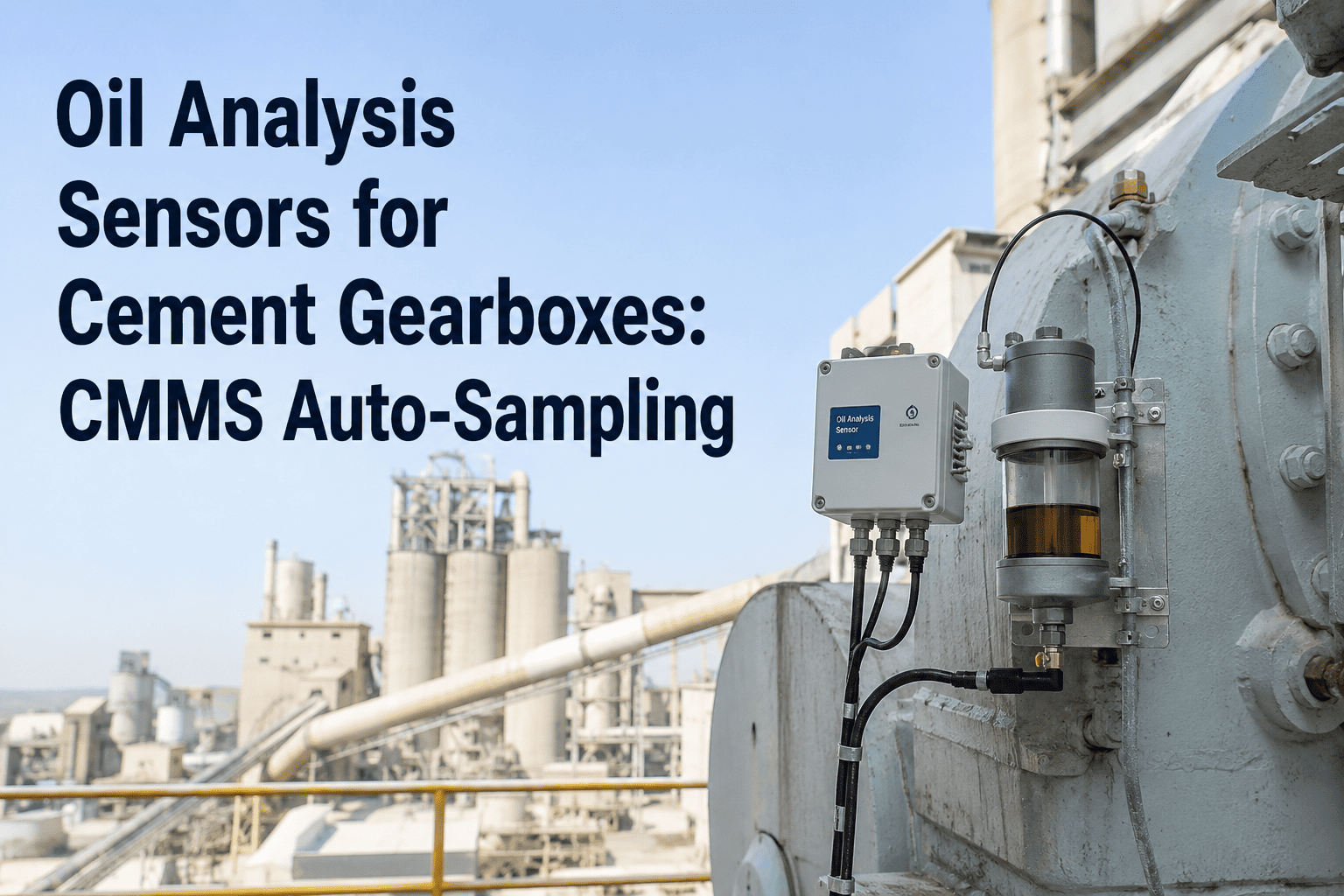
Sensor typeTuning-fork or MEMS viscometer installed in the oil circuit. Reports cSt continuously against the OEM's specified range.
Cement failure mode caughtRaw mill and kiln drive gearbox oil thinning under high shear — oil film collapse leads to metal-on-metal contact in 48 to 96 hours.
P2
Water Content (Moisture)
DetectsMoisture ingress from breathers, condensation, or washdown. Water destroys the oil additive package, promotes acid formation, and causes bearing micro-pitting.
Sensor typeCapacitive relative-humidity probe calibrated to oil. Reports ppm continuously — alarm threshold typically 300 to 500 ppm for gear oils.
Cement failure mode caughtCooler tower humidity + worn breather = silent water ingress into ball mill pinion gearbox over monsoon season. Sensor sees it on day 1; sampling sees it at next change.
P3
Wear Debris & Ferrous Particles
DetectsFerromagnetic and non-ferrous particles in the oil — the direct signature of gear pitting, bearing spalling, or abrasive wear before mechanical vibration picks it up.
Sensor typeInductive magnetic probe (ferrous) + optical particle counter (ISO 4406 cleanliness code) for fine debris.
Cement failure mode caughtHelical pinion fatigue crack on a cement mill gearbox — sub-micron ferrous spike appeared 45 days before vibration harmonics shifted.
P4
Dielectric Constant
DetectsBulk chemical change in the oil — oxidation, varnish formation, additive depletion, and water ingress all shift dielectric. A single sensor covering multiple contamination types.
Sensor typeDielectric probe in-line with the oil circuit. Output correlates to oil quality deterioration on a continuous scale.
Cement failure mode caughtKiln drive gearbox running hot during summer — oxidation acceleration caught weeks before acid number would have flagged in lab.
P5
Oil Temperature
DetectsOperating temperature of the lubricant in circulation. Essential context for every other parameter — viscosity, water, and dielectric all vary with temperature.
Sensor typePt100 or Pt1000 RTD sensor integrated with the oil circuit or as part of a combined multi-parameter probe.
Cement failure mode caughtKiln girth gear drive running 12°C above baseline for 72 hours — correlated with viscosity drop pointed directly at a failing cooler or blocked oil line.
OxMaint · Smart Lubrication CMMS
Stop Changing Oil by the Calendar. Start Changing It by the Data.
OxMaint connects smart lubrication sensors directly to your CMMS — so every oil anomaly triggers a condition-based work order before the gearbox takes damage.
From Sensor Signal to Work Order — The Six-Stage Data Flow
A smart lubrication sensor is only valuable if its reading ends up in a technician's hands with a clear action. OxMaint's lubrication architecture moves the signal from the oil circuit to the shop floor in six defined stages — and every stage is traceable in the audit log.
Stage 1
Sensor Measurement
In-line smart lubrication sensor measures viscosity, water content, dielectric, wear debris, and temperature inside the gearbox oil circuit at 1 Hz or higher sampling rate.
Stage 2
Edge Gateway Aggregation
Wireless LoRa or wired 4-20 mA signals stream into a plant-floor edge gateway. Local buffering handles connectivity gaps common in kiln and mill environments.
Stage 3
Cloud Ingestion & Baseline Comparison
OxMaint ingests the stream, compares each parameter against OEM spec, historical asset baseline, and peer-asset benchmarks — flagging any deviation above threshold.
Stage 4
Severity Classification
Rule engine classifies deviation as Watch, Alert, or Critical based on magnitude, duration, and correlation with other parameters. Multi-parameter signatures escalate faster than single-sensor drift.
Stage 5
Work Order Auto-Generation
OxMaint creates a condition-based work order with the asset, parameter, trend chart, recommended action, and required parts — assigned to the right technician on the current shift.
Stage 6
Resolution & Closed-Loop Learning
Technician executes the action, logs the finding, and closes the WO. OxMaint's model learns from the resolution — improving severity thresholds and the recommended-action library over time.
Which Cement Plant Assets to Instrument First
Not every oil-wetted asset in a cement plant justifies a smart sensor. The right instrumentation strategy ranks assets by failure consequence, then deploys the sensor stack on the highest-consequence gearboxes first. Below is the deployment priority used across cement plants running structured condition-based lubrication programmes.
| Asset |
Failure Cost |
Sensor Priority |
Parameters |
| Kiln main drive gearbox |
$1.2M+ |
Tier 1 · Highest |
All 5 parameters |
| Raw mill planetary gearbox |
$800K-1M |
Tier 1 · Highest |
All 5 parameters |
| Cement mill main gearbox |
$600K-900K |
Tier 1 · Highest |
All 5 parameters |
| Coal mill gearbox |
$300K-500K |
Tier 2 · High |
Visc, Water, Debris, Temp |
| Clinker cooler drive |
$200K-400K |
Tier 2 · High |
Visc, Water, Temp |
| Preheater fan gearbox |
$150K-300K |
Tier 2 · High |
Visc, Water, Temp |
| Conveyor drive gearboxes |
$30K-80K |
Tier 3 · Moderate |
Water, Temp |
| Packer & auxiliary drives |
$10K-40K |
Tier 3 · Moderate |
Periodic sampling |
What Changes When Oil Monitoring Becomes Continuous
38%
Extension of oil drain interval when condition-based
Oil is changed when it has reached its actual degradation threshold — not when the calendar says — extending fluid life significantly.
45 days
Earlier failure detection vs. vibration-only programmes
Oil chemistry drift precedes mechanical symptom. Multi-parameter sensing catches failure signatures weeks before vibration monitoring picks them up.
70%
Share of hydraulic failures caused by oil contamination
Industry-wide data shows the overwhelming majority of hydraulic and lubrication failures are contamination-driven — exactly the failure category continuous sensing addresses.
$1.2M+
Cost of one planetary gearbox failure avoided
A single prevented kiln or raw mill gearbox seizure pays for the entire sensor stack and multi-year CMMS integration budget many times over.
99.4%
Multi-parameter failure detection accuracy
Combining viscosity, water, debris, and dielectric in one inference model dramatically outperforms any single-parameter alarm threshold in reducing false positives.
0
Lost samples due to drain-port access hazards
Manual oil sampling in a cement plant is often hazardous and skipped during shutdown pressure. In-line sensors remove the human access requirement entirely.
Frequently Asked Questions
Do smart lubrication sensors replace laboratory oil analysis?
No — they complement it. Continuous sensors catch fast-developing contamination events between lab samples and reduce sampling frequency from every 90 days to every 180 or 365 days. Laboratory analysis remains essential for additive depletion, acid number, and ICP metal analysis.
Book a demo to see how both streams combine in OxMaint.
How are the sensors installed without taking the gearbox offline?
Most smart oil sensors install on an external lubrication loop or an auxiliary port that can be fitted during a short planned stop — typically 2 to 4 hours per asset. Installation does not require breaching the gearbox housing and is usually scheduled into an existing PM window.
Can OxMaint handle data from sensors from multiple vendors?
What is the baseline period before sensors produce useful alerts?
Parameter baselines establish within 14 to 30 days of operation at stable conditions. Critical threshold alerts work from day one against OEM spec. Multi-parameter failure-signature detection reaches full maturity after 60 to 90 days of asset data accumulation.
How do the alerts reach the technician who can act on them?
When a sensor breaches threshold, OxMaint creates a condition-based work order and routes it by trade and shift to the right technician's mobile app. Severity-classified push notifications escalate if the WO is not acknowledged within the defined window.
Book a demo to see the alert routing configuration.
What is the typical payback period for a smart lubrication deployment?
Most cement plants reach payback in 3 to 6 months. A single prevented planetary gearbox seizure covers the full sensor + integration cost for a plant. Extended oil drain intervals and reduced laboratory sampling fees deliver ongoing operational savings thereafter.
OxMaint · Smart Lubrication Intelligence for Cement Operations
The Gearbox Told You 45 Days in Advance. You Just Needed a Sensor to Hear It.
Smart lubrication sensors wired into OxMaint turn every oil circuit into a continuous reliability signal — detecting contamination, degradation, and wear weeks before mechanical symptoms reach vibration monitoring. Stop waiting for lab reports. Start acting on live data.