Cement plants run some of the most punishing rotating equipment in heavy industry — a single 5-stage preheater kiln can cost upwards of $18,000 per hour of unplanned downtime, and a 4,500 kW cement mill that throws a bearing can take 72 hours to rebuild. The shift from route-based vibration rounds to continuous IIoT condition monitoring is no longer optional for plants chasing 85%+ OEE. This deployment guide walks through sensor selection, wireless mesh architecture, edge-versus-cloud processing, and the CMMS integration pattern that lets a mid-size plant instrument 300+ assets without a data-integration nightmare. If you want to skip straight to deployment, you can Start Free Trial on Oxmaint and wire sensors into work orders today.
Can a 300-asset cement plant move from route-based rounds to continuous condition monitoring without a data nightmare?
The deployment pattern below has been used on kilns, mills, separators, fans and conveyors across dry-process plants — cutting unplanned downtime by an average of 34% in the first 14 months and paying back sensor investment in under 11 months.
Match each sensor class to the failure mode it actually catches
A 6,000-ton-per-day kiln line carries five distinct failure domains — mechanical, thermal, electrical, process and structural. No single sensor type covers them all. The deployment framework below maps each sensor class to the asset and failure mode it is proven to detect.
Vibration Accelerometers
Mechanical · ISO 10816Tri-axial 100 mV/g MEMS or piezo sensors mounted on kiln pinion bearings, mill gear housings, fan pedestals and conveyor drive ends. Capture 0–10 kHz spectra for bearing defect frequencies, gear mesh faults and rotor unbalance.
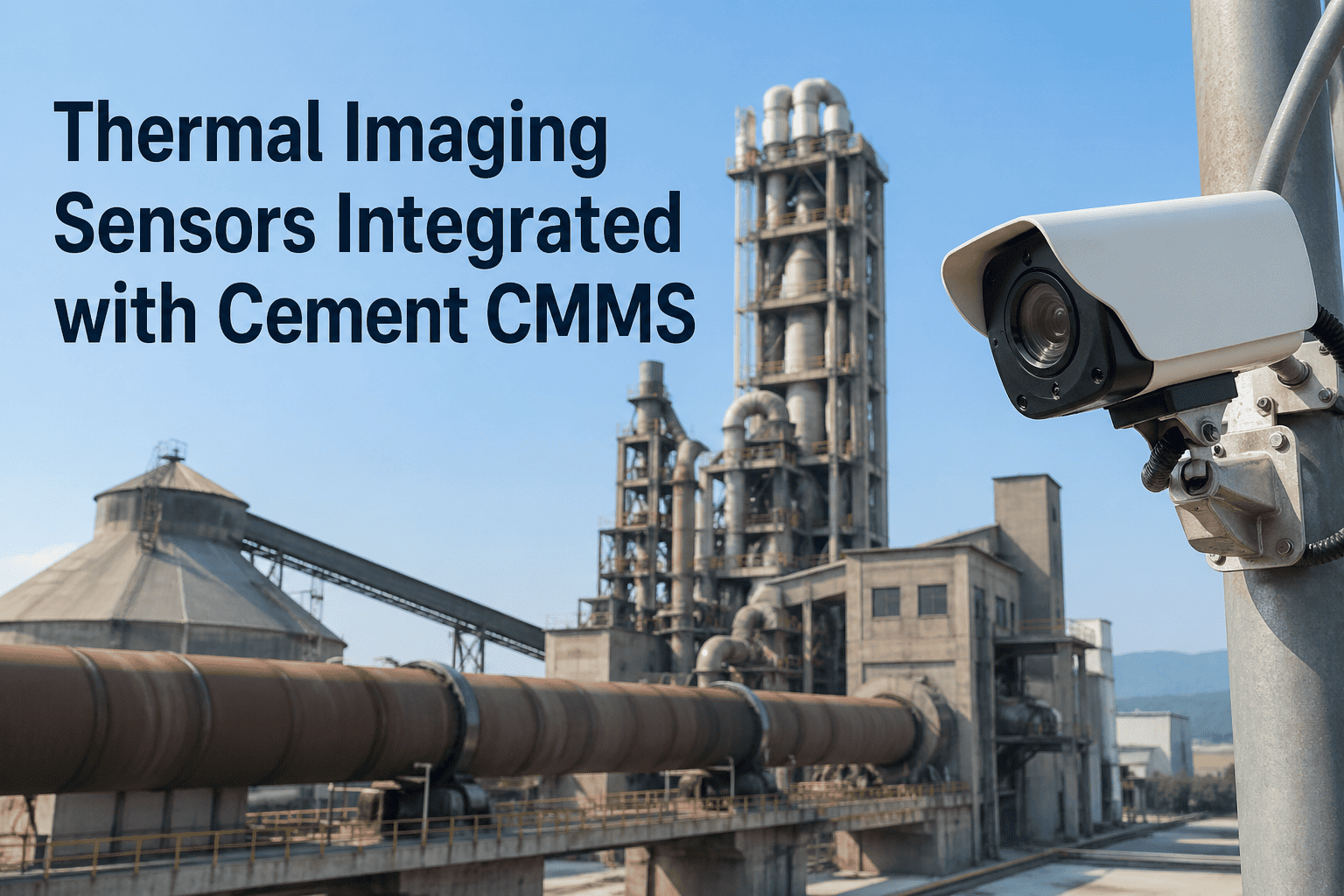
Thermal Imaging Cameras
Thermal · 24/7 fixedFixed radiometric thermal cameras on the kiln shell at 10–15 m spacing scan for refractory hot spots, tyre and riding-ring creep, plus cooler grate overheating. Replaces quarterly handheld thermography with continuous surface-temperature trend lines.
Motor Current Signature
Electrical · MCSASplit-core current transformers on the stator feeds of mill motors, fan VFDs and conveyor drives. Motor Current Signature Analysis detects rotor bar breaks, stator winding faults, shaft misalignment and cavitation — without stopping the machine.
Acoustic Ultrasonic
Structural · 40 kHzAirborne and contact ultrasonic sensors listen for compressed-air leaks at the pneumatic conveyors, bearing friction on slow-speed girth gears, and valve leakage in the clinker cooler. Catches sub-vibration-stage faults weeks before they escalate.
A 4-tier network that scales from one kiln line to a full plant
Most failed IIoT deployments stall at the network layer. The architecture below separates sensor, edge, cloud and CMMS tiers so each can be upgraded independently — the same pattern that scaled a 180-asset grey-cement plant to 320 assets in 90 days without a rip-and-replace of the legacy PLC layer.
A 180-asset plant spending $42K/year on route-based rounds
Consider a 5,500 TPD dry-process plant running a 4-stage preheater kiln, two cement mills and a 12-fan cooler. Under route-based monitoring, a single vibration technician covers 180 critical assets monthly — and still misses 60% of early-stage bearing defects because the 30-day gap between readings is wider than the fault propagation window.
Where each calculation should run — and why it matters
Pushing every raw vibration waveform to the cloud burns bandwidth and adds latency to tripping alarms. The split below is what plants running 300+ sensors on a single kiln line actually use: edge handles time-critical protection, cloud handles pattern recognition and historian duties.
- RMS velocity and acceleration calculation
- Instantaneous trip logic for catastrophic protection
- Local FFT computation to reduce upload payload
- Store-and-forward buffer during network outage
- Tag-level threshold and deviation alarms
- ML-based bearing fault classification across asset fleet
- Remaining-Useful-Life (RUL) prediction models
- Long-term historian (3–5 year trend retention)
- Multi-plant benchmarking and OEE rollup dashboards
- ISO 10816/20816 compliance reporting and audit trail
Ready to wire your cement plant's sensors into real work orders?
Deploy Oxmaint's CMMS-integrated IIoT pipeline in under 30 days — sensor to work order, with no SCADA rip-and-replace.
Cement plant IIoT deployment — what teams ask first
How many sensors does a typical cement kiln line need for meaningful condition monitoring?
A single 5-stage preheater kiln line with two cement mills and auxiliary equipment usually lands between 120 and 220 sensors. The breakdown is roughly 55% vibration, 20% thermal, 15% motor current and 10% ultrasonic or process. You can start with 30–40 sensors on the 10 highest-criticality assets and scale up — the architecture is designed to grow without re-cabling.
Will wireless IIoT sensors survive the EMI and heat around a rotating kiln?
Yes, when you pick the right radio. 2.4 GHz mesh nodes struggle near large rotating masses; 900 MHz or LoRaWAN handles kiln-bay multipath far better. Sensor enclosures should be rated IP67 minimum, with high-temp variants rated to 125°C for girth-gear and tyre positions. Expect 10–15% of positions to need a heat shield or remote antenna.
How does sensor data flow into the CMMS without a custom integration project?
Oxmaint ingests MQTT or REST payloads from the edge gateway and maps them to your asset hierarchy using tag names — no SCADA rewrite needed. When a vibration threshold breaches, a work order auto-generates in under 30 seconds with the fault type, asset ID and recommended action. You can Start Free Trial and connect a gateway the same day.
What is the realistic payback period for a full IIoT sensor deployment?
Most mid-size cement plants see payback between 9 and 14 months. The dominant savings line is unplanned downtime avoided — a single caught mill bearing fault can save $25K–$60K. Secondary savings come from energy waste reduction (5–15% on instrumented motors) and reduced route-based labor, typically freeing 1.5–2 technician-days per week.
Do we need to replace existing PLCs and vibration analyzers to deploy IIoT sensors?
No. The edge gateway is designed to bridge legacy Modbus, Profinet and OPC UA tags alongside new wireless IIoT nodes. Existing portable vibration analyzers stay useful for confirmation rounds — they just stop being the primary detection layer. A 30-minute demo will show how your current stack maps onto the integration.
Instrument 300+ assets in 90 days — without a data nightmare
Join the cement plants using Oxmaint to turn sensor noise into prioritized work orders, every shift.
Free 14-day trial · No credit card