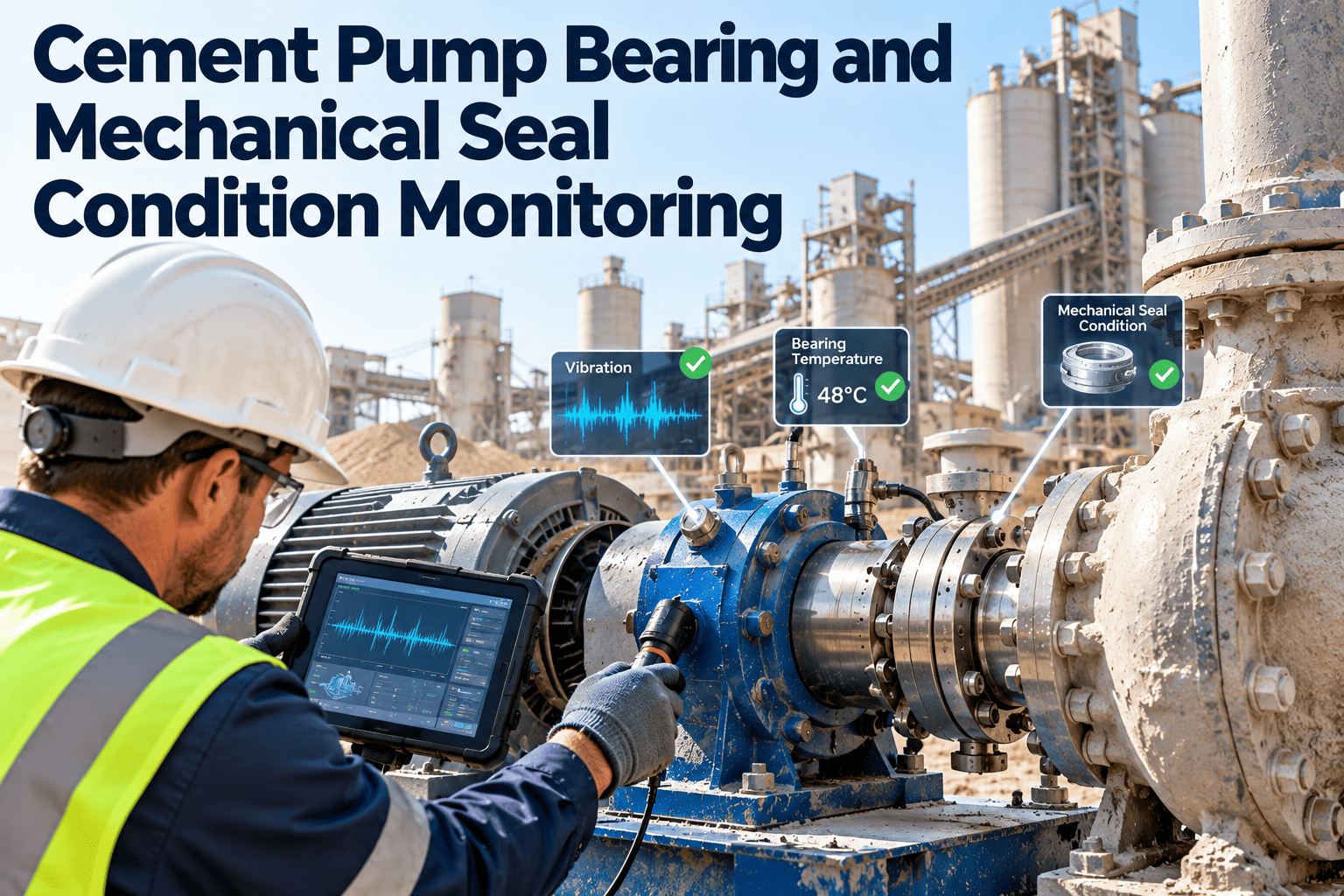
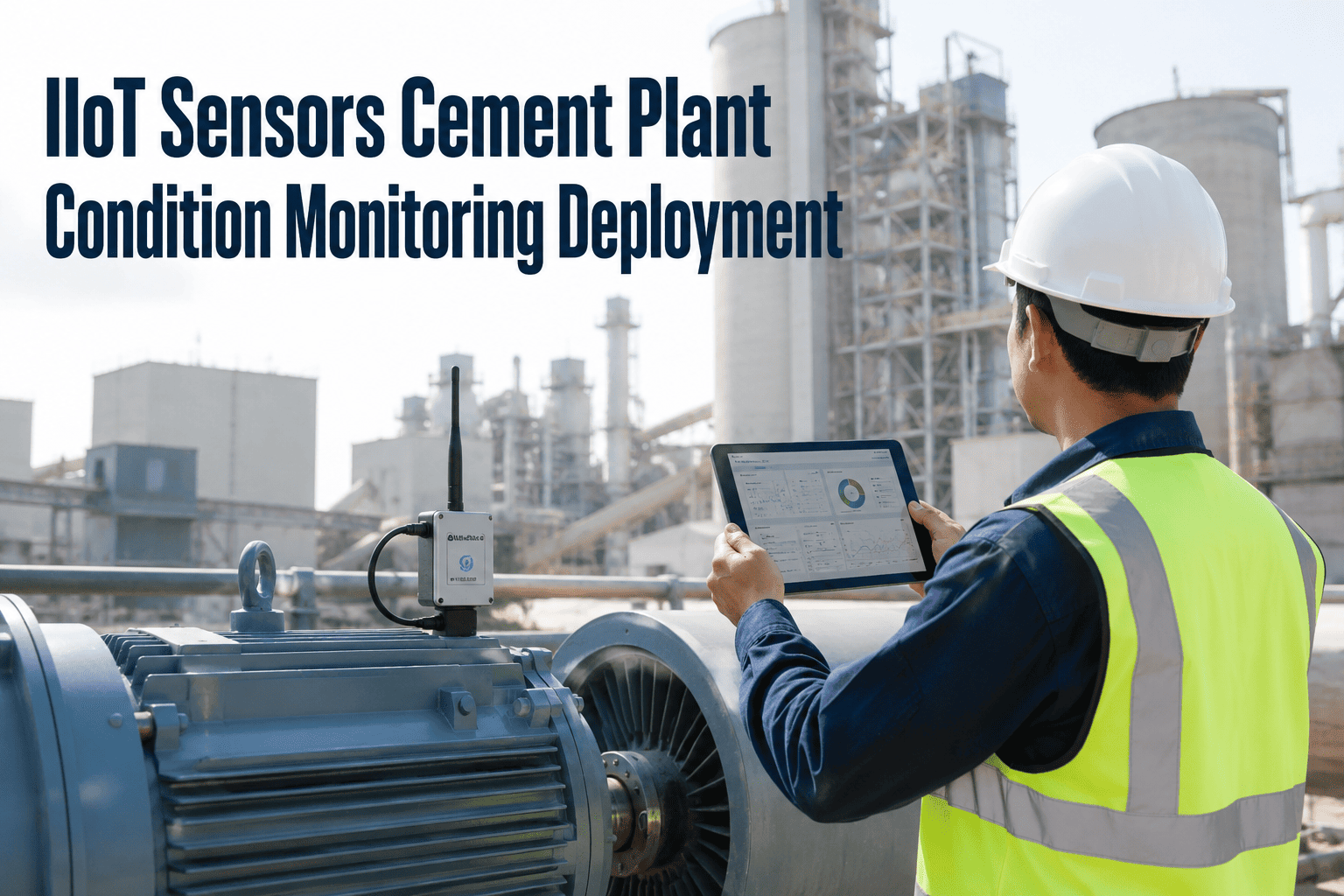
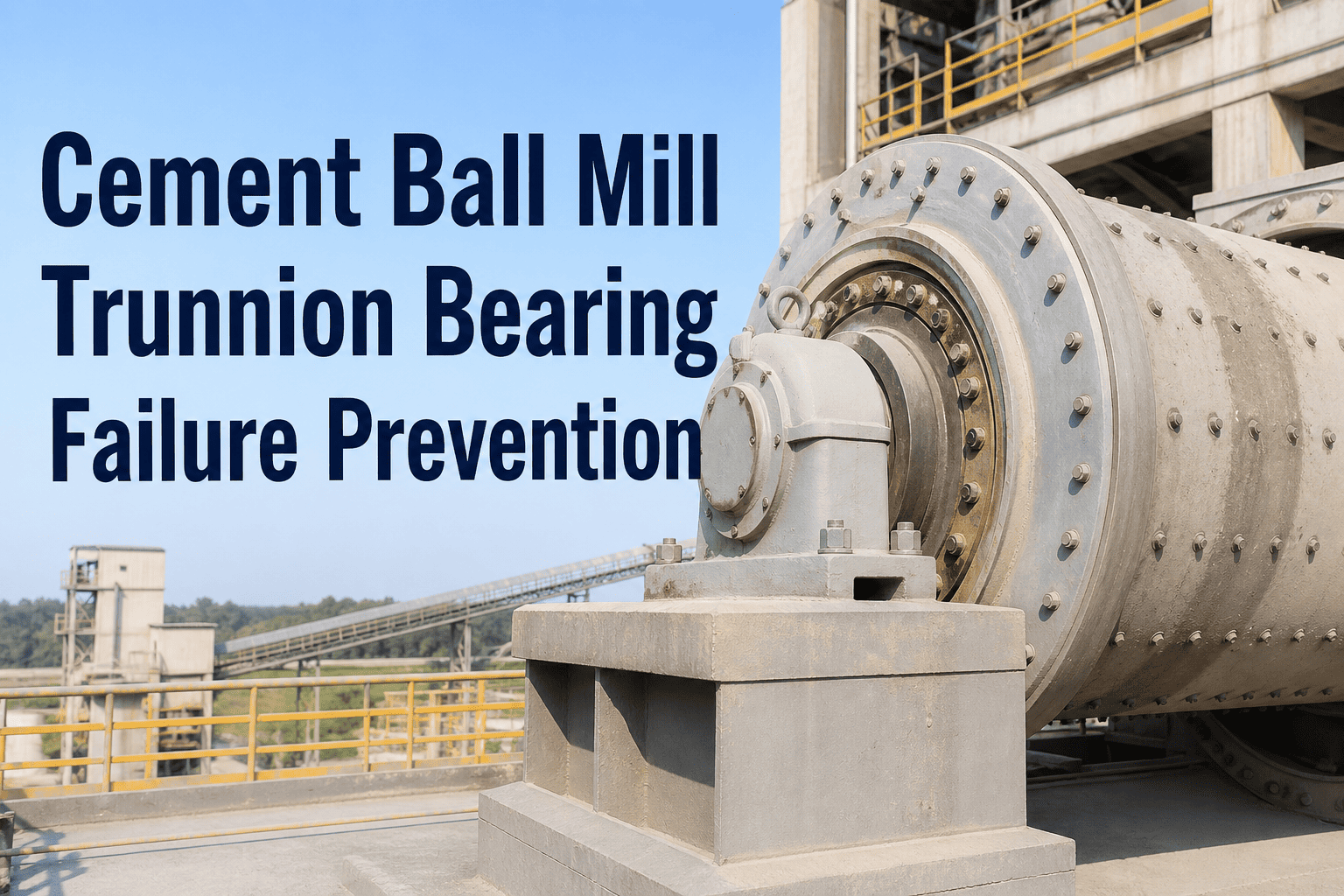
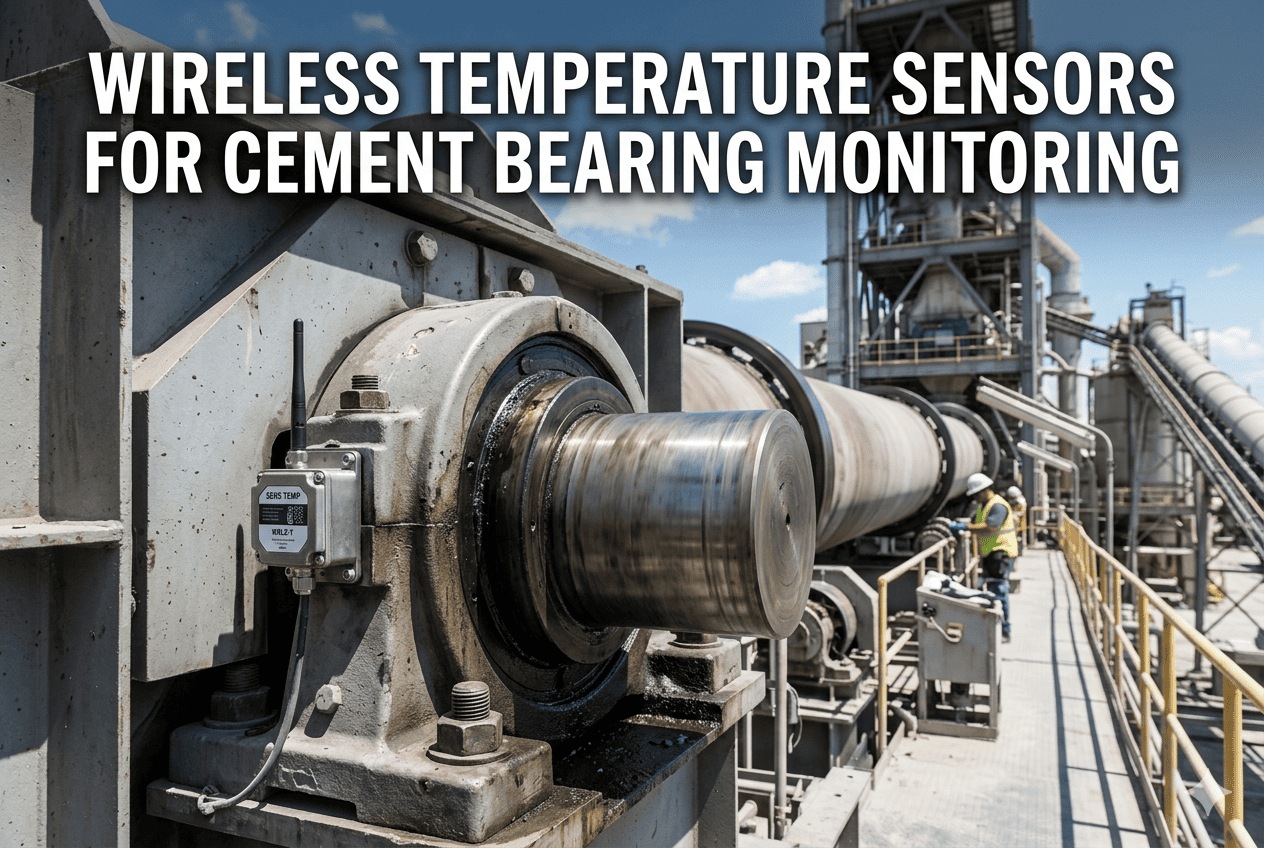
Wireless IIoT vibration sensors mounted on cement mill bearings stream real-time FFT data directly into your CMMS — triggering predictive maintenance alerts 4 to 8 weeks before catastrophic failure. Ball mill and vertical roller mill main bearings are among the highest-consequence assets in a cement plant: a single bearing failure can cause 7 to 14 days of unplanned downtime, structural damage to the mill shell, and clinker production losses exceeding $500,000 per event at mid-sized plants. Traditional route-based vibration analysis with handheld analyzers, conducted monthly or quarterly, misses the rapid deterioration patterns that precede bearing spall and cage failure. Continuous wireless monitoring changes the economics entirely. For cement plants evaluating IIoT vibration monitoring, Oxmaint integrates with leading wireless sensor platforms to bring real-time bearing health into your predictive maintenance workflow — or book a 30-minute session to discuss your mill bearing monitoring requirements with our team.
Technical Case Study
IIoT Predictive Maintenance
IIoT Vibration Sensors for Cement Mill Bearing Health Monitoring
Continuous wireless FFT monitoring detects bearing faults 4–8 weeks before failure — converting $500k+ unplanned outages into planned bearing replacements costing a fraction of the downtime.
4–8 wks
Early warning before failure
85%
Reduction in catastrophic bearing failures
6–12 mo
Typical ROI payback period
Why Route-Based Vibration Analysis Is Not Enough for Cement Mills
Monthly or quarterly handheld analysis works for assets with slow-developing faults. Cement mill bearings do not fail slowly. Understanding the failure timeline is the key to understanding why continuous monitoring changes the outcome.
Months 1–4
Subsurface fatigue begins
Micro-cracks form below the raceway surface. Handheld analysis misses this. Continuous high-frequency monitoring detects subtle ultrasonic emission changes.
Weeks 4–8 before failure
Bearing defect frequencies appear in FFT
BPFI, BPFO, BSF and FTF defect frequencies become detectable. IIoT sensors streaming 24/7 catch this window — monthly handheld rounds may miss it entirely.
Weeks 2–4 before failure
Overall vibration and temperature rise
Visible overall velocity and temperature trends. This is where most predictive maintenance alerts trigger — still enough time for planned replacement in the next maintenance window.
Days before failure
Rapid deterioration — emergency window
Spalling accelerates. Vibration and temperature spike rapidly. Without continuous monitoring this is often the first visible warning — leaving only hours to respond before catastrophic failure.
Wireless IIoT Sensor Specifications for Cement Mill Bearings
Not all wireless vibration sensors are suitable for cement plant conditions. Dust, moisture, temperature, and radio interference from large motor drives all affect sensor performance. These specifications define the minimum requirements for reliable deployment.
Frequency Range
10 Hz – 10 kHz minimum
Must cover bearing defect frequencies for all mill bearing sizes. High-speed pinion bearings on mill reducers require coverage to 20 kHz for reliable BPFI and BSF detection.
Operating Temperature
–20°C to +85°C
Cement mill bearing housings routinely reach 70–80°C under normal operation. Water-cooled housings can drop below ambient. Sensors must operate across this full range without calibration drift.
Ingress Protection
IP67 minimum
Cement dust is fine, abrasive, and penetrating. IP67 ensures the sensor electronics survive water wash-down and continuous dust exposure in mill building environments.
Communication Protocol
WirelessHART or ISA100
Industrial wireless mesh protocols designed for electrically noisy environments. Avoid WiFi or Bluetooth-only sensors in cement plants — large VFD motor drives generate significant RF interference that degrades consumer-grade wireless reliability.
Battery Life
3 years minimum at 15-min sampling
Access to bearing locations for battery replacement is often difficult and time-consuming in cement mills. Sensors requiring annual battery replacement add significant ongoing maintenance burden that negates some of the economic benefit.
Mounting Method
M8 stud or adhesive pad
Stud-mount gives the most consistent coupling and is strongly preferred for permanent installations. Adhesive pad mounting is acceptable as a trial installation but degrades over time in high-temperature, high-vibration cement mill environments.
Already have IIoT sensors installed but no predictive maintenance workflow? Oxmaint integrates with wireless sensor platforms to turn raw vibration data into CMMS work orders, maintenance alerts, and bearing health trend reports — automatically.
Sensor Mounting Positions: Ball Mill vs. VRM
Sensor placement determines which faults you can detect. These are the proven mounting locations for the two most common cement mill types, validated against actual bearing failure case data.
Ball Mill
Trunnion bearing — drive end
3-axis: radial X, radial Y, axial Z
Highest priority location. Detects radial and thrust loading anomalies including misalignment and unbalance in addition to bearing defect frequencies.
Trunnion bearing — non-drive end
Radial only or 3-axis
Monitors the free-end bearing which is subject to thermal expansion loads and is a common failure point during startup after maintenance.
Pinion bearing — gearbox output
3-axis, high-frequency range
Pinion bearings run at higher speeds than trunnion bearings. Requires sensor frequency range to 20 kHz. Gear mesh frequency analysis also possible from this location.
Vertical Roller Mill (VRM)
Main gearbox — input bearing
3-axis, high-frequency
VRM main gearboxes contain multiple bearing stages. Input bearing monitors motor-side loads. Gear mesh frequencies at this location detect gearbox tooth wear before destructive failure.
Main gearbox — output bearing
3-axis
Carries grinding table radial and axial loads. Highest load bearing in the machine. Temperature sensor at same location adds a second failure indicator for cross-validation of vibration alerts.
Separator bearing — upper and lower
Radial, moderate frequency range
Separator shaft bearings are a common but undermonitored failure point in VRMs. Failures here cause product quality issues before generating obvious vibration changes at the gearbox.
Alarm Threshold Configuration: Getting It Right
Poorly configured alarm thresholds are the single biggest reason IIoT monitoring programs fail to deliver value — too sensitive creates alert fatigue and ignored alarms; too loose misses faults until it is too late. Use a tiered approach.
Normal Band
No alert generated
Set based on 30-day baseline of steady-state operation after installation. Trend recorded continuously for pattern detection algorithms. Baseline must be re-established after any bearing replacement or maintenance intervention.
Advisory Alert
150–200% of baseline
Notify maintenance analyst for manual review. May represent process change rather than bearing degradation. No immediate action — increase monitoring frequency to continuous high-resolution capture for 48 hours.
Warning Alert
200–300% of baseline
CMMS auto-generates a planning work order. Bearing replacement scheduled for next available maintenance window within 30 days. Monitoring frequency increases to every 15 minutes with hourly analyst review.
Critical Alert
Above 300% of baseline
CMMS generates emergency work order with immediate response required. Production manager notified. Evaluation of planned shutdown vs. continued operation based on rate of deterioration and production schedule.
Case Study: 3,200 tpd Cement Plant, 14-Month IIoT Monitoring Results
A Southeast Asian plant installed 28 wireless vibration sensors across two ball mills and one VRM as a predictive maintenance pilot. Here are the documented outcomes over 14 months of operation.
4
Bearing failures detected in advance
All four converted from unplanned failures (historical average 9.5 days downtime each) to planned replacements during scheduled 8-hour maintenance windows.
0
Catastrophic bearing failures in 14 months
Previous 3-year average was 1.8 catastrophic failures per year — each involving structural inspection of the mill shell and 2-week repair campaigns.
$1.2M
Estimated avoided downtime cost
Based on 4 events × average 9.5 days unplanned downtime × $32,000/day clinker margin loss plus avoided structural repair costs from catastrophic failure prevention.
8 mo
System ROI payback period
Total sensor network and CMMS integration cost was $148,000. Full payback achieved in month 8 when the third planned bearing replacement was completed without production impact.
The plant extended the program to 72 sensors covering all rotating equipment above 75kW in the 12 months following the pilot. Book a demo to see how Oxmaint manages the CMMS integration side of IIoT monitoring programs like this one.
Frequently Asked Questions
How many IIoT vibration sensors does a typical cement ball mill require?
A complete ball mill installation requires a minimum of 6 sensors: two at each trunnion bearing (radial and axial) and two at the pinion bearing housing. For a more comprehensive program covering the gearbox and motor bearings as well, 10–14 sensors per mill is typical. Start with the highest-criticality positions (trunnion drive-end and pinion bearings) and expand coverage based on pilot results.
Oxmaint's asset management module helps you track sensor positions against mill asset records.
What FFT resolution is needed to detect cement mill bearing faults reliably?
A minimum of 3,200 lines of resolution is required for reliable bearing defect frequency identification in cement mill bearings. At 10 kHz maximum frequency, this gives a frequency resolution of approximately 3 Hz per line — sufficient to resolve BPFO and BPFI sidebands. For gearbox monitoring at pinion bearings, 6,400 lines at 20 kHz is recommended to resolve gear mesh harmonics cleanly alongside bearing frequencies.
How does cement dust affect IIoT vibration sensor performance over time?
Cement dust accumulation on sensor housings acts as thermal insulation, causing sensors to run hotter than their ambient temperature rating assumes. Clean sensors regularly with compressed air and check that stud-mount coupling integrity has not been compromised by corrosion or vibration loosening. IP67-rated sensors with recessed antenna designs perform significantly better in cement plant environments than sensors with external antenna elements.
Book a session to discuss sensor maintenance integration in Oxmaint.
Can Oxmaint receive data directly from wireless vibration sensor gateways?
Yes. Oxmaint integrates with IIoT sensor platforms via REST API, MQTT broker connections, and OPC-UA where sensor gateways support these protocols. When sensor data crosses a configured threshold, Oxmaint automatically generates a work order and notifies the responsible maintenance technician — no manual monitoring of sensor dashboards required. Contact our team to confirm compatibility with your specific sensor platform.
Sign up free to explore integration options.
Is IIoT vibration monitoring cost-effective for smaller cement plants under 1,000 tpd?
Yes — smaller plants are often more exposed to single bearing failure events because they lack redundant milling capacity. A single ball mill bearing failure shutting down the only milling line for 10 days is proportionally more damaging than at a multi-line plant. Start with 6–8 sensors on the primary mill's highest-risk bearings at a capital cost of $15,000–$25,000. The ROI case requires only one prevented catastrophic failure to justify the full program.
Book a review to size a program for your plant capacity.
Stop Reacting to Bearing Failures. Start Predicting Them.
Oxmaint connects IIoT vibration sensor data to your cement plant maintenance workflow — automatically generating work orders, tracking bearing health trends, and giving your team the 4–8 week warning that converts catastrophic failures into planned maintenance events.