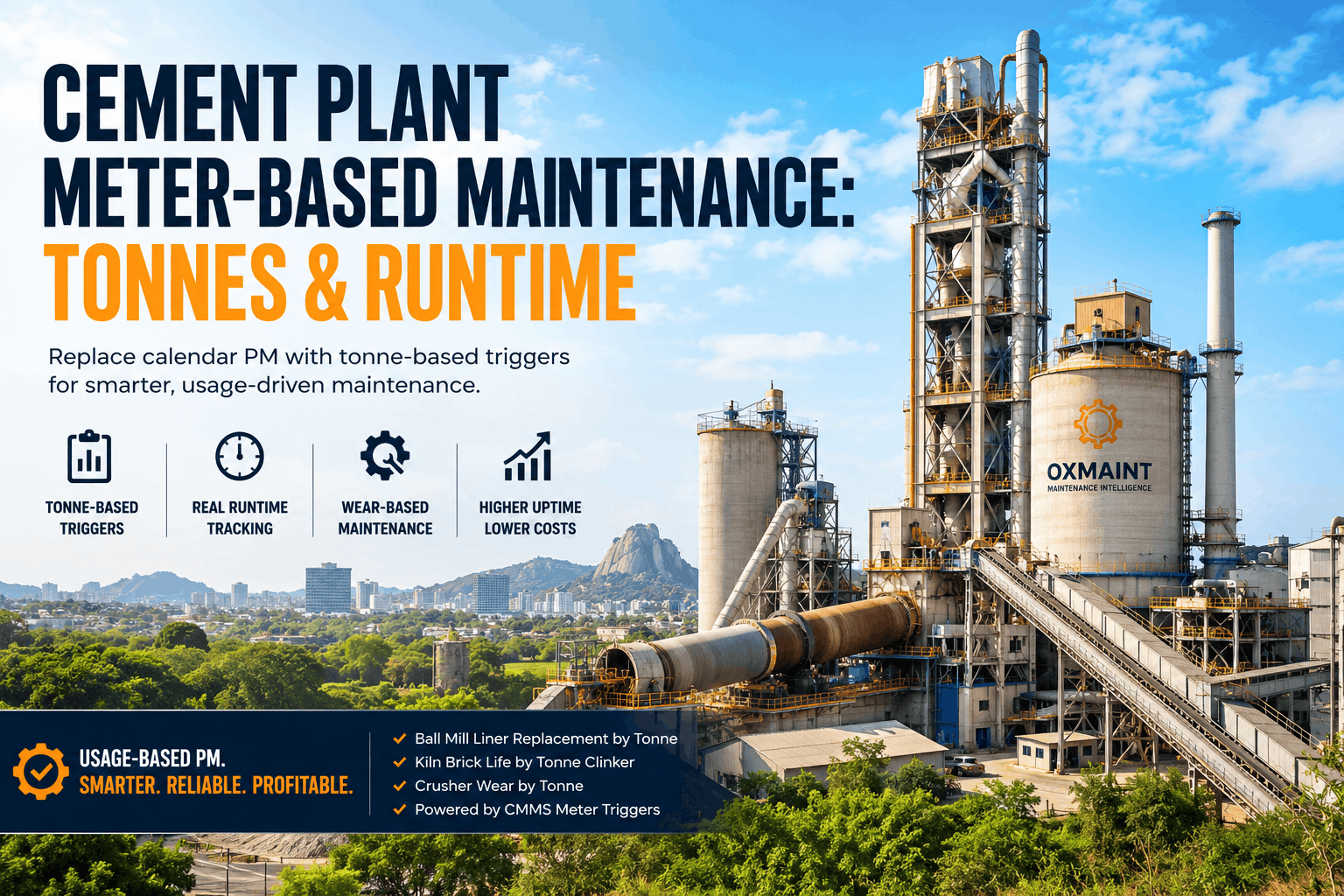
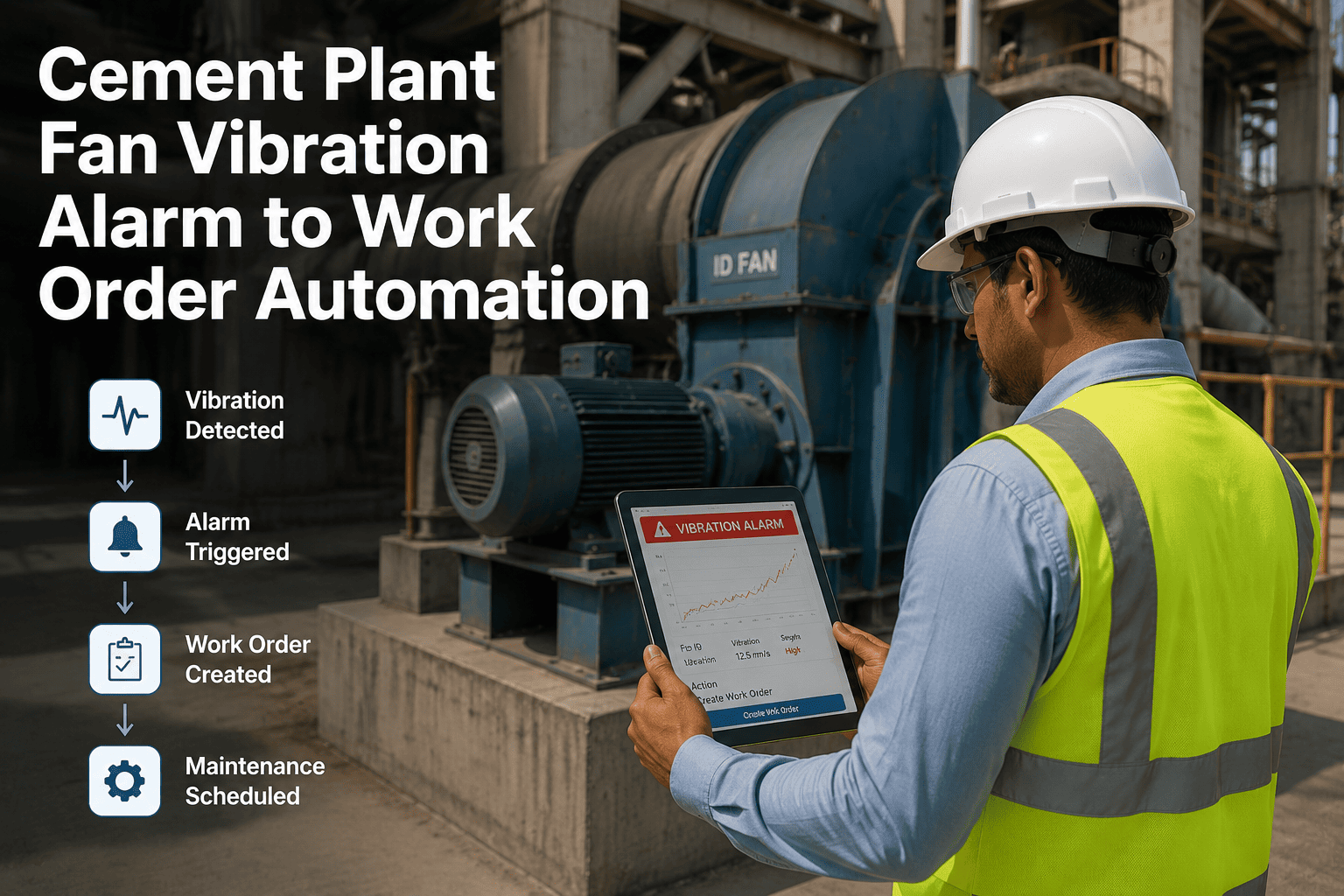
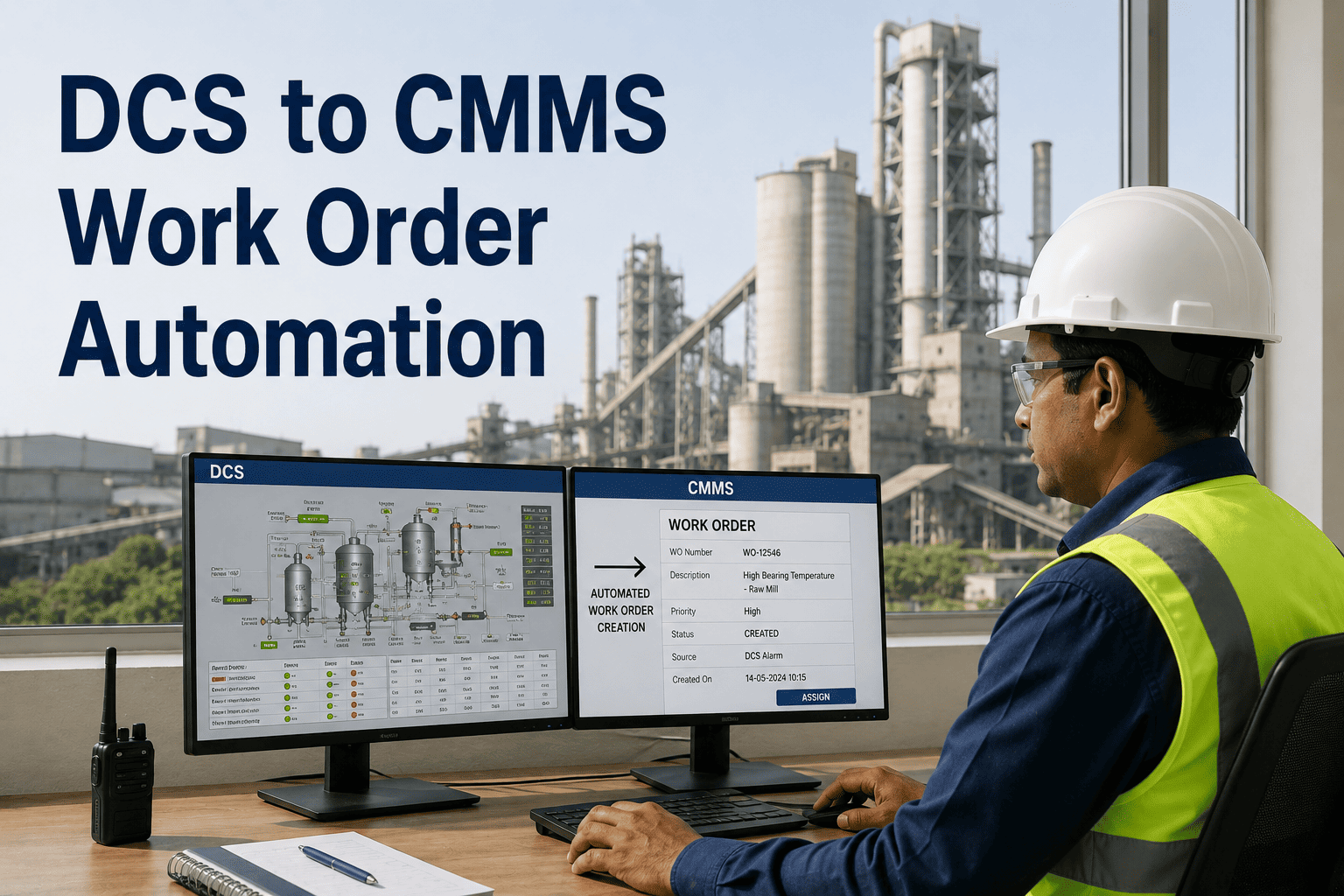
Most cement plants still send a technician on a fixed walking round to check compressor hour meters, water flow gauges, and electricity sub-meters once or twice a shift, write the numbers on a clipboard, and file them until someone has time to review the trend. By the time a compressor's specific power has drifted well past baseline or a pump has logged thousands of hours since its last service, the reading that should have triggered a work order weeks earlier is sitting in a binder nobody opened. The cost shows up as unplanned compressor downtime, pump seal failures, and electricity or water bills that climb without anyone able to say which circuit caused it. OxMaint's Preventive Maintenance module reads runtime, flow, pressure, and energy meters continuously and converts every threshold breach into a routed work order before the asset fails.
Utilities Maintenance · Meter-Triggered PM
Cement Plant Utility Meter Reading and PM Automation
Runtime hours, flow rates, header pressure, and kWh draw across electricity, water, and compressed air — turned into automatic work orders instead of numbers on a clipboard.
06:00
Electricity Feeders
kWh meter — specific power check
10:00
Compressed Air Header
Pressure transmitter — leak signature
14:00
Water Pumps & Cooling Loops
Flow meter — minimum cooling threshold
18:00
Compressors & Blowers
Runtime-hour meter — service milestone
Three Utilities, Three Different Failure Clocks
Electricity, water, and compressed air each carry their own consumption benchmark, and each degrades on its own schedule. A plant that tracks only the monthly utility bill never sees which circuit, pump, or compressor caused the gap between an efficient reading and a lagging one — meter-level tracking is what makes the gap visible early enough to act on.
Electrical Energy (kWh per ton of cement)
90 kWh/ton — best-in-class plant
130+ kWh/ton — losing ground unnoticed
Process & Cooling Water (tonnes per ton of cement)
0.22 t/t — dry-process benchmark
0.40 t/t — unmonitored cooling loops
Compressed Air Energy (kWh per tonne clinker)
2.8 kWh/tonne — leak-managed system
4.5 kWh/tonne — unmanaged leak rate
Compressor Specific Power Drift, Time to Detection
Caught within days — meter reviewed daily
3-4 weeks unnoticed — manual round only
From Gauge to Work Order — The Five-Step Trigger Chain
01
Continuous Read
kWh meters, flow meters, pressure transmitters, and runtime-hour counters log values at fixed intervals across electricity, water, and compressed air circuits — without a technician standing at the gauge.
02
Baseline Compare
Every new reading is checked against that asset's running baseline and its manufacturer service interval, not a fixed calendar date that ignores actual usage.
03
Threshold Breach
A flow drop, pressure dip, runtime milestone, or kWh drift outside the configured band is flagged as a maintenance-relevant event the moment it happens.
04
Work Order Auto-Created
OxMaint generates a work order with the asset's history, last service date, and the readings that triggered it attached, then routes it to the right technician.
05
Close & Re-Baseline
Completed work, parts consumed, and the new readings are logged against the asset record, and the baseline updates itself for the next cycle.
Stop Reading Meters Just to File Them Away
If a meter reading isn't compared against a baseline the moment it's taken, it isn't preventive maintenance — it's a record of a problem you'll find out about later. OxMaint closes that gap automatically.
Meter Type, Asset, and Trigger Logic — The Mapping That Runs in the Background
| Meter Type |
Utility |
Typical Assets |
PM Trigger Logic |
Review Frequency |
| kWh Meter |
Electricity |
Compressor banks, kiln drives, mill motors |
Specific power drift beyond configured baseline band |
Continuous, reviewed daily |
| Flow Meter |
Water |
Bearing cooling loops, cooling towers, process mains |
Flow drop below minimum cooling threshold |
Hourly, reviewed per shift |
| Pressure Transmitter |
Compressed Air |
Distribution header, dryer outlet, filter banks |
Pressure drop indicating leak or filter clogging |
Continuous, reviewed daily |
| Runtime-Hour Meter |
Compressed Air & Water |
Compressors, pumps, blowers, cooling tower fans |
Service-interval hour milestone reached (500 / 1,000 / 2,000 hr) |
Per-cycle, auto-triggered |
The Manual Reading Round vs the Automated Trigger
The Manual Reading Round
Gauges checked once or twice a shift on a fixed walking route
Readings written on paper or a spreadsheet after the round ends
Trend comparison happens only when someone reviews the log
A missed reading or a transposed number breaks the trend silently
A work order is raised after someone notices a problem, often a failure
The OxMaint Automated Trigger
Meters report continuously or at short fixed intervals, unattended
Every reading is compared against the asset's baseline on arrival
A threshold breach creates a work order with asset history attached
A stalled or missing reading raises its own alert instead of going unseen
A work order is raised before the failure window closes, not after
What Changes in the First 90 Days of Meter-Triggered PM
PM Compliance
58%
becomes
92%
Reactive Work Orders (Share of Total)
70%
becomes
28%
Time to Detect Compressor Drift
3-4 weeks
becomes
Same day
Pump & Compressor Unplanned Stops
Frequent
becomes
Rare
Every utility meter in a cement plant is already producing the warning sign maintenance needs — most plants simply aren't reading it in time to act. A compressor's specific power climbing eight percent, a cooling water flow dropping below its set point, a pump crossing its rated runtime hours: none of these are surprises by the time they show up in a quality or production report. They were visible on a meter days or weeks earlier. The plants that close that gap aren't the ones with the most expensive meters; they're the ones whose meter data feeds straight into a work order instead of a spreadsheet someone reviews when there's time.
Anil Deshpande, B.Tech Mechanical Engineering
Utilities & Reliability Consultant · 19 Years in Cement Plant Maintenance Systems
Frequently Asked Questions
What's the real difference between meter-based PM and calendar-based PM for utility equipment?
Calendar-based PM services a pump or compressor every fixed number of days regardless of how hard it actually ran that period — overservicing equipment that sat idle and underservicing equipment that ran continuously. Meter-based PM ties the service trigger to actual runtime hours, flow volume, or energy drawn, so the work order fires exactly when the asset's real condition warrants it. For utilities with uneven seasonal or production-driven load, this difference alone closes most of the gap between planned and reactive maintenance.
OxMaint's PM module runs both trigger types side by side per asset.
Which utility meters should a cement plant connect first?
Start with the circuits that carry the highest failure consequence and the most variable load — compressor banks, critical cooling water pumps, and the main electrical feeders to kilns and mills. These three categories typically account for the majority of unplanned utility-related downtime and the largest avoidable energy waste, which means they return the fastest, most visible result once meter data starts triggering work orders instead of sitting in a log.
Do we need new hardware, or can OxMaint read our existing SCADA and meters?
In most plants, the meters and SCADA infrastructure already exist — what's missing is the connection between that data and a maintenance work order. OxMaint integrates with existing kWh meters, flow meters, pressure transmitters, and SCADA or PLC historian data through standard interfaces, so plants rarely need to install new sensing hardware just to start triggering PM from meter readings. Where a circuit genuinely has no metering, that gap is usually limited to a handful of high-value assets rather than the whole plant.
How fast will PM compliance improve after meters are connected?
Plants typically see measurable improvement within the first one to three months — baselines establish themselves within the first few weeks of continuous readings, and work orders start auto-generating against real thresholds almost immediately after that. Full compliance gains build over the following months as technicians and planners adjust to working from triggered work orders instead of a fixed PM calendar.
Book a demo to see the typical rollout timeline for a plant your size.
What happens if a meter reading is missed or a sensor fails?
A missing or stalled reading is treated as its own event rather than silently skipped — if a meter that normally reports every interval goes quiet, OxMaint flags the gap so a technician can check the sensor or connection rather than assuming everything is fine because no alert came through. This is one of the clearest advantages over a manual round, where a skipped gauge check often goes completely unnoticed until the next scheduled visit.
Every Utility Meter Is Already Telling You What's Next
Electricity, water, and compressed air meters in your plant are generating the exact data that should be triggering work orders today. Connect them to OxMaint and let the readings do the scheduling.