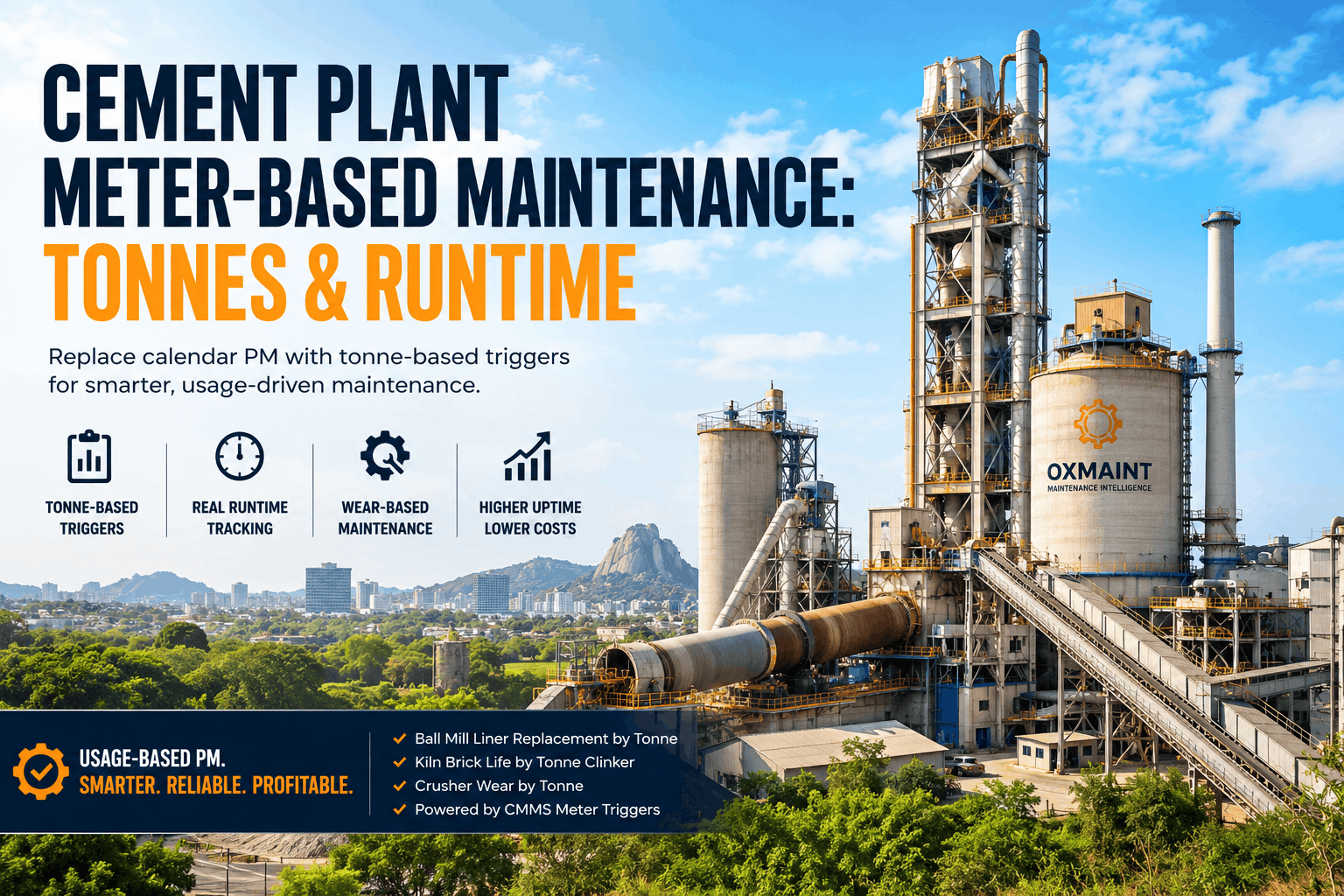
Cement plants relying on calendar-based preventive maintenance—replacing ball mill liners every X months regardless of production, replacing kiln bricks every Y months whether throughput is high or low, scheduling cooler maintenance on fixed dates—waste 15–25% of maintenance budgets on premature component replacement while simultaneously missing early wear detection when production spikes. Meter-based maintenance ties PM intervals to actual equipment utilization: ball mill liners replaced when wear reaches critical thickness per tonne throughput (not "every 14 months"), kiln refractory inspected when thermal cycling load accumulates (not "every quarter"), clinker cooler performance checked when ambient conditions stress cooling capacity (not "every two weeks"). Sign Up Free with Oxmaint to deploy tonne-based PM triggers that automatically create maintenance work orders when production load crosses wear thresholds, enabling accurate spare parts forecasting, eliminating premature replacement, and preventing the silent degradation that strikes when production volume spikes beyond historical patterns. Book a Demo to see how Oxmaint meter-based triggers reduce maintenance waste 20–30%, improve parts inventory accuracy 40–50%, and prevent the equipment failures that occur when calendar-driven maintenance misses high-utilization periods.
Why Calendar-Based Maintenance Fails Cement Plants: Waste, Risk, and Hidden Equipment Degradation
Calendar-based maintenance assumes constant equipment utilization: if ball mill runs 300 TPD on average, replace liners every 14 months (assume ~22K tonne throughput). But when a customer order spikes production to 350 TPD for 2 months, throughput is 23K tonne in the same 14-month window—degradation is 5% faster than plan, but maintenance schedule doesn't adjust. Liners wear beyond design thickness while next planned replacement is still weeks away. Catastrophic failure occurs under accelerated load, destroying the mill journal and forcing emergency replacement at 3x the cost of planned reline. Conversely, if production declines to 250 TPD, the same 14-month calendar schedule triggers replacement when liners are only 60% worn, wasting $8K in premature replacement cost. Across a cement plant with 15–20 major rotating equipment items, calendar-based PM waste compounds: premature replacement of kiln bricks ($40K per event), clinker cooler fan blade changes when erosion hasn't reached replacement threshold ($6K unnecessary spend), gearbox oil changes on fixed 3-month intervals even when oil analysis shows 6-month remaining life (unnecessary labor + disposal cost). Meter-based maintenance eliminates this waste: PM is triggered only when equipment utilization actually reaches wear threshold, eliminating premature replacement and ensuring maintenance happens when it's needed, not when the calendar says.
| Maintenance Approach | Ball Mill Liner Replacement Logic | Kiln Brick Inspection Logic | Clinker Cooler Fan Maintenance | Budget Waste / Risk Profile |
|---|---|---|---|---|
| Calendar-Based (Fixed) | Replace liners every 14 months (assumes 300 TPD × 14 mo = 4.2K tonne) | Inspect kiln bricks every 90 days (assumes 70K tonne per 90 days) | Replace fan blades every 6 months on fixed date | 15–25% premature replacement waste; 2–3 failures/year from missed high-utilization wear |
| Meter-Based (Load-Driven) | Replace liners when mill throughput reaches 75K tonne cumulative (varies 12–18 months) | Inspect bricks when kiln clinker output reaches 2M tonne cumulative (thermal load tied to output) | Inspect fan performance every 30K cooler operating hours; clean/replace at erosion threshold | 5–8% waste (only on borderline components); 0–1 failure/year from improved wear tracking |
Core Meter-Based Maintenance Triggers: Tonne-Throughput, Operating Hours, and Production Load Sensing
Meter-based maintenance requires three types of usage sensors: cumulative production tonnage (how much clinker has the kiln produced, how much raw material has the mill ground), operating hours (how many continuous hours has equipment run), and environmental load (ambient temperature stressing cooler, humidity affecting material handling). Each equipment type has different primary wear driver: ball mill liners wear directly by tonne ground (linear correlation), clinker cooler fans wear by cumulative runtime (erosion), kiln refractory wears by both thermal cycling (calendar time) and tonne throughput (chemical attack from clinker). Sign Up Free to configure CMMS tonne-based triggers per asset, enabling Oxmaint to automatically surface maintenance tasks when production load crosses wear thresholds instead of waiting for calendar dates.
Primary Wear Driver: Clinker tonne produced (higher throughput = higher clinker temperature = accelerated refractory wear)
Meter Source: Clinker production counter on kiln production meter
Trigger Thresholds:
- Initial brick thickness inspection: 0 tonne (baseline at installation or recent reline)
- Accelerated wear monitoring: Every 50K tonne produced (visual inspection + thickness gauge)
- Maintenance alert: At 70% of design wear threshold (typically ~60mm minimum thickness)
- Replacement planning trigger: At 80% wear (alert procurement for spare brick set, schedule next kiln stop)
- Critical alert: At 90% wear or thermal profile breaks (indicates imminent breakthrough)
CMMS Action: Kiln asset record linked to production meter; CMMS auto-creates inspection work order every 50K tonne, tracks brick wear progression, sends alerts at 70%/80%/90% wear thresholds to maintenance supervisor and plant manager
Primary Wear Driver: Tonne of raw material ground (liner surface area contact per tonne governs wear rate)
Meter Source: Mill feed tonne counter or mill rotation counter (can derive tonne from speed × time if counter unavailable)
Trigger Thresholds:
- First liner condition check: 0 tonne (baseline after fresh reline)
- Routine wear assessment: Every 25K tonne (visual check for liner buildup, balls condition)
- Wear trending observation: Every 50K tonne (thickness gauge measurement of discharge liners)
- Replacement planning: At 70K tonne cumulative (liners typically 70% worn; order spare set)
- Replacement execution: At 75K tonne (discharge liners <30mm thickness; schedule reline in next maintenance window)
CMMS Action: Mill asset record linked to feed tonne meter; automatic work order creation at 25K, 50K, 70K, 75K tonne intervals. Trend worn liner thickness over multiple relines to identify accelerated wear patterns requiring root cause investigation
Primary Wear Driver: Cumulative operating hours (blade erosion) + ambient temperature peaks (thermal stress cycles)
Meter Source: Cooler fan runtime hour meter + thermocouple data (if connected to CMMS)
Trigger Thresholds:
- Baseline performance curve: At installation (record fan pressure drop, air flow, power draw at reference conditions)
- Routine performance check: Every 15K runtime hours (measure pressure drop & compare to baseline; flag if >10% degradation)
- Thermal load assessment: After each ambient temperature peak >40°C (assess fan blade condition if cooler was under stress)
- Accelerated inspection: If performance drops 15%+ from baseline (visual blade erosion inspection required within 72 hours)
- Blade replacement trigger: At 25% baseline flow loss or visible blade edge spalling (schedule replacement in next 2–4 week window)
CMMS Action: Cooler fan asset linked to runtime hour meter; auto-create performance check work order every 15K hours. Link thermal sensor data to trigger accelerated inspection alerts when ambient load spikes. Build cooler performance trend line to enable predictive blade replacement scheduling
Primary Wear Driver: Cumulative operating hours (bearing fatigue) + oil degradation (acid number, particle count trend)
Meter Source: Gearbox runtime hour meter + monthly oil sample data (trending particle count, iron content)
Trigger Thresholds:
- Initial oil baseline: At installation (document initial oil type, acid number, viscosity, particle count)
- Monthly oil sampling: Every 720 operating hours (standard maintenance protocol)
- Condition trending: Track particle count and iron content month-over-month; flag if particle count >200/mL or iron content rising >15% month-over-month
- Accelerated inspection: If oil trending shows spalling indicators (iron > 200 ppm, particles >300/mL), schedule bearing inspection within 2 weeks
- Replacement alert: If bearing spalling confirmed on inspection, schedule gearbox replacement in next planned maintenance window (8–12 weeks to source spare unit)
CMMS Action: Gearbox asset linked to runtime hour meter + oil lab analysis data. Auto-create oil sampling work order every 720 hours; import lab results and flag threshold crosses automatically; escalate bearing condition alerts to maintenance manager
Primary Wear Driver: Tonne of raw material crushed (jaw plate contact pressure per tonne governs wear rate)
Meter Source: Crusher feed tonne counter (or derive from feeder speed × bulk density)
Trigger Thresholds:
- Baseline jaw plate dimension: 0 tonne (establish reference measurement after installation or plate replacement)
- Wear measurement checkpoint: Every 50K tonne crushed (use caliper to measure jaw plate thickness at center and edges)
- Wear pattern analysis: Plot wear depth vs. cumulative tonne; identify if wear is uniform (normal) or spalling (overload condition)
- Replacement alert: At 60% of design wear depth (~50mm minimum for typical 100mm plate) or any sign of spalling
- Parts order trigger: At 55% wear (lead time for jaw plates typically 2–3 weeks; order while still operating at partial efficiency)
CMMS Action: Crusher asset linked to feed tonne meter; auto-create jaw plate measurement work order every 50K tonne. Maintain wear depth trend chart in CMMS to enable predictive replacement scheduling and supplier lead time planning
Implementing Meter-Based Maintenance: Data Source Integration, CMMS Configuration, and Trigger Validation
Shifting from calendar-based to meter-based maintenance requires four implementation steps: installing or retrofitting production meters (tonne counters, hour meters), integrating meter data into CMMS (automated data feed or manual daily logging), defining wear thresholds per equipment type, and validating trigger accuracy against historical failure patterns. Most cement plants already have production meters; the challenge is connecting them to CMMS rather than reading them manually once per shift. Book a Demo to see how Oxmaint integrates with existing production systems, enables automatic tonne-based trigger configuration, and surfaces maintenance alerts when equipment reaches true wear threshold instead of calendar date.
Walk production floor and document which equipment has production/runtime meters: kiln clinker output counter, mill tonne input gauge, cooler fan runtime hour meter, crusher tonne counter. Determine if meters are analog gauges (read manually), digital displays (read daily or shift-end), or networked (data feed available to CMMS). Identify gaps: if kiln has no tonne counter, is motor hour meter available as proxy? If mill feed isn't metered, can discharge tonne counter serve as proxy? Plan retrofit or workaround for missing critical meters.
Start with 3–5 highest-criticality assets: kiln, raw mill, clinker cooler fan, primary crusher. For each asset, define wear threshold triggering PM (e.g., ball mill liner replacement at 75K tonne). Configure CMMS to create work order at 70K tonne (5K tonne early alert for procurement) and auto-escalate at 75K tonne (critical alert). Set daily meter data logging process: manual data entry if meters aren't networked, or automated API pull if SCADA is available.
Review past 2–3 years of maintenance records: when did ball mill liners typically fail, how many tonne had been produced before replacement? Backtrack actual wear rate: if liners were replaced after 14 months at 300 TPD, actual throughput was ~19K tonne (not planned 22K tonne). Recalibrate CMMS trigger from "75K tonne" to "actual historical trigger point" (e.g., 68K tonne if historical pattern shows failure at 68–70K). Test triggers on 2–3 equipment items for 4–6 weeks; refine thresholds based on feedback before plant-wide rollout.
After initial 4–6 week validation, expand trigger configuration to all rotating equipment and support systems. Track metrics: (1) Calendar PM completion rate before triggers (baseline), (2) Actual PM execution rate after meter-based triggers (should shift from calendar-driven to load-driven, creating more flexibility), (3) Spare parts spend trends (should drop 15–25% as premature replacement decreases), (4) Maintenance cost per tonne (should improve 8–12% from waste reduction). Report ROI within 90 days of full rollout.
Meter-Based Maintenance Best Practices and Common Implementation Pitfalls
Frequently Asked Questions: Meter-Based Maintenance for Cement Plants
"Switching to meter-based maintenance was the single biggest win for our plant. For years, we were replacing ball mill liners on a fixed 14-month schedule—blind to the fact that production varied 250–350 TPD month-to-month. Some liners were replaced at 60% wear (waste), others failed at 95% wear (risk). After implementing Oxmaint tonne-based triggers, we replaced liners when they actually needed replacement, not when the calendar said. Result: 28% reduction in spare parts cost for mill maintenance alone, zero liner-related failures in the past year, and our mill OEE improved from 74% to 79% because liners are optimally conditioned. The ROI was immediate."