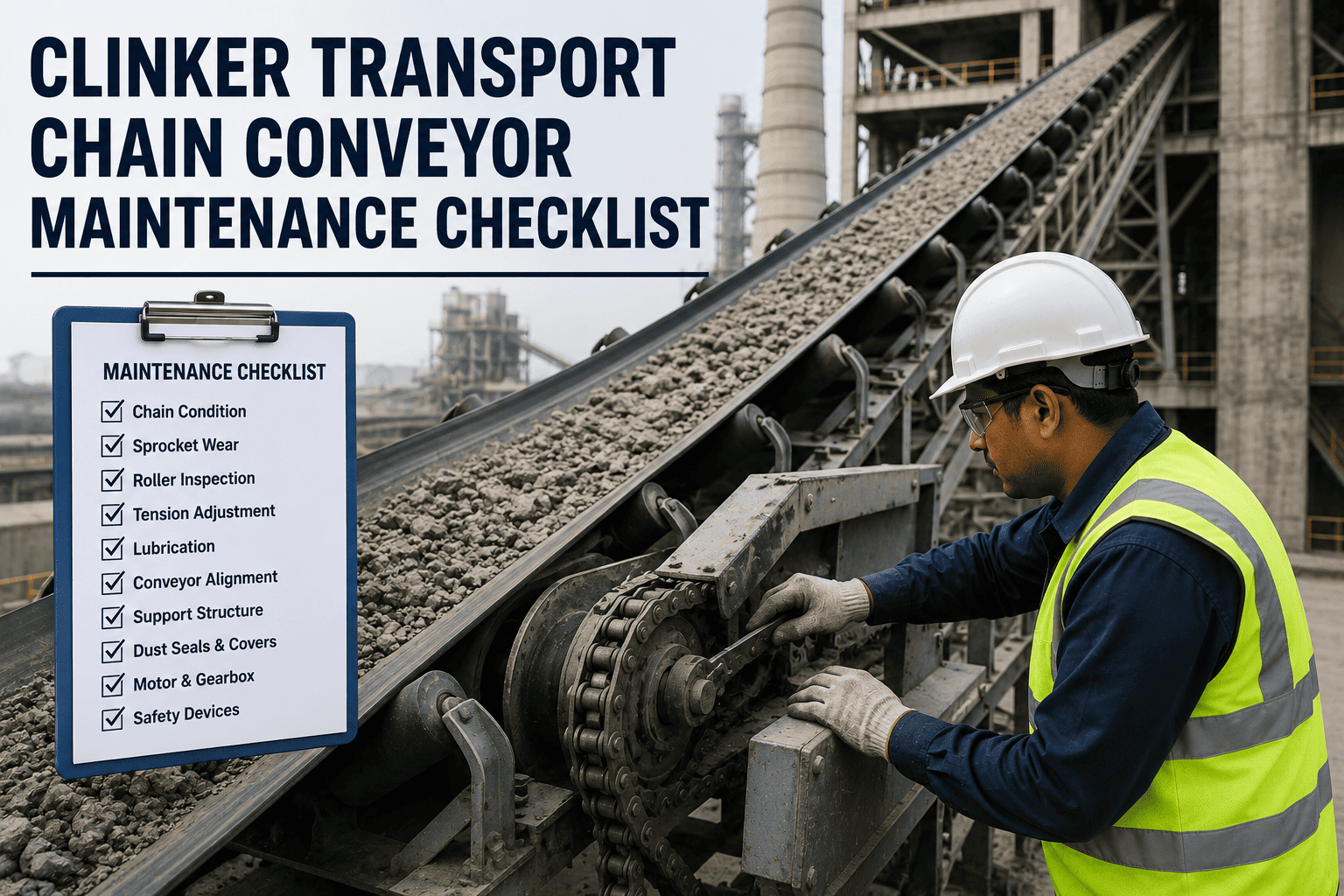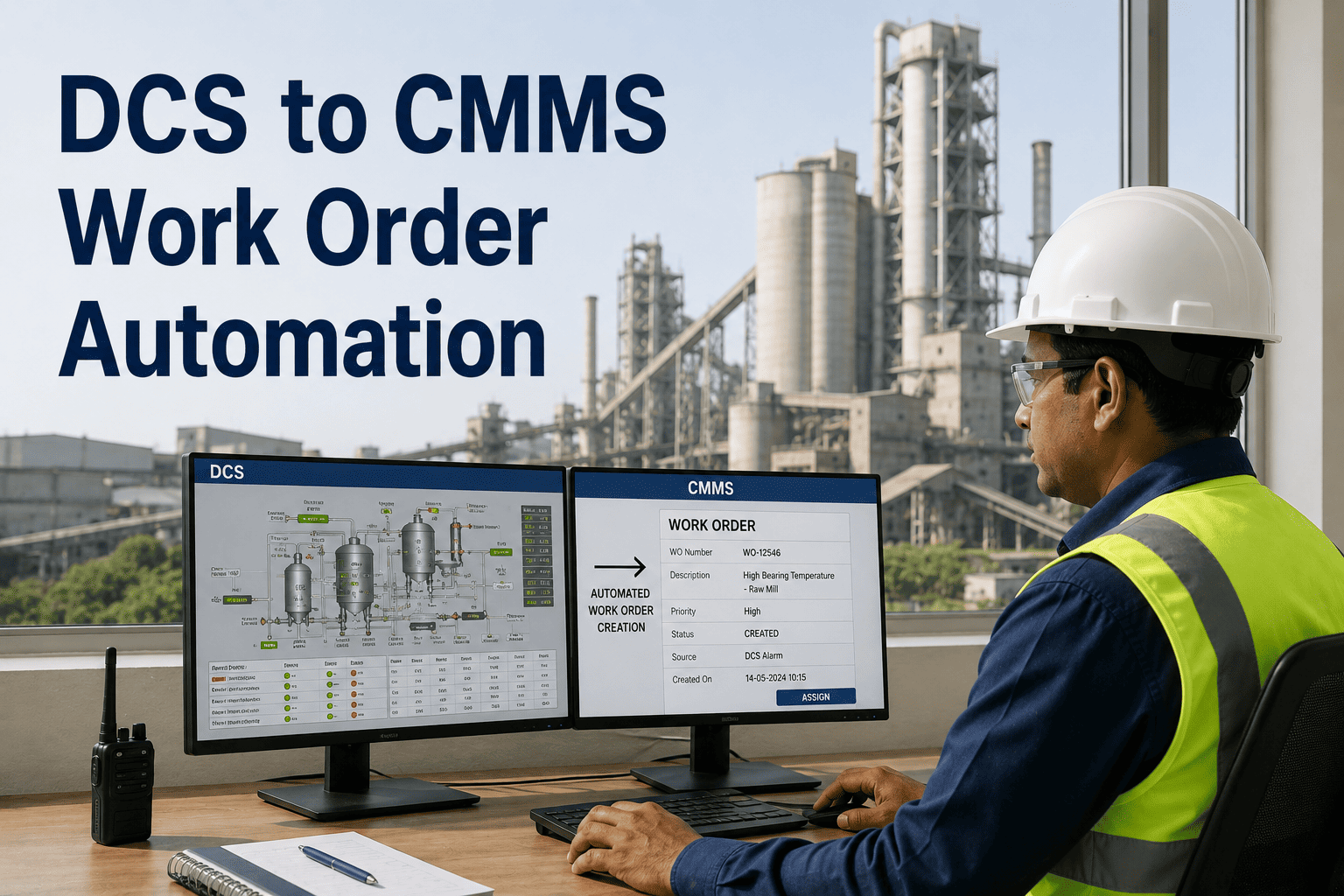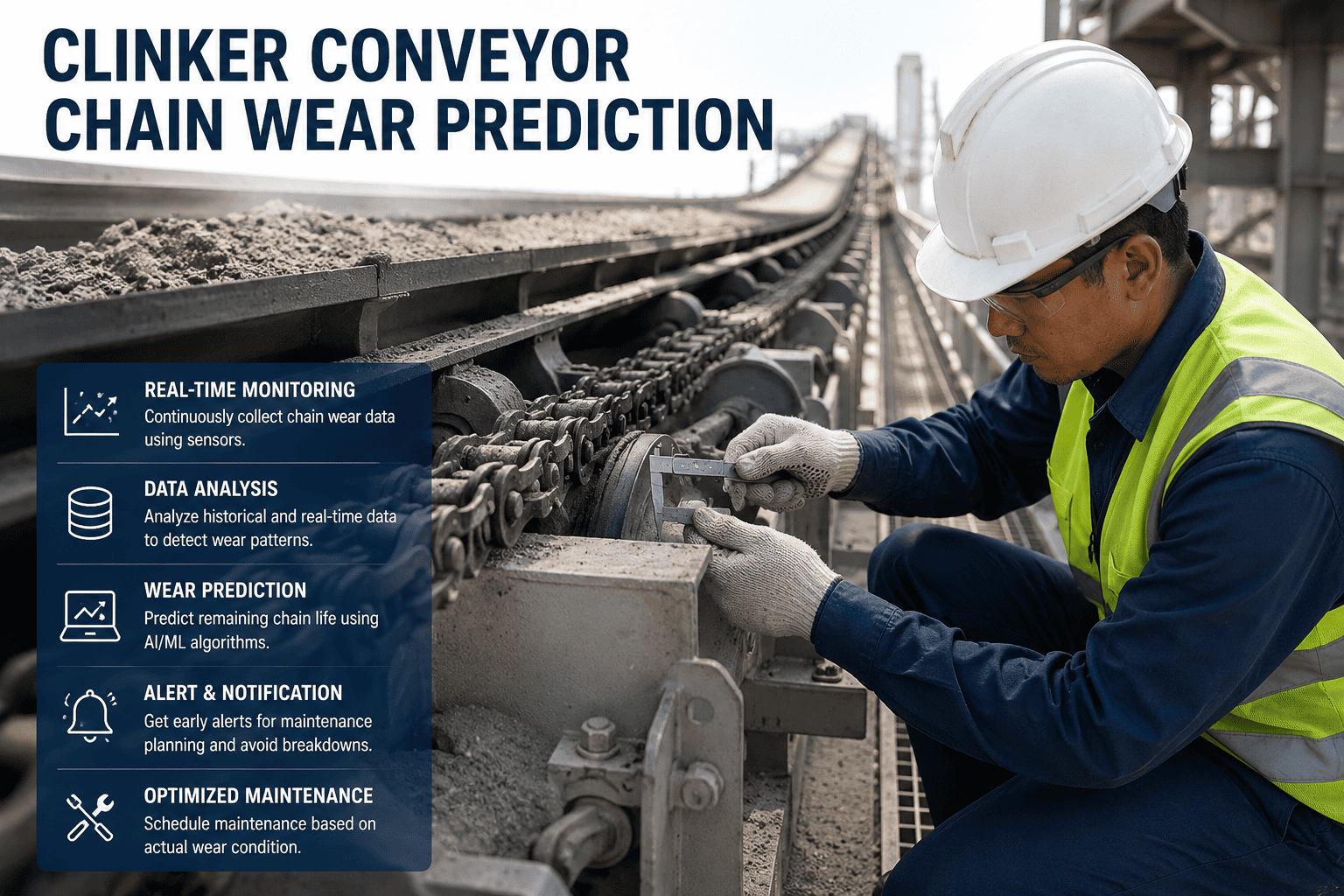
Clinker conveyor chain wear is not a sudden event — it is a slow accumulation of elongation, link fatigue, and sprocket pitch mismatch that is entirely visible in the data months before the chain snaps and production stops. The difficulty has never been detecting the wear; it has been capturing the measurements consistently enough to spot the trend before failure. OxMaint's predictive maintenance module gives cement plant reliability teams the structured data capture, asset-level trending, and condition-triggered alert system to convert chain wear from a guessing game into a managed, scheduled replacement program. This article covers how to measure chain wear precisely, what the data should look like at each wear stage, and how to configure a predictive workflow that eliminates the unplanned failures that cost far more than the chain itself. Start free on OxMaint or book a demo to see chain wear prediction running on your conveyor assets.
Clinker Conveyor Chain Wear Prediction
How to measure, trend, and predict clinker conveyor chain wear before it becomes an unplanned outage — the data capture method, alert thresholds, and replacement scheduling workflow that keeps cement plant conveyors running.
How Clinker Conveyor Chains Actually Fail
Understanding the failure sequence is prerequisite to predicting it. Clinker chains fail through three overlapping mechanisms that compound each other — lubrication breakdown, abrasive wear, and thermal cycling — and each mechanism leaves a measurable signature well before the chain reaches its failure point.
Clinker dust infiltrates the pin-bush joint and acts as a lapping compound. Chain elongation begins here — measurable as pitch increase from the nominal. At less than 1.5% elongation, the chain still tracks correctly and tension remains normal. This is the ideal window for intervention.
Beyond 2% elongation, the chain begins to climb the sprocket teeth instead of seating cleanly. Lateral load increases; side plates develop micro-cracks at the link holes. Vibration signature changes — detectable in drive motor current draw and audible as irregular clatter at the drive head.
At 3% elongation or above, the chain is operating outside its design envelope. Link plate fracture or pin shear is imminent. A failure at this point stops production, drops clinker into the conveyor housing, and typically damages the drive sprocket — turning a chain replacement into a full drive assembly overhaul.
How to Measure Clinker Chain Elongation Accurately
Chain elongation measurement sounds straightforward but produces unreliable data without a consistent protocol. These are the two accepted methods and the conditions each requires for a valid reading.
Measure the center-to-center distance across exactly 10 links at mid-span, with the chain under rated tension. Compare against the nominal 10-link dimension from the manufacturer's specification sheet. A reading 1.5% above nominal triggers the first alert; 2% triggers a planned replacement schedule; 3% triggers immediate removal.
With the chain stationary, observe the gap between the chain link and the sprocket tooth root. A worn chain rides high on the tooth because the increased pitch no longer matches the sprocket's designed root circle. This method is faster and does not require chain tensioning, but it is qualitative rather than quantitative — use it as a supplementary check between formal measurements rather than as the primary elongation metric.
Building the Wear Trend in OxMaint
A single measurement tells you where the chain is today. A trend line tells you when it will reach the replacement threshold. OxMaint builds that trend automatically as technicians log readings through scheduled work orders.
Turn Chain Wear Readings into a Replacement Schedule
OxMaint automatically builds the elongation trend from your technicians' field measurements and alerts your planner when the replacement window opens — weeks before the chain reaches its failure point.
Additional Signals That Predict Chain Wear
Elongation measurement is the primary chain wear indicator, but three supporting data streams add prediction confidence — especially on conveyors where stopping for a formal measurement is difficult to schedule frequently.
How to Schedule a Planned Chain Replacement
| Phase | Trigger | Action Required | Lead Time |
|---|---|---|---|
| Watch | Elongation 1.0–1.4% | Increase measurement frequency to weekly; review lubrication compliance | 8–12 weeks |
| Alert | Elongation 1.5–2.4% | Raise replacement purchase order; lock planned stop date with production | 4–8 weeks |
| Critical | Elongation 2.5%+ | Escalate to emergency planned stop at next available window; no further deferral | 1–2 weeks max |
| Execute | Stop confirmed | Replace chain; inspect sprockets; measure and record as-installed tension; lubricate | At stop |
| Baseline | Post-installation | Log new chain's 10-link measurement as the fresh baseline in OxMaint asset record | Day 1 after start-up |
Frequently Asked Questions
What is the correct elongation limit for clinker conveyor chain replacement?
The standard industry replacement threshold for heavy-duty conveyor chain in clinker service is 3% elongation from the nominal pitch, but planning the replacement at 2–2.5% is strongly recommended. At 3%, the chain has already begun climbing sprocket teeth irregularly, and secondary damage to the sprocket is likely occurring. Starting the procurement and scheduling process at 1.5% — the alert threshold — gives the maintenance team a 4 to 8 week window to procure the correct chain specification and align the replacement with a planned production stop, avoiding both an emergency failure and secondary damage costs. Always verify the specific limit against the chain manufacturer's datasheet for your installation. Start free to log your first elongation baseline.
How does clinker dust affect chain wear rate compared to other bulk materials?
Clinker presents a particularly aggressive wear environment because it combines high abrasivity — a Mohs hardness of 5 to 7 depending on free lime and silicate content — with elevated temperature and angular particle geometry. Compared to limestone or coal conveying, clinker chain wear rates are typically two to three times higher on the same chain specification. This means lubrication intervals must be shorter, measurement frequency higher, and the elongation trend monitored more conservatively. Plants that use the same chain management approach they apply to raw meal conveyors on their clinker cooler chains consistently see premature failures, because the wear environment is fundamentally different. Book a demo to configure asset-specific alert thresholds.
Can a worn chain damage the sprockets during continued operation?
Yes, and this is the most expensive consequence of deferred chain replacement that rarely appears in the initial cost estimate. As chain pitch increases beyond the sprocket's design pitch, the chain links contact the tooth flanks rather than seating at the root. This localized contact accelerates sprocket tooth wear at a much higher rate than designed, and in severe cases causes tooth fracture or gouging. Replacing a worn sprocket can cost three to five times the chain replacement alone, plus the additional downtime for sprocket removal from the shaft. Predictive chain replacement, planned at 2–2.5% elongation, reliably prevents sprocket damage and eliminates this compounding cost. Start free to build the trend before the next stop.
How does OxMaint predict the remaining chain life from elongation readings?
OxMaint plots each elongation measurement against the date logged and calculates the rate of wear progression — typically expressed as percentage elongation per month of operation at a given throughput and lubrication standard. Using that rate, the system projects the date on which the chain will reach the 2.5% critical threshold and displays it on the asset dashboard as the recommended replacement window. The projection updates each time a new reading is logged, so if lubrication improves or throughput drops and wear rate slows, the replacement window adjusts accordingly. This is not a static life estimate from the manufacturer's curve — it is a live calculation from your plant's actual operating data. Book a demo to see the prediction model.
What should be checked when installing a new chain after replacement?
Four checks are essential before returning the conveyor to service: first, verify and record the as-installed tension using the take-up position relative to the conveyor manufacturer's recommended tension for the chain specification; second, measure and log the 10-link dimension on the new chain to establish the fresh baseline in OxMaint — this is the reference all future elongation measurements compare against; third, confirm that all connecting links are correctly installed with the closed end of the spring clip facing the direction of travel; fourth, apply the first lubrication charge before start-up, not after. The first 48 hours of operation on a new chain are the period of highest wear risk as surfaces seat in. Start free to create the post-installation work order template.
Predict Every Clinker Chain Replacement Before It Becomes an Emergency
OxMaint builds the elongation trend from your technicians' measurements, alerts your planner at the right window, and tracks every chain replacement with a complete before-and-after asset record.