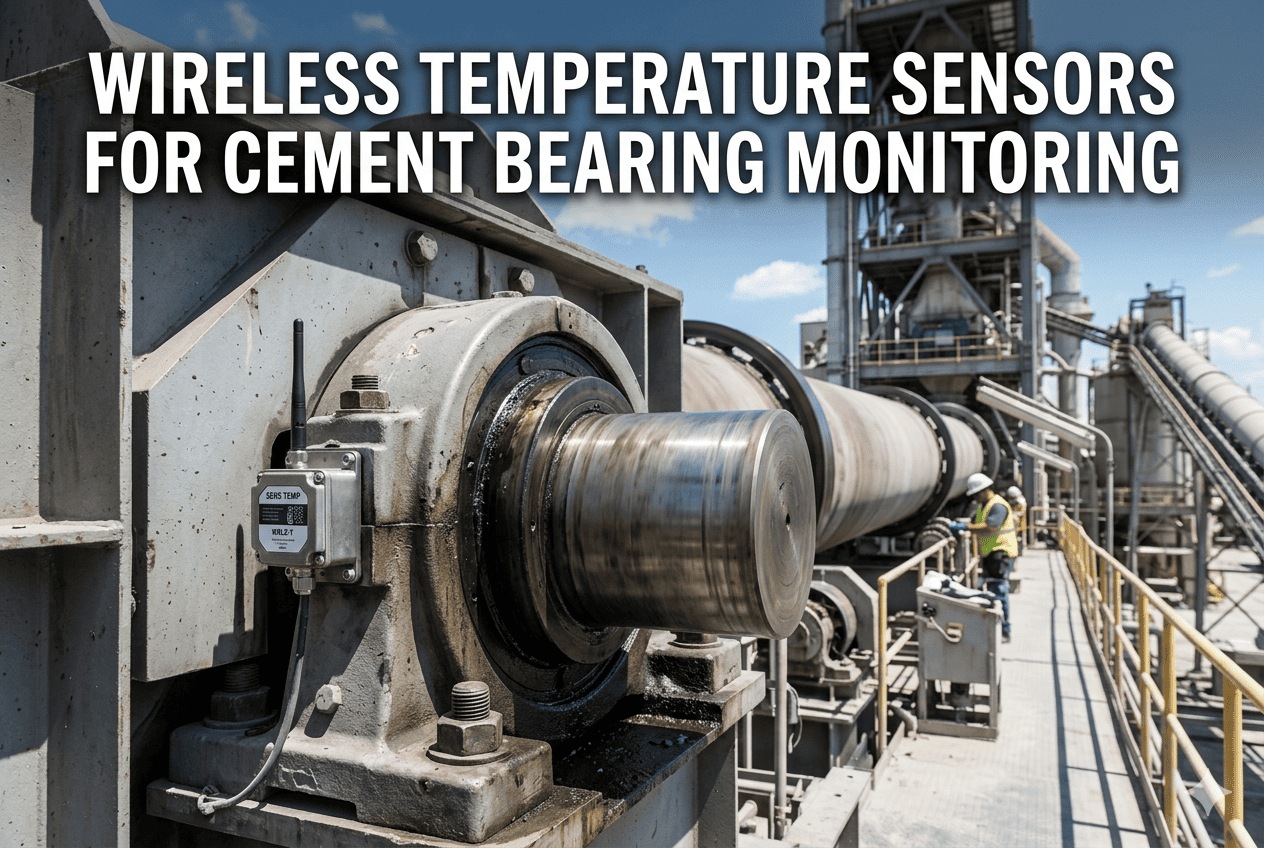
Conveyor idler failures are the silent production killers in cement plants — individually small, collectively catastrophic. A single seized idler bearing generates enough friction heat to ignite belt material within minutes; a missed overheating idler on a 1.5 km raw mill feed conveyor can trigger a belt fire that halts production for days. The challenge is not that these failures are unpredictable — thermal signatures, vibration anomalies, and acoustic changes precede every seized bearing — it is that traditional walk-down inspections happen too infrequently to catch them in time. OxMaint AI monitoring closes this gap by continuously tracking bearing temperature and vibration signatures across every idler set, triggering corrective work orders the moment anomalies emerge — not after the damage is done. Start your free OxMaint trial or book a 30-minute specialist demo to see the full idler prediction workflow.
Conveyor Idler Failure Prediction in Cement Plants
Catch bearing overheat, abnormal vibration and seized idlers before they trigger belt fires or production stoppages — with OxMaint AI alerts and planned corrective workflows.
The Four Failure Modes That Stop Cement Conveyors
Idler failures follow predictable physical sequences. Understanding the failure chain is the first step toward intercepting it at the earliest detectable stage — before heat, vibration, or misalignment reaches destructive levels.
Grease degradation, contamination ingress, or overloading causes bearing friction to rise. Surface temperature climbs from ambient to 60°C, then 90°C, then ignition threshold — each stage detectable with IR or contact sensors if monitoring frequency is sufficient.
Bearing race defects, roller imbalance, and shell damage each produce characteristic vibration signatures. Vibration-based detection typically provides a 48–120 hour advance warning window — the longest lead time of any single failure indicator.
Idlers knocked out of plane by material impact or frame settling cause belt tracking deviation. Edge wear accelerates, belt splices fail prematurely, and adjacent idlers take uneven load — creating cascading failures along the carry strand.
Complete bearing failure locks the shell. A stationary shell under a moving belt generates frictional heat at 6–10 kW, sufficient to reach belt ignition temperature within 4–8 minutes. Shell seizure is the end-state of every undetected overheat or vibration failure.
From First Signal to Belt Fire: The 72-Hour Failure Window
Every catastrophic idler failure is preceded by a detectable signal window. The difference between a planned replacement and a belt fire is whether your monitoring system sees the signal — and whether your maintenance workflow acts on it fast enough.
OxMaint AI monitors bearing temperature and vibration patterns across every conveyor, correlates multi-signal anomalies, and generates prioritized work orders automatically — so your team replaces idlers on schedule, not after belt fires.
How OxMaint Predicts Idler Failure and Closes the Loop
Detection alone does not prevent failures — the signal must trigger the right action, at the right priority, with the right information, delivered to the right person. OxMaint connects monitoring data to corrective action in a closed workflow.
Temperature and vibration sensors on each idler set feed readings into OxMaint in real time. Baseline profiles are established per conveyor zone and operating condition — so alarms fire against the right normal, not a global average.
OxMaint AI correlates temperature trend, vibration amplitude, and historical failure patterns together. Single-signal spikes (load changes, ambient temperature shifts) are filtered out. Correlated multi-signal anomalies trigger prioritized alerts.
Alert priority (low, medium, high, critical) determines work order urgency and scheduling window. Each WO includes sensor readings, trend charts, asset location, and recommended replacement action — no additional investigation required before dispatch.
Technicians receive work orders on mobile with exact idler location (conveyor ID, bay number, carry/return strand), required replacement parts, and safety isolation instructions. Completion is logged directly in the app — no paper, no radio calls, no data loss.
After replacement, the sensor baseline resets automatically. Replacement records — technician, date, idler part number, pre/post readings — are stored against the asset. Repeat failures on the same location trigger root cause escalation prompts.
Cement Plant Conveyor Idler Inspection Schedule
AI monitoring supplements — it does not replace — periodic physical inspection. The table below reflects industry-standard inspection intervals for cement plant conveyors, calibrated to operating environment and belt speed.
| Conveyor Type | Environment | Walk-Down Interval | Idler Replacement Trigger | OxMaint Action |
|---|---|---|---|---|
| Raw Mill Feed | High dust, abrasive | Daily visual check | Temp >55°C or vibration >2x baseline | Auto WO on threshold breach |
| Kiln Feed | High temp, fine dust | Daily visual + weekly IR scan | Any thermal anomaly or noise | Priority WO with kiln outage alignment |
| Clinker Transport | High temp, heavy load | Bi-weekly inspection | Shell temp >70°C, misalignment detected | Immediate high-priority WO |
| Cement Product | Fine powder, enclosed | Weekly inspection | Vibration anomaly or lubrication interval | Scheduled replacement WO |
| Limestone Quarry Feed | Outdoor, abrasive, wet | Bi-weekly full inspection | Seal failure, shell rust, misalignment | WO with location coordinates |
Frequently Asked Questions
How does OxMaint detect idler overheat without continuous IR cameras on every idler?
Can OxMaint identify which specific idler in a bay is generating the anomaly?
How long does it take to configure OxMaint for an existing cement plant conveyor network?
Does OxMaint store idler replacement history for warranty and reliability tracking?
Can OxMaint alert supervisors when a high-priority idler WO has not been actioned within the required window?
Your Next Belt Fire Is Still Preventable. Act on the Signal, Not the Aftermath.
OxMaint gives cement plant maintenance teams AI-driven idler anomaly detection, automatic prioritized work orders, and mobile dispatch — closing the gap between the first overheat signal and the planned replacement that prevents a belt fire. Most plants are up and running within two weeks.