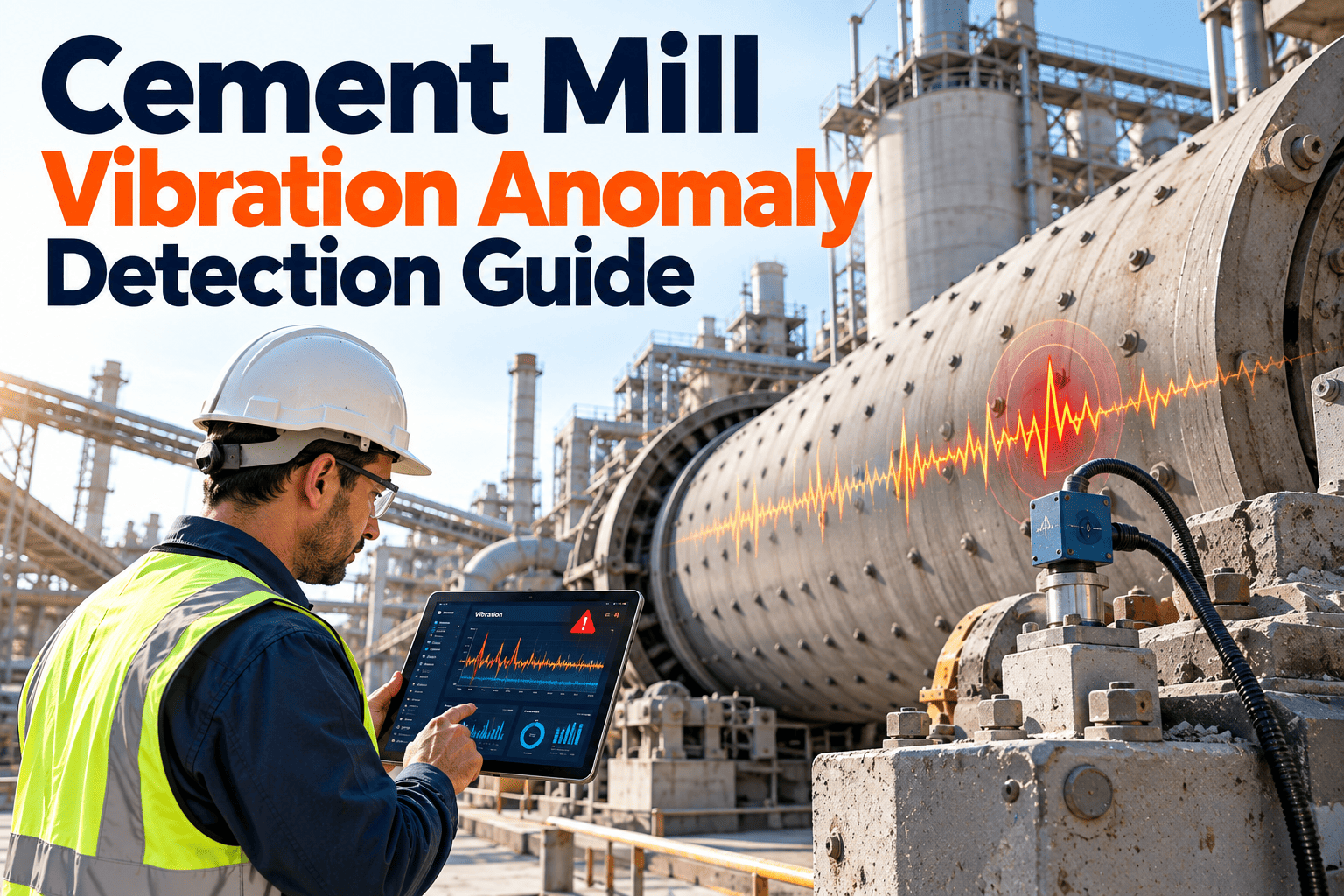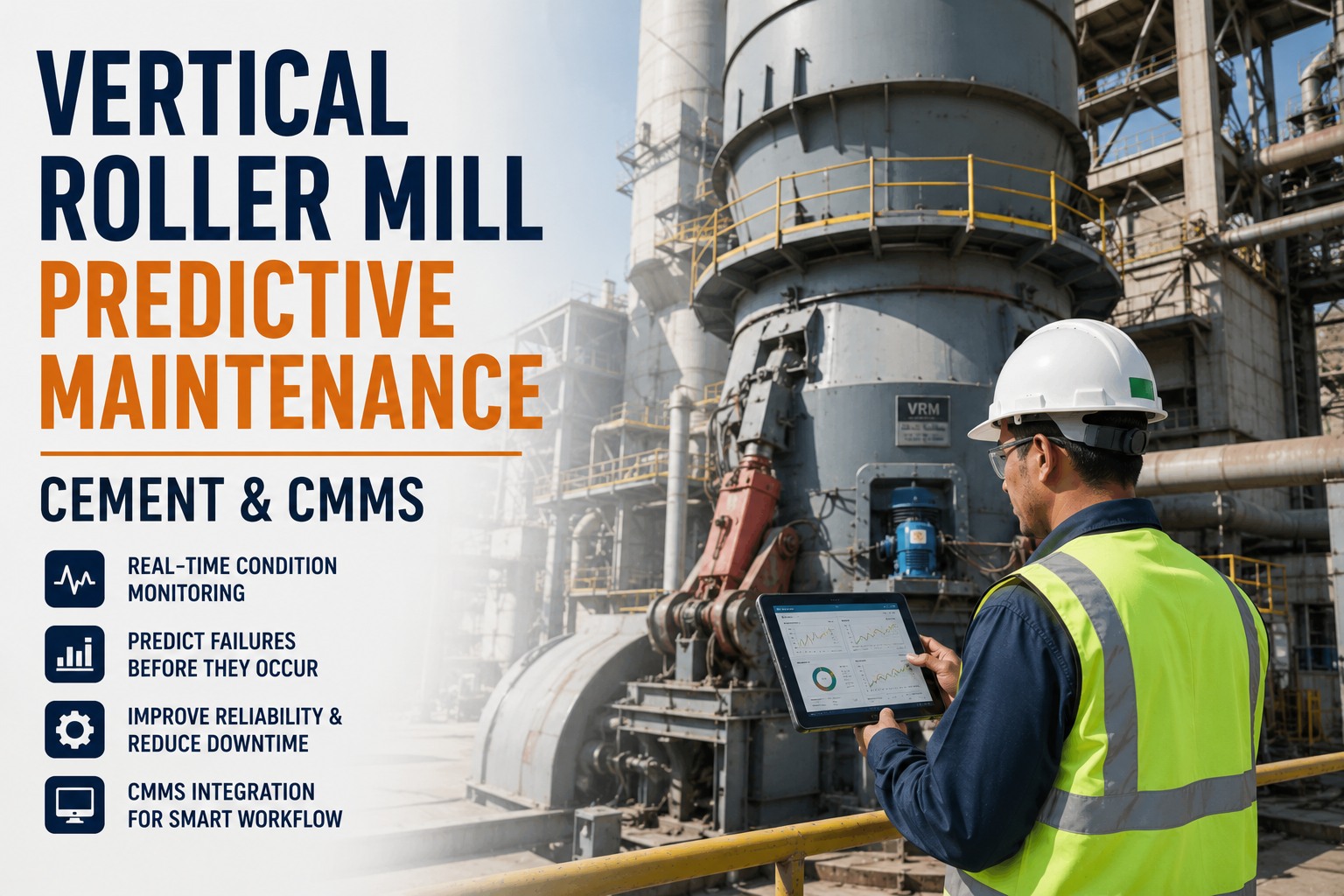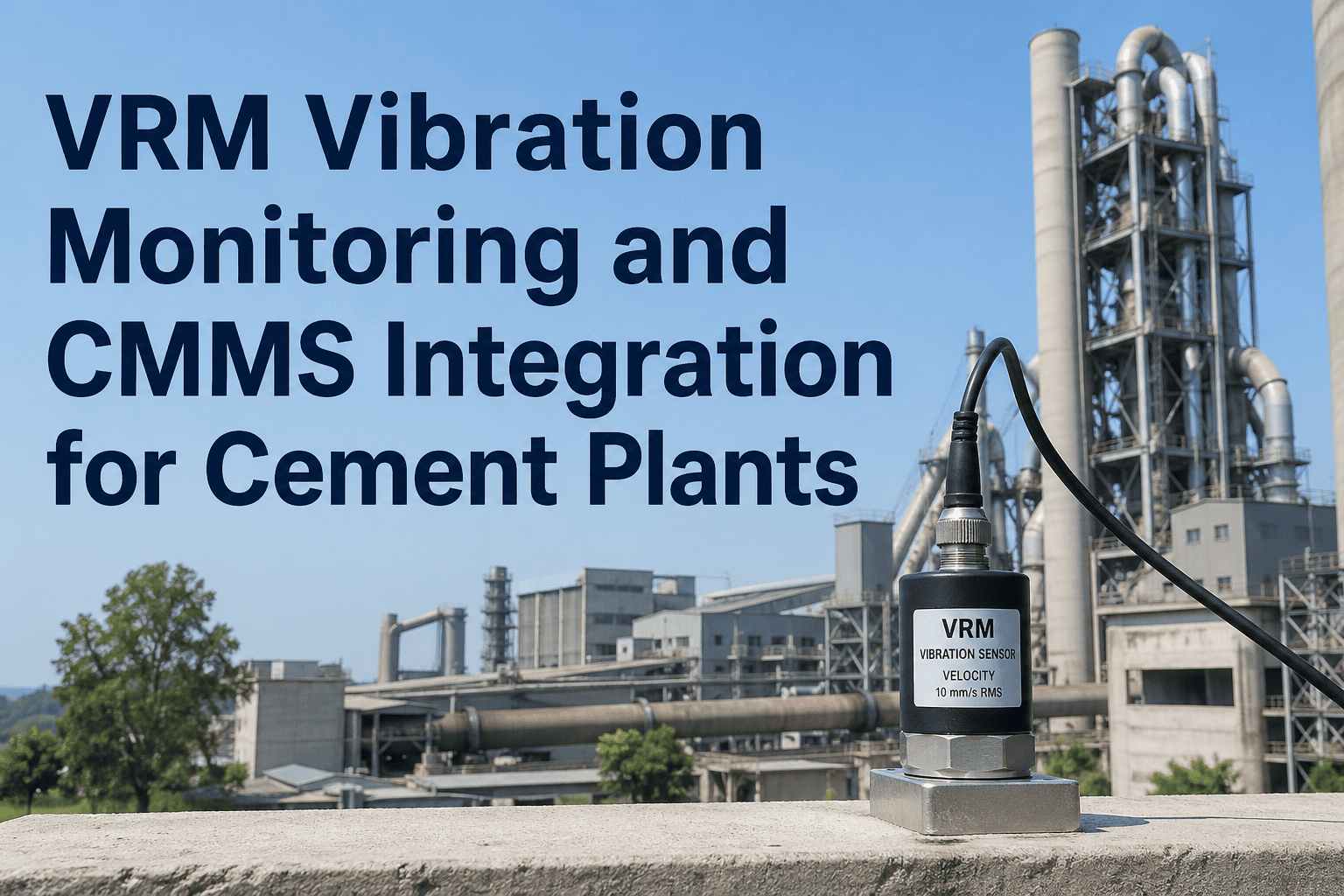
Vertical roller mill vibration is the loudest complaint and the costliest blind spot inside modern cement plants — and it is also the most preventable failure mode in the entire grinding circuit. A VRM that trips at 9.0 mm/s does not break suddenly; it sends warning signatures for days through bearing harmonics, hydraulic accumulator pressure transients, and material bed pressure fluctuations that most plants never capture because their sensors live on isolated dashboards instead of inside a maintenance system. Plants still chasing vibration alarms with paper logbooks and Excel trend sheets pay $18,000 to $32,000 per hour of unplanned mill stoppage, and a single uncontrolled trip can cascade into roller liner damage, gearbox shock loading, and table segment cracking that pushes outage costs past half a million dollars. The plants that have moved past this — and the maintenance leaders running them — connect every vibration sensor, every nitrogen pressure reading, and every roller hour to one place: Oxmaint's CMMS platform turns shapeless sensor noise into prioritised, asset-linked work orders that hit the technician's mobile before the trip alarm hits the control room.
Why VRMs Vibrate — The Six Root Causes Every Cement Engineer Sees
Vertical roller mills are extraordinarily sensitive to small process upsets. A 5% drop in nozzle ring pressure, a 3-bar dip in hydraulic accumulator nitrogen, or a 50-ppm change in feed gradation can all produce the same outward symptom — mill body vibration climbing through the alert band. Reading the cause from the symptom is the difference between a 20-minute process correction and a 14-hour emergency relining. The six families below cover virtually every vibration event recorded in a modern cement VRM.
Unstable Material Bed
The single largest cause of VRM vibration. Bed too thin and rollers contact the table directly; bed too thick and pressure differential collapses the bed. Driven by feed rate swings, particle size variation, and grindability changes in raw mix.
Nitrogen Bladder & Accumulator Loss
Low or fluctuating nitrogen pressure removes the system's ability to absorb dynamic loads. Bladder rupture causes hydraulic arm resonance that can crack table segments within 48 hours if undetected. The most overlooked failure mode in the circuit.
Roller Tire & Table Liner Wear
Wear patterns beyond 20–30 mm depth break uniform material distribution and create cyclic compression imbalance. Worn segments produce a once-per-revolution vibration spike that grows linearly with cumulative tonnes processed.
Nozzle Ring & Dam Ring Imbalance
Inadequate airflow through the nozzle ring fails to fluidise the bed and lets material settle. Improper dam ring height (typical range 45–75 mm) collapses bed stability. Adjusting pressure drop to 4–6 mbar across the mill cuts vibration by up to 40%.
Bearing Defects in Gearbox & Roller Arms
BPFO, BPFI, BSF, and FTF defect frequencies persist regardless of bed depth or feed hardness. Envelope demodulation isolates these constant-frequency impacts 3–6 months before spectral analysis detects them — the single largest predictive window in the mill.
Loose Foundation & Anchor Bolt Drift
Foundation grout cracking or anchor bolt loosening produces low-frequency rocking that masquerades as mill imbalance. Underdiagnosed because operators tighten bolts without addressing the grout — the issue returns within weeks at higher amplitude.
ISO 10816 Severity Zones — The Numbers That Decide When to Act
Vibration severity is not subjective. ISO 10816-3 maps machine RMS velocity (mm/s) to four operational zones — Zone A through D — that translate directly into alert and trip thresholds. For VRM main drive motors and gearbox housings (typically Group 1, rigid foundation, >300 kW), the zones below define the maintenance response. Book a demo to see how Oxmaint applies these thresholds asset-by-asset across your mill fleet.
Brand-new mill state. Acceptance test target after major overhaul. Baseline reference for all future deviation thresholds.
Acceptable for unrestricted long-term running. Trend-watch zone. Set advisory alarm at +20% above baseline drift.
Mill can run only for limited duration until corrective work is scheduled. Auto-generated inspection work order in CMMS.
Vibration sufficient to cause damage to bearings, table segments, or roller arms. Trip threshold typically set at 9.0 mm/s.
Where Sensors Go on a VRM — The Twelve Measurement Points That Matter
Sensor placement decides everything that follows. A poorly mounted accelerometer on a flat painted surface produces noise; a stud-mounted sensor on a clean machined boss produces diagnostic-grade data. The diagram below shows the twelve high-value mounting locations on a typical 5-roller VRM — these positions cover 95% of the failure modes that actually trigger emergency stops.
Stop Treating VRM Vibration as a Control Room Alarm. Treat It as a Maintenance Signal.
Oxmaint connects every vibration sensor, hydraulic pressure reading, and roller hour to one asset record — turning sensor data into work orders before vibration trips become outage events.
Live VRM Health Dashboard — What Sensor-to-CMMS Integration Looks Like
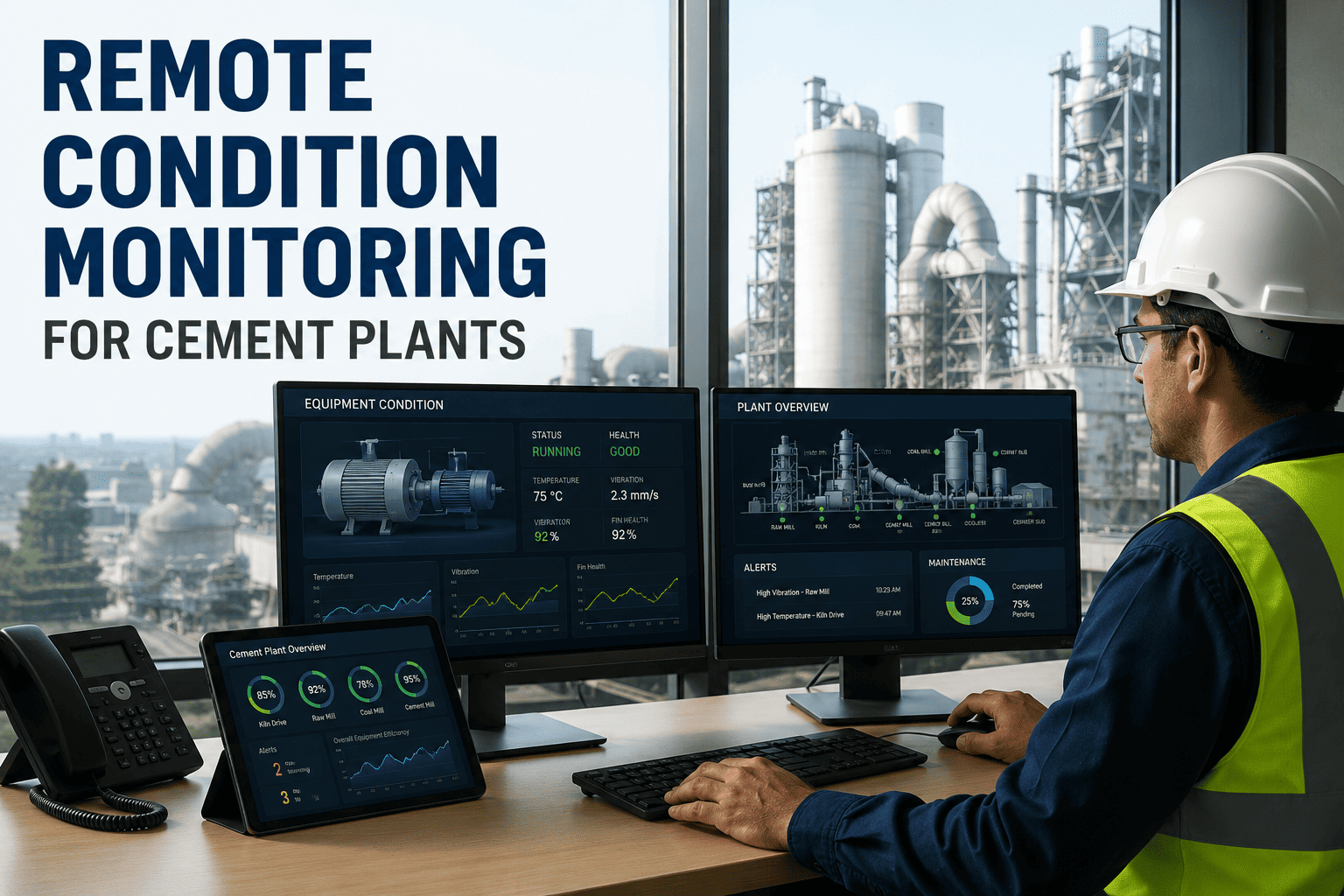
The mill condition feed below shows what closed-loop VRM monitoring looks like when shapeless sensor data flows directly into a maintenance system. Each row is a real condition signature mapped to an automatic CMMS action — no manual triage, no alarm fatigue, no spreadsheet handoff between operations and maintenance.
The Cost Equation — Reactive vs Predictive VRM Maintenance
The financial gap between catching a VRM fault three weeks early and catching it three minutes early is not marginal — it is the difference between an $8,000 oil flush and a $400,000 emergency relining. The breakdown below shows what each fault stage actually costs in a typical 1.2 MTPA cement plant. Try Oxmaint free to see how these intervention windows are scheduled in the platform.
| Fault Stage | Vibration Signature | Detection Method | Intervention Cost | Outage |
|---|---|---|---|---|
| Stage 1 — Early | Envelope amplitude 1.5× baseline | AI envelope demodulation | $8,000 – $18,000 | Planned, < 4 hrs |
| Stage 2 — Developing | Sidebands appear, 2× baseline | Spectral FFT trending | $45,000 – $80,000 | Planned, 8–12 hrs |
| Stage 3 — Advanced | 3–5× baseline, broadband rise | Standard ISO 10816 alarm | $120,000 – $200,000 | Semi-planned, 1–2 days |
| Stage 4 — Failure | Trip alarm, secondary damage | Trip alarm, post-failure | $280,000 – $620,000 | Emergency, 5–10 days |
The Sensor-to-Work-Order Pipeline — Five Stages That Make CMMS Integration Real
Most cement plants already own the sensors. What they lack is the connective tissue that turns a vibration spike into a parts-staged, technician-assigned, mobile-delivered work order without manual triage. The five-stage pipeline below is what differentiates a CMMS that documents failures from one that prevents them.
Sensor Capture
Wireless triaxial accelerometers on twelve VRM measurement points sample at 1-second to 15-minute intervals depending on asset criticality. Hydraulic pressure transducers stream at 100 Hz to catch transients invisible to slow polling.
Edge Aggregation
Lightweight edge connector reads OPC-UA, Modbus TCP, MQTT, and REST endpoints. Buffers data during connectivity loss. Pushes upstream securely. Reads from existing DCS — no control system writes, no automation modifications.
AI Analytics Layer
Machine learning models compare each reading to asset-specific baselines and ISO 10816 zone limits. Envelope demodulation isolates bearing fault frequencies from grinding background noise with 99.6% accuracy across the 1× to 36 kHz range.
Work Order Generation
Threshold breach or AI anomaly auto-creates a CMMS work order linked to the specific asset component — not the parent mill. Severity-scored, parts-reserved, technician-routed, and timestamped against the original sensor event.
Mobile Closure & Feedback Loop
Technician receives WO with full asset context, prior readings, and sensor trend chart on mobile. Closure data — replaced parts, root cause, time spent — feeds back into the asset history and refines future thresholds and ML baselines.
The CMMS Practices That Actually Reduce VRM Vibration Trips
Bed Depth & Pressure Drop Logging
Operators log bed depth, mill differential pressure, and feed rate against asset history. Oxmaint flags deviations against rolling 7-day baseline before vibration alarms activate.
Hydraulic Accumulator Pressure Check
Nitrogen pressure verified against OEM spec on each accumulator. Trending pressure drop is the earliest signal of bladder degradation — weeks before grinding force loss.
Roller Tire Wear Measurement
Ultrasonic thickness measurement at fixed points on each roller. Wear trended against cumulative tonnes processed. RUL engine projects replacement window 45 days ahead.
Gearbox Oil Sampling
Iron, copper, lead particle count and ISO cleanliness code logged against gearbox asset record. Threshold breach on Fe > 80 ppm triggers oil flush WO automatically.
Sensor Calibration & Mount Audit
Stud-mount torque check, sensor response baseline, and dust contamination inspection. Bad sensor data destroys ML baselines — calibration discipline protects predictive accuracy.
Foundation Grout & Anchor Bolt Survey
Visual and tap-test inspection of foundation grout. Bolt torque verification against OEM specification. Grout cracking is the silent cause of recurring 1× mill body vibration.
What a 1.2 MTPA Plant Actually Recovered with Sensor-to-CMMS Integration
The numbers below are typical results from cement plants that moved from periodic vibration routes to continuous sensor-to-CMMS integration on their VRM circuit. Reading them as standalone metrics misses the point — the pattern is that every single number compounds into the next, because every prevented failure prevents three more downstream.
Avoided maintenance costs and production losses on a 3-mill VRM circuit at a 1.2 MTPA complex.
Year-one benchmark across plants moving from reactive to predictive vibration response.
Year-one kWh/t reduction from stable bed operation and tighter pressure-drop control.
Envelope demodulation lead time vs standard spectral analysis on roller arm bearings.
Frequently Asked Questions
Every VRM Vibration Trip Was a Maintenance Signal That Got Ignored
The plants that catch hydraulic drift, roller wear, and bearing harmonics before they become outages all share one thing — their sensors talk to their CMMS, not to a forgotten dashboard.