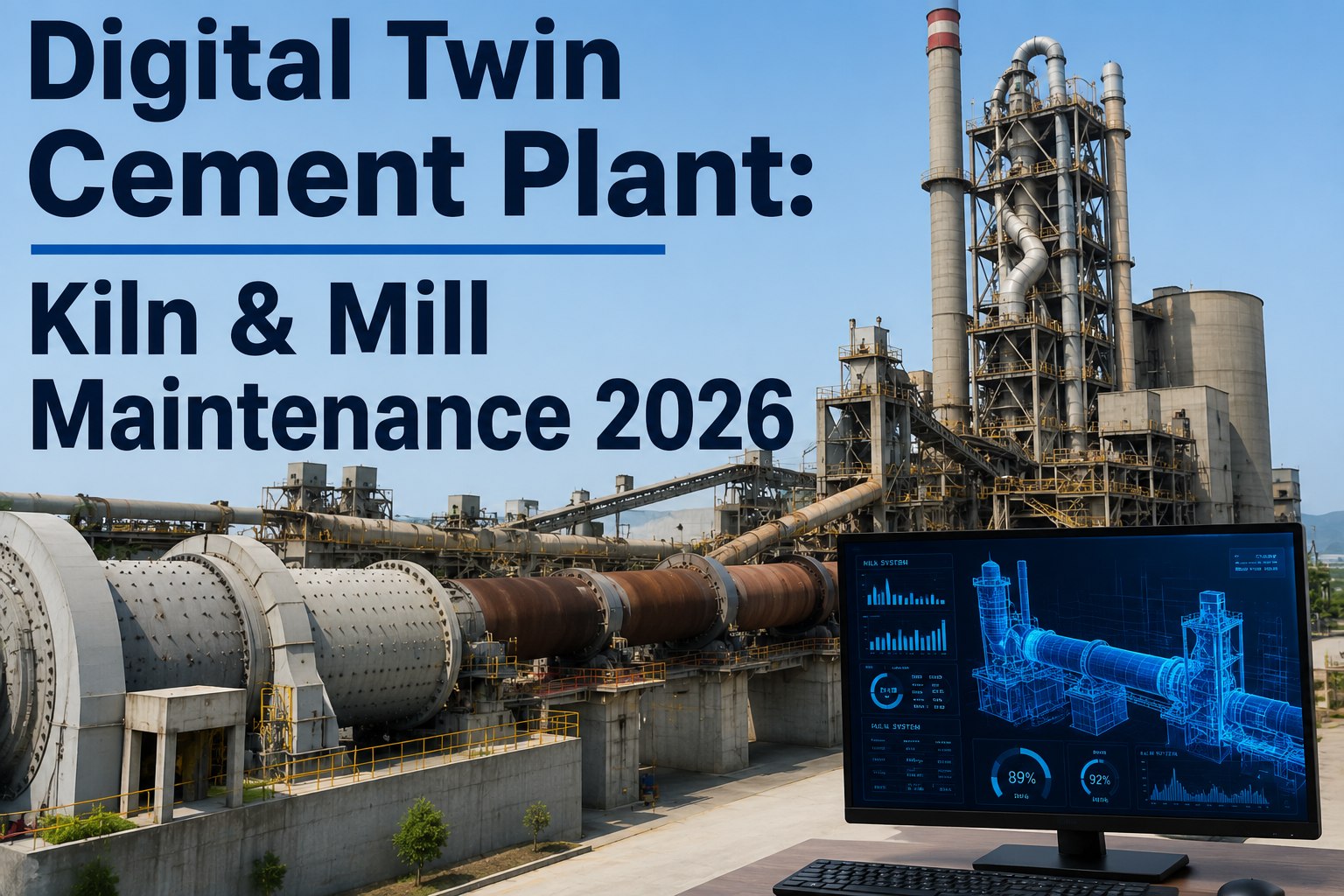
Digital twins for cement plant kiln and mill circuits are no longer pilot-lab experiments — they are delivering real value in 2026. Thermal, mechanical, and process models tied to live plant data now support maintenance decisions on refractory lining campaigns, ball mill shell and diaphragm wear, and VRM roller-table gap management. This guide covers the scope of a digital twin for a cement plant, the data architecture behind it, the use cases that move OEE, and the phased deployment approach that gets value inside 12 months instead of five years. Skip the slide-deep theories and Start Free Trial to model your first kiln thermal circuit this quarter.
How fast can a kiln digital twin pay for itself in your plant?
A properly scoped cement plant digital twin — thermal kiln model, ball mill simulation, VRM twin, and CMMS-connected maintenance loop — typically returns its first-year cost inside one refractory campaign and lifts mill-circuit OEE by 4–7 points within twelve months.
What a cement plant digital twin actually covers
A defensible twin is not a 3D rendering — it is a live, physics-backed model of four coupled asset systems, each with its own failure signature and maintenance trigger.
Kiln thermal model
Finite-element shell temperature map, burning-zone estimation, and refractory wear projection tied to PID setpoints and shell-scanner data. Drives coating-build alerts and brick-change scheduling.
Ball mill simulation
Charge-motion DEM model, power-draw curve, and diaphragm wear progression. Predicts when first-chamber throughput drops below 85% of design and flags liner bolt re-torquing windows.
VRM digital twin
Roller-table gap, hydraulic pressure, vibration spectrum, and classifier speed mapped to specific power consumption. Predicts table-liner overhaul 6–10 weeks before vibration trip.
CMMS-connected loop
Twin outputs raise work orders directly in the CMMS with fault code, priority, parts list, and recommended downtime window — closing the loop between model and wrench.
Four layers that keep the twin honest
Without a disciplined architecture, a twin degrades into a dashboard. These four layers — from edge to closed-loop work order — are what separate a 2026 production twin from a 2020 pilot.
Edge acquisition
PLC, DCS, and SCADA tags collected at 1-second granularity for thermal variables and 100 ms for vibration. Target 99.5% tag availability before any model goes live — bad data is the number-one cause of twin drift.
Historian + context layer
Time-series historian with asset hierarchy (ISA-95) and maintenance-event context overlaid. This is where a bearing temperature reading becomes meaningful — paired with the last grease date and the work order that followed.
Physics + ML model layer
Reduced-order thermal FEM for the kiln, DEM charge-motion for the ball mill, and hybrid physics-ML for the VRM. Models retrain weekly on the last 90 days of data; drift is monitored with a KPI gate before promotion.
CMMS action loop
Model outputs translate into condition-based work orders — fault code, recommended action, parts BOM, and a suggested downtime slot — then track execution and feed the result back into retraining.
Where the money comes back
A worked example: a 1.8 MTPA plant running one 5-stage preheater kiln and two ball mills typically spends $4.1M/yr on kiln refractory and mill internals. The four use-cases below, drawn from 2025–26 deployments, recover $610K–$940K of that spend inside the first campaign cycle.
Burning-zone temperature deviation alerts extend brick life by 8–14% on average. On a $1.2M lining, that is $96K–$168K per campaign — typically realized within 9 months of go-live.
Optimized charge level and diaphragm condition on a 3500 kW ball mill cut 1.8–2.6 kWh/t. At 1.2 MTPA and $0.09/kWh, that is $194K–$280K per year — payback under 11 months.
| Use case | Asset | Typical gain | Annual value (1.8 MTPA) | Time to value |
|---|---|---|---|---|
| Refractory campaign prediction | Kiln burning zone | +8–14% brick life | $96K–$168K | 9 months |
| Charge-motion optimization | Ball mill | −1.8 to −2.6 kWh/t | $194K–$280K | 11 months |
| Roller-table vibration prediction | VRM | −2 unplanned trips/yr | $120K–$210K | 7 months |
| Condition-based WO automation | All assets | −18% PM hours | $200K–$282K | 6 months |
From data audit to closed-loop value in four phases
The phased plan below is designed to put the first condition-based work order into the CMMS inside 90 days, then expand to a full kiln + mill twin by month 12. Each phase has a hard exit gate — no phase begins until the prior gate is signed off.
Phase 1 — Foundation & quick win
Tag audit, historian cleanup, and ISA-95 hierarchy build. Deploy a single high-value model (usually VRM vibration) and trigger the first condition-based work order in the CMMS by week 12.
Exit gate: 1 live CBM work orderPhase 2 — Kiln thermal twin
Stand up the reduced-order kiln FEM, integrate shell-scanner data, and validate against the last two campaign outcomes. Burning-zone coating alerts go live to the shift supervisor's tablet.
Exit gate: ±15°C burning-zone accuracyPhase 3 — Mill circuit twin
Add ball-mill DEM charge-motion and VRM hybrid model. Optimize feed rate, classifier speed, and hydraulic pressure. Begin weekly retraining cadence with a drift KPI gate.
Exit gate: −1.5 kWh/t sustainedPhase 4 — Closed-loop CMMS
Automated WO generation with fault code, BOM, and downtime slot. Maintenance feedback feeds model retraining. Hand-off to plant reliability team with documented playbooks.
Exit gate: −18% PM hoursReactive maintenance vs. digital-twin-driven maintenance
The shift is not just about dashboards — it changes who initiates the work order, when parts are ordered, and how much unplanned downtime the plant absorbs. The comparison below is drawn from a 180-asset cement plant running one kiln and two mills.
| Dimension | Reactive / time-based (before) | Digital-twin-driven (after) |
|---|---|---|
| Work order trigger | Calendar interval or breakdown | Model-predicted condition threshold |
| Refractory change planning | Fixed 11-month cycle, ±3 week error | ±5 day prediction, scheduled to market window |
| Mill liner reorder lead time | 14-day emergency reorder, 2× cost | 6-week predictive reorder, list price |
| Unplanned downtime per quarter | 42 hours (kiln + mill combined) | 11 hours within 12 months |
| Maintenance labor allocation | 62% reactive, 38% planned | 19% reactive, 81% planned |
| First-year maintenance spend | $4.1M baseline | $3.2M (−22%) with $610K–$940K recovered |
We stopped changing kiln bricks on a calendar and started changing them on a prediction. That single shift recovered $142K in lining cost and 19 hours of downtime in the first campaign.
Stand up your kiln thermal twin in the next 90 days
Oxmaint's CMMS comes pre-wired for digital-twin inputs — tag audit, ISA-95 hierarchy, and condition-based work orders out of the box.
Digital twin cement plant — five questions answered
What is the minimum data quality needed before deploying a kiln digital twin?
You need 99.5% tag availability on kiln shell temperature, fuel rate, feed rate, cooler I/O, and burning-zone PID setpoints, plus at least 12 months of clean historian data to train and validate the thermal FEM. Below that, the twin will drift within weeks and the CMMS will start generating false work orders that erode operator trust.
How does the digital twin connect to my existing CMMS?
The twin's action layer (L4) pushes condition-based work orders through the CMMS API — fault code, recommended action, parts BOM, priority, and suggested downtime slot. Oxmaint supports this out of the box; legacy systems typically need a REST or OPC-UA bridge. Start Free Trial to test the connector against your asset hierarchy.
Can a VRM digital twin predict roller failure before vibration trips the mill?
Yes. A hybrid physics-ML model using hydraulic pressure, accelerometer spectra, table RPM, and classifier speed typically flags roller-table distress 6–10 weeks before the vibration trip threshold. That lead time lets you plan the overhaul in a scheduled downtime window instead of losing 18–30 hours to an unplanned stop.
What does a 12-month deployment actually cost for a single-kiln, two-mill plant?
A scoped deployment — tag audit, kiln thermal FEM, ball-mill DEM, VRM hybrid model, and CMMS loop — runs $180K–$320K depending on existing historian quality and the number of tags. Against the $610K–$940K annual recovery, first-year payback is 1.9–5.2×, and the twin continues compounding value across subsequent campaigns.
How do I keep the twin from drifting after go-live?
Weekly retraining on the trailing 90 days of data, a drift KPI gate that blocks promotion of a degraded model, and a monthly review of false-positive work orders with the reliability team. Book a Demo to see the drift dashboard and retraining workflow in action.
Model your first kiln thermal circuit this quarter
Join the cement plants already running digital-twin-driven maintenance on Oxmaint — kiln, ball mill, VRM, and CMMS in one platform.
Free 14-day trial · No credit card