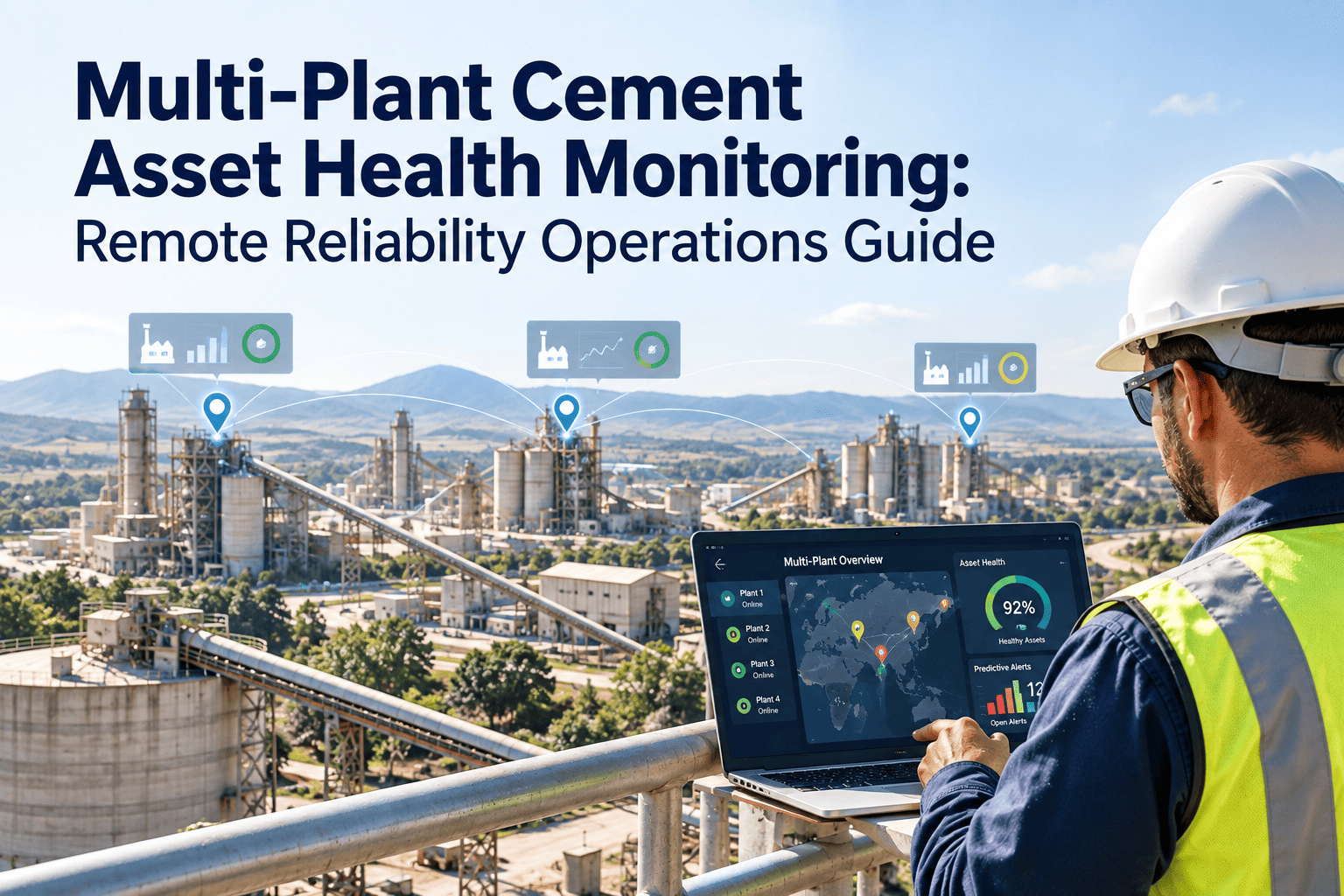
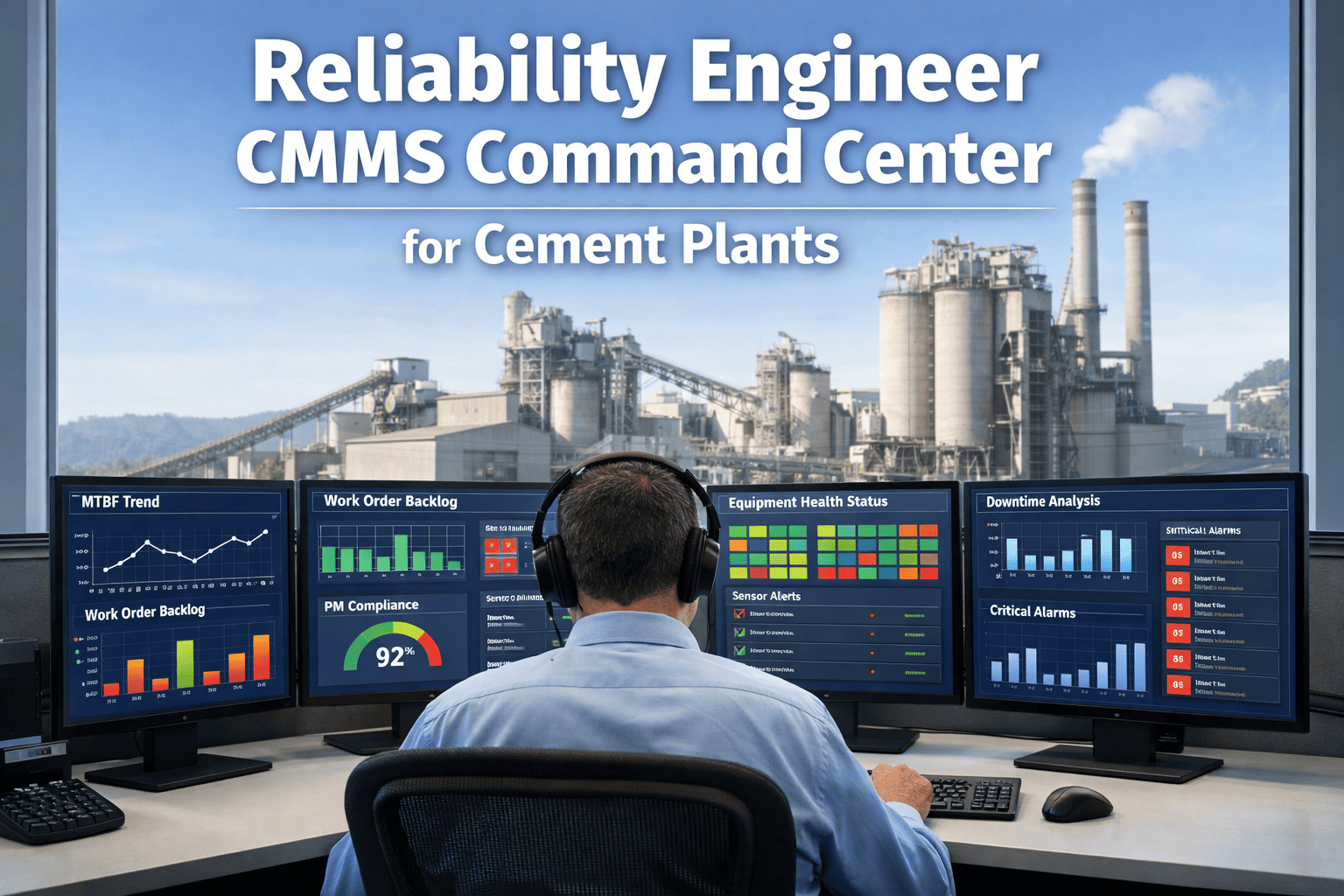
In 2026, cement plant reliability engineers are moving beyond reactive dashboards into digital twin environments that simulate kiln behavior, mill vibration patterns, and crusher load cycles in real time. A cement plant digital twin creates a living virtual replica of physical assets — feeding sensor data into predictive models that flag failure signatures weeks before a forced outage. This page breaks down exactly how reliability engineers are deploying digital twins today, what CMMS integration looks like in practice, and the measurable outcomes plants are achieving.
Reliability Engineering · 2026
Cement Plant Digital Twin
How reliability engineers use process simulation, asset health twins, and CMMS integration to eliminate unplanned downtime across kiln, mill, and crusher circuits.
38%
Reduction in unplanned kiln shutdowns after digital twin deployment — global cement benchmark 2025
11 Days
Average failure prediction lead time on critical rotating equipment using asset health twin models
$2.4M
Average annual avoided loss per 2 MTPA kiln when predictive alerts prevent a single major outage
6 Weeks
Typical time to first actionable failure alert after CMMS-integrated digital twin goes live
What Is a Cement Plant Digital Twin
Three Layers Every Reliability Engineer Must Understand
A cement plant digital twin is not a single system — it is three interconnected layers working together. Reliability engineers who treat it as only a visualization tool miss 80% of the operational value. Here is the correct model.
01
Process Simulation Twin
Models thermodynamic behavior of the pyroprocess — kiln inlet/outlet temperatures, gas flow, fuel mix ratios, and clinker quality. Engineers use this layer to simulate process changes before implementing them, avoiding trial-and-error on live production. In 2026, AI-assisted process twins can recommend fuel adjustments that reduce specific heat consumption by 3–6% without manual tuning.
02
Asset Health Twin
Mirrors the condition state of individual physical assets — kiln tyre and roller wear, separator bearing temperatures, raw mill gearbox vibration signatures. Ingests real-time data from PLCs, vibration sensors, and thermal cameras. Compares live readings against degradation models to produce remaining useful life estimates and maintenance recommendations with 72–96 hour lead time.
03
Maintenance Planning Twin
Integrates with the CMMS to translate asset health signals into scheduled work orders. When the asset health twin detects early bearing wear on the main fan, the maintenance planning twin automatically creates a PM work order in Oxmaint, attaches the vibration trend data, assigns the correct parts from inventory, and schedules the job within the next production window — no manual handoff required.
CMMS Integration
How Digital Twin Data Flows Into Oxmaint Work Orders
| Digital Twin Signal |
Asset / Equipment |
CMMS Action Triggered |
Lead Time |
| Bearing temperature trending +4°C above baseline |
Kiln main drive gearbox |
Predictive PM work order created, lubrication parts reserved |
7–14 days |
| Vibration RMS crossing alert threshold |
Raw mill separator bearing |
Condition-based work order with vibration report attached |
5–10 days |
| Kiln tyre migration rate exceeding spec |
Kiln riding ring / tyre |
Scheduled inspection work order + engineering review flag |
14–21 days |
| Preheater differential pressure anomaly |
Cyclone stage 4 |
Blockage investigation work order with process trend data |
24–72 hours |
| Kiln shell temperature hot spot detected |
Refractory zone 3 |
Emergency inspection work order, shutdown recommendation flag |
Immediate |
Asset Health Use Cases
High-Value Applications for Cement Reliability Teams in 2026
Kiln
Kiln Shell and Refractory Health Monitoring
Infrared thermal cameras feed shell temperature data into the digital twin, which tracks hot spot development across all kiln zones. The model correlates shell readings with refractory brick thickness estimates, generating replacement schedules 3–4 weeks ahead of failure — long enough to source correct brick grades and plan a kiln stop within a scheduled maintenance window rather than an emergency halt.
Mill
Cement Mill and Raw Mill Drive Train Prediction
Mill drive gearboxes are the highest replacement-cost components in the grinding circuit, often exceeding $400,000 per unit. The asset health twin tracks oil temperature, vibration spectrum changes, and load cycling to predict gearbox wear stages. Plants using this model have extended gearbox inspection intervals by 40% while reducing emergency replacements to near zero.
Crusher
Limestone Crusher Liner Wear Optimization
Crusher liner wear depends on stone hardness, feed rate, and operational hours — all captured by the process twin. The asset health model predicts liner replacement intervals based on actual wear rate rather than fixed schedules, reducing over-maintenance by 25% and eliminating unplanned liner failures that can idle a crusher for 8–16 hours.
Fan
ID and Preheater Fan Blade Erosion Tracking
Raw meal dust erodes ID fan and preheater fan blades in ways that are invisible until vibration spikes. The digital twin builds a blade erosion model from vibration harmonics and airflow efficiency metrics, alerting reliability engineers when imbalance crosses actionable thresholds. Planned balancing interventions cost roughly 85% less than emergency repairs following a blade failure.
See It In Action
Connect Your Cement Plant Digital Twin to Oxmaint
Oxmaint integrates with your SCADA, PI historian, and vibration monitoring systems to translate asset health signals into structured work orders — automatically. Reliability engineers get predictive lead time. Plant managers get OEE visibility. Finance gets a real maintenance cost number.
Implementation Roadmap
Digital Twin Deployment Phases for a Cement Plant
1
Asset Data Foundation — Weeks 1–4
Build the unified asset registry in Oxmaint. Tag all critical assets with manufacturer specs, failure modes, and sensor IDs. Establish SCADA and PI historian data feeds. Define failure signatures for kiln, mill, crusher, and fan assets based on historical data.
2
Process Twin Calibration — Weeks 5–10
Commission the process simulation twin against 12–24 months of historical operating data. Validate kiln heat balance model, mill throughput predictions, and crusher wear rate calculations. First failure alerts typically appear within this phase.
3
Asset Health Twin Go-Live — Weeks 11–16
Activate remaining useful life models for all monitored assets. Configure automated work order generation in Oxmaint based on digital twin alerts. Train reliability engineers on alert interpretation and false-positive management protocols.
4
Continuous Learning and Audit — Month 5 Onward
Digital twin models self-improve as more failure events are recorded in Oxmaint. Quarterly model audits validate prediction accuracy. Reliability engineers review alert lead times and adjust sensitivity thresholds to minimize missed failures and false alarms.
Expert Reviews
What Reliability Engineers Say About Digital Twin Programs
The biggest mistake I see is treating the digital twin as a visualization project rather than a maintenance decision tool. If your twin is not generating work orders automatically in your CMMS, you are leaving 70% of the value on the table. The integration layer between the asset health model and the planned maintenance schedule is where the ROI actually lives.
We deployed an asset health twin on our kiln main drive and separator fan circuits in late 2024. By Q2 2025, we had avoided two events that our failure history would have classified as forced outages — one gearbox and one fan blade. The total avoided loss was just over $1.8 million. The model paid for itself in the first intervention.
Book a demo and ask about kiln gearbox models specifically.
Performance Benchmarks
Cement Plant Digital Twin — Before vs After Results
| Metric |
Without Digital Twin |
With Digital Twin + CMMS |
Change |
| Unplanned kiln shutdowns per year |
4.2 average |
1.6 average |
-62% |
| Failure prediction lead time |
0 (reactive) |
11 days average |
New capability |
| Maintenance cost per tonne clinker |
$3.80–$5.20 |
$2.60–$3.40 |
-32% average |
| PM compliance rate |
51% |
93% |
+42 pts |
| Emergency spare parts spend |
Baseline |
-58% vs baseline |
-58% |
| Kiln OEE |
71% |
88% |
+17 pts |
Common Questions
What Reliability Engineers Ask Before Starting a Digital Twin Program
Do we need to replace our existing SCADA or DCS to implement a digital twin?
No — in almost all cases, the digital twin sits alongside your existing control infrastructure and ingests data via OPC-UA, PI historian, or direct SCADA integration. Oxmaint connects to AVEVA, OSIsoft, and most major DCS platforms without requiring any control system replacement. The integration layer maps existing sensor tags to asset models in the CMMS, so your existing instrumentation investment becomes the foundation of the digital twin rather than something to replace.
Book a demo to review your specific control environment.
How many sensors do we need before a digital twin produces reliable failure predictions?
The minimum viable configuration for kiln circuit asset health modeling is bearing temperature on main drive, kiln shell infrared scanning, and at least one vibration monitoring point per major rotating machine in the circuit. Most cement plants already have the majority of this instrumentation installed — the gap is typically in data historian connectivity and failure model training, not in sensors. Oxmaint's implementation team conducts a sensor gap audit during the first phase of deployment to identify what additional instrumentation, if any, is needed before go-live.
How long does it take for the digital twin to produce accurate failure predictions after go-live?
Plants with 12 or more months of historical sensor data in a PI historian or similar system typically see calibrated failure predictions within 4–6 weeks of go-live, because the asset health models can be trained on historical failure events from the start. Plants with limited historical data run in observation mode for 60–90 days before prediction confidence reaches actionable levels. In both cases, process simulation models and PM compliance improvements begin delivering value on day one.
Sign up free to start the asset data foundation immediately.
Can Oxmaint integrate the digital twin alerts into our existing SAP PM or Oracle EAM environment?
Yes. Oxmaint supports bidirectional integration with SAP PM, Oracle EAM, and IBM Maximo via standard API connections. Digital twin alerts can create work orders natively in Oxmaint with full sensor trend data attached, or they can pass structured notifications to SAP PM for work order creation in plants where SAP is the system of record. The integration approach is defined during the implementation scoping phase based on your ERP architecture and maintenance workflows.
Start Your Digital Twin Program
See How Oxmaint Connects Your Cement Plant Assets to Predictive Maintenance
Reliability engineers at leading cement groups use Oxmaint to bridge the gap between digital twin alerts and structured maintenance execution. Asset health signals become work orders. Failure history trains better models. Plant leadership gets real OEE numbers for the first time.