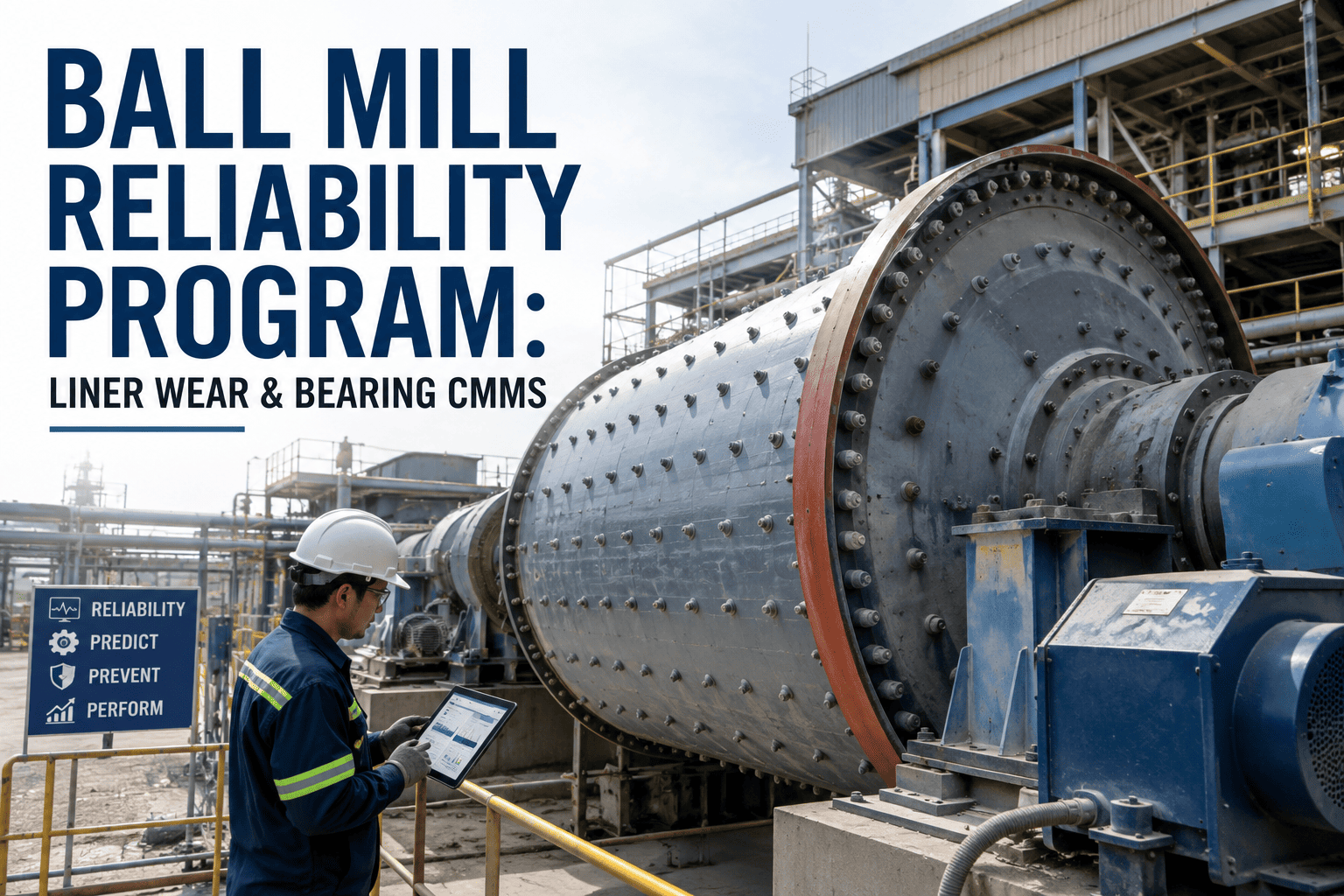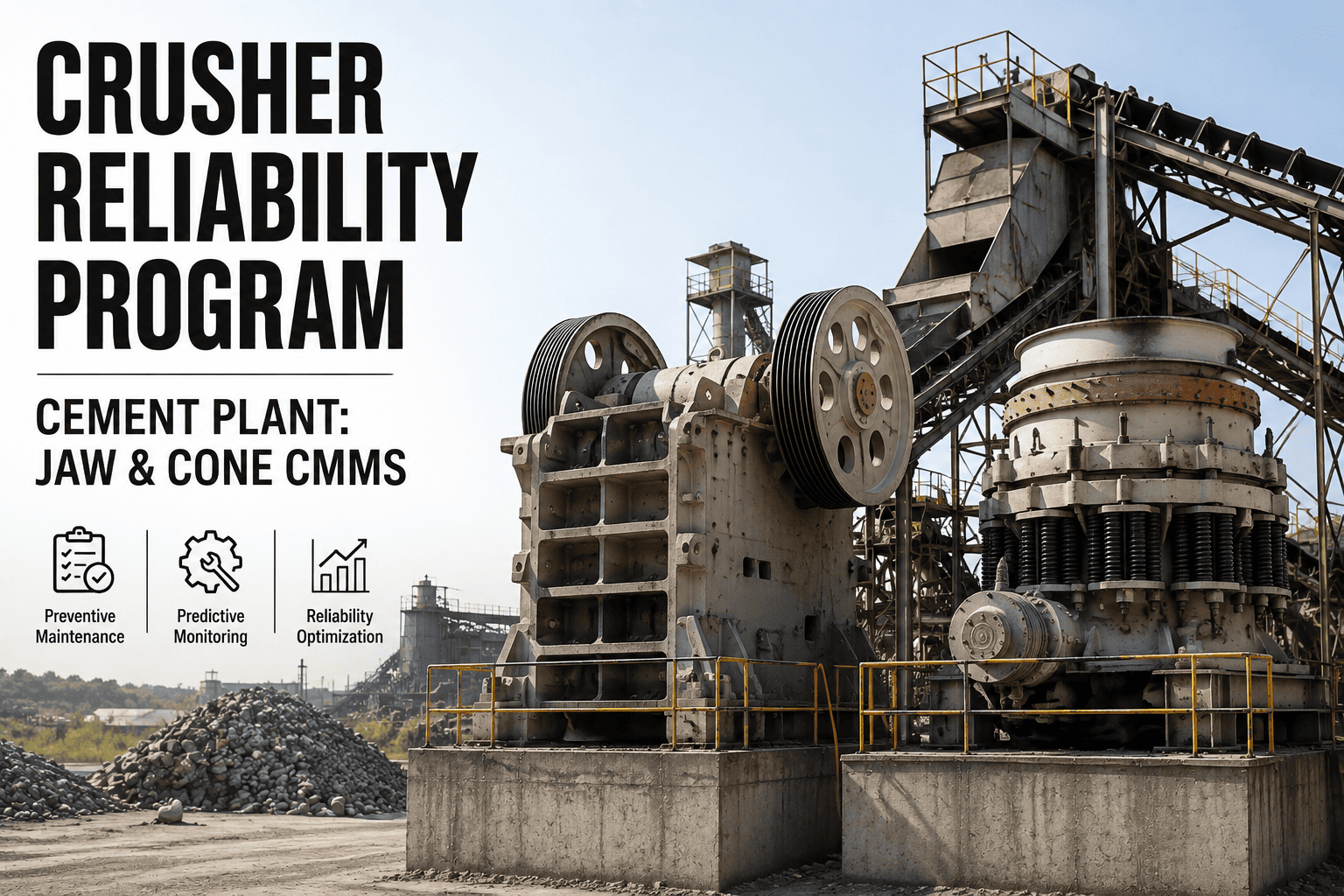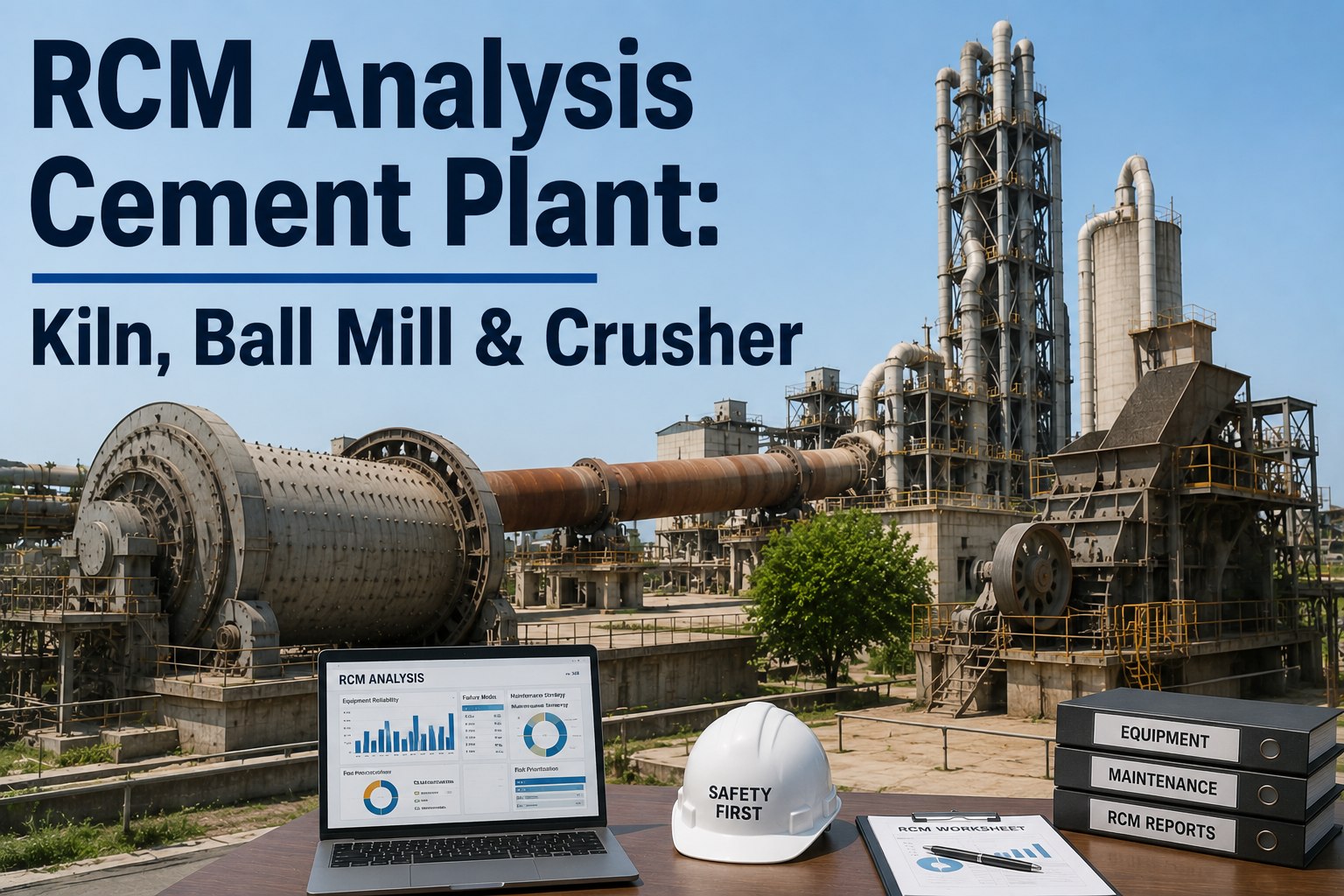
Reliability-centered maintenance in a cement plant lives or dies on three assets: the rotary kiln, the ball mill, and the primary crusher. These are the units that consume 60–70% of your electrical kWh and nearly all of your unplanned downtime budget, yet too many plants still run them on calendar-based PMs inherited from the OEM manual. A proper RCM analysis re-examines every failure mode against its functional consequence — production loss, safety, environmental — and assigns a defensible task: on-condition, scheduled restoration, run-to-failure, or redesign. When those RCM decisions are coded into a CMMS like Oxmaint, the program stops being a binder on a shelf and becomes a living maintenance strategy the planner actually executes.
Where does your cement RCM program actually pay back — and where does it quietly leak dollars?
Most cement plants have an RCM binder. Few have a CMMS that enforces it. The gap between the two is where kiln outages, ball mill bearing failures, and crusher liner surprises hide — at an average cost of $18K–$42K per unplanned event.
Seven questions RCM forces you to answer for every cement asset
RCM isn't a form you fill in — it's an interrogation. SAE JA1011 lists seven questions; below is how each one lands when the asset is a 4,500 TPD kiln, a 3,500 HP ball mill, or a 1,200 TPH limestone crusher.
Functions
What must the asset do, at what throughput, in what operating context? A kiln's primary function isn't "rotate" — it's "produce 187 TPH of clinker at free-lime ≤1.5%."
Functional Failures
How can it fail to meet that function? Not "bearing breaks" — "mill throughput drops below 110 TPH for >2 consecutive hours." Failure is a performance gap, not a parts list.
Failure Modes
What specific event causes each functional failure? Tire contact-face spalling, slide-shoe oil viscosity loss, girth-gear backlash drift — each one a CMMS work-order trigger.
Failure Effects
What happens when the mode occurs? Downtime hours, secondary damage, safety exposure, environmental release. This is where consequence severity gets scored.
Consequence
Does it matter? Hidden, safety, environmental, operational, or non-operational. A cracked crusher mantle is operational; a kiln shell hot-spot is safety + environmental.
Proactive Tasks
Is there a task that reduces the failure's likelihood to acceptable levels? On-condition (vibration, thermography), scheduled restoration, or scheduled discard — each with a defensible interval.
Default Actions
If no proactive task is technically feasible or worth doing: redesign, run-to-failure (with a contingency), or a one-off change to the operating context.
Then: CMMS Coding
Each surviving task becomes a PM trigger inside the CMMS — meter-based, condition-based, or event-based — with the failure mode tagged on the work order so you can measure effectiveness later.
Kiln RCM: failure modes that decide a 30-day outage
A modern 5-stage preheater kiln runs 320+ days between planned outages. The RCM job is to make sure none of the modes below becomes the one that ends the campaign early.
| Failure Mode | Mechanism | Consequence | RCM Task & Interval |
|---|---|---|---|
| Coating collapse / ring formation | Chemical build-up in burning zone or lower transition | Throughput drop 8–15%, torque spikes on drive | Shell-scan thermography weekly; kiln-shell temp trend in CMMS dashboard |
| Tire / roller surface spalling | Contact fatigue, uneven support loading | Vibration >7 mm/s, shell ovality drift | Monthly visual + quarterly vibration route; lubrication audited per shift |
| Girth gear backlash drift | Foundation settlement, pinion wear | Catastrophic tooth failure; 18–30 day outage | Backlash & tooth contact pattern quarterly; ultrasonic thickness annually |
| Shell hot spot | Refractory thinning, brick migration | Shell distortion, potential safety + environmental event | Continuous shell-temp monitoring; planned stop at 380°C |
| Planetary / drive gearbox bearing | Lubrication breakdown, misalignment | Seizure; 12–20 day outage; $280K–$620K repair | Monthly oil analysis + vibration; bearing-temp trending |
Ball mill RCM and crusher RCM: where 70% of your kWh lives
The ball mill and the crusher together account for the lion's share of electrical draw and the majority of wear-parts spend. RCM here is less about catastrophic failure and more about preventing the slow efficiency bleed that few plants ever quantify.
Failure function: throughput × fineness
- Slide-shoe bearing temp rise — lube viscosity or water-cooling fault; CMMS task: hourly temp log + monthly lube analysis, stop at 75°C.
- Girth gear pitting — lubricant film breakdown; on-condition task: quarterly vibration + monthly grease audit.
- Diaphragm slot blinding — reduces throughput 5–12%; scheduled restoration every 8,000–10,000 running hours.
- Media grading drift — specific kWh/t rises 6–9% before anyone notices; quarterly ball recharge + annual grading analysis.
Wear modes that quietly choke the kiln feed
- Mantle & concave wear — product topsize drift, kiln feed chemistry upset; task: weekly liner profile gauge, discard at 60% worn.
- Main shaft sleeve wear — eccentricity loss, capacity drop 15–22%; scheduled discard 14,000–18,000 hours.
- Hydraulic tramp release drift — uncrushable passes through; calibration every 90 days, pressure trended in CMMS.
- Drive motor bearing — vibration route monthly, oil sample quarterly; failure here is a 6–10 day outage.
"A 180-asset cement plant spending $42K per year on calendar-based ball-mill PMs typically finds, after RCM, that 38% of those tasks add no value — while three missing condition-based tasks were the ones that actually prevented the $280K bearing failure."
Typical RCM study finding · mid-capacity integrated plantFrom RCM finding to CMMS PM task — the closure that matters
An RCM study that isn't coded into the CMMS is, within 18 months, a dead document. Below is the mapping an Oxmaint implementation follows so each RCM decision becomes an executable, measurable PM.
Trigger: 6.5 mm/s RMS on girth gear
CMMS: auto-generated work order
Trigger: 9,000 hrs diaphragm
CMMS: planned stop + parts kit
Trigger: mantle at 60% wear
CMMS: inspection → replacement WO
Trigger: failure occurrence
CMMS: contingency WO template ready
A 12-month RCM implementation timeline for cement assets
Pace matters. Plants that try to RCM everything in one quarter end up with shallow analysis on everything. The proven path scopes the three critical assets first, then expands.
Asset criticality ranking & FMEA scaffolding
Rank all assets by production-criticality, safety, and downtime cost. Pull 24 months of CMMS failure history. Output: a prioritized RCM queue with kiln, ball mill, and crusher in the top three.
RCM analysis on top-3 critical assets
Cross-functional team (maintenance, process, operations). Work through the seven questions for each failure mode. Output: defensible task selection per mode — not opinions, documented logic.
CMMS PM build-out & task migration
Each surviving RCM task becomes a CMMS PM with the failure mode tagged. Retire calendar-based PMs that RCM invalidated. Train planners and technicians on the new trigger logic.
Condition-monitoring instrumentation gaps
Where RCM specified on-condition tasks, close the sensor gaps — vibration on the mill pinion, shell-scan on the kiln, hydraulic pressure on the crusher. Wire alarms into the CMMS.
Effectiveness review & expansion plan
Measure: MTBF, PM compliance, unplanned downtime hours on the three assets. Compare to baseline. Decide whether to expand RCM to the next 20% of assets or deepen the existing scope.
What an ad-hoc maintenance strategy actually costs a cement line
RCM isn't a cost — it's a cost-avoidance mechanism. The numbers below are typical for a single 5,000 TPD line running without a CMMS-enforced RCM program.
Turn your RCM findings into CMMS-enforced PMs this quarter
Oxmaint gives cement maintenance teams the structure to execute RCM — failure-mode tagging, condition-based triggers, and the audit trail ISO 55000 expects.
RCM analysis in cement plants — the five questions we hear most
How long does a full RCM analysis take for a cement plant's top three assets?
For kiln, ball mill, and crusher combined, expect 10–14 weeks of facilitated analysis with a cross-functional team of 4–6 people. The bottleneck isn't the analysis itself — it's data collection (24 months of CMMS history, OEM manuals, process data) and getting operations and maintenance to agree on functional failure definitions.
Do we need to RCM every asset, or just the critical ones?
Start with the top 5–10% by criticality — typically the kiln, mill, crusher, preheater ID fan, and clinker cooler. These assets hold 70–80% of your downtime risk. Expanding RCM to lower-criticality assets is worthwhile but only after the first wave is CMMS-enforced and showing measurable MTBF improvement. You can start free with Oxmaint to scope the criticality ranking.
How is RCM different from the PM program we already have?
A traditional PM program is mostly time-based and inherited from OEM recommendations. RCM re-examines each task against the actual failure mode and its consequence — so you end up doing fewer low-value PMs, more condition-based tasks, and you have a defensible answer when an auditor asks "why this interval?"
What CMMS features does an RCM program actually need?
Failure-mode tagging on work orders, condition-based trigger support (vibration, temp, oil analysis thresholds), PM effectiveness reporting, and a clear audit trail from failure mode → task → work-order history. Without these, RCM findings decay into paper within 18 months. Book a walkthrough via the Oxmaint demo calendar to see the mapping.
What's the typical ROI window for a cement RCM implementation?
Most integrated cement plants recover the RCM study cost within 9–14 months, driven by a single avoided kiln drive failure or ball mill bearing seizure. Sustained ROI comes from the 20–35% reduction in unplanned downtime hours and the 5–10% specific-energy improvement on the milling circuit over years two and three.
Build a defensible maintenance strategy — not another binder
Run your kiln, ball mill, and crusher RCM program inside a CMMS built for cement reliability teams.
Free 14-day trial · No credit card