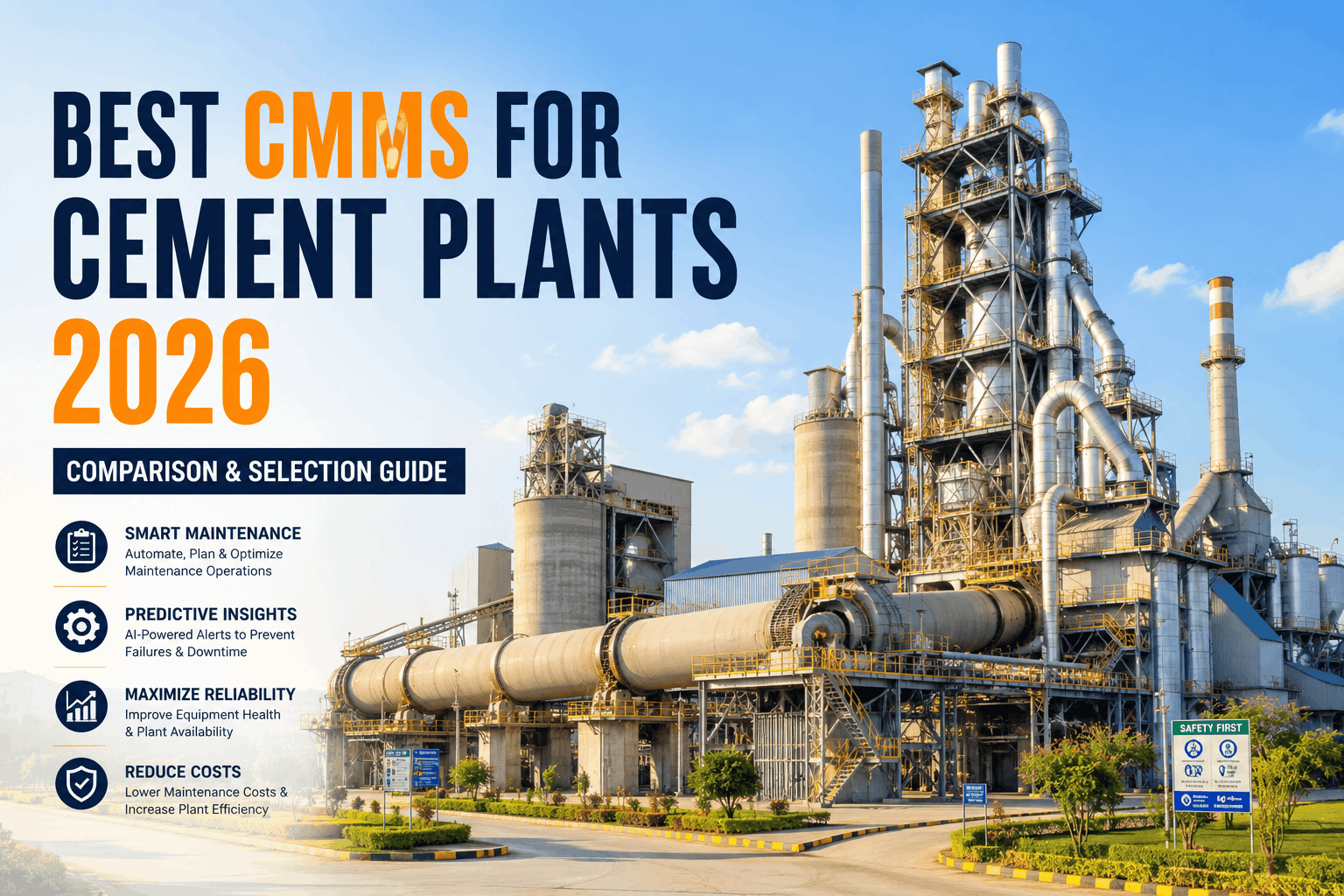
A cement plant running 2,400-plus assets — rotary kilns, ball mills, clinker coolers, preheater towers, and ID fans — cannot afford the wrong software decision. Choosing between an EAM (Enterprise Asset Management) system and a CMMS (Computerized Maintenance Management System) is not a feature comparison. It is a strategic call that shapes how your plant manages capital, controls downtime, and justifies replacement spend at board level. This guide breaks down the real scope difference, what each system actually does for cement operations, and exactly how to decide which one your plant needs in 2026.
Cement Industry
Asset Management
2026 Guide
EAM vs CMMS for Cement Plants: How to Choose in 2026
Scope, lifecycle tracking, CapEx planning, vendor shortlists, and an RFP framework — everything your team needs to make the right call for your plant.
$18K–$45K
Lost per hour in an unplanned kiln stop
$200M–$500M
Installed asset value managed per integrated cement plant
4–5x
Higher cost of emergency repairs vs planned maintenance
Core Definition
What Each System Actually Does — in Plain Language
The confusion between EAM and CMMS stems from marketing overlap. Both systems handle assets, both run on computers, and both promise lower downtime. The real difference is scope — and in cement manufacturing, scope determines whether your capital budget is built on data or guesswork.
CMMS
Computerized Maintenance Management System
Focus: Keep assets running efficiently
- Work order creation, assignment, and closure
- Preventive maintenance scheduling by time or meter
- Spare parts and storeroom inventory control
- Technician task routing and mobile updates
- Maintenance history and repair cost logging
- PM compliance tracking and downtime reporting
Best for: Maintenance teams focused on daily uptime
VS
EAM
Enterprise Asset Management System
Focus: Optimize asset value from acquisition to disposal
- Full lifecycle cost tracking per asset (TCO)
- Capital expenditure forecasting and planning
- Remaining Useful Life (RUL) modeling
- Repair-vs-replace financial analysis
- Depreciation schedules and finance integration
- Cross-functional stakeholder dashboards
Best for: Finance + operations alignment on capital decisions
Cement-Specific Stakes
Why the Choice Matters More in Cement Than Almost Any Other Industry
Cement plants are capital-intensive in a way most industries are not. A single rotary kiln represents tens of millions in sunk cost. A clinker cooler replacement event can consume an entire year's maintenance budget. Without lifecycle intelligence, these decisions are made on gut, age, and calendar — not on actual asset condition data.
$1.6M
Cost of a 9-day unplanned kiln stop — the outcome when an ID fan bearing was missed in capital planning because no RUL data existed
89%
Reduction in unplanned kiln and mill replacement events within 18 months when lifecycle programmes replace reactive management
78%
Reduction in emergency repair spend when planned lifecycle interventions replace reactive callouts across kiln and mill assets
68%
Improvement in shutdown scope accuracy versus unplanned outage baseline — directly reducing overrun costs and budget variance
Scope Breakdown
Five Dimensions That Separate EAM from CMMS in a Cement Plant Context
The decision does not come down to one feature. It comes down to five operational dimensions — and where your plant sits on each one determines which system delivers value and which adds cost without return.
| Dimension |
CMMS |
EAM |
Cement Plant Need |
| Scope |
Maintenance operations only |
Full asset lifecycle + finance |
EAM if managing $200M+ asset base |
| User base |
Maintenance managers, technicians |
Finance, operations, C-suite, maintenance |
EAM for board-level capital visibility |
| CapEx planning |
Not included — manual forecasting |
Built-in RUL-based 5–10 year forecast |
EAM for kiln/mill replacement cycles |
| Implementation |
60–90 days, maintenance team-led |
6–18 months, cross-department rollout |
CMMS if speed to value is priority |
| Cost |
Lower — focused feature set |
Higher — enterprise licensing + integration |
CMMS for plants under $50M revenue |
Scroll horizontally on smaller screens to view all columns
Not sure which system fits your plant? Oxmaint delivers both CMMS and EAM capabilities on one platform.
Purpose-built for cement plant asset structures — from preheater to packing line — with automated CapEx forecasting, PM scheduling, and real-time inventory control in a single deployment.
Lifecycle vs Maintenance
What CMMS Cannot Do for Cement Plant Capital Planning — and Where EAM Fills the Gap
A CMMS records what you spent fixing an asset. An EAM tells you whether it is cheaper to keep fixing it or replace it — and by how much. For a cement plant making multi-million dollar capital decisions on kilns, mills, and gearboxes, that difference is the gap between a defensible board presentation and an opinion-based budget request.
What CMMS tracks
Work order cost per repair event
PM schedule adherence
Spare parts inventory levels
Downtime duration per asset
Technician time and labor cost
What EAM adds on top
Total Cost of Ownership (TCO) per asset
Remaining Useful Life (RUL) modeling
Repair-vs-replace financial analysis
Depreciation and acquisition cost integration
Rolling 5–10 year CapEx forecast by asset class
Decision Framework
Five Questions That Tell You Which System Your Cement Plant Actually Needs
Use this framework before issuing an RFP or engaging a vendor. Answer each question honestly against your current operations — not against where you want to be in five years.
1
Do your board or finance teams make annual capital allocation decisions based on asset condition data?
Yes → EAM scope required. Capital decisions need TCO and RUL data, not just repair logs.
No → A CMMS that feeds structured lifecycle data may be sufficient to start.
2
Is your installed asset base valued at $100M or more — kilns, mills, coolers, gearboxes combined?
Yes → EAM lifecycle intelligence pays back faster than CMMS alone at this asset scale.
No → A modern CMMS with condition monitoring delivers strong ROI without EAM overhead.
3
Do you currently have cross-departmental visibility into asset health — finance, operations, and maintenance on one view?
Yes → EAM supports this structure. Consolidate into one platform with proper role-based access.
No → Start with CMMS to build maintenance data discipline before expanding to full EAM scope.
4
Can your team absorb a 6–18 month implementation project without impacting production schedules?
Yes → Proceed with full EAM evaluation and vendor shortlist.
No → Choose a CMMS that deploys in 60–90 days and delivers measurable results before the next shutdown window.
5
Are unplanned kiln or mill stoppages your primary problem — not capital misallocation?
Yes → A CMMS with condition monitoring solves the immediate problem fastest and at lowest cost.
No → Capital misallocation is an EAM problem. Evaluate platforms with built-in CapEx forecasting and TCO modeling.
Vendor Shortlist
Leading EAM and CMMS Platforms Evaluated for Cement Plant Operations
Not all platforms marketed as EAM or CMMS deliver equal depth for cement manufacturing. The evaluation criteria below reflect the operational realities of rotary kilns, grinding circuits, and capital-intensive replacement cycles — not generic manufacturing benchmarks. Book a demo with Oxmaint to compare platform capabilities against your specific asset base.
Recommended for Cement
Oxmaint
CMMS + EAM Hybrid
Cement-specific asset hierarchy (kiln to packing line)
60–90 day deployment — no production shutdown
CapEx forecasting with RUL per asset class
Condition monitoring to work order automation
PM triggered by kiln revolutions and mill hours
IBM Maximo
Full EAM Platform
Enterprise-grade lifecycle and financial management
High implementation cost and 12–18 month deployment
Best suited for multi-plant enterprises with dedicated IT teams
Strong ERP integration but complex for cement-specific triggers
SAP PM / S4HANA
ERP-Embedded EAM
Deep financial integration for plants already on SAP ERP
High configuration cost; cement-specific logic requires customization
Best for organizations with existing SAP infrastructure
Long implementation cycle; not recommended for speed-to-value
Limble CMMS
Cloud CMMS
Strong work order and PM scheduling for maintenance teams
No built-in cement-specific asset hierarchy or CapEx modeling
Good fit for smaller facilities focused on maintenance operations
Limited lifecycle tracking depth for capital-heavy asset decisions
RFP Guidance
What to Include in Your Cement Plant EAM or CMMS RFP to Filter Out Generic Vendors
Most RFPs ask the wrong questions — feature checklists that every vendor passes. These cement-specific criteria separate platforms with genuine operational depth from those retrofitting generic maintenance software to your industry.
Asset Hierarchy
Can the system structure assets across five tiers — Portfolio, Plant, System, Equipment, Component — with cement-specific equipment classes pre-configured?
Kiln-Specific PM
Does PM scheduling trigger on kiln revolutions and refractory zone cycles — not just calendar time — and does the system track zone-level lining thickness over shutdown intervals?
CapEx Forecasting
Does the platform generate a rolling 5–10 year replacement forecast based on Remaining Useful Life data — not age-based assumptions — with refurbish-vs-replace analysis per asset?
Condition Monitoring
Can sensor alerts from vibration, temperature, and motor current monitoring automatically create work orders and trigger procurement workflows in the same system?
Implementation Timeline
What is the realistic timeline from contract signing to a live asset register and active PM schedule — and can this be completed without a production shutdown at any stage?
Mobile + Offline
Does the mobile application function offline in kiln galleries and preheater towers without stable WiFi — and does it sync work order updates automatically on reconnection?
FAQ
Frequently Asked Questions on EAM vs CMMS for Cement Plants
Can a CMMS replace an EAM for a large cement plant?
For most cement plants under $100M in annual revenue, a modern CMMS with built-in lifecycle tracking and CapEx forecasting covers 90% of what a full EAM delivers — without the 12–18 month implementation and enterprise licensing cost. The gap only becomes critical when cross-functional capital planning at board level requires full depreciation integration with your ERP.
Oxmaint bridges both scopes in a single platform built for cement environments.
What is the biggest risk of choosing EAM over CMMS for a cement plant?
The primary risk is implementation delay. EAM deployments that take 12–18 months mean your maintenance teams are still running on spreadsheets and reactive callouts while the software project runs. Every month of delay costs an average of four to five unplanned repair events that a live CMMS would have prevented. If your most urgent problem is kiln downtime, solve it with a fast-deploying CMMS first.
Book a demo to see Oxmaint's 60–90 day deployment model.
How does CapEx forecasting differ between EAM and a modern CMMS?
Traditional EAM platforms generate CapEx forecasts using depreciation schedules and asset age. Modern CMMS platforms with lifecycle modules generate forecasts from Remaining Useful Life data — meaning the forecast updates in real time as condition monitoring detects degradation. This produces capital plans that are materially more accurate than age-based models and far more defensible in board-level budget reviews.
Is Oxmaint an EAM or a CMMS for cement plants?
Oxmaint is designed as a hybrid — delivering the daily maintenance operations depth of a CMMS alongside the lifecycle tracking, CapEx forecasting, and cross-functional visibility of an EAM, deployed at CMMS speed and cost. It is purpose-built for asset-intensive industries including cement, with a native asset hierarchy that covers rotary kilns, ball mills, vertical roller mills, clinker coolers, and preheater systems.
Start free and configure your cement plant asset structure from day one.
What is the first step after deciding between EAM and CMMS?
Issue a focused RFP using cement-specific evaluation criteria — not generic feature checklists. Require vendors to demonstrate kiln PM trigger configuration, CapEx forecast generation from actual RUL data, and a live asset hierarchy demo using your plant's equipment profile. This filters generic platforms from those with genuine cement operations depth within the first vendor conversation.
Connect every kiln, mill, and capital decision to one platform — built for cement plant operations in 2026
Oxmaint delivers CMMS and EAM capabilities from commissioning baseline to board-ready CapEx forecasts — with 60–90 day deployment, no production shutdown, and no implementation consultants required.