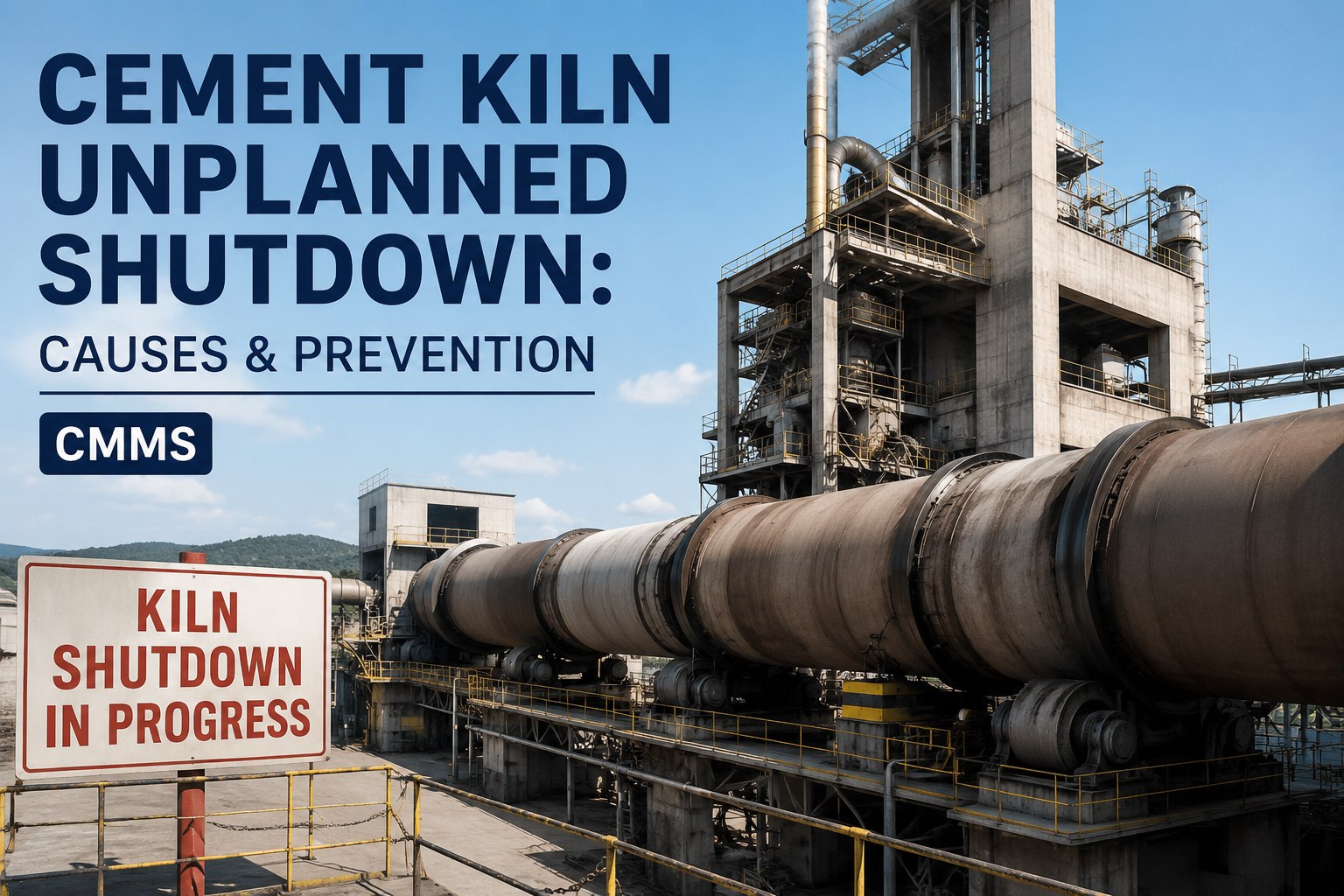
A kiln shutdown is the single highest-leverage maintenance window a cement plant gets in any given year — the few hours when brick thickness, coating profile, tyre alignment and drive-train health can all be measured, mapped and corrected before the next campaign begins. Done well, a disciplined refractory survey and internal inspection add weeks of run-factor and prevent the unplanned hot-shell stoppages that typically cost $180,000–$420,000 per event in lost clinker production. The brief below walks through inspection protocols, thickness mapping, coating analysis and the CMMS-driven shutdown plan that ties it all together — and you can Start Free Trial to operationalise every checklist item directly inside oxmaint.
KILN SHUTDOWN INSPECTION GUIDE
Is your refractory survey capturing the data that actually extends campaign life?
Most plants lose 6–11 days of run-factor per year not to brick failure, but to inspection gaps — unmapped coating rings, undocumented nose-ring wear, and thickness readings that never make it back into the CMMS. Close the loop on your next shutdown.
INSPECTION PROTOCOL
The 4-zone internal inspection, in order of campaign risk
A typical 4-stage preheater kiln yields 18–24 inspection points per shutdown. Zone them by failure frequency and you will spend crew time where 90% of campaign-ending events actually originate.
Inlet & Feed Shelf
Inspect for build-up rings, alkali spalling and castable degradation at the transition. 70% of feed-chute blockages trace back to refractory debris left undetected at the previous survey.
Upper-Mid Calcining Zone
Map brick thickness at 1 m intervals. Look for longitudinal cracking and stub-end loss. This zone runs 950–1,150 °C shell-side and accounts for 30% of all partial brick replacements.
Burning Zone
The highest-risk zone. Document coating thickness, stability and chemistry. A stable 150–250 mm coating layer extends brick life by up to 40%; loss of coating here predicts brick failure within 2–4 weeks.
Nose Ring & Discharge
Inspect nose ring castables, retaining segments and tip-castable for spalling and mechanical loosening. Hot clinker bypass here erodes steel fast — a 5 mm nose-ring gap can widen to 20 mm inside one campaign.
REFRACTORY THICKNESS MAPPING
From brick gauge readings to a CMMS action plan
A 60 m kiln should produce 60 thickness readings per ring position, per shutdown — not a rough sketch. The methodology below is what separates a 10-month campaign from a 14-month one.
RESIDUAL BRICK LIFE ESTIMATE
RBL (days) = ( Tmeasured − Treject ) ÷ Wrate
Where Tmeasured = current brick thickness (mm), Treject = minimum safe thickness (typically 80 mm for basic brick), and Wrate = average wear rate per day (mm/day, plant-specific — commonly 0.18–0.32 mm/day in the burning zone).
No action. Log baseline. Schedule next survey at planned shutdown. Campaign risk: low.
Flag in CMMS. Increase shell-temp monitoring frequency to daily. Plan partial replacement at next shutdown.
Replace at this shutdown. Install bricks with compatible chemistry. Update wear-rate model.
Do not restart kiln. Full ring replacement mandatory. Root-cause the accelerated wear before relining.
A 4,500 TPD plant in South-East Asia measured 96 mm residual brick in the burning zone at shutdown. Applying the formula: (96 − 80) ÷ 0.24 mm/day ≈ 67 days of residual life. By scheduling a targeted 36-hour partial reline during that window instead of running to failure, the plant avoided an unplanned hot stop that would have cost an estimated $312,000 in lost clinker and cool-down/reheat fuel. Total cost of the planned partial reline: $54,000. Net avoidance: $258,000.
COATING PROFILE ANALYSIS
What a stable coating ring looks like — and what kills it
Coating is the brick's first line of defence. A well-established burning-zone coating reduces shell radiation losses by 8–12% and shields brick from chemical attack. Document its length, thickness and adhesion at every shutdown.
| Coating Parameter | Target Range | Inspection Method | Risk if Out of Spec |
|---|---|---|---|
| Coating length (burning zone) | 6 – 9 × kiln diameter | Visual + laser distance at 1 m stations | Short coating → brick overheating, 2× wear rate |
| Coating thickness | 150 – 250 mm | Probe rod + photographic log | Below 100 mm → direct flame impingement on brick |
| Coating stability / adhesion | Firm, no hollow zones | Tap test, acoustic response | Hollow coating → sudden shedding, thermal shock |
| Ring formation in transition | None / minor | Visual + shell scan overlay | Severe rings → reduced gas flow, 5–8% capacity loss |
| Coating chemistry vs brick | Compatible (low liquid phase) | Sample + XRF if available | Incompatible → alkali penetration, brick spalling |
CMMS-DRIVEN SHUTDOWN PLAN
Turn 180 inspection findings into 14 prioritised work orders
The gap between survey and action is where most plants lose campaign days. A CMMS-driven shutdown plan converts field findings into ranked work orders with labour, materials and downtime estimates before the crew leaves the kiln floor.
Baseline data pull & checklist dispatch
Export previous-survey thickness maps, shell-temperature trends and CMMS open findings. Dispatch digital inspection checklists to crew tablets. Confirm brick inventory and spares availability.
Internal inspection & thickness mapping
Crew enters once shell temp drops below 50 °C. Map every zone in a single pass: thickness readings, coating sketches, photos and GPS-station-tagged defects all logged live in the CMMS mobile app.
Findings review & work-order generation
Maintenance engineer reviews all findings in the CMMS dashboard. System auto-generates work orders ranked by severity, residual-life estimate and crew availability. Critical-path items locked in first.
Refractory repair & verification
Partial relines, nose-ring castable pours and coating removal executed against the ranked work-order list. Each completed task closes the loop with a verification photo and updated thickness reading in the CMMS.
Baseline reset & predictive model update
New thickness map becomes the campaign baseline. Wear-rate model recalibrated. Shell-temp alarms re-set against the new brick profile. Next inspection date scheduled automatically based on RBL projections.
RUN-FACTOR IMPACT
The numbers behind a disciplined kiln survey programme
Plants that standardise internal inspection and feed every finding into a CMMS see measurable run-factor gains within two shutdown cycles. Below is the typical improvement profile across 40+ cement kilns tracked over 24 months.
From a baseline of 87.2% to 95.6% within two shutdown cycles after standardising inspection and CMMS logging.
Reduction in mid-campaign hot-shell events driven by early detection of sub-120 mm brick and unstable coating.
Combined savings from avoided unplanned stops, extended brick life and optimised shutdown labour scheduling.
Up from a 10.5-month baseline — achieved through targeted partial relines and coating-stability corrections.
READY FOR YOUR NEXT SHUTDOWN?
Put your kiln inspection data to work before the next campaign starts
oxmaint turns every thickness reading, coating sketch and defect photo into a ranked, scheduled, verifiable work order — so your next shutdown closes in record time and your next campaign runs longer.
FAQ
Kiln internal inspection & refractory survey — answered
The five questions maintenance managers ask most often when standardising their kiln shutdown inspection programme.
How soon after flame-out can a crew safely enter the kiln for internal inspection?
Typical cool-down before entry is 24–48 hours depending on kiln size, draught strategy and ambient conditions. The shell temperature at the planned entry point must read below 50 °C, CO and O₂ levels must be within safe-entry limits, and a confined-space permit must be issued. Never compress this window — 70% of inspection-related injuries happen during rushed entries on hot refractory.
What is the minimum brick thickness that allows a safe kiln restart?
For basic magnesia-spinel brick in the burning zone, 80 mm is the widely accepted reject limit. Below this, the steel shell is at direct risk of overheating and the brick's residual structural integrity is insufficient to survive thermal cycling. If readings fall between 80–120 mm, schedule a partial reline at the current shutdown rather than risk a mid-campaign failure.
How do coating survey findings feed into the CMMS shutdown plan?
Each coating observation — length, thickness, stability and ring location — is logged as a finding with station, photo and severity. The CMMS then ranks these alongside brick-thickness data and auto-generates work orders: coating removal, partial reline, castable repair or no-action monitor. This ensures no finding stays as a notebook sketch. You can Start Free Trial to see the full CMMS workflow on your own kiln data.
How often should a full internal refractory survey be conducted?
At every planned kiln shutdown — typically every 10–14 months for a well-managed burning zone. Between full surveys, monthly shell-temperature scans and monthly visual checks through the hood port provide early warning. If shell temperatures in the burning zone exceed 380 °C, schedule an interim inspection regardless of the calendar.
What does a CMMS-driven shutdown plan cost to implement, and what is the payback?
For a single-kiln plant, a CMMS rollout including mobile inspection checklists, thickness-mapping templates and work-order automation typically costs $12,000–$28,000 per year. Against an average avoidance of $1.2 million per kiln annually — from prevented unplanned stops, extended campaign life and reduced shutdown duration — payback is generally achieved within the first shutdown cycle. Most plants see full ROI in under 90 days.
START YOUR NEXT CAMPAIGN STRONGER
Run your next kiln shutdown on a CMMS built for cement
Standardise inspection. Map every brick. Close every finding. oxmaint gives your crew the digital checklists, thickness templates and ranked work orders that turn a 72-hour shutdown into a campaign-extending advantage.
Free 14-day trial · No credit card