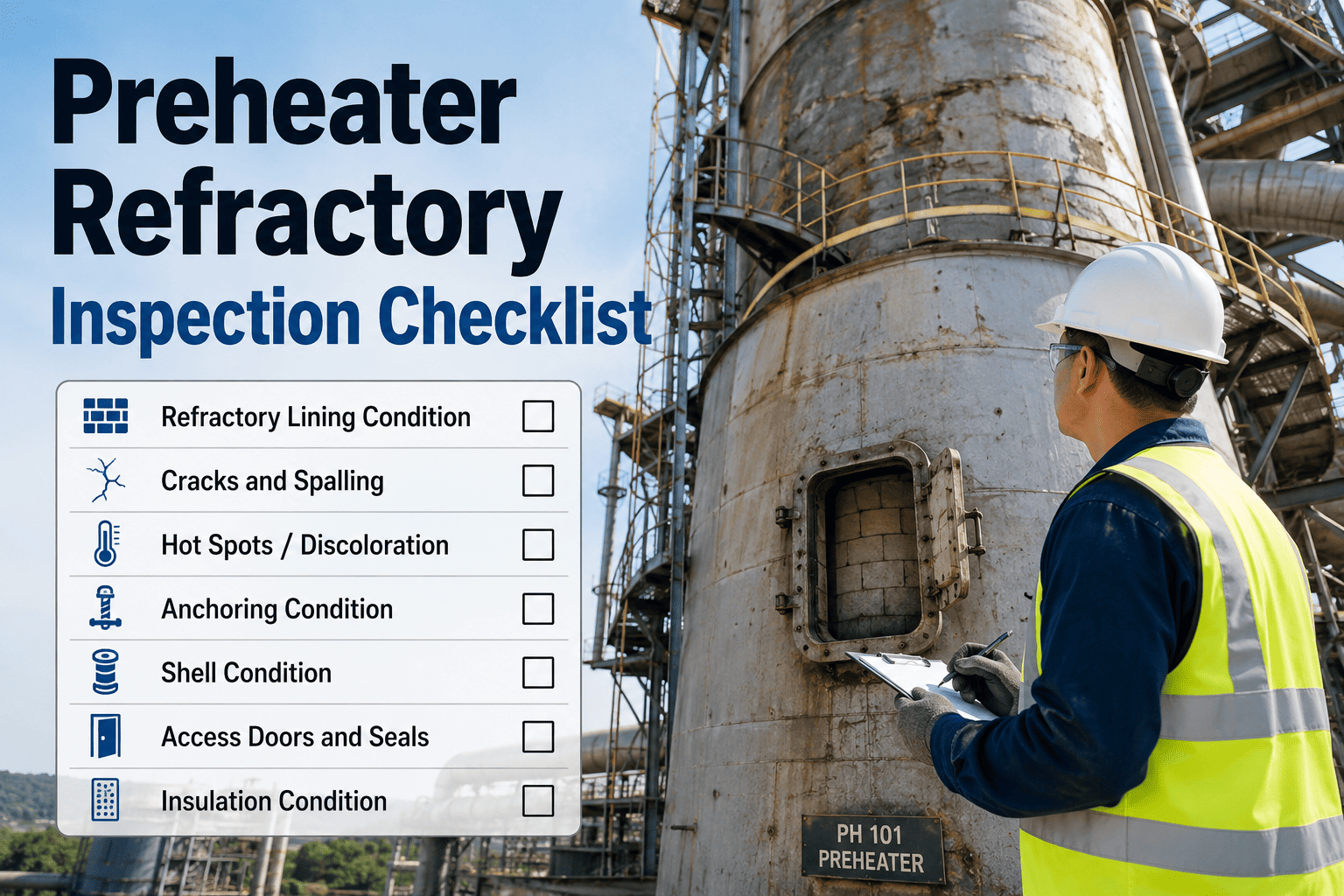
Refractory failure is the leading cause of unplanned kiln stops — and 73% of those failures show detectable precursor conditions at the previous inspection. This checklist gives cement process engineers and kiln maintenance engineers a structured zone-by-zone assessment protocol covering 85 inspection items across seven zones. Each item is a single observable or measurable condition. Complete it at every kiln stop and as a running-kiln walkdown every 30 days using pyrometer and shell scanner data. For digital completion with automatic work order routing, deploy via OxMaint’s zone-based inspection module. Book a demo to see how OxMaint converts this checklist into live digital work orders assigned to your kiln asset hierarchy.
38%
of all unplanned kiln stops caused by refractory failure — the single largest preventable shutdown cause in cement operations
73%
of refractory-related stops show visible deterioration at the prior inspection that was not escalated before the failure event
7
inspection zones covered — burning zone, transition zones, nose ring, inlet, kiln shell and mechanical, preheater tower, and cooler throat
85
individual inspection items structured across Critical, Monitor, and Routine priority tiers with PASS / FLAG / STOP status classification
Checklist Scope and Usage
This checklist covers seven zones: burning zone brickwork and shell temperature, upper and lower transition zones, nose ring and discharge outlet, kiln inlet and feed end, kiln shell mechanical (tyres, rollers, girth gear), preheater tower cyclones and riser ducts, and clinker cooler throat and hood. Priority ratings are assigned per item based on failure consequence and detection window. Critical items have a short detection window to unrecoverable failure. Monitor items require a work order and defined re-inspection. Routine items are documented and trended over time. All FLAG and STOP findings require photo documentation before the work order is raised.
Zone 1 — Burning Zone: Brickwork and Coating Assessment
The burning zone runs from 0 to approximately 5D from the discharge end. Shell surface temperature is the primary running-kiln indicator. Brick thickness and coating condition require internal access at every kiln stop. These items cannot be substituted by control room data review.
Shell Temperature — Running Kiln and At Stop
Brick Condition — Internal Inspection at Stop
Shell and Anchor Condition
Zone 2 — Upper and Lower Transition Zones
The transition zones (5D to 10D from discharge) experience the highest fatigue loading in the kiln system — the thermal gradient between coated burning zone brick and uncoated transition brick, combined with shell ovality bending loads, produces the highest brick-to-brick compressive stress cycling of any zone. Frequent short stops that cycle the thermal load without allowing coating to reform are the most damaging operating pattern for transition zone life.
Brick Integrity and Wear
Shell Temperature — Transition Zone Specific Limits
Zone 3 — Nose Ring and Discharge Outlet
The nose ring (0 to 1.5D from discharge) carries the highest thermal exposure in the kiln system and is the most frequently replaced refractory component. Exposure to direct flame radiation, clinker impact, and kiln shell ovality cycling simultaneously. Inspect at every kiln stop without exception, regardless of stop duration.
The inlet zone (rear 15% of kiln length) is the alkali and sulfur attack zone. In plants running high sulfur fuels or high-alkali raw mixes, inlet castable life can be as short as 4 to 6 months. Inlet zone failure is characterised by castable falling away in large sections rather than gradual wear — the transition from stable to failed condition can occur within a single campaign.
Inlet Castable and Brick Condition
Feed End Seal and Inlet Housing
Zone 5 — Kiln Shell, Tyres, and Drive Mechanical
Mechanical condition of the kiln shell and drive system is the second-highest contributor to unplanned stops after refractory. Shell ovality and tyre migration are leading indicators for brick damage — a kiln running 0.8% ovality at the tyre stations will produce 3 to 4 times the brick fatigue loading of a kiln within the 0.5% design limit. These measurements must be recorded quantitatively, not visually estimated.
Shell Ovality and Distortion
Tyres and Riding Rings
Support Rollers and Thrust System
Girth Gear and Pinion
Zone 6 — Preheater Tower: Cyclone and Riser Duct Refractory
Preheater tower refractory failures are the most consequential after kiln refractory — a riser duct breakthrough or cyclone body failure can cause a forced shutdown lasting 5 to 14 days depending on the extent of structural damage. Alkali and sulfur condensation at Stage 2 and Stage 3 cyclones creates the most aggressive chemical attack environment in the preheater string.
Cyclone Body Refractory — Stages 1 to 5
Riser Duct and Calciner Refractory
Zone 7 — Clinker Cooler Throat and Hood Refractory
The cooler inlet hood is subject to simultaneous thermal shock from kiln discharge clinker, mechanical impact from clinker trajectory, and oxidising atmosphere at temperatures exceeding 1,200°C. Hood roof refractory failures can produce a complete unplanned stop within hours of the first hot-spot indication on the casing exterior thermograph.
Cooler Inlet Hood Refractory
First Grate Module and Secondary Air Duct
Inspection Zone Summary by Frequency and Priority Distribution
Inspection Zone
Every Stop
Running Monthly
Critical Items
Monitor Items
Total Items
Zone 1 — Burning Zone
All items
Shell temp only
5
6
13
Zone 2 — Transition Zones
All items
Shell temp only
3
5
9
Zone 3 — Nose Ring
All items
Seal and outlet only
3
4
8
Zone 4 — Inlet Zone
All items
Shell temp traverse
1
6
8
Zone 5 — Shell and Mechanical
All items
Tyre migration
5
9
17
Zone 6 — Preheater Tower
All items
Casing thermal scan
3
6
10
Zone 7 — Cooler Throat
All items
Hood thermal scan
2
5
8
Total Checklist Items
85
Selected
22
41
85
OxMaint Compliance Coverage for Refractory Inspection Records
Timestamped zone inspection records, corrective action WO linkage, photo evidence archive against asset record, audit trail exportable for PSM compliance documentation
UK / Germany
BetrSichV (TRBS 1201 inspection intervals), TUV kiln vessel inspection, EU IED BAT emission compliance, PUWER 1998
TUV-compatible inspection records with measurement values, BAT condition documentation, PUWER inspection interval compliance tracking against asset-based PM schedule
UAE / Saudi Arabia
Civil Defence inspection permit requirements, UAE Federal Law No. 24, SASO industrial equipment standards
Equipment condition inspection records for Civil Defence permit compliance, asset condition scoring documentation, inspection certificate expiry tracking
India
Factories Act 1948 Rule 73, BIS IS 14489, DGMS inspection directives for rotary kiln pressure vessels
Statutory inspection register entries, work order history per asset per inspection window, corrective action closure documentation for DGMS audit requirements
Inspection Records That Satisfy Every Regional Framework
OxMaint structures zone inspection records to satisfy audit requirements across all frameworks above — timestamped findings, photo evidence, corrective action linkage, and compliance export without post-processing or manual assembly after each inspection event.
Kiln stops at 12 months post structured zone PM deployment at OxMaint-deployed cement sites
91%
Inspection Compliance
Zone checklist completion rate on critical kiln refractory items across digital deployment sites
4 wks
Deployment Time
Average time to live digital zone inspections on a two-kiln site including asset hierarchy build and team training
100%
Work Order Linkage
FLAG and STOP findings automatically routed to corrective work orders with photo evidence attached from the inspection event
Frequently Asked Questions
QAt what brick thickness should a scheduled relining be triggered versus an emergency stop?
Industry practice distinguishes two thresholds: the planned intervention threshold, which triggers a scheduled relining at the next convenient campaign stop, and the emergency threshold, which requires an immediate unplanned stop regardless of campaign. For burning zone brick, the planned threshold is 65% original thickness (used in this checklist) and the emergency threshold is 50%. For transition zones: 60% planned, 45% emergency. For the inlet zone: 55% planned, 40% emergency. Below emergency thresholds, the thermal gradient across the remaining lining becomes steep enough to risk sudden through-crack formation during normal thermal cycling without further warning.
QHow does this checklist integrate with daily operator rounds for running-kiln monitoring?
This zone checklist covers the full internal inspection regime at kiln stops. The cement plant daily operator rounds checklist provides the between-inspection layer — shell temperature walkdown, tyre migration reading, girth gear lubrication check, and support roller temperature observations on a running kiln. The two checklists are complementary: operator rounds detect developing abnormalities in the 2 to 6 week window before they would be visible at a planned zone stop inspection, giving maintenance teams actionable lead time rather than a reactive response to a condition that is already critical at the next inspection date.
QWhat causes accelerated wear in the transition zones compared to the burning zone?
The transition zones experience higher fatigue loading per operating cycle than the burning zone for three simultaneous reasons: the thermal gradient changes sharply at the burning-to-transition zone boundary, creating differential expansion stress at brick ring interfaces; the absence of the protective clinker coating that the burning zone maintains exposes transition brickwork to direct gas and dust abrasion; and the mechanical bending loads from shell ovality apply at their greatest brick-to-brick compressive stress in the sections immediately adjacent to the tyre stations. Frequent short kiln stops are particularly damaging because each restart cycles the full thermal load through the transition zone without allowing the partial coating that provides limited protection during longer campaigns.
QCan this checklist replace specialist refractory inspection by a qualified inspector?
No. This checklist is an operational PM tool designed for use by trained maintenance engineers and operators on each kiln stop as part of the standard maintenance programme. It does not replace the specialist refractory condition assessment conducted by qualified refractory engineers at major maintenance campaigns, which includes measurement survey by pin probe across the full lining, material sampling for laboratory analysis, shell scanner data interpretation, and formal remaining life assessment with campaign duration recommendations. The outputs of this checklist should feed directly into the specialist assessment brief — providing quantified trending data across multiple stops that makes the specialist assessment significantly more accurate and actionable.
QHow should this checklist be migrated from paper to a digital CMMS without losing historical data?
The cement plant spreadsheets to CMMS transformation guide covers the migration protocol in detail. The critical principle is that historical paper inspection data should be imported as structured records against the kiln zone asset before digital checklists go live — the trending value of this checklist depends on campaign-to-campaign comparison, and that comparison requires historical baseline data to be accessible in the same system rather than archived in paper binders. OxMaint’s implementation team provides structured data import from prior paper records as part of the standard kiln zone inspection deployment.
Deploy This Checklist as Live Digital Zone Inspections in OxMaint
Every zone and every item in this checklist is available as a structured digital work order in OxMaint — assigned to your kiln asset hierarchy, triggered by stop events, and completed on mobile at the inspection location with photo capture and automatic work order routing for every abnormal finding.