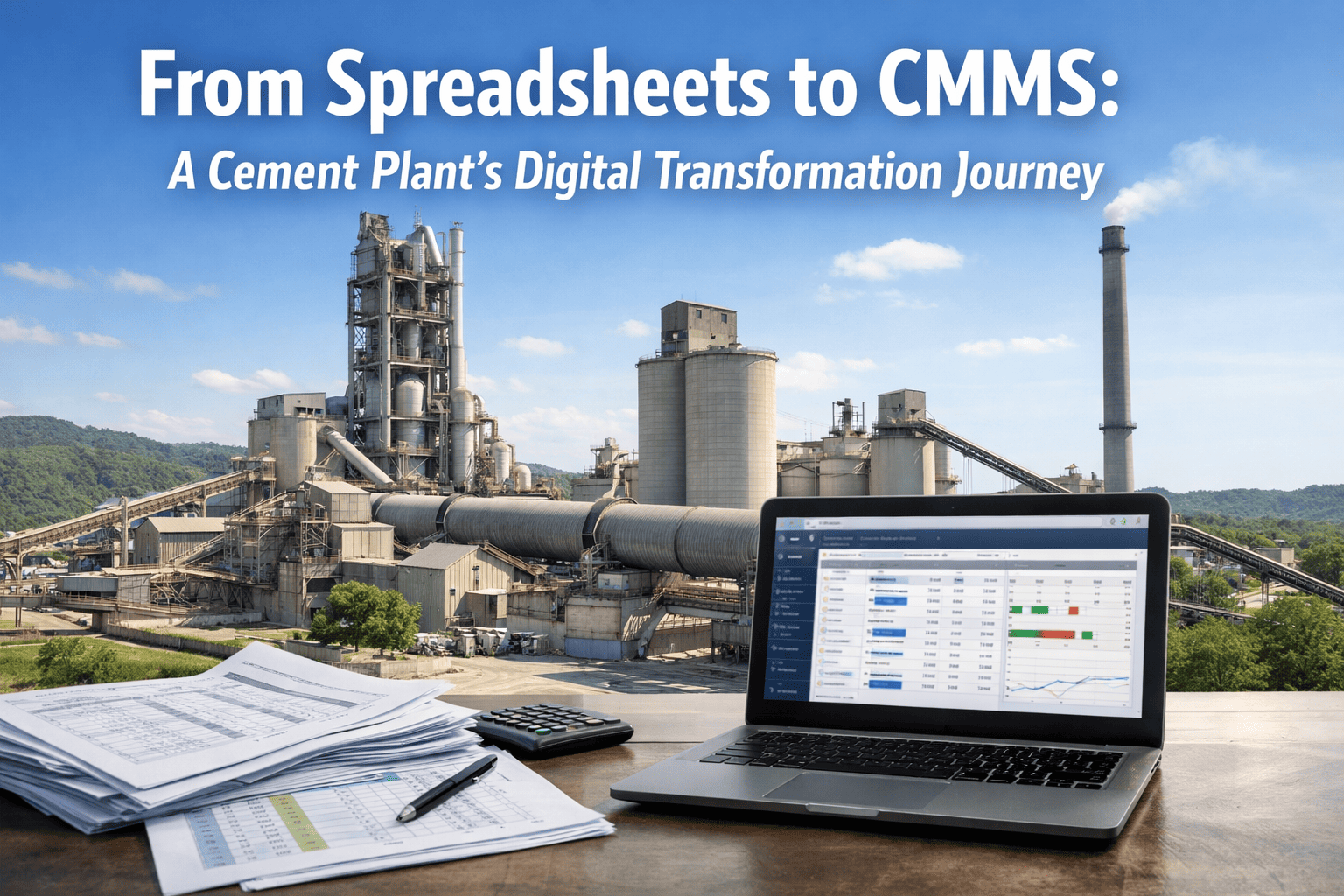
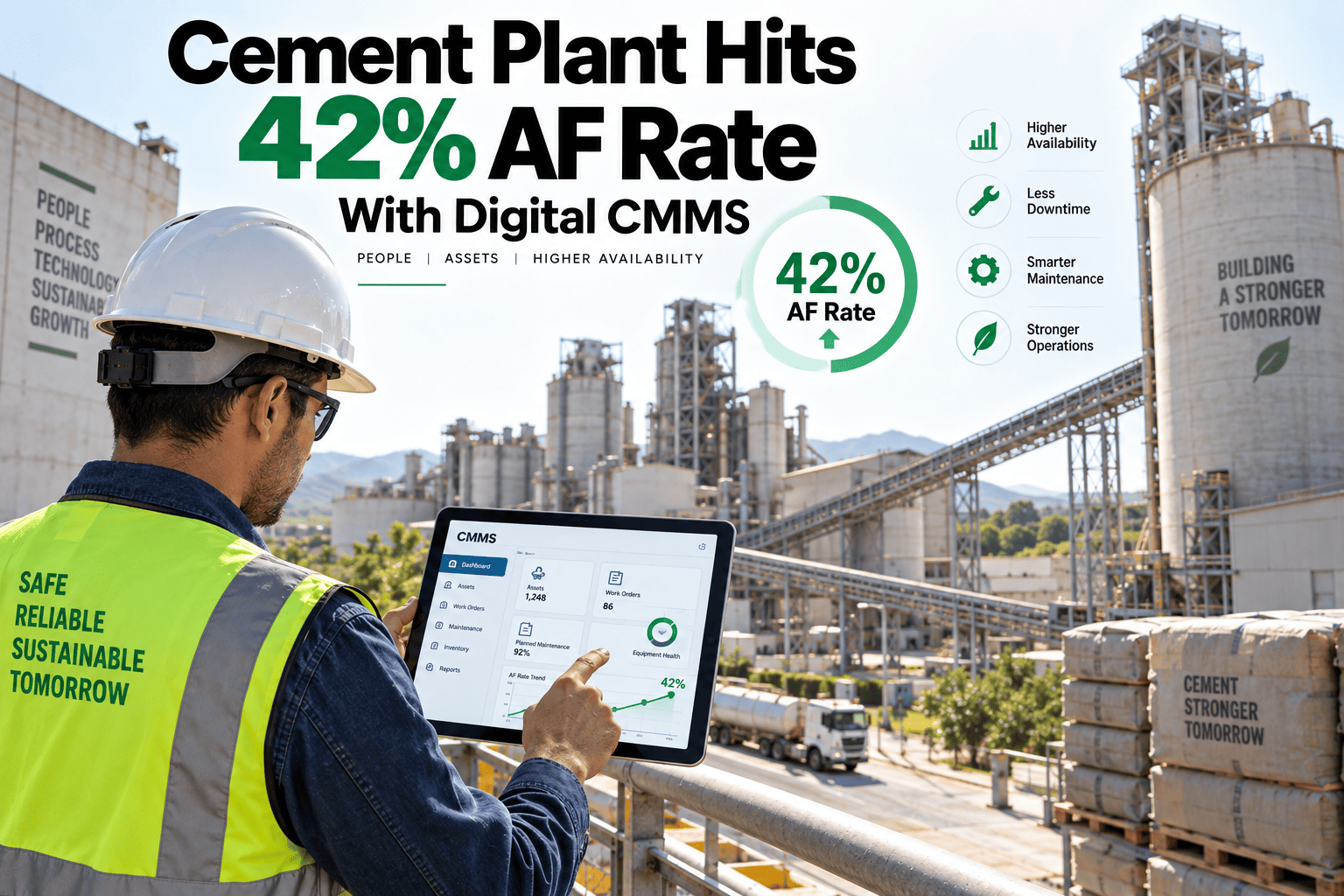
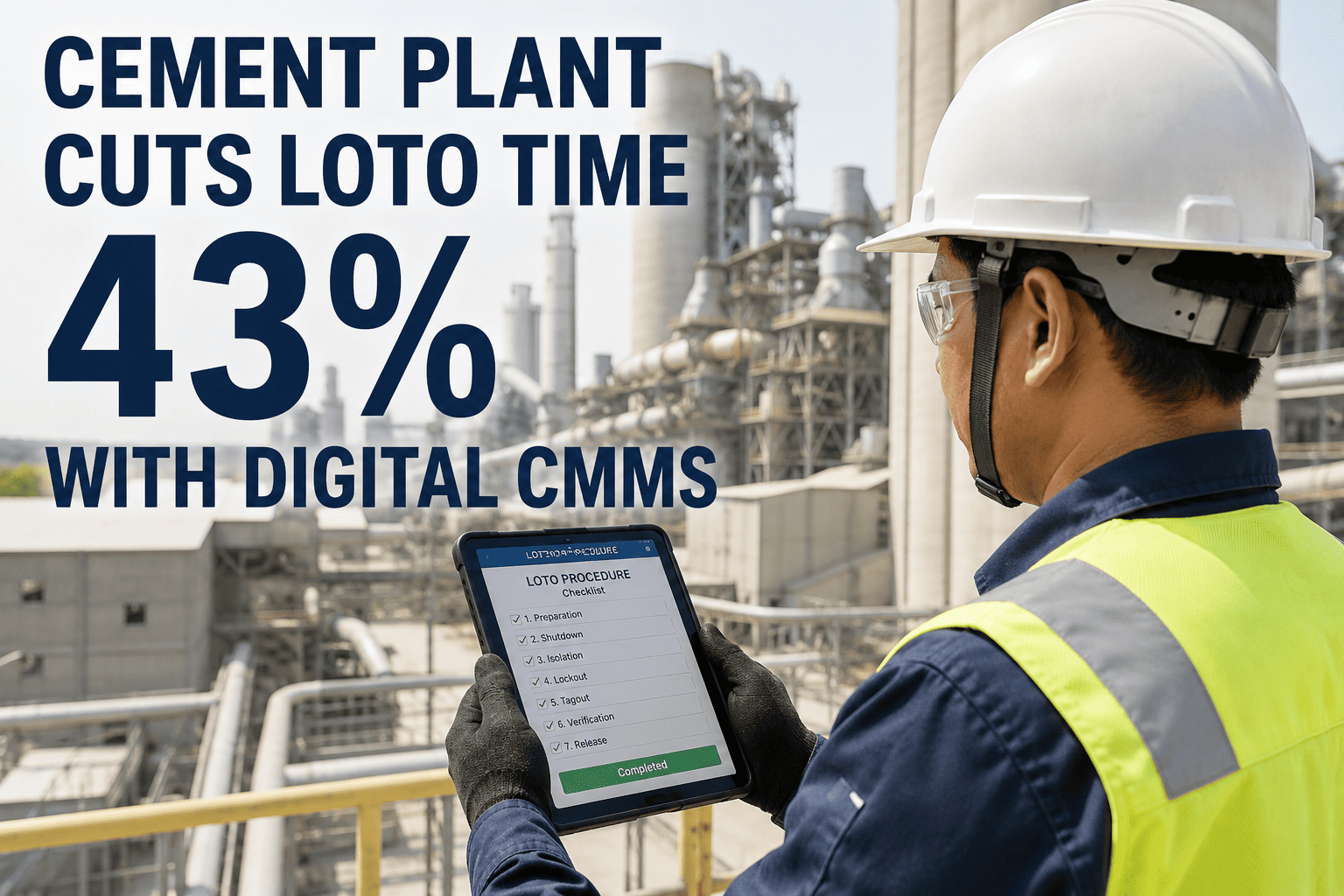
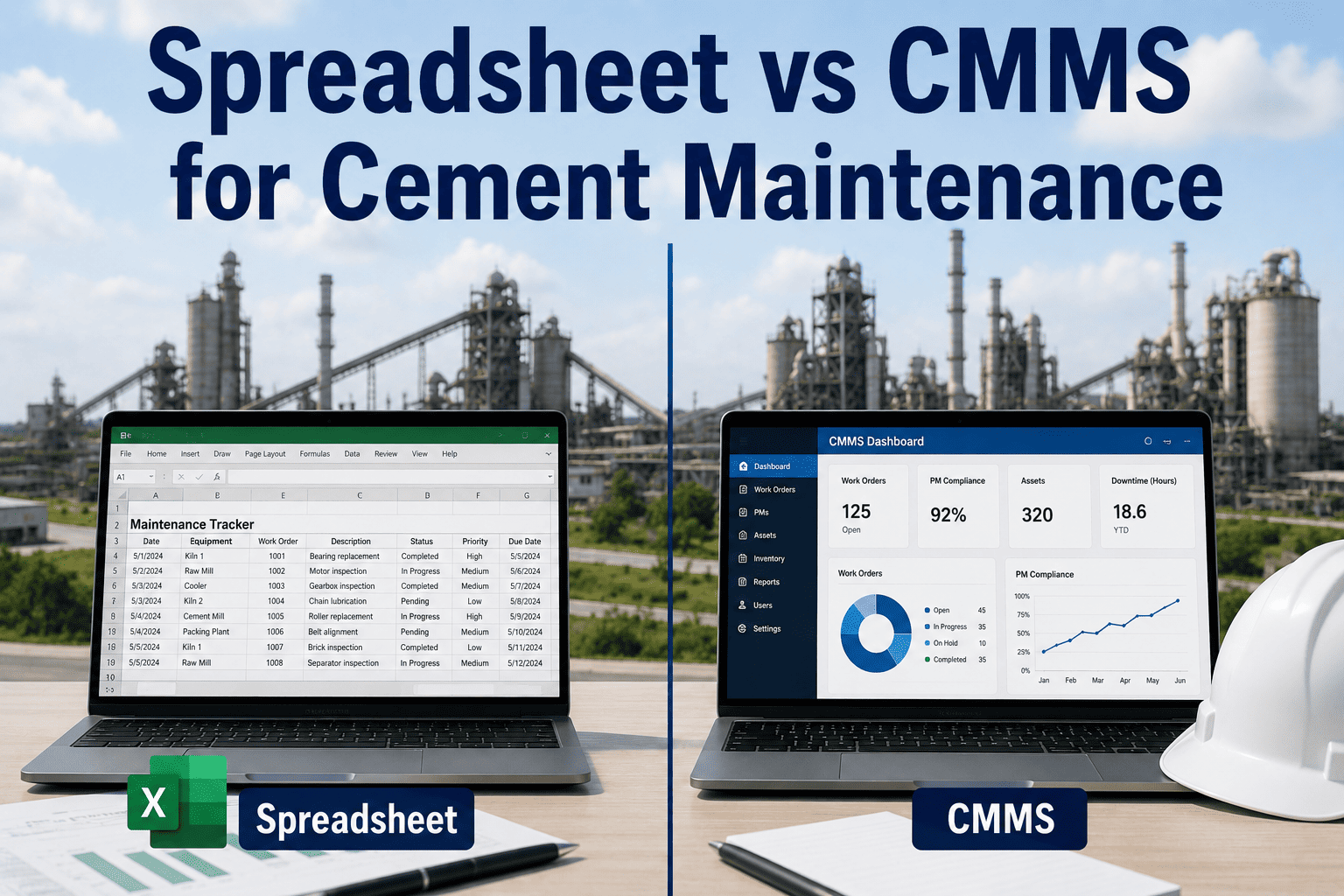
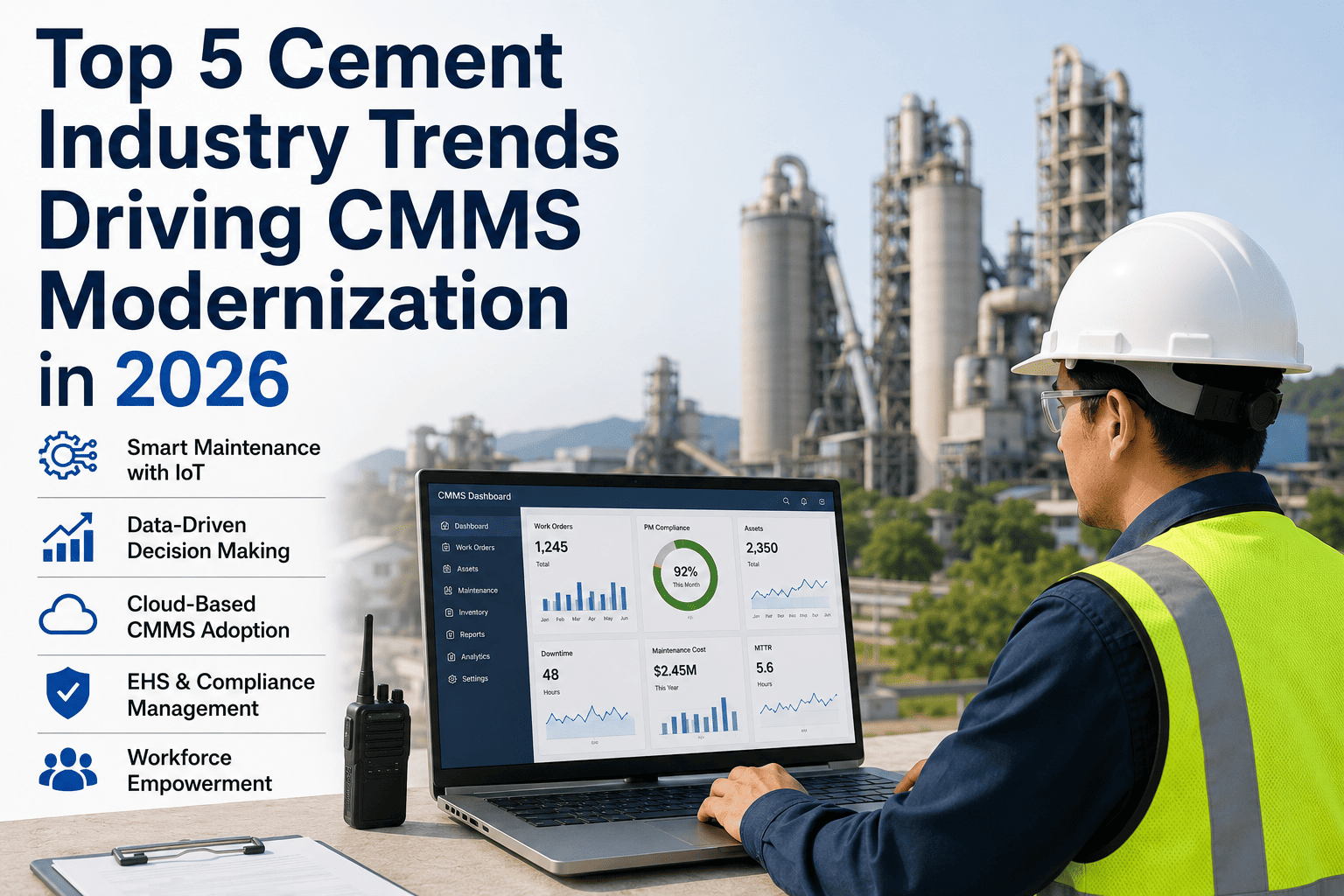
When the maintenance manager at a 2.4 MTPA integrated cement plant in the U.S. Southeast walked into his first board meeting with a maintenance performance report, it was a 38-tab Excel workbook that took three people two days to compile. The data was 23 days old by the time it reached the boardroom. The kiln had stopped three times in the prior quarter for failures that the spreadsheet data — had it been current — would have flagged as developing faults weeks earlier. That board meeting was the decision point: the plant needed a system where data moved at the speed of the equipment, not the speed of a spreadsheet. This is the account of how that plant moved from 40-plus spreadsheets to a fully deployed Oxmaint CMMS in 94 days without a single day of unplanned production interruption during the transition. Book a demo to see how Oxmaint structures a cement plant migration from spreadsheet-based maintenance management.
Case Study
From Spreadsheets to CMMS: A Cement Plant's Digital Transformation Journey
10–12 min read
Plant TypeIntegrated cement plant — kiln, raw mill, two ball mills, packing
Production Capacity2.4 MTPA (single kiln line)
LocationSoutheastern United States
Maintenance Team22 technicians, 3 planners, 1 reliability engineer
Prior SystemExcel workbooks + paper work orders + shared drives
Migration Duration94 days — foundation to full deployment
94
days from project kick-off to full Oxmaint deployment across all asset classes
82%
PM compliance rate within 60 days of go-live, up from 54% on the prior spreadsheet system
$1.8M
avoided production loss from three developing faults detected and resolved in the first 6 months post-deployment
Zero
unplanned production interruptions during the migration period itself
The Starting Point: What "Managing on Spreadsheets" Actually Looked Like
Before the migration, the plant's maintenance operation ran on a system that had grown organically over 14 years. What began as a simple Excel PM tracker had evolved — through successive planners adding their own logic, technicians creating their own tracking sheets, and supervisors building their own reporting workbooks — into a sprawling, fragmented architecture of 43 separate files maintained across three shared drives.
No single person held a complete picture of the maintenance operation. Work orders existed as printed sheets filed in binders after completion — no digital history attached to the equipment. When a bearing on Ball Mill #2 failed in March, the team had no searchable record of prior inspections, readings, or similar failures on that asset.
The Spreadsheet Failure Mode That Triggered the Decision
In Q3 of the year prior to migration, the kiln trunnion bearing at Support Station 2 failed without warning. Post-incident analysis revealed that vibration readings taken six weeks earlier by the reliability engineer had been entered into a monitoring spreadsheet that was not shared with the PM planning team. The PM planner had no visibility of the anomaly. A lubrication inspection work order that would have caught the developing fault was scheduled for the following week but had not yet been created. Total production loss from the 31-hour unplanned stop: $560,000. The spreadsheet hadn't failed to capture the data — it had failed to connect it to the people and actions that could have prevented the event.
The Quantified Cost of the Prior System
Before committing to a CMMS investment, the plant's maintenance manager and controller conducted an honest accounting of what the spreadsheet-based system was actually costing. The exercise — which took three days and involved interviews with all three planners and the reliability engineer — produced numbers that made the investment decision straightforward.
Planner Labor — Report Compilation
~$84,000/yr
Three planners averaging 14 hrs/month compiling KPI reports from spreadsheet exports. At $65/hr fully loaded, report production cost $84,000/yr — for data always at least 3 weeks stale.
Condition-to-WO Delay — Missed Interventions
~$560K+ (single event)
The Q3 trunnion bearing failure cost $560,000 in lost production. Two other developing faults found during the CMMS audit had been missed by the spreadsheet-to-planner communication gap for 4–6 weeks each.
PM Compliance Gap — Overdue Tasks
54% compliance rate
Audit of the prior 12 months showed 54% compliance — 46% of PM tasks completed late or with no completion record. The primary driver was planner visibility, not technician capacity: no real-time view of due, overdue, or completed tasks without paper sign-off.
Regulatory Audit Preparation
~40 hrs per audit cycle
OSHA PSM inspections required 35–45 hours of manual record reconstruction from paper binders and spreadsheet exports per audit cycle, with no guarantee of completeness.
The Migration Decision: Why Oxmaint, and Why Now
The plant evaluated three CMMS platforms over a 6-week period. The selection criteria were specific to cement operations: condition-based PM triggering from kiln and mill sensor data, cement-specific asset hierarchy templates that would not require building from scratch, mobile work order execution for field technicians, and a migration path that would carry existing maintenance history from the spreadsheet system into the new platform without losing the institutional knowledge embedded in 14 years of records.
Oxmaint was selected on three differentiating factors. First, pre-configured cement plant asset hierarchy templates — the plant could load its kiln, raw mill, ball mills, and preheater tower as structured asset trees with class-specific PM templates pre-built, rather than configuring a generic system from a blank asset register. Second, native OPC-UA integration with the plant's ABB 800xA control system, enabling automatic work order creation from sensor threshold breaches without custom development. Third, the Oxmaint implementation team's structured 90-day cement plant deployment methodology, which had been executed at comparable facilities and had a documented track record of go-live without production interruption.
“
We weren't buying software. We were buying a maintenance operation that could see itself clearly — where a bearing anomaly detected at 2am on a Saturday automatically becomes a Monday morning work order with the right context attached, without anyone having to write an email or make a call to make that happen.
— Maintenance Manager, U.S. Southeast Cement Plant
The Migration: 94 Days in Three Phases
Phase 1
Foundation — Days 1 to 30
Asset Register · PM Templates · User Setup
The first 30 days were dedicated to building the data foundation that the rest of the migration depended on. Oxmaint's cement plant implementation team worked alongside the plant's reliability engineer and lead planner to load the complete asset register — 312 maintainable assets across kiln, raw mill, two ball mills, preheater, clinker cooler, and packing circuits — into the Oxmaint hierarchy. Pre-built cement plant PM templates were loaded and customized to the plant's specific OEM documentation, with intervals validated against both the spreadsheet history and the manufacturer's maintenance manuals.
The most time-consuming work in Phase 1 was the data archaeology exercise: extracting maintenance history from 14 years of paper records and spreadsheets. The team prioritized the 20 highest-criticality assets and manually imported 5 years of work order history. For lower-criticality assets, the most recent 12 months were entered. This established a condition baseline in Oxmaint before any technician ran a digital work order.
Phase 1 outcome: 312 assets loaded · 847 PM tasks configured · 22 user accounts created · 5 years of critical asset history imported
Phase 2
Go-Live — Days 31 to 60
Mobile Rollout · Parallel Run · DCS Integration
Days 31 through 45 were the parallel run — every work order created in both Oxmaint and the old paper system simultaneously. This was the validation mechanism confirming Oxmaint was capturing the same activity before the paper system was switched off. Non-critical PM tasks were temporarily deferred to protect technician capacity during this window.
Day 46 was the paper cutoff. Oxmaint mobile became the single system of record. The shift was smoother than anticipated — 15 days of parallel use had built technician familiarity with the interface.
The ABB 800xA OPC-UA integration went live on Day 54. Within the first week, one alert fired: a vibration step-change on the ID fan non-drive-end bearing not caught on the prior Wednesday manual round. The work order was executed that Friday — bearing clearance was at the upper end of acceptable tolerance, an early-stage fault that would not have been caught for another 3–4 weeks under the prior inspection cycle.
Phase 2 outcome: Paper cutoff achieved on Day 46 · 22 technicians fully operational on Oxmaint mobile · DCS integration live Day 54 · First condition-triggered work order raised and closed Day 57
Phase 3
Intelligence — Days 61 to 94
KPI Dashboards · Benchmark Analysis · PM Optimization
With 60 days of live work order data, the maintenance manager ran the first meaningful MTBF analysis, calculated a current PM compliance rate, and benchmarked both against the 2026 cement industry dataset. The result was a boardroom moment: kiln MTBF at 890 hours was below the 1,240-hour industry average for comparable operations. For the first time, the team had a precise picture of where they stood and what closing each gap was worth in production hours per year.
Phase 3 also delivered the PM optimization analysis the plant had never been able to perform. With completion timestamps, technician IDs, and condition readings on every PM task, the reliability engineer identified which tasks had never triggered a corrective finding and which consistently found issues at the same interval. Twelve PM intervals were adjusted. One task was reclassified to run-to-failure, freeing 18 hours of annual technician time.
Phase 3 outcome: Live KPI dashboards operational · Benchmark gap analysis completed · 12 PM intervals optimized · Full deployment certified Day 94
See the 94-Day Deployment Methodology for Your Plant
Oxmaint's structured cement plant implementation methodology — foundation, go-live, and intelligence phases — is designed specifically to migrate from spreadsheet-based maintenance management without production interruption. Book a demo to see the deployment plan configured for your plant's asset count and team structure.
Results at 12 Months Post-Deployment
$1.8M
Avoided Production Loss
Three developing faults — ID fan bearing, ball mill #1 girth gear pinion bearing, and a Stage 3 cyclone blockage — detected and resolved through Oxmaint condition alerts before failure. Combined production loss avoidance: $1.8M.
82% → 91%
PM Compliance Rate
From 54% pre-migration to 82% at Day 60 to 91% at Month 12 — world-class threshold of 92% within reach. The driver was planner visibility, not technician behavior: every overdue task visible in real time without a spreadsheet export.
23 days → 0
Reporting Lag Eliminated
The 38-tab, 3-person, 2-day board report now generates in under 4 minutes from live data. The controller identified this as the single most visible organizational change from the migration.
40 hrs → 2 hrs
Audit Preparation Time
The first OSHA PSM inspection post-migration required 2 hours to assemble the documentation package, versus 40 hours previously. All records exportable directly from Oxmaint in the required format.
44%
Reduction in MTTR
MTTR fell 44% across kiln and mill equipment. The driver: technicians arriving with complete asset history and parts requirements on Oxmaint mobile rather than starting cold from a verbal briefing.
890 → 1,180 hrs
Kiln MTBF Improvement
Kiln MTBF improved from 890 to 1,180 hours at Month 12 — the 1,240-hour industry average within reach. Attribution: PM compliance above 90%, condition-triggered interventions replacing reactive repairs, and Phase 3 PM interval optimization.
What the Team Would Do Differently
The maintenance manager and lead planner provided candid reflections on the migration 12 months after go-live. These lessons are documented here in their words because they are more useful to other cement plants considering a similar transition than a success-only account.
01
Start the data archaeology earlier than you think you need to
The historical data import was the most time-consuming Phase 1 element and the most consistently underestimated — the team underestimated it by a factor of roughly 2. Begin the digitization of critical asset history 60 days before the formal migration start date, not as part of Phase 1.
02
The parallel run period needs explicit capacity protection
Running paper and digital work orders simultaneously for 15 days generated real workload on both planners and technicians. The team managed this by temporarily deferring non-critical PM tasks during the parallel window, which was the right call — but the decision was made reactively rather than planned. Future migrations should formally schedule the capacity reduction as part of the parallel run plan from the outset, with supervisor alignment before Day 1 of the parallel period.
03
Condition monitoring integration delivered more value faster than any other feature
The team had anticipated that mobile work order management would be the highest-value feature in the first year. It was not. The OPC-UA integration with the ABB 800xA — and specifically the automatic work order creation from sensor threshold breaches — delivered more measurable value in the first 6 months than any other capability. The recommendation: prioritize the DCS integration configuration in Phase 1 alongside the asset register build, not as a Phase 2 add-on. The one condition alert that fired in Week 1 of integration justified the entire migration cost on its own.
04
The PM optimization analysis should be scheduled at Month 6, not left open-ended
The PM optimization work in Phase 3 was valuable — 12 intervals adjusted, one task reclassified to run-to-failure, 18 hours of annual technician time freed — but happened organically rather than as a scheduled deliverable. Schedule the first formal PM optimization review at the 6-month mark with the reliability engineer as accountable owner.
Frequently Asked Questions
QHow much historical maintenance data can be migrated from spreadsheets into Oxmaint?
No technical limit. The practical constraint is the quality and structure of source data. Oxmaint supports structured import from Excel, CSV, and prior CMMS exports. For paper-only records, the team provides a digitization prioritization framework focused on the highest-criticality assets — which deliver the most condition baseline value per digitization hour.
Book a demo to see the data migration assessment process.
QWhat is the typical disruption level during a spreadsheet-to-CMMS migration at an operating plant?
With the structured 3-phase deployment methodology, production disruption is near zero. The parallel run adds 15–20 minutes per work order for planners and technicians but requires no production stoppage. Plants that attempt a "big bang" cutover without a parallel validation period experience significantly higher disruption and post-go-live data quality issues.
QHow long does it take for field technicians to become proficient on Oxmaint mobile?
All 22 technicians were completing work orders independently within 8 days of their initial 2-hour training session. The large-touch-target interface with minimal text entry reduced adoption resistance. Plants with technicians who have limited prior smartphone experience should plan for a 3–4 day supervised period during the parallel run before expecting fully independent mobile use.
QDoes Oxmaint integrate with legacy ABB, Siemens, or other DCS systems?
Yes. Oxmaint's native OPC-UA integration supports ABB 800xA, ABB Symphony Plus, Siemens PCS7, WinCC, DeltaV, and other OPC-UA enabled control systems. For legacy DCS environments without native OPC-UA support, Oxmaint provides historian polling via file export and MQTT broker integration as alternative paths. The integration used in this case study — ABB 800xA via OPC-UA — was live and generating automatic work orders within 7 days of the integration configuration start.
Book a demo to assess the right integration path for your DCS environment.
Related Case Studies
Start Your Plant's Migration from Spreadsheets to Oxmaint
Oxmaint's 94-day deployment methodology is built for operating cement plants — structured to migrate from spreadsheet-based maintenance management without production interruption, with pre-configured cement asset hierarchies, condition-based PM templates, and native DCS integration included from Day 1. Book a 30-minute demo to see the deployment plan for your plant's asset count and team structure.
Data Migration Support
Zero-Downtime Deployment
Cement Asset Templates
DCS Integration Included