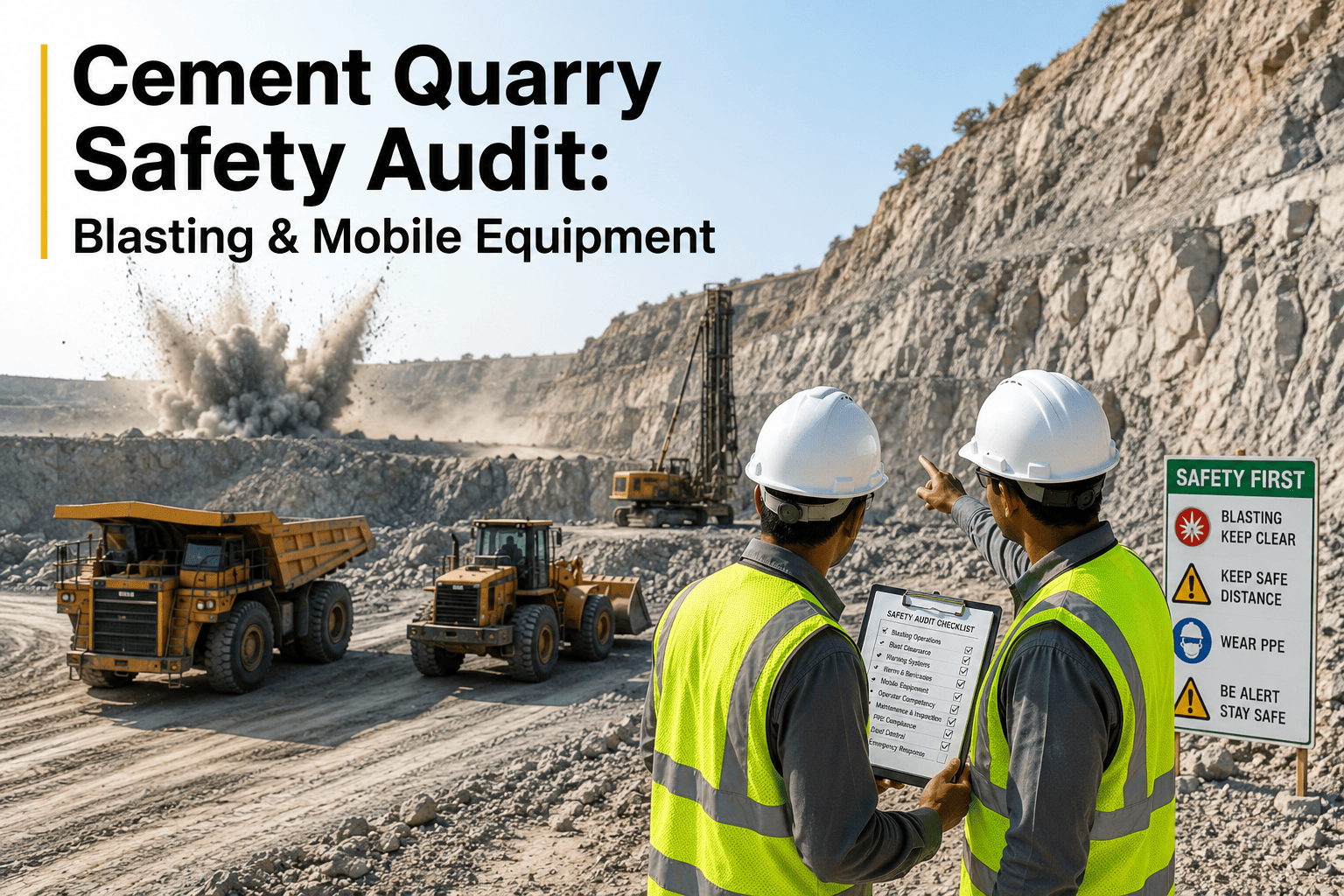
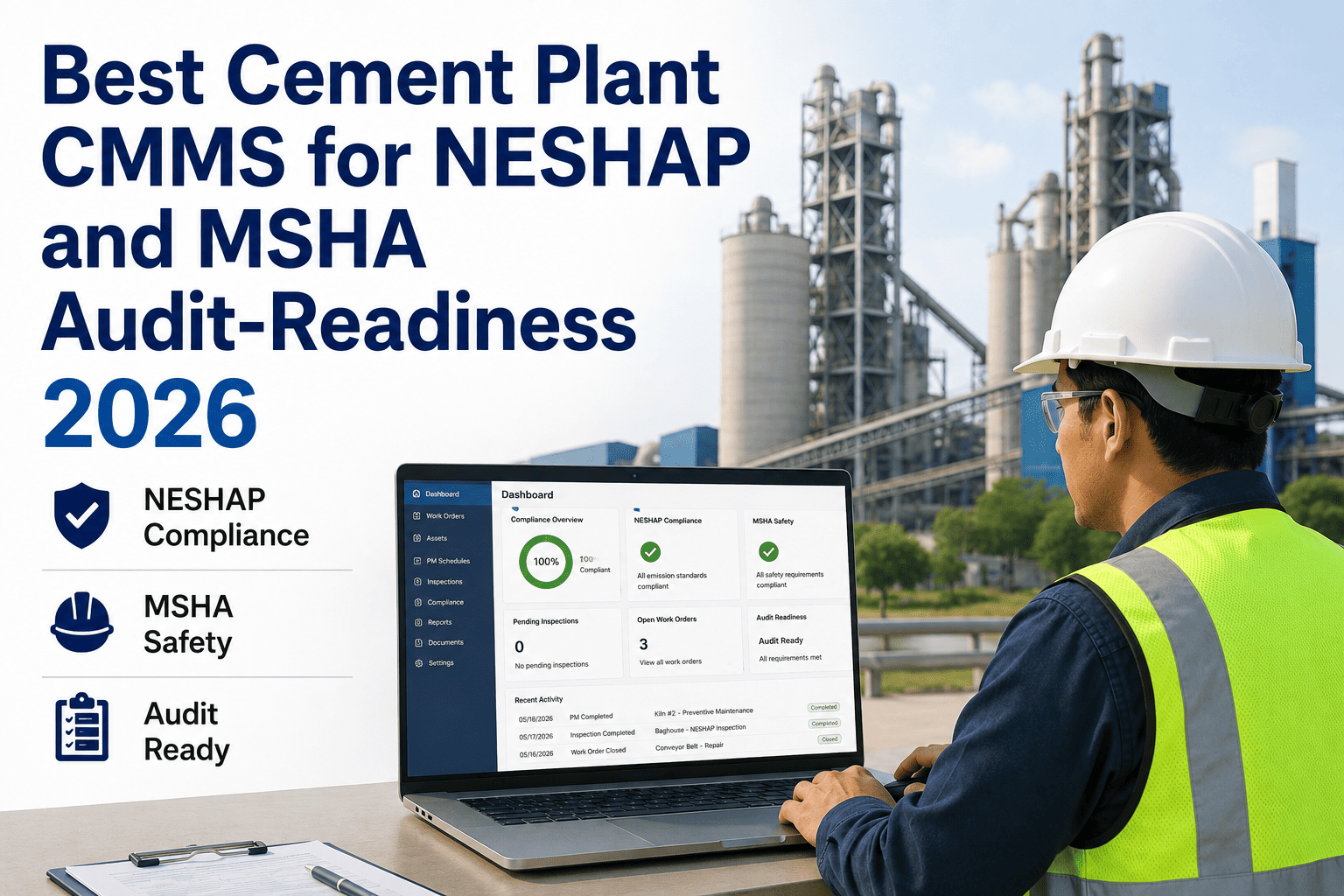
MSHA Part 56 and Part 57 citations are not just compliance paperwork — they are a leading indicator that your quarry's safety management system has a gap between what your procedures say and what your records prove. The difference between a citation that closes in 30 days and one that escalates to a pattern-of-violations designation often comes down to one question MSHA inspectors ask: can you show me the record? Workplace examination logs, competent person designations, training records, ground control plan documentation, and hazard communication records all exist in most cement quarries — but they exist in different places, in different formats, maintained by different people, and rarely assembled into the coherent audit trail that a Part 56/57 inspection demands. OxMaint's CMMS gives cement quarry safety and maintenance teams a single, structured system to document, track, and retrieve every MSHA-relevant record — so an inspector arriving on site finds evidence of compliance, not evidence of guesswork. Book a demo to see how OxMaint structures Part 56/57 compliance documentation for cement quarries.
MSHA Compliance · Part 56 / Part 57 · Cement Quarries
MSHA Citation Risk Removed by Design — Not Managed by Luck
OxMaint builds the structured documentation trail that Part 56 and Part 57 compliance requires — workplace exams, miner training, ground control plans, and hazard records — all in one CMMS your whole team uses every day.
What MSHA Part 56 and Part 57 Actually Require — Simplified
Part 56 covers surface metal and nonmetal mines — including the quarry face and surface operations of a cement quarry. Part 57 covers underground sections where applicable. Both regulations share the same enforcement architecture: mandatory workplace examinations, training requirements, equipment standards, and recordkeeping — and both are enforced by surprise inspections with no advance notice.
Part 56 — Surface Operations
Applies to the quarry face, crushing and screening operations, surface haul roads, and all surface facilities. Covers ground control, mobile equipment, electrical hazards, explosives, and working environment standards.
Key Documentation Requirement: Workplace examination records for each working shift and area, retained for 1 year minimum.
Part 57 — Underground Operations
Applies where cement quarries operate underground extraction. Extends Part 56 requirements with additional ground support, ventilation, atmospheric monitoring, and refuge chamber standards unique to underground environments.
Key Documentation Requirement: Ground control plan on file, current, and demonstrably followed — MSHA inspectors compare plan vs actual conditions.
The 5 Areas Where Cement Quarries Accumulate the Most Citations
01
Workplace Examination Records — Incomplete or Missing
Part 56.18002 requires a competent person to examine each working area before work begins each shift. The record must include the date, area examined, examiner identity, and any hazards found with corrective action taken. Quarries that conduct the examination but record it on scraps of paper, in a shared logbook no one can find, or not at all accumulate citations every inspection cycle.
OxMaint Fix: Mobile digital workplace exam forms — completed at the site, timestamped, geotagged, and stored in the CMMS automatically.
02
Miner Training Records — New Miner and Annual Refresher
Part 48 (incorporated by reference in 56/57) requires new miner training before independent work and annual refresher training for all miners. Inspectors check training certificates, verify instructor qualifications, and cross-reference the training log against the current workforce. Gaps between hire date and first training record are a reliable citation source at cement quarries with high turnover.
OxMaint Fix: Training records linked to each worker profile — with auto-alerts when annual refresher is approaching expiry and gaps visible in the compliance dashboard.
03
Ground Control Plan — Not Current or Not Followed
Part 56.3200 requires a written ground control plan adopted by the operator. The plan must reflect current bench geometry, highwall heights, and blast patterns. Inspectors walk the quarry face and compare actual conditions to the plan — a bench cut at a different angle than the plan specifies, or a highwall height that exceeds the plan's maximum, generates a citation regardless of whether an examination was conducted.
OxMaint Fix: Ground control plan document linked to the quarry asset record, with version history and a scheduled review work order triggered when mining geometry changes.
04
Equipment Inspection Records — Pre-Shift Checks
Part 56.14100 requires that mobile equipment be examined before each use. Haul trucks, front-end loaders, drill rigs, and blast hole drills all need pre-shift inspection records showing brakes, steering, lights, and safety devices were checked. A 200-tonne haul truck with no pre-shift record for the morning shift is a citation — even if the truck ran perfectly all day.
OxMaint Fix: Pre-shift inspection checklists on operators' mobile devices — submitted at the start of each shift and automatically stored against the equipment asset record.
05
Hazard Communication and HAZMAT Records
Part 56.4200 requires hazard communication programs for all hazardous materials present on site — cement quarries work with explosives, fuels, lubricants, and process chemicals. Safety data sheets must be accessible at the point of use, and training records must demonstrate worker awareness. Inspectors check for current SDSs, inventory against training records, and accessible storage documentation.
OxMaint Fix: Chemical registry linked to work areas, with SDS documents accessible from mobile devices and training records cross-linked to the hazmat inventory.
Every MSHA Inspector Visit Is a Records Audit First and a Safety Inspection Second
OxMaint gives you the documentation architecture that turns a surprise inspection into a demonstration of your compliance program — not a scramble through filing cabinets.
Part 50 Accident Reporting — And Why Your CMMS Should Drive It
Part 50 requires operators to notify MSHA within 15 minutes of a fatal accident or accident with serious injuries, and to file a written report within 10 working days. The written report requires specific information: date, time, location, equipment involved, nature of injury, and contributing factors. Quarries that reconstruct this information from memory after the 10-day clock is running produce reports that MSHA inspectors find inconsistent with the physical evidence — generating additional citations separate from the original incident.
What Part 50 Requires
15-minute notification for fatal and serious injury accidents
10-working-day written report on MSHA Form 7000-1
Records of all accidents, occupational injuries, and illnesses
Retention of all Part 50 records for 5 years minimum
What OxMaint Provides
Incident report forms that capture MSHA Form 7000-1 fields at the time of occurrence
Equipment and location linkage so contributing factors are pre-populated from asset records
10-day report deadline auto-calculated and assigned to responsible manager
Five-year record retention with searchable incident history by location and equipment
MSHA Compliance Record Checklist: What You Should Have in Your CMMS
| Regulation |
Required Record |
Retention Period |
OxMaint Module |
| Part 56.18002 |
Workplace examination records, per shift, per area |
1 year minimum |
Mobile inspection forms — auto-timestamped |
| Part 48 |
New miner and annual refresher training certificates |
Duration of employment + 2 years |
Worker competency records — expiry alerts |
| Part 56.14100 |
Pre-shift equipment inspection records |
1 year minimum |
Equipment pre-shift checklists — linked to asset |
| Part 56.3200 |
Ground control plan — current revision |
Current version on file, prior versions 2 years |
Document control — version history and review schedule |
| Part 50 |
Accident and injury reports, MSHA Form 7000-1 |
5 years minimum |
Incident management — deadline tracking |
| Part 56.4200 |
Hazard communication program and SDS records |
Current SDSs accessible; training records 2 years |
Chemical registry — SDS library and training links |
Frequently Asked Questions
Q
How does OxMaint handle the "competent person" designation requirement in Part 56?
OxMaint's worker profile module supports competency designation records — including MSHA-defined competent person status for specific inspection categories. Workplace examination forms can be configured to require a competent-person-designated user to submit them, creating an automatic record of who conducted each examination and their qualification.
Book a demo to see this in action.
Q
Can OxMaint generate the audit trail MSHA inspectors look for during a pattern-of-violations review?
Yes. OxMaint's compliance dashboard provides a date-ranged view of all inspection records, corrective actions, and closure status — exportable as a PDF audit report. During a pattern-of-violations review, this report demonstrates that the mine identified hazards, took corrective action, and documented outcomes — the three elements MSHA looks for in an effective safety management system.
Sign up free to build your audit trail.
Q
Does OxMaint support multi-site cement quarry operations under a single MSHA ID?
OxMaint's multi-site architecture supports separate compliance records per site — each with its own MSHA mine ID, workplace examination schedules, ground control plans, and training registers. Corporate-level dashboards give safety managers visibility across all sites simultaneously, with the ability to drill into individual site records for an inspection response.
Q
How quickly can we have MSHA-ready documentation in place after starting with OxMaint?
Most cement quarries have their core MSHA documentation — workplace exam forms, pre-shift checklists, and training records — configured and in use within the first two weeks. Historical records can be migrated from existing systems or spreadsheets during onboarding. The compliance dashboard is active from day one of live use.
Build Your MSHA Compliance System
The Difference Between a Citation and Clean Record Is Documentation — OxMaint Builds It Automatically
Start with workplace examination forms and pre-shift equipment checklists. Deploy on mobile for your first shift. Every completed form is a timestamped, MSHA-ready record from day one — no transcription, no filing, no gaps.